Things to Do in Death Valley: Sights, Hikes and Timing
What to do in Death Valley: Badwater Basin, Zabriskie Point, the dunes and Artist's Drive, plus heat safety, timing and driving distances inside the park.
In this guide
- Unveiling the Majesty of Death Valley National Park
- Iconic Sights: Must-See Death Valley National Park Attractions
- Explore on Foot: Best Death Valley Hiking Trails
- Planning Your Visit: Best Time to Visit Death Valley
- Crafting Your Adventure: Death Valley Itinerary (1-3 Days)
- Where to Stay and Eat in Death Valley
- Practical Tips for Visiting Death Valley
- Pro Tips
- Budget Breakdown: How Much Does a Death Valley Trip Cost?
- Common Mistakes to Avoid in Death Valley
- Avoiding the Classic Death Valley Errors
Unveiling the Majesty of Death Valley National Park
Death Valley National Park is unlike anywhere else: the silence, the vastness, the sheer alien beauty of it all. Heat shimmers off the asphalt, creating mirages that dance in the distance, and the dry air envelops you the moment you step out of the car. Many people hesitate, thinking Death Valley is just a barren wasteland, but it's a living, breathing landscape full of incredible surprises. If you're wondering what the best Death Valley Things to Do are, you've come to the right place. This guide is your essential companion for exploring one of North America's most unique national parks in 2025, offering everything from iconic viewpoints to challenging hikes and stargazing opportunities that will leave you breathless. The goal is to help you uncover every layer of this magnificent desert jewel.
From the lowest point in North America to towering sand dunes, Death Valley National Park offers a myriad of adventures for every type of traveler. Whether you're a photographer chasing the perfect light, a hiker seeking solitude, or a family looking for an educational road trip, the park's diverse landscapes promise an unforgettable journey. This guide dives deep into the heart of this extreme environment, with practical tips and all the information you need to plan your ultimate Death Valley adventure.
Iconic Sights: Must-See Death Valley National Park Attractions
Death Valley is famous for its extreme temperatures, but it's the otherworldly landscapes that truly captivate. Start at Badwater Basin, the lowest point in North America. Standing there, 282 feet (86 meters) below sea level, surrounded by vast salt flats, is a humbling experience. It’s one of the quintessential Death Valley Things to Do.
Badwater Basin: Stand at the Lowest Point
This immense salt flat is a surreal landscape, especially at sunrise or sunset when the light paints the cracked earth in hues of pink and gold. Walking out onto the basin, you can feel the immensity of the place. Look up at the mountains to spot the 'sea level' sign – a stark reminder of how far down you truly are.
- Location: Badwater Road, about 17 miles (27 km) south of Furnace Creek.
- Opening Hours: 24/7. Best at sunrise/sunset.
- Entry Fee: Included in park entrance fee.
- Pro Tip: Bring plenty of water, even for this short, flat walk. The heat radiates off the salt, making it feel even hotter. Allow 1-2 hours to truly soak it in.
Zabriskie Point: A Painter's Palette
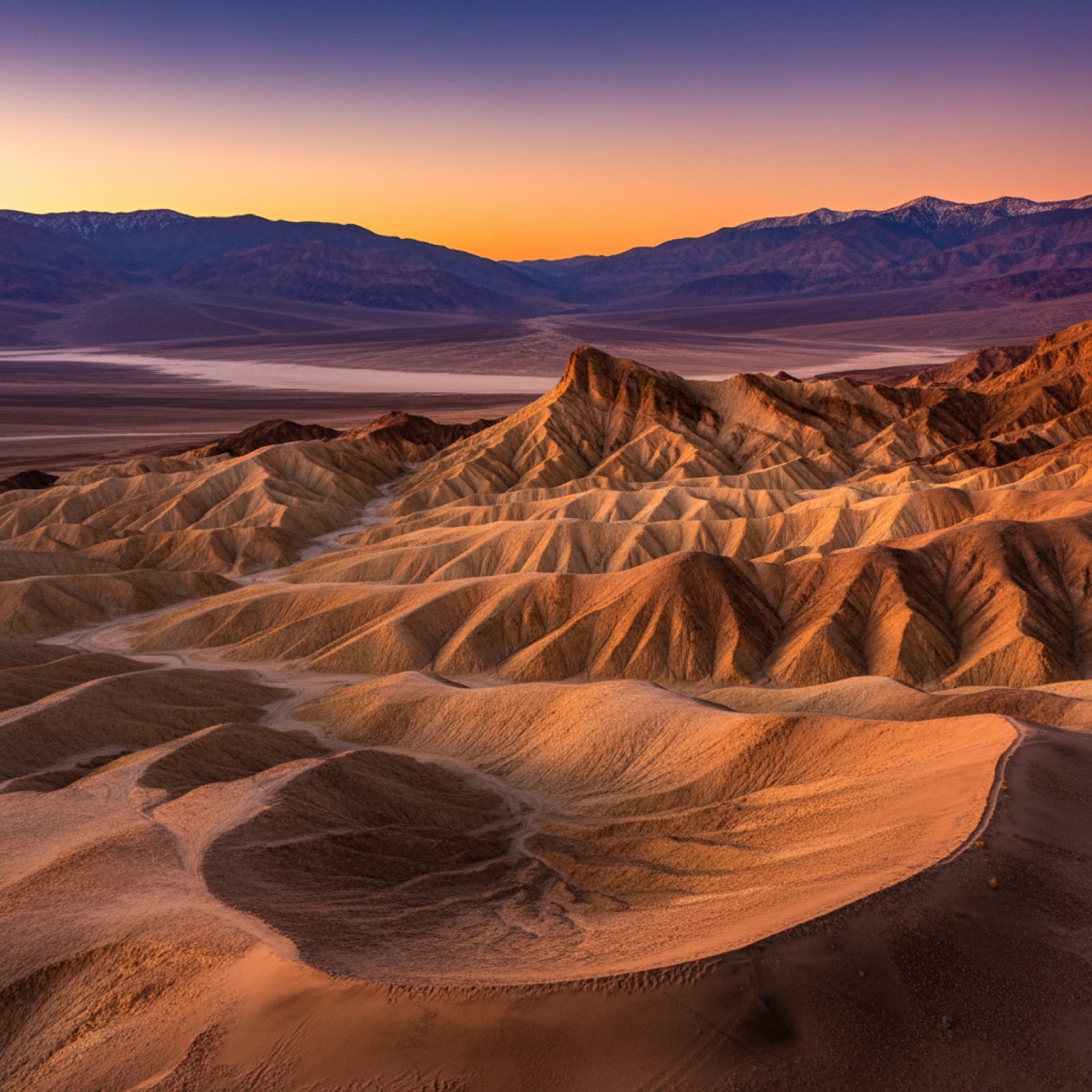
Zabriskie Point offers one of the most stunning panoramic views in the park. The undulating badlands, carved by erosion over millennia, create a mesmerizing tapestry of gold and brown. It's an absolute must for any photography enthusiast or anyone seeking breathtaking vistas.
- Location: Highway 190, 4 miles (6.4 km) east of Furnace Creek.
- Opening Hours: 24/7. Sunrise is spectacular here.
- Entry Fee: Included in park entrance fee.
- Accessibility: Paved, accessible path to the viewpoint. Plenty of parking.
- Tip: Arrive just as the sun breaks over the horizon, when the light playing on the ridges is pure magic. This is definitely one of the top Death Valley National Park attractions.
Dante's View: Panoramic Grandeur
Ascending to Dante's View, you'll feel like you're on top of the world. From this elevated overlook, you get an unparalleled vista of Badwater Basin below and the Panamint Mountains towering in the distance. The scale is simply mind-boggling.
- Location: Take CA-190 east from Furnace Creek, turn south on Dante's View Road. Approximately 25 miles (40 km) from Furnace Creek. The last half-mile is steep and winding; RVs and trailers are advised to park lower down.
- Opening Hours: 24/7. Sunset offers incredible colors.
- Elevation: 5,475 feet (1,669 meters).
- Note: Can be significantly cooler and windier up here, even if it's hot below.
Mesquite Flat Sand Dunes: Desert's Sculpted Beauty
No trip to Death Valley is complete without visiting the iconic Mesquite Flat Sand Dunes. Hike out onto these golden giants, feel the soft sand underfoot, and marvel at the ripple patterns etched by the wind. They are particularly captivating at dawn or dusk when the shadows play across the crests.
- Location: Just west of Stovepipe Wells Village, off Highway 190.
- Opening Hours: 24/7.
- Activity: Hiking, photography, stargazing.
- Tips: Go early in the morning to avoid the heat and see untouched sand. Wear closed-toe shoes to protect against hot sand and potential critters. Look for animal tracks!
- Stargazing: Lying on the dunes on a clear evening and watching the Milky Way emerge offers one of the most brilliant displays of stars anywhere. This is truly one of the best Death Valley Things to Do at night.
Artist's Drive & Artist's Palette: A Kaleidoscope of Color
This scenic nine-mile (14.5 km) one-way loop road showcases volcanic and sedimentary rock formations painted with a myriad of colors – greens, purples, yellows, and reds – due to the oxidation of various metals. The most vibrant spot, Artist's Palette, is a highlight and easily accessible.
- Location: South of Furnace Creek off Badwater Road.
- Vehicle Restrictions: Not recommended for RVs or trailers due to narrow, winding roads.
- Best Time: Afternoon for the best light on the colors.
- Don't Miss: A short walk into the washes at Artist's Palette allows you to get up close to the colorful rock faces.
Explore on Foot: Best Death Valley Hiking Trails
While driving is essential in Death Valley, truly experiencing its magic means hitting the trails. The sheer diversity of landscapes means you can go from salt flats to canyons to dunes, all in one day. These Death Valley Things to Do on foot will give you a different appreciation for the park.
Golden Canyon Trail: A Journey Through Time
The Golden Canyon Trail is a fantastic moderate hike that takes you through narrow canyons with walls glowing in various shades of gold, amber, and red. It's a great introduction to the park's geology.
- Trailhead: Off Badwater Road, 2 miles (3.2 km) south of Furnace Creek.
- Length: 2-3 miles (3.2-4.8 km) round trip to Red Cathedral (highly recommended!).
- Difficulty: Moderate, with some uphill sections and scrambling near Red Cathedral.
- Best Time: Morning or late afternoon to avoid direct sun in the canyon.
- Advice: Extend your hike to the Red Cathedral for an extra rewarding experience. The vibrant red rock formation is truly impressive. This is one of the best Death Valley hiking trails.
Harmony Borax Works Trail: Historical Insight
For a short, accessible walk with a fascinating historical twist, the Harmony Borax Works Trail is perfect. This easy paved loop takes you past the remains of the 1880s borax processing plant and the famous 20-Mule Team wagons. It's a key part of understanding the human history within this extreme environment.
- Trailhead: Just north of the Furnace Creek Visitor Center on CA-190.
- Length: 0.4 miles (0.6 km) loop.
- Difficulty: Easy, paved, wheelchair accessible.
- Ideal for: Families, history buffs.
Mosaic Canyon Trail: Marble Polished by Water
Located near Stovepipe Wells, Mosaic Canyon is a wonderfully unique hike. The canyon walls are made of smooth, polished marble and breccia, sculpted by countless flash floods. You'll find yourself scrambling over small obstacles and marveling at the intricate patterns.
- Trailhead: A short, unpaved road off CA-190 near Stovepipe Wells (passable by most cars).
- Length: Up to 4 miles (6.4 km) round trip, but you can turn back at any point.
- Difficulty: Moderate, involves some rock scrambling.
- Gear: Good grip shoes are essential.
- Warning: Do not enter if there is any sign of rain in the area due to flash flood danger.
Salt Creek Interpretive Trail: A Desert Oasis
It's hard to believe, but a tiny little fish, the Death Valley pupfish, survives in the brackish waters of Salt Creek! The Salt Creek Interpretive Trail is a short wooden boardwalk loop that allows you to observe this remarkable ecosystem. It's a surprising contrast to the surrounding aridity and one of the more unique Death Valley Things to Do.
- Location: Off CA-190, 14 miles (22 km) north of Furnace Creek.
- Length: 0.5 miles (0.8 km) loop, boardwalk.
- Best Time: Early spring (March-April) when the pupfish are most active for spawning.
Planning Your Visit: Best Time to Visit Death Valley
Timing is everything when it comes to Death Valley. My early trips often coincided with spring, and for good reason!
Winter (November – February): Ideal Temperatures
This is arguably the best time to visit Death Valley. Temperatures are mild and pleasant, typically ranging from 60-70°F (15-21°C) during the day. Nights can be cool, dropping to 30-40°F (-1-4°C). This allows for comfortable hiking and exploration of all Death Valley Things to Do without the extreme heat.
Spring (March – April): Wildflowers and Mild Weather
Spring offers beautiful weather similar to winter, with the added bonus of potential wildflowers if there has been enough rain. Daytime highs are usually 70-90°F (21-32°C). This is a popular time, so expect more crowds.
Fall (October): Transition Period
October sees temperatures cooling down from the summer extremes, with daytime highs often in the 80s and 90s°F (27-37°C), making it a good shoulder season to visit.
Summer (May – September): Extreme Heat - Proceed with Caution
Summer in Death Valley is not for the faint of heart. Temperatures regularly exceed 100°F (38°C) and can reach over 120°F (49°C). While the park is open, outdoor activity should be minimal and limited to very early mornings or late evenings. Many of the Death Valley Things to Do are simply unsafe during peak summer hours – even a short trail hike in June is a mistake. It's a reminder of the raw power of this place. If visiting in summer, focus on scenic drives, short walks, and indoor exhibits.
Crafting Your Adventure: Death Valley Itinerary (1-3 Days)
Planning is key to maximizing your time here. Here's a suggested Death Valley itinerary, scalable for different trip lengths.
One-Day Death Valley Itinerary: The Highlights
If you only have one day, focus on the iconic eastern sights:
- Morning: Arrive at Furnace Creek. Visit the Furnace Creek Visitor Center (8:00 AM - 5:00 PM usually) to get maps and current conditions. Drive to Zabriskie Point for sunrise (or shortly after) for incredible views.
- Late Morning/Early Afternoon: Drive south on Badwater Road. Hike a portion of Golden Canyon. Continue to Badwater Basin and walk out onto the salt flats.
- Afternoon: Explore Artist's Drive & Artist's Palette.
- Late Afternoon/Evening: Drive up to Dante's View for sunset and panoramic vistas. Head back to Furnace Creek or Stovepipe Wells for dinner.
Two-Day Death Valley Itinerary: Deeper Exploration
With an extra day, you can delve into more diverse landscapes:
- Day 1: Follow the One-Day Itinerary.
- Day 2:
- Morning: Head west towards Stovepipe Wells. Hike Mosaic Canyon.
- Late Morning: Explore the Mesquite Flat Sand Dunes.
- Afternoon: Visit Harmony Borax Works for a historical perspective. Perhaps a drive up to Scotty's Castle (note: currently closed for repairs from flood damage, check NPS website for updates).
- Evening: Stargazing at the Sand Dunes or a remote pull-out. Death Valley is an International Dark Sky Park, offering some of the best night sky views in the US.
Three-Day Death Valley Itinerary: The Full Experience
For those with three days, you can add some lesser-known gems and more challenging hikes, really getting to grips with the Death Valley Things to Do beyond the main road.
- Days 1 & 2: Follow the Two-Day Itinerary.
- Day 3 (Choose Your Adventure):
- Option A (Canyons & Views): Explore more slot canyons like Desolation Canyon (moderate, unmarked) or take a scenic drive up Twenty Mule Team Canyon.
- Option B (Racetrack Playa & Backcountry - high clearance 4x4 required): This is an epic adventure. Drive to the famous Racetrack Playa to see the mysterious moving rocks. This is a very remote area, requiring a high-clearance 4x4 vehicle with rugged tires, spare tires, and extensive preparation. It’s a full-day commitment. \u200b\u200bYou’ll want to pack everything you need, as there are zero services out there.
- Option C (Salt Creek & Wildflowers): Visit Salt Creek Interpretive Trail (especially in spring). Look for wildflowers along Badwater Road.
- Option D (Telescope Peak - spring/early summer, snow dependent): For experienced, fit hikers, a hike up Telescope Peak (11,049ft / 3368m) offers incredible views and a huge contrast to the valley floor. This is a serious undertaking and requires careful planning.
Where to Stay and Eat in Death Valley
While the park is vast and remote, there are a few options for lodging and dining. Planning ahead is crucial, especially during peak season.
Lodging Options:
- The Oasis at Death Valley (Furnace Creek): This is the most developed area. It offers two distinct options:
- The Inn at Death Valley: A historic, luxury resort.
- The Ranch at Death Valley: A more family-friendly, moderately priced hotel with a general store, restaurants, and a spring-fed pool.
- Booking: Online via their official website.
- Prices (2025 estimate): Inn rooms from $400-$800+ USD per night. Ranch rooms from $200-$450 USD per night.
- Stovepipe Wells Village Hotel: A more rustic, budget-friendly option with a general store, restaurant, and saloon.
- Booking: Online via their official website.
- Prices (2025 estimate): Rooms from $150-$300 USD per night.
- Panamint Springs Resort: Located in the far western part of the park, offering cabins, motel rooms, and a campground. More secluded.
- Booking: Online via their official website.
- Prices (2025 estimate): Rooms/cabins from $100-$250 USD per night.
- Camping: Several campgrounds are available, ranging from primitive to those with facilities.
- Furnace Creek Campground: Open year-round. Reservations taken for the 15 October–15 April season via Recreation.gov.
- Stovepipe Wells Campground: First-come, first-served.
- Texas Springs, Sunset, Mesquite Spring and other campgrounds: Check NPS website for seasonal availability and booking.
- Prices (2025 estimate): $18 - $36 USD per night, depending on amenities and campground. Primitive sites can be free.
Dining Options:
- The Oasis at Death Valley (Furnace Creek): Multiple options from fine dining at The Inn Dining Room to more casual fare at The Ranch (e.g., The 1849 Restaurant, The Last Kind Words Saloon).
- Stovepipe Wells Village: Toll Road Restaurant and Badwater Saloon for American cuisine.
- Panamint Springs Resort: Restaurant and bar.
- General Stores: Both Furnace Creek and Stovepipe Wells have general stores where you can buy groceries, snacks, and drinks, which are ideal for picnic lunches to save money and time!
- Food Tip: While there are dining options, they can be pricey and limited. Pack a cooler with sandwiches, fruits, and an abundance of water. It makes a huge difference, especially during a full day of exploring Death Valley Things to Do.
Practical Tips for Visiting Death Valley
Death Valley demands respect and preparation. Here's how to ensure a safe and enjoyable trip.
Park Entrance Fees:
- Vehicle Pass: $30 USD (valid for 7 days).
- Motorcycle Pass: $25 USD (valid for 7 days).
- Individual Pass: $15 USD (per person entering by foot or bike, valid for 7 days).
- America the Beautiful Pass: $80 USD for US residents or $250 USD for non-residents (annual pass covering all National Parks and Federal Recreational Lands, highly recommended if you plan to visit multiple parks).
- Where to Pay: Entrance stations (often unstaffed, requiring self-payment), Furnace Creek Visitor Center, Stovepipe Wells Ranger Station, or online via Recreation.gov.
Getting Around:
- Vehicle Required: Death Valley is immense. A car is essential. Rental cars are available at major airports like Las Vegas Harry Reid International (LAS) or Los Angeles (LAX).
- Fuel: Gas stations are scarce and expensive within the park (Furnace Creek, Stovepipe Wells, Panamint Springs). Fill up your tank before entering the park, especially if coming from Beatty (Nevada) or Lone Pine (California).
- Example Gas Prices (as of late 2024, subject to change): Furnace Creek often $6.00-$7.50 USD/gallon, while outside the park might be $4.00-$5.00 USD/gallon.
What to Pack:
- Water, Water, Water: This is non-negotiable. Carry at least 1 gallon (3.8 liters) per person per day, and more if hiking. A 5-gallon jug in the back of the car is a smart backup. Bottled water at Furnace Creek General Store might be around $2.00-$3.00 USD per liter.
- Sun Protection: Wide-brimmed hat, sunglasses, high-SPF sunscreen, and light-colored, long-sleeved clothing.
- Snacks & Food: Due to limited and expensive options, bring your own food.
- Sturdy Shoes: For hiking on uneven terrain.
- Map: A physical map (available at visitor centers) is crucial as cell service is very limited.
- Headlamp/Flashlight: For stargazing or early morning/late evening hikes.
- First-Aid Kit: Basic supplies for cuts, blisters, and headaches.
- Emergency Kit: Jumper cables, extra water, basic tools.
Accessibility:
Many viewpoints like Zabriskie Point, Dante's View, and Badwater Basin have accessible paths. The Harmony Borax Works Trail is also paved and wheelchair-friendly. Check the NPS website for detailed accessibility information on specific Death Valley Things to Do.
Pro Tips
- Start Early: Especially if you're visiting outside of winter months. Beat the heat and enjoy the tranquility. Get up before dawn to catch sunrise at Zabriskie Point and get your hikes in.
- Stay Hydrated: This cannot be stressed enough. Drink constantly, even if you don't feel thirsty.
- Cell Service is Spotty: Don't rely on your phone for navigation or emergencies. Download offline maps and inform someone of your itinerary.
- Check NPS Website: Always check the official National Park Service Death Valley website for current conditions, road closures, and alerts, especially regarding extreme heat or flash floods.
- Look Up at Night: Death Valley is an International Dark Sky Park. On a clear, moonless night, the stargazing is simply phenomenal. Pull over at a designated viewpoint or a safe road shoulder, turn off your lights, and let your eyes adjust. It’s one of the most magical Death Valley Things to Do.
- Respect the Heat: If visiting during summer, adjust your expectations. Focus on short drives, air-conditioned visitor centers, and brief stops at viewpoints. Avoid strenuous activity after 10 AM.
- Leave No Trace: Pack out everything you pack in. Preserve this fragile ecosystem for future visitors.
Budget Breakdown: How Much Does a Death Valley Trip Cost?
To give you a clearer picture, here’s an estimated budget for a 2-day, 1-night trip for two people, excluding airfare to the region.
| Category | Estimated Cost (USD) | Notes |
|---|---|---|
| Park Entrance Fee | $30 | Vehicle pass, valid 7 days. |
| Accommodation (1 night) | $150 - $450 | Stovepipe Wells Motel to Ranch at Death Valley. Camping: $18-$36. |
| Fuel | $80 - $150 | Depends on vehicle MPG and starting point. Park gas is ~$6.00-$7.50/gal. Make sure you fuel up outside the park. A full tank plus half a tank inside usually covers it. |
| Food & Snacks | $100 - $200 | Two restaurant meals, plus packed lunches/snacks. Significantly less if you self-cater entirely. |
| Water & Drinks | $20 - $40 | Essential! Buy large jugs outside the park. |
| Miscellaneous (e.g., Souvenirs) | $20 - $50 | |
| Total Estimated Cost | $400 - $920+ | Excludes rental car, airfare. Can be lower with camping/self-catering. |
This budget breakdown shows that a trip to Death Valley can be done economically, especially if you opt for camping and bring your own food. However, for those seeking more comfort, the costs can quickly add up, particularly at The Oasis resorts. Regardless of your budget, the natural beauty of the park is priceless and among the absolute best Death Valley Things to Do.
Common Mistakes to Avoid in Death Valley
Plenty of travellers underestimate Death Valley. Learn from their pitfalls.
Avoiding the Classic Death Valley Errors
Most problems in Death Valley come from underestimating the heat and the distances. Carry at least one gallon (3.8 litres) of water per person per day, and more for hiking. Outside winter, start early and avoid strenuous activity after 10 AM; in summer, stick to scenic drives and short stops. Fill the tank before entering, as fuel inside the park is scarce and expensive.
Do not rely on your phone: cell service is spotty, so carry a physical map, download offline maps and tell someone your plans. Keep RVs off Artist's Drive, stay out of Mosaic Canyon if rain threatens, book Furnace Creek camping ahead for October to April, and check the NPS website for current alerts and closures.