Paris Catacombs: Tickets, Tours and What to Expect
The Paris Catacombs' history, tickets and booking, skipping the queue, what the visit is like, tour options, photography rules and scams to avoid.
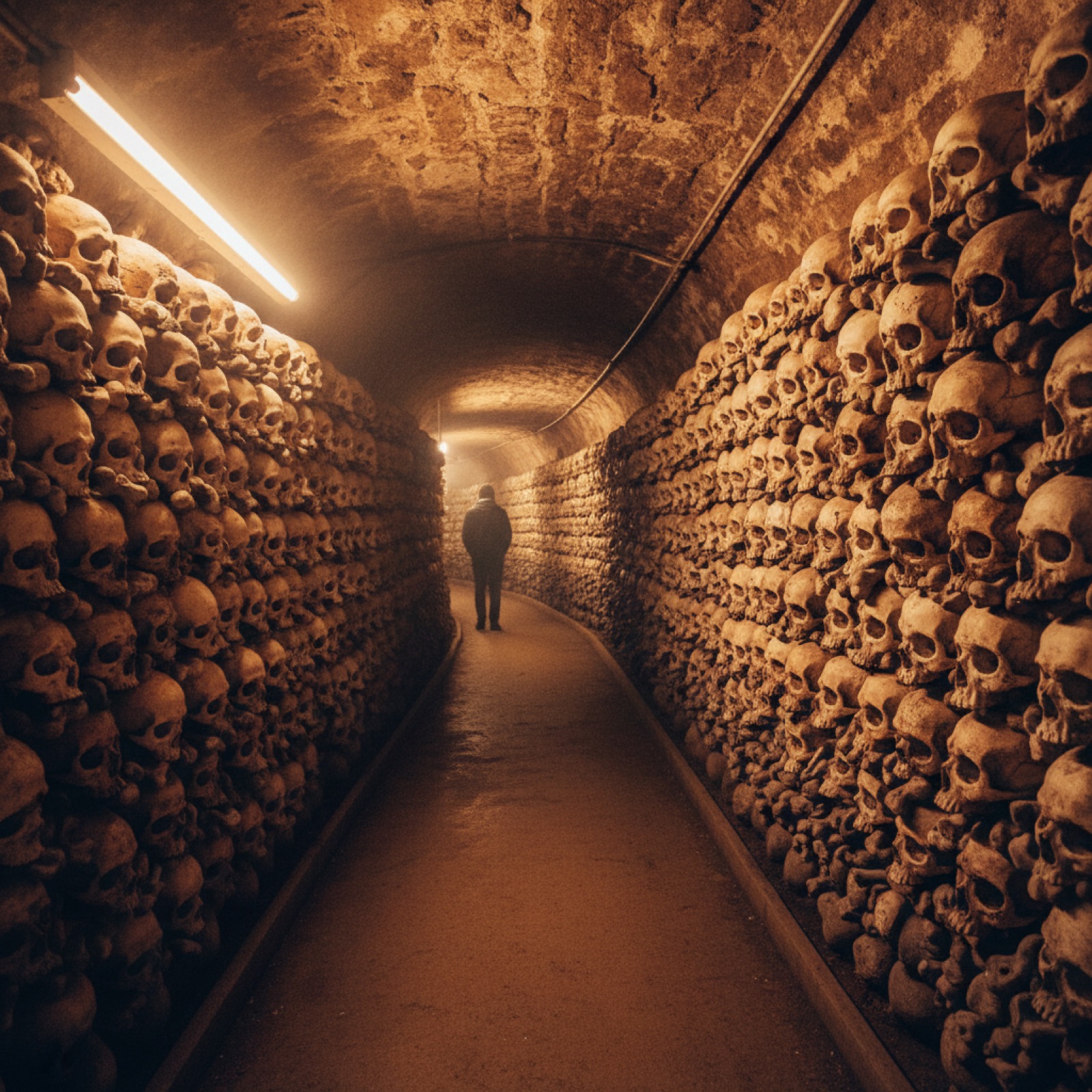
In this guide
- What Are the Paris Catacombs?
- The Fascinating History Behind 6 Million Bones
- Tickets, Prices & How to Book
- Skip-the-Line Strategies That Actually Work
- What to Expect During Your Visit
- Tour Options Compared
- Photography Tips for the Catacombs
- The Secret Catacombs: What They Don't Tell You
- Practical Information
- Pro Tips from 12 Visits
- Scams to Avoid
- Nearby Attractions
- Frequently Asked Questions
- Conclusion
This guide is part of our Paris Travel Guide — start there for the overview, itineraries and costs.
Descending the 131 spiral steps into the Paris Catacombs is not for everyone, and queues can snake around Place Denfert-Rochereau for up to two hours. But it's an experience that stays with you—in the best possible way.
What Are the Paris Catacombs?
The Paris Catacombs (Catacombes de Paris) are an underground ossuary containing the remains of approximately 6 million people in a network of tunnels beneath the streets of Paris. The official tourist section covers about 1.5 kilometers of the estimated 300+ kilometers of tunnels that honeycomb the Parisian underground.
Located 20 meters (65 feet) below street level, the temperature remains a constant 14°C (57°F) year-round—something that's both atmospheric and practical to know for dressing appropriately. The air is surprisingly fresh, thanks to a ventilation system installed in the 19th century.
Why Visit the Catacombs?
Unlike any museum or monument in Paris, the Catacombs offer a visceral, almost primal experience. You're not viewing history through glass cases—you're walking through it, surrounded by the physical remains of Parisians who lived centuries before the Eiffel Tower was even conceived.
Visitor reactions range from profound silence and contemplation to groups of friends laughing nervously at the absurdity of their situation. Both reactions are valid. The Catacombs have a way of stripping away pretense and connecting visitors to something fundamentally human.
The Fascinating History Behind 6 Million Bones
The Cemetery Crisis of 1780
The story begins with death—specifically, too much of it in too small a space. By the late 18th century, Paris's cemeteries, particularly the Cimetière des Innocents (Cemetery of the Innocents), had become a public health nightmare. Centuries of burials had created a situation where corpses were literally spilling into neighboring basements.
In 1780, a wall of the Innocents cemetery collapsed, sending decomposing bodies tumbling into an adjacent property. The resulting scandal forced city officials to act. The solution? The abandoned limestone quarries beneath the city.
The Quarries Beneath Paris
What many visitors don't realize is that the tunnels weren't dug for the bones—they were excavated centuries earlier to provide building materials. Much of Paris's iconic limestone architecture, including Notre-Dame Cathedral, was built from stone extracted from these very tunnels.
By the 18th century, the quarries had been largely abandoned, leaving a vast underground network that officials saw as the perfect solution to their cemetery problem.
The Great Bone Transfer (1786-1860)
Beginning in 1785, under the cover of night (to avoid disturbing Parisians), remains were transferred from overcrowded cemeteries to the quarries. This process continued for nearly 75 years, with bones arriving from over 150 different cemeteries.
Initially, the bones were simply dumped in heaps. It wasn't until 1810 that Louis-Étienne Héricart de Thury, Inspector General of Quarries, began organizing the remains into the artistic arrangements visible today.
Famous Residents
Among the 6 million remains are several notable figures:
- Nicolas Fouquet – Louis XIV's disgraced finance minister
- Jean-Paul Marat – Revolutionary leader assassinated in his bathtub
- Maximilien Robespierre – Architect of the Reign of Terror
- Antoine Lavoisier – Father of modern chemistry
- Charles Perrault – Author of Cinderella and Sleeping Beauty
However, individual identification is impossible—the bones were deliberately mixed during transfer to prevent veneration of specific individuals.
Tickets, Prices & How to Book
Standard Ticket Prices
| Ticket Type | Price (EUR) | Price (USD) | Notes |
|---|---|---|---|
| Adult (Standard) | €31 | ~$36 | Audio guide included |
| Child (8-17) | €15 | ~$17 | Audio guide included |
| Reduced Rate | €25 | ~$29 | Ages 18-26 and students (valid ID) |
| Free Entry | €0 | $0 | Under 8, disabled visitors + companion |
| Guided Tour (English) | — | — | Official guided tours currently unavailable |
Where to Buy Tickets
Official Website (Recommended): catacombes.paris.fr
Tickets release approximately 7 days in advance. Book online. During peak season, walk-up queues can exceed 3 hours, and tickets often sell out.
Booking Strategy
Here's the recommended booking strategy:
- Check the official website on Tuesday mornings (when new slots often release)
- Book the earliest slot available (9:45 AM)—crowds build throughout the day
- Consider weekday visits (Tuesday-Thursday are quietest)
- If peak season (June-August), book as soon as slots open, 7 days ahead
Skip-the-Line Strategies That Actually Work
Pre-Booked Timed Entry
The most reliable skip-the-line method is simply booking a timed ticket online. Your designated time slot guarantees entry with minimal waiting—usually under 10 minutes.
Guided Tours
Guided tours from authorized operators include skip-the-line access plus expert commentary. While pricier, you'll learn details impossible to discover independently.
Early Morning Visits
The 9:45 AM opening slot consistently has the shortest pre-entry wait and the least crowded tunnels inside, and this holds true even in August.
Off-Season Timing
Best months: November through February (excluding Christmas holidays)
Best days: Tuesday, Wednesday, Thursday
Best time: First slot of the day (9:45 AM) or last slot (7:30 PM)
What to Expect During Your Visit
The Descent
Your journey begins at 1 Avenue du Colonel Henri Rol-Tanguy, directly above the Denfert-Rochereau metro station. After ticket validation, you'll descend 131 steps in a tight spiral staircase. The descent takes 2-3 minutes and can feel claustrophobic—if you're prone to anxiety in confined spaces, prepare mentally.
The Quarry Tunnels
The first section (about 500 meters) passes through unadorned quarry tunnels. This portion establishes the subterranean atmosphere before you reach the ossuary itself. The ceilings are low in places—tall visitors (over 6 feet) should be prepared to duck occasionally.
The Ossuary
You'll know you've arrived when you pass through a portal inscribed with the famous warning: "Arrête! C'est ici l'empire de la mort" (Stop! This is the Empire of the Dead). Beyond this threshold, walls of carefully arranged bones stretch before you.
The bone arrangements are surprisingly artistic—skulls form heart shapes and crosses, tibias create decorative patterns, and plaques mark which cemetery the remains originated from. The effect is simultaneously macabre and beautiful.
The Ascent
After approximately 1.5 kilometers of walking, you'll ascend 112 steps to emerge at 21 bis Avenue René-Coty, nearly 700 metres from where you entered. Important: You cannot return through the entrance—plan accordingly for meeting companions or returning to your starting point.
Duration
Most visitors spend 45 minutes to 1 hour inside. With an audio guide or guided tour, expect 60-90 minutes. The total experience, including queueing and security, typically takes 2-3 hours.
Tour Options Compared
| Option | Duration | Price | Best For | Limitations |
|---|---|---|---|---|
| Self-Guided | 45-60 min | €31 | Budget travelers, repeat visitors | No expert context |
| Audio Guide | 60-75 min | €31 (included) | First-timers wanting context | Can feel isolated |
| Official Guided Tour | 60 min | Currently unavailable | History enthusiasts | Fixed pace, set times |
| Private Tour | 90-120 min | €150-300 | Serious history buffs, photographers | Expensive |
My Recommendation
For first-time visitors, the audio guide option is the best choice. It provides rich historical context while allowing you to move at your own pace. For those deeply interested in history, the guided tour adds invaluable insights about the quarry system and bone arrangement techniques.
Photography Tips for the Catacombs
Camera Settings
The Catacombs are dimly lit, requiring specific camera settings:
- ISO: 1600-6400 (expect noise)
- Aperture: f/2.8 or wider
- Shutter: 1/30s minimum (brace against walls)
- Flash: Prohibited (and would ruin the atmosphere anyway)
What Works
Wide-angle lenses capture the claustrophobic atmosphere beautifully; a 16-35mm works well, particularly for tunnel perspectives. Prime lenses (35mm or 50mm f/1.8) work well for detail shots of bone arrangements.
Respectful Photography
Remember: these are human remains. While photography is permitted, approach with respect. Avoid "funny" poses with skulls or treating the site like a Halloween attraction. Guards actively monitor behavior and will ask disrespectful visitors to leave.
The Secret Catacombs: What They Don't Tell You
The Illegal 300 Kilometers
The official tourist section represents less than 1% of the total tunnel network. The remaining 300+ kilometers remain officially off-limits but are regularly explored by cataphiles—a subculture of urban explorers who know the underground intimately.
Entering unofficial sections is illegal and carries fines up to €60, yet a community of cataphiles has spent decades mapping these tunnels. Their stories include underground parties, art installations in secret chambers, and encounters with the cataflics—the police unit that patrols the tunnels.
The Bunker
During World War II, both German forces and French Resistance fighters used the tunnels. A German bunker remains in the unofficial sections, complete with Nazi graffiti—a chilling reminder of the occupation.
Underground Cinema
In 2004, police discovered a fully equipped cinema in a cavern beneath the Palais de Chaillot. Complete with a screen, projector, seating, bar, and restaurant, it had been secretly built and operated by a cataphile collective. When police returned with experts to investigate further, the entire installation had vanished, replaced by a note: "Do not try to find us."
Practical Information
Location & Getting There
Address: 1 Avenue du Colonel Henri Rol-Tanguy, 75014 Paris
Metro: Denfert-Rochereau (Lines 4 and 6, RER B)
Exit at: "Place Denfert-Rochereau" exit
Opening Hours
Tuesday - Sunday: 9:45 AM - 8:30 PM (last entry 7:30 PM)
Closed: Mondays, January 1, May 1, December 25
Accessibility
Unfortunately, the Catacombs are not accessible for wheelchairs or visitors with mobility limitations. The 131 steps down and 112 steps up have no elevator alternatives. The tunnels include uneven surfaces, low ceilings, and narrow passages.
What to Bring
- Warm layers (constant 14°C/57°F)
- Comfortable walking shoes with grip
- Camera with low-light capability
- Water bottle for before or after (eating and drinking are not allowed on the circuit)
- Charged phone (for audio guide app)
What NOT to Bring
- Large bags (no storage available)
- Tripods (prohibited)
- Food (prohibited)
- Children under 10 (not recommended, though allowed)
Pro Tips from 12 Visits
1. Use the Bathroom Before Entry
There are no facilities inside the 1.5-kilometer route. The total visit time (including potential queue) can exceed 2 hours.
2. Dress Warmer Than You Think
That constant 14°C feels much colder after 45+ minutes underground. Bring a light jacket, even in summer.
3. The Exit Location Matters
You'll exit at 21 bis Avenue René-Coty, nearly 700 metres from the entrance. If meeting someone or returning to a parked car, plan accordingly; it's easiest to arrange for companions to meet you at the exit point.
4. Visit the Gift Shop
Located at the exit, the gift shop sells legitimately interesting items, including historical maps and catacomb-themed art. It's one of the better museum shops in Paris.
5. Combine with the Montparnasse Cemetery
If the subterranean realm sparked your interest in mortality, the nearby Montparnasse Cemetery contains graves of Sartre, Beauvoir, Baudelaire, and Gainsbourg—a fascinating above-ground complement.
Scams to Avoid
Unofficial "Skip the Line" Sellers
Street vendors near the entrance may offer "skip the line" tickets at inflated prices. These are often invalid or for unauthorized tours. Only purchase through the official website or authorized partners like GetYourGuide.
Fake Guided Tours
Unofficial guides sometimes approach tourists in the queue offering "enhanced" experiences. Official guided tours are only available through the Catacombs website—don't trust random approaches.
Pickpockets in the Queue
The long queues attract pickpockets. Keep valuables in front pockets, use money belts, and stay aware of your surroundings—particularly when distracted by phones or cameras.
Overpriced Nearby Cafes
Cafes directly facing the entrance often charge €5+ for espresso. Walk one block in any direction for normal Parisian prices.
Nearby Attractions
Montparnasse Cemetery (10-minute walk)
One of Paris's most famous cemeteries, containing notable graves including Sartre, Beauvoir, and Serge Gainsbourg. Free entry.
Luxembourg Gardens (15-minute walk)
Beautiful formal gardens perfect for decompressing after the underground intensity. Free entry.
Le Ciel de Paris (closed)
This restaurant atop the Tour Montparnasse closed in June 2025, and the tower itself closed for a multi-year renovation in spring 2026.
Frequently Asked Questions
Is it scary?
That depends entirely on your disposition. The bones are arranged artistically rather than gruesomely, and the atmosphere is contemplative rather than horrific. Most visitors describe the experience as "fascinating" rather than "frightening."
Can I bring children?
Children under 14 must be accompanied by adults. The official site doesn't recommend the visit for children under 10 due to the subject matter and physical demands. Well-prepared 8-year-olds can handle it fine, but know your child.
How far do you walk?
Approximately 1.5 kilometers (just under 1 mile), entirely underground. The path is linear—no decision-making required.
Can I touch the bones?
Absolutely not. Guards monitor constantly, and touching is both disrespectful and illegal. Fines apply.
What if I'm claustrophobic?
The tunnels are tight in places but generally passable. The most challenging section is the spiral staircase descent. If you have severe claustrophobia, this attraction may not be suitable.
Conclusion
The Paris Catacombs remain one of the most singular experiences available in a city overflowing with remarkable attractions. Unlike the Louvre or Eiffel Tower, the Catacombs offer something beyond aesthetic appreciation—they provide a direct, physical encounter with mortality itself.
Even repeat visitors find new details in the bone arrangements, new contemplations emerging from the silence. Whether you're a history enthusiast, a photography obsessive, or simply someone seeking an experience beyond the ordinary, the Empire of the Dead delivers.
Book your tickets in advance, dress warmly, and prepare for an encounter you'll carry with you long after you've ascended those 112 steps back into the light of Paris.
More Paris guides
Paris in Winter: Things to Do From December to February
What Paris is like from December to February: Christmas markets, museums, winter food and drink, what to wear, plus a month-by-month…

Le Marais, Paris: A Neighbourhood Guide
Le Marais' history, main sights, quieter corners, restaurants and cafés, shopping, bars, where to stay, practical tips and what a visit…

Best Croissants in Paris: Bakeries Worth Queuing For
The Paris bakeries known for their croissants, what separates a great one from an average one, how to order, other flavours, prices and…