Airbnb vs Hotels in Japan: An Honest Comparison
An honest comparison of Airbnbs and hotels in Japan - the minpaku law, room sizes, real costs, and which wins in Tokyo, Kyoto, Osaka and rural onsen towns.
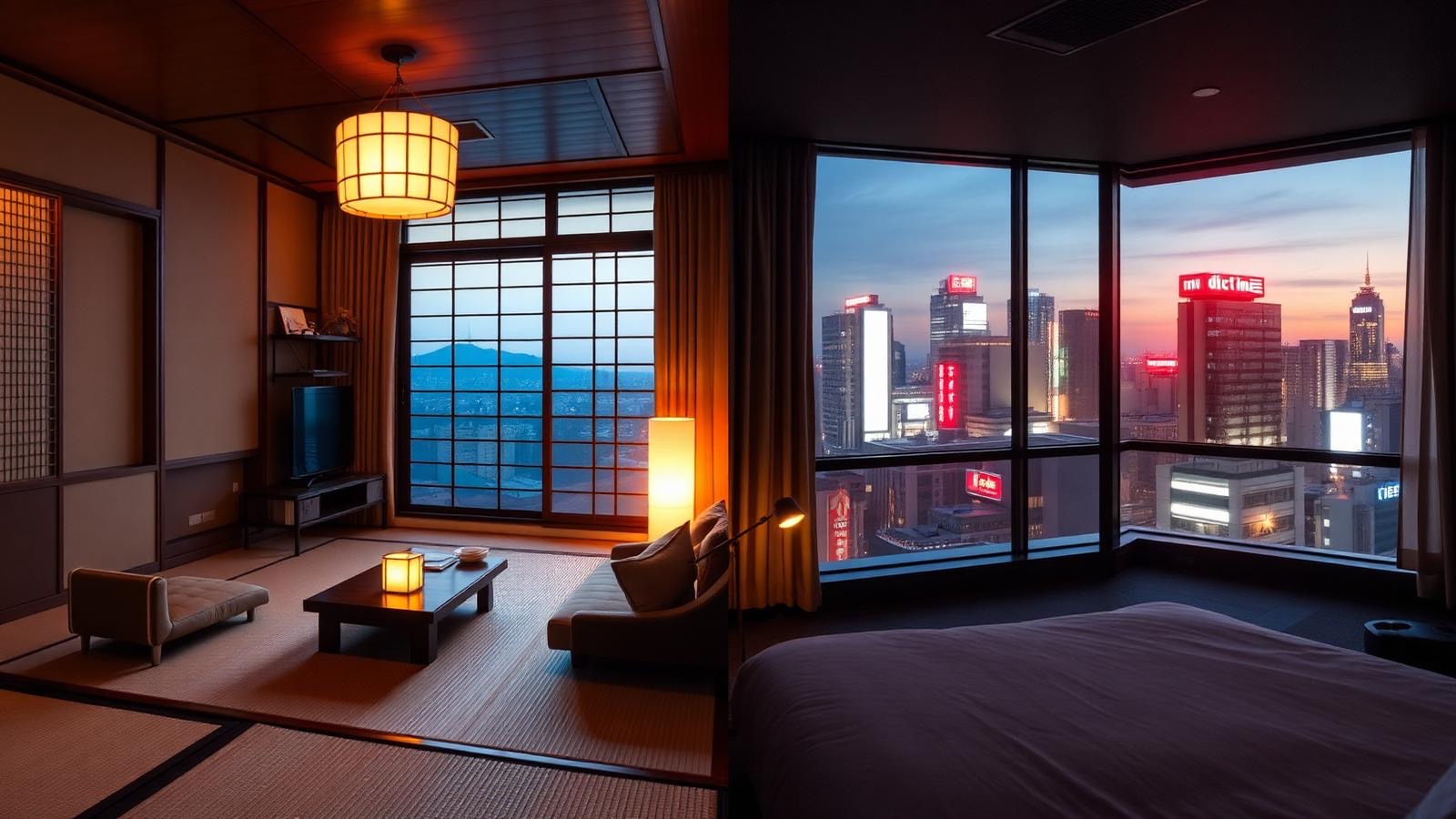
In this guide
- The Quick Verdict
- Japan's Minpaku Law: What You Need to Know
- Space and Room Size
- Cost: What You Actually Pay
- Amenities and Service
- Location and Neighbourhood
- Check-in, Language and Practical Friction
- Groups, Families and Long Stays
- City by City: Where Each One Wins
- The Japanese Hotel Types Worth Knowing
- Airbnb Red Flags in Japan
- How to Actually Choose
This guide is part of our Tokyo Travel Guide: Neighbourhoods, Food and Getting Around — start there for the overview, itineraries and costs.
Japan's accommodation runs from shoebox capsule hotels in Shinjuku to full three-bedroom machiya townhouses in Kyoto, and the honest answer to "Airbnb or hotel in Japan?" isn't the answer most travel blogs give you. Japan is one country where the right choice can flip from trip to trip — sometimes within the same trip. This is the guide to read before your first Japan booking.
The short version: Japan has some of the best hotels in the world at any price point, and it also has some of the most magical Airbnbs in Asia — old wooden townhouses, minka farmhouses, family-run apartments in neighbourhoods tourists never see. But Japan also has strict short-term rental laws (the minpaku law) that have quietly killed a large chunk of the Airbnb market, and hotels here punch far above their price tag in ways they simply don't in Europe or the US. Which one is right for you depends on your city, your group size, and what kind of trip you're actually trying to have.
The Quick Verdict
If you're a solo traveller or a couple staying under a week in Tokyo, Osaka or Kyoto — book a hotel. You'll get a spotless room, a real front desk, luggage forwarding, breakfast that would embarrass a five-star hotel in most other countries, and you'll pay less than you think.
If you're a family of four, a group of friends, or you're staying two weeks or more, or you specifically want to live in a traditional Japanese house — book an Airbnb, but only from a properly licensed host, and read the next section before you do anything.
Japan's Minpaku Law: What You Need to Know
This is the single most important thing to understand before booking a short-term rental in Japan, and most guides skip it entirely.
In June 2018, Japan introduced the Housing Accommodation Business Act — usually called the minpaku law. It legalised short-term rentals under strict conditions and effectively wiped out the grey-market Airbnb scene that had exploded in the years before. Overnight, more than 80% of Japan's Airbnb listings were pulled from the platform.
Under the law, a legal short-term rental in Japan must have one of three things:
- A minpaku licence (private residence): capped at 180 nights per year and must display a registration number starting with something like "M" followed by digits.
- A ryokan/hotel business licence: no night cap, treated like a small hotel — the gold standard.
- A special zone (tokku) licence: only in designated areas of Osaka, parts of Tokyo (Ota Ward) and a handful of other cities, with a minimum stay of 2–3 nights depending on the zone.
Every legal listing on Airbnb Japan must display its licence number in the description. If you don't see a licence number, don't book it. Unlicensed rentals can be — and regularly are — cancelled at short notice, sometimes while guests are mid-flight to Japan. Airbnb itself will cancel and refund, but you'll be scrambling for a hotel the night you arrive.
Practical rule of thumb: scroll to the bottom of the listing description, look for something like "Notification Number: M123456789" or "Hotel Business Act Licence". No number, no booking.
Space and Room Size
This is where Airbnb's biggest advantage in Japan lives. Japanese hotel rooms are famously small.
- Standard business hotel room (APA, Toyoko Inn, Route Inn): 11–14 m² (120–150 sq ft). One double bed, a bathroom the size of an aircraft toilet, just enough floor space to stand next to your suitcase.
- Standard 3–4 star hotel room in Tokyo: 15–20 m². Comfortable for one, cosy for two, tight for two people plus two large suitcases.
- 4–5 star hotel room: 25–35 m². Genuinely spacious by Japanese standards.
- Typical Tokyo Airbnb apartment: 25–45 m² for a 1-bedroom. That's often more square metres than a mid-range hotel room for less money per night.
- Kyoto machiya (traditional townhouse) Airbnb: 60–120 m² across two floors. This is the space you literally cannot buy at a hotel, at any price.
If you're travelling with more than two people, the maths gets brutal fast. A family of four in a Tokyo hotel usually means two connecting rooms or a rare (and expensive) "family room." An Airbnb with two bedrooms and a proper living area is often half the total cost and infinitely more comfortable.
Cost: What You Actually Pay
Japan is one of the few countries where hotels are arguably the better value at the low end. Here's the honest breakdown of typical prices:
- Business hotel (APA, Toyoko Inn, Super Hotel): ¥8,000–¥14,000/night for a solo or couple. Includes small breakfast, free tea, spotless room.
- Mid-range hotel (MIMARU, Mitsui Garden, Richmond): ¥18,000–¥30,000/night. Larger rooms, kitchenettes at MIMARU, excellent locations.
- Luxury hotel (Park Hyatt, Aman, Ritz-Carlton, Hoshinoya): ¥80,000–¥300,000+/night. World-class.
- Tokyo Airbnb (1BR, licensed): ¥12,000–¥22,000/night, plus a ¥3,000–¥8,000 one-off cleaning fee.
- Tokyo Airbnb (2–3BR): ¥25,000–¥60,000/night, plus cleaning fee.
- Kyoto machiya (whole house): ¥30,000–¥80,000/night for 4–8 people, plus cleaning fee.
For 1–2 people staying 3–5 nights, a good business or mid-range hotel almost always beats Airbnb on total cost once you factor in cleaning fees. For 4+ people or stays of a week or more, Airbnb pulls ahead — sometimes dramatically.
One thing to watch: Japan added an accommodation tax in several cities (Tokyo, Kyoto, Osaka, Fukuoka). It applies to both hotels and legal Airbnbs, and it's typically ¥100–¥1,000 per person per night depending on the room rate, although since March 2026 Kyoto charges up to ¥10,000 per person per night for rooms costing ¥100,000 or more. Legal listings pay it; unlicensed ones don't — another quiet giveaway.
Amenities and Service
This is where Japanese hotels are, frankly, unbeatable — even the cheap ones.
Even a ¥9,000 Toyoko Inn room comes with: a heated Toto washlet toilet, in-room yukata, slippers, a full toiletries set, a decent kettle with green and hōjicha tea, blackout curtains, a private hot bath, free wifi that actually works, and usually a modest but real free breakfast. The front desk speaks enough English to help, luggage forwarding (takkyubin) is easy to arrange, and they'll hold your bags for hours before or after checkout.
An Airbnb in Japan gives you a full kitchen (a real advantage if you're travelling with kids or have dietary restrictions), a washing machine (huge for stays over a week — laundry in Japan is otherwise expensive), often a bathtub big enough to actually soak in, and the freedom to eat convenience-store dinners on your own schedule after a 14-hour temple day. What you lose: no daily housekeeping, no front desk, no luggage storage if you arrive early, and no one to call at 11pm when the aircon controller won't switch to English.
Location and Neighbourhood
Japanese hotels cluster around train stations. That's a genuine perk — you walk out of the hotel, walk two minutes to the JR line, and you're anywhere in the city in half an hour. In Tokyo, most travellers benefit hugely from being within a 5-minute walk of a JR Yamanote Line station.
Airbnbs are more likely to be in residential neighbourhoods a 10–15 minute walk from a subway. That trade-off is worth it if you want to experience how Tokyoites actually live — laundromats, tiny local izakayas, morning stretching in the park. It's not worth it if your legs are already destroyed from day one and you're trying to hit three neighbourhoods a day.
Check-in, Language and Practical Friction
Hotel check-in in Japan is one of the smoothest experiences on earth. Passport scan, key, done. Someone at the desk 24/7. Signs in English, Chinese and Korean.
Airbnb check-in in Japan is often self check-in via a keybox — which is fine, until it isn't. The address in the Airbnb app can be slightly wrong, or the building may have no visible number, leaving you hunting for a lockbox on a Kyoto side street at night. Always screenshot the address and access instructions before you land, and always test the wifi password within an hour of arrival so you can message the host in daylight if something's off.
Groups, Families and Long Stays
This is the single strongest argument for Airbnb in Japan.
Japanese hotels almost never sleep more than 3 people per room, and true family rooms are rare and expensive. Two connecting hotel rooms for a family of four in central Tokyo can easily run ¥45,000/night. A 2-bedroom apartment 10 minutes away? ¥25,000–¥30,000, with a washing machine, kitchen, and enough space that nobody's stepping on each other by day three.
For anything over 10 nights, the washing machine alone justifies the switch. Japanese hotel laundry costs are steep, coin laundromats work but eat evenings, and the kitchen means you can eat one homemade meal a day for the price of a single restaurant dinner.
City by City: Where Each One Wins
Tokyo
Hotel wins for most trips. Tokyo has the best mid-range hotel scene in the world — MIMARU, Mitsui Garden, Sequence, Hotel Gracery Shinjuku all deliver excellent value and are steps from the train. Book Airbnb only if you're 4+ people or staying 10+ nights.
Kyoto
Airbnb wins if you can get a proper machiya. Staying in a 100-year-old wooden townhouse with a small garden, in a quiet neighbourhood, cooking breakfast on tatami in the morning — this is one of the great travel experiences in Asia. It's also the one thing no hotel can give you. If you can't get a machiya, book a ryokan for at least one night for the same reason.
Osaka
Hotel wins. Osaka hotels are cheap, well-located near Namba and Umeda, and the city is compact enough that a residential Airbnb feels less rewarding than in Tokyo or Kyoto.
Hokkaido (Niseko, Furano, Sapporo)
Airbnb (or self-contained condo) wins for ski trips. You want a kitchen, a drying room, and space for gear. Ski areas have plenty of legal, licensed self-contained rentals purpose-built for this.
Rural Japan and Onsen Towns
Ryokan wins — this isn't really a hotel-vs-Airbnb question. In Hakone, Nikko, Kinosaki, Kurokawa Onsen, book a traditional ryokan with kaiseki dinner and breakfast included. It's one of the best experiences the country offers.
The Japanese Hotel Types Worth Knowing
- Business hotels: compact, spotless, cheap, near stations. APA, Toyoko Inn, Route Inn, Super Hotel. My default for solo Tokyo trips.
- Mid-range hotels: MIMARU (kitchenette + up to 6 people, brilliant for families), Mitsui Garden, Richmond, Sequence. My default for couples and short family trips.
- Ryokan: traditional inns, tatami rooms, futons, communal onsen baths, multi-course dinner. Essential experience for at least 1–2 nights.
- Capsule hotels: worth trying once. Nine Hours and First Cabin are the modern upmarket versions.
- Love hotels: unironically some of the best-value rooms in Tokyo if you're a couple and don't mind the aesthetic. Big rooms, huge baths, karaoke machines.
Airbnb Red Flags in Japan
These are the warning signs worth filtering for ruthlessly:
- No licence number in the listing description. Non-negotiable. Skip.
- Host has fewer than 20 reviews. Japan's legal Airbnbs tend to accumulate reviews steadily; a brand-new listing with a great photo and no history is a common pattern for hosts operating in the grey market.
- Address only revealed after booking. Standard on Airbnb, but combined with no licence number, this is a red flag.
- "Minimum 2-night stay in Osaka" but the listing says Tokyo. Some hosts try to disguise tokku-zone restrictions. Read carefully.
- Photos that look Photoshopped or generic. Legal, professionally operated listings almost always have real photos of a real, specific space.
How to Actually Choose
A simple decision tree:
- Solo or couple, under 7 nights, city-focused? Hotel. Almost always a mid-range business hotel or a MIMARU.
- Rural onsen town or a traditional Japan experience is the point of the trip? Ryokan for at least half the nights.
- Family of 3+ or group of 4+? Licensed Airbnb, ideally a 2-bedroom near a JR station.
- Kyoto and I can get a machiya? Machiya. Always.
- Ski trip in Hokkaido or Nagano? Self-contained rental with kitchen and drying room.
- Anything over 12 nights? Split it: 5–7 nights hotel for landing/logistics, remainder in a licensed apartment with a washing machine.
Japan is one of the rare countries where the accommodation itself is part of the trip. A ryokan dinner, a machiya morning, a business-hotel breakfast — these are all memorable in ways that a chain hotel in most countries just isn't. Don't lock yourself into one type. Mix them up, and the trip gets better.
More Japan guides
Universal Studios Japan: Tickets, Express Passes and Tips
Planning Universal Studios Japan: ticket and Express Pass options, the Wizarding World, which rides to hit first, and how to avoid the…
Zao Onsen Guide: Snow Monsters, Skiing and Hot Springs
Zao Onsen in winter: the snow monsters, the ski terrain, sulphur hot springs, how to get there from Yamagata, and when the frost-covered…
Niseko Ski Guide: Powder, Passes and Where to Stay
Niseko's four resorts compared, getting there from Sapporo, the ski season, lift passes, gear rental, accommodation, onsen, dining and a…