Amsterdam Itinerary: Canals, Museums and Bikes
How many days to spend in Amsterdam, transport, the canal ring, the Rijksmuseum, Van Gogh and Anne Frank House, neighbourhoods, cycling and day trips.
In this guide
- Quick Facts
- First trip? Here's How Many Days You'll Need
- Getting In and Around the City
- Finding Your Feet: The Canal Ring
- The Big Three: Rijksmuseum, Van Gogh and Anne Frank House
- Exploring Amsterdam's Neighbourhoods
- Embracing the Dutch Outdoors: Parks and Bikes
- On the Water: Canal Cruises and Blue Hour Beauty
- Understanding Amsterdam: Coffeeshops and the Red Light District
- Beyond the City: Classic Day Trips from Amsterdam
- Frequently Asked Questions
- Final Thoughts
This guide is part of our Netherlands Travel Guide: Beyond Amsterdam — start there for the overview, when to go and how to get around.
The first thing that hits you isn't the canals, or the crooked gabled houses leaning against each other like tired old friends. It's the sound. A symphony of bicycle bells—a bright, polite ‘ding-ding’—woven through the rumble of a distant tram and the gentle lapping of water against a hundred moored boats. Stand on the corner of Prinsengracht and just listen. An immaculately dressed woman might glide past on a bike with a toddler in a front-mounted seat, followed by a student balancing grocery bags on his handlebars, both expertly navigating the cobblestones. This is the city's true rhythm. It's a place that moves at a human pace, a city designed for living in, not just for looking at.
Amsterdam is a city of layers, and this guide is designed to help you peel them back. We'll cover the essentials, from navigating the straightforward train journey from Schiphol Airport into the heart of the city to orienting yourself within the beautiful 17th-century canal ring. We'll dive into the world-class museums that hold works by Dutch Masters, and the quiet, leafy courtyards of the Jordaan. We'll share advice on cycling like a local (without causing a pile-up), the practicalities of booking tickets for popular sites like the Anne Frank House, and how to respectfully and safely navigate areas like the Red Light District. We'll even look beyond the city centre to the creative hub of Amsterdam Noord and some of the best day trips. This is more than a checklist; it's a map to finding your own Amsterdam rhythm.
Quick Facts
- Location: North Holland, The Netherlands, Western Europe.
- Getting There: Amsterdam Airport Schiphol (AMS) is a major international hub with excellent rail connections directly to Amsterdam Centraal Station in the city centre.
- Getting Around: The city is incredibly walkable. For longer distances, the GVB public transport system of trams, buses, and metros is efficient. Cycling is the local way, and free ferries connect the city centre to Amsterdam Noord.
- Language & Currency: Dutch is the official language, but English is spoken almost universally. The currency is the Euro (€).
- Best Time to Visit: Spring (April-May) for tulips and milder weather, though it's peak season. Summer (June-August) is warm and lively. Autumn (September-October) offers beautiful colours and fewer crowds. Winter is cold but cosy and atmospheric.
First trip? Here's How Many Days You'll Need
For a first-time visitor, a minimum of three to four full days is ideal. This gives you enough time to slow down and embrace the city's pace without feeling rushed. A three-day itinerary allows you to dedicate one day to the major museums (like the Rijksmuseum and Van Gogh Museum), one day to exploring neighbourhoods like the Jordaan and De Pijp, and a third day for a canal cruise, wandering the central canal ring, and perhaps visiting the Anne Frank House.
With four or five days, you can do all the above more deeply. You could add a visit to the creative hub of NDSM in Amsterdam Noord, spend a leisurely afternoon in Vondelpark, or even take a fantastic day trip to a nearby city like Haarlem or Utrecht. Amsterdam isn't a city to be blitzed through with a checklist. The real magic happens when you give yourself time to get a little lost, to sit at a canal-side café, or to just stop and watch the bikes go by. It’s a city that rewards unhurried exploration.
Getting In and Around the City
Amsterdam's public transport system is a dream, right from the moment you land. Arriving at Schiphol Airport, you can simply follow the signs for 'Trains' and be whisked directly to Amsterdam Centraal Station in about 15-20 minutes. It’s one of the most efficient airport-to-city transfers anywhere. Centraal Station is a magnificent building in its own right and the city's main transport hub, placing you at the northern edge of the historic centre.
Trams, Metros and Ferries — The GVB
Once in the city, the GVB network of blue-and-white trams is your best friend. They crisscross the city centre and are perfect for hopping between neighbourhoods when your feet need a rest. You can use a pre-purchased public transport card or tap-on and tap-off with a contactless card or phone. Remember to tap both when you get on and when you get off! The metro is faster for longer distances, particularly if you're heading to the outer suburbs, while the buses fill the gaps.
One of the best parts of the system is the free GVB ferries that depart from behind Centraal Station. The most useful for travellers is the one heading to Buiksloterweg (for the Eye Filmmuseum) or NDSM-Werf. It’s a short, scenic trip across the IJ river that offers a fantastic perspective back on the city and delivers you to the doorstep of Amsterdam's vibrant, industrial north.
Finding Your Feet: The Canal Ring
At first glance, Amsterdam's map of concentric canals can look confusing. But once you understand the layout, it's one of the easiest cities to navigate. Think of it as a half-wheel, with Centraal Station at the hub.
The core is the medieval centre, the oldest part of the city. Radiating outwards from here are the three main canals that make up the 17th-century Canal Ring (Grachtengordel), a UNESCO World Heritage site. From inside to out, they are the Herengracht (Gentlemen's Canal), Keizersgracht (Emperor's Canal), and Prinsengracht (Prince's Canal). The smaller Singel canal wraps around the very centre.
Once you learn to identify these three main canals, you can easily orient yourself. If you're on Prinsengracht and need to get to the Rijksmuseum, you know you need to head further away from the centre. If you're at the Anne Frank House (on Prinsengracht) and want to go to Dam Square, you need to head inwards. The streets that cut across the canals, like rays of the wheel, often lead you from one major landmark to another. It's a beautifully logical system, and getting "lost" in the small streets connecting them is one of the city's greatest pleasures.
The Big Three: Rijksmuseum, Van Gogh and Anne Frank House
Amsterdam punches well above its weight in the art world. The Museumplein (Museum Square) is home to two of the Netherlands' most important institutions, located just a stone's throw from each other.
The Rijksmuseum is the national museum of the Netherlands, a grand and cavernous space dedicated to Dutch arts and history. You could spend days here, but most people come for the Dutch Masters. Seeing Rembrandt's 'The Night Watch' in person, filling an entire wall in its own dedicated hall, is a truly breathtaking experience. Don't miss the Vermeers either; their quiet, light-filled domestic scenes are mesmerising.
Just across the square, the Van Gogh Museum holds the world's largest collection of the artist's work. It's an emotional journey, taking you from his early, sombre Dutch paintings to the vibrant, swirling colours of his final years in France. Seeing the brushstrokes up close, thick with paint and emotion, gives you a connection to his genius that prints can never replicate.
Finally, there's the Anne Frank House on the Prinsengracht canal. This is not a museum in the traditional sense; it is a memorial, a place of quiet reflection. Walking through the crowded rooms and then, behind the hinged bookcase, into the silence of the Secret Annex where Anne and her family hid for two years, is a profoundly moving experience.
Important Booking Advice
This can't be stressed enough: book your tickets online, well in advance, for all three. Queues are a thing of the past because most major attractions now operate on timed-entry slots to manage crowds. For the Anne Frank House, it is especially critical. Tickets are released online only, on a specific schedule, weeks in advance, and they sell out almost instantly. Visiting on a whim is not possible. Check the official Anne Frank House website for the exact ticket release rules and be ready. For the Rijksmuseum and Van Gogh Museum, you have more flexibility, but booking a few days or a week ahead is still wise, especially in high season.
Exploring Amsterdam's Neighbourhoods
The true character of Amsterdam is found away from the crowds of Dam Square. Each neighbourhood has its own distinct personality.
A standout is the Jordaan. Once a working-class district, it's now a beautiful, upscale labyrinth of narrow streets, quirky independent shops, cosy pubs (known as 'brown cafes'), and hidden courtyards called hofjes. It's pressed against the western side of the main canal ring, perfect for an afternoon of aimless wandering.
South of the centre lies De Pijp, a bustling, multicultural neighbourhood known for its bohemian vibe. The main artery is the Albert Cuyp Market, a fantastic street market that assaults the senses in the best way possible. The smells of freshly baked stroopwafels, sizzling satay, and pungent Dutch cheese mingle in the air. It's the perfect place to grab a cheap and delicious lunch and watch local life unfold.
For a complete change of pace, take the free ferry from behind Centraal Station to Amsterdam Noord. The former shipyard at NDSM-Werf has been transformed into a gritty, creative hub of artist studios, industrial-chic restaurants, and sprawling street art. It has a raw, energetic feel that provides a fantastic contrast to the polished history of the canal ring.
Embracing the Dutch Outdoors: Parks and Bikes
When the sun is out, Amsterdammers flock to their parks. The most famous is Vondelpark, a huge swathe of green just south of the main canal ring. It's the city's backyard, a wonderful place to walk, have a picnic, or just sit on a bench and people-watch. On a sunny day, it feels like the entire city has come here to relax.
A Guide to Cycling for Visitors
Seeing Amsterdam on two wheels is a wonderful experience, but it comes with a warning: this is not a leisure activity for locals, it’s their primary mode of transport. The bike lanes are serious business.
If you decide to rent a bike, follow these rules religiously:
- Stay in your lane. Use the designated bike paths, which are usually reddish-brown asphalt. Do not cycle on the footpaths.
- Follow the flow. Look at how the locals are moving and do your best to blend in. Keep to the right of the lane to allow faster cyclists to pass on your left.
- Use hand signals. A simple arm out to the left or right before you turn makes a huge difference.
- Beware of trams. They always have right of way and they can't swerve. Look and listen carefully at all intersections.
- Do not stop suddenly in the middle of a bike lane. Never. If you need to check your map or take a photo, pull over to the side completely, off the path. This is the number one tourist mistake that infuriates locals.
My advice for your first time? Perhaps start in a quieter area like Vondelpark to get the feel of the bike before venturing into the chaotic centre. It takes some getting used to, but once you find the rhythm, it's liberating.
On the Water: Canal Cruises and Blue Hour Beauty
You cannot visit Amsterdam and not see it from the water. A canal boat tour gives you a completely different perspective. Seeing the gabled houses, historic bridges, and houseboats glide by from water level is essential. There are dozens of tour operators near Centraal Station and around Damrak, offering everything from large glass-topped boats with audio guides to smaller, more intimate group tours. Some even offer food and drink service. The smaller, open-air boats are a great choice on a sunny day, as they feel a bit more personal and offer better photo opportunities.
A Photographer's Note: Chasing the Blue Hour
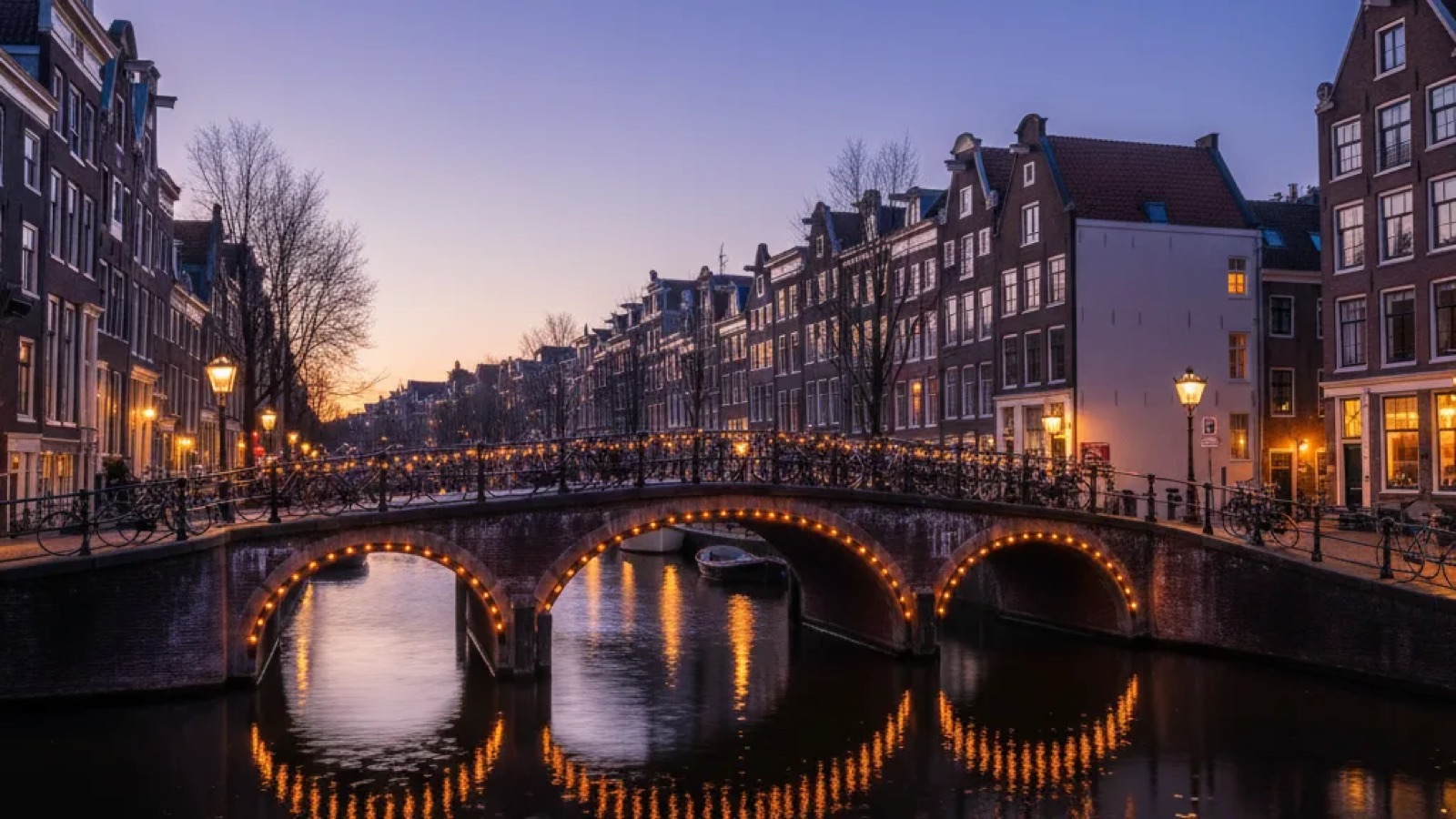
Amsterdam is at its most photogenic during the 'blue hour'—that magical time just after sunset when the sky glows a deep, rich blue before turning black. This is when the city turns on its charm. The streetlights and the lights on the iconic arch bridges begin to glow, their warm golden colour reflecting in the dark, still water of the canals. The best spot is the corner of Reguliersgracht and Herengracht, known as the 'Bridge of 15 Bridges', where you can see a succession of beautifully lit arches. Find a stable spot on a bridge, rest your camera on the balustrade for a long exposure, and you'll capture the quintessential Amsterdam evening scene. The reflections, the colours, the stillness—it’s pure magic.
Understanding Amsterdam: Coffeeshops and the Red Light District
Amsterdam's reputation for tolerance is famous, but it's important for visitors to understand the rules and etiquette, which are often stricter and more complex than people assume.
The Red Light District (De Wallen) is one of the oldest parts of the city and a residential neighbourhood. It is not just a tourist attraction. The city has implemented strong rules to manage crowds and improve liveability for residents. Loud and drunken behaviour is not tolerated and can result in fines. Most importantly, it is strictly forbidden to take photos or videos of the workers in the windows. This is a rule of respect and privacy, and it is enforced. Please be respectful, keep your voice down, and put your camera away.
Similarly, the rules around 'coffeeshops' (where cannabis is sold) are nuanced. They are not lawless places; they are highly regulated businesses. You must be an adult to enter, and you'll need to show ID. Coffeeshops are for the sale and consumption of cannabis products; they do not sell alcohol. It is illegal to smoke cannabis in public spaces. Be aware that the rules surrounding coffeeshops, particularly concerning access for tourists, have been a subject of ongoing debate and legislative changes. Always check the most current regulations before your visit, as what was true last year may not be true today.
Beyond the City: Classic Day Trips from Amsterdam
The Dutch train network is so efficient that getting out of the city for a day is incredibly easy. All of these are reachable via a short train ride from Amsterdam Centraal.
- Haarlem: My top recommendation. It's often called 'little Amsterdam' but with a fraction of the crowds. It has beautiful canals, a stunning Grote Kerk (Great Church) in the central square, and some excellent small museums. It's only a 15-minute train ride away.
- Utrecht: A vibrant university city with a unique twist: its main canal, the Oudegracht, has two levels, with wharfs at water level now lined with restaurants and cafés. It's a lively, beautiful city with a younger feel than Amsterdam and a great place to spend a day.
- Zaanse Schans: If you're looking for the full 'clogs, windmills and cheese' experience, this is the place. It's a reconstructed historic village with a collection of working windmills moved here from around the region. While undeniably touristy, it's a photogenic and fun look at a romanticised version of Dutch heritage.
- Keukenhof Gardens: This is a seasonal one. If you are visiting in the spring (roughly late March to mid-May), a trip to the Keukenhof is a must. It is one of the world's largest flower gardens, an overwhelming and unforgettable spectacle of millions of tulips, daffodils, and hyacinths. You need to book tickets well in advance and can get there via combination bus/train tickets.
Frequently Asked Questions
What's the best neighbourhood to stay in for a first-time visitor?
For your first visit, staying within or very near the Canal Ring (Herengracht, Keizersgracht, Prinsengracht) is ideal. It places you in the most beautiful, historic part of the city and within walking distance of major sights like the Anne Frank House and the "Nine Streets" shopping area. Alternatively, neighbourhoods just outside the ring like Jordaan offer a quieter, more local atmosphere while still being very central. De Pijp is great for foodies and those seeking a lively, younger vibe, but it's a bit further out from the main historical attractions.
Is cycling in Amsterdam safe for a tourist?
It can be, but it requires caution and respect for the local rules. The cycling infrastructure is incredible, but it's used intensely by locals for their daily commute. They are fast and confident. If you're a nervous cyclist, the city centre can be overwhelming. It's best to start in a park like Vondelpark or explore a quieter neighbourhood first. The most important rules are to stay in the bike lane, never stop suddenly, use hand signals, and give way to trams. If you're not confident, walking and using the excellent tram system is a perfectly good, and less stressful, alternative.
Do I really need to book museum and attraction tickets in advance?
Yes, absolutely. In the post-pandemic era, almost all major attractions in Amsterdam have moved to a timed-entry system to manage crowds. This is no longer just a suggestion to avoid queues; it is a necessity. For the Anne Frank House, tickets go on sale online only, several weeks in advance, and sell out very quickly. For the Rijksmuseum and Van Gogh Museum, you might get away with booking a day or two before, but in peak season even they can be fully booked. To avoid disappointment, plan your itinerary and book all your 'must-do' tickets at least a week before you travel.
What should I know before visiting a "coffeeshop" in Amsterdam?
Firstly, a 'coffeeshop' is where cannabis is sold, while a 'koffiehuis' is a regular café. You must be 18+ and will need to show ID. Coffeeshops are not allowed to sell alcohol. It's illegal to consume cannabis in public places, so consumption is restricted to the coffeeshop or private residences. The rules can be complex and are subject to change, especially regarding access for tourists. It's wise to check the latest city regulations before your visit. Politeness and discretion are key; these are licensed businesses, not a free-for-all.
Is Amsterdam a good city for a solo traveller?
Amsterdam is one of the best cities in Europe for solo travellers. It's incredibly safe, compact, and easy to navigate on foot or with public transport. English is spoken everywhere, so communication is never an issue. The culture is relaxed and open, and it's easy to blend in, whether you're exploring a museum, sitting in a café, or joining a walking tour. The city's structure, with its many cosy cafes, small restaurants, and walkable neighbourhoods, makes it feel very manageable and welcoming for one person to explore at their own pace.
Final Thoughts
Amsterdam is worth visiting in every season, and it's easy to leave feeling you've only scratched the surface. It's a city that constantly reinvents itself while holding fiercely to its history. You'll come for the postcard images of canals and famous paintings, but you'll fall in love with the details: the way light filters through the leaves in Vondelpark, the taste of a hot, fresh stroopwafel from a market stall, the satisfying ‘click’ of a bike lock snapping shut at the end of the day.
My best advice is to build space into your itinerary. Don't schedule every minute. Allow yourself to be distracted by a pretty side street, to follow the sound of a distant carillon, to sit by a canal with a coffee and do absolutely nothing. Amsterdam's greatest gift is its atmosphere, its gezelligheid—a Dutch word that loosely translates to a feeling of cosiness, conviviality and contentment. Go find yours.