Netherlands Travel Guide: Beyond Amsterdam
A Netherlands trip that isn't only Amsterdam: Rotterdam, Utrecht, Delft and the Hague by train, bikes, tulip season and how long to stay.
In this guide
- Quick Facts
- Getting There & Around: A Transit Dream
- A Perfect Week: The Randstad Loop
- Two-Wheeled Freedom: Dutch Cycling Culture
- Icons of the Polder: Windmills at Kinderdijk & Zaanse Schans
- Chasing Colour: Keukenhof and the Tulip Fields
- Beyond the Randstad: Giethoorn and the Great Outdoors
- A Taste of the Netherlands: More Than Just Cheese
- When to Visit: Wind, Weather and Orange Fever
- Explore in Depth
- Frequently Asked Questions
- Final Thoughts
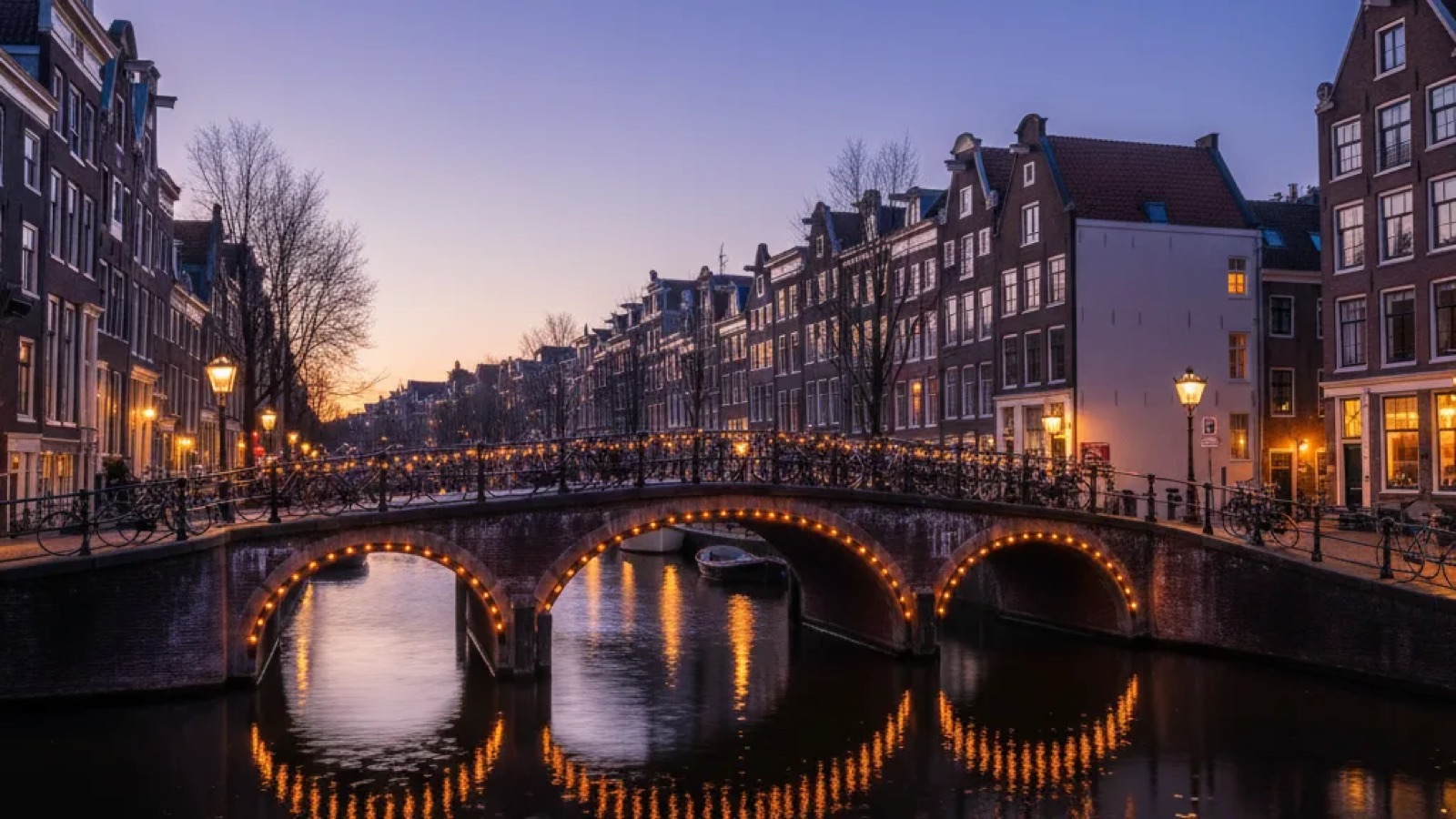
Step off the train at Haarlem station and you enter a world that feels both familiar and entirely new. It has all the charm of Amsterdam – the gabled houses, the gentle chime of bicycle bells, the smell of fresh coffee from a canalside café – but without the frantic energy. In its place is a settled calm. Within ten minutes you can be leaning over a canal bridge, watching swans drift by, the reflection of the 14th-century Grote Kerk church shimmering on the water. Just a 15-minute train ride from the capital's chaos, Haarlem reveals the secret of travelling in the Netherlands: the whole country is a city, and Amsterdam is just its busiest neighbourhood.
For many, the Netherlands begins and ends with Amsterdam. That's understandable; it's a magnificent, world-class city. But to truly understand this country of water, wind, and resilient spirit, you have to board the train. This guide is for the traveller who wants to see beyond the Dam Square crowds. We'll cover how to navigate the brilliant rail system, explore a perfect week-long circuit through historic cities like Utrecht and Delft, discuss the practicalities of hiring a bike, and chase iconic sights like the windmills of Kinderdijk and the tulips of Keukenhof. We’ll also venture further afield, eat like the Dutch, and figure out the best time to experience it all. This is your guide to the rest of the Netherlands.
Quick Facts
- Location: Northwestern Europe, bordered by Germany to the east, Belgium to the south, and the North Sea to the northwest.
- Getting There: Amsterdam Airport Schiphol (AMS) is one of Europe's major international hubs with superb global connections. High-speed rail connects the Netherlands to Paris, Brussels, London, and multiple German cities.
- Getting Around: An exceptionally dense, efficient, and affordable train network (run by NS, the Nederlandse Spoorwegen) makes car hire completely unnecessary for most trips. Cities are compact and best explored on foot or by bicycle.
- Language & Currency: The official language is Dutch. English proficiency is among the highest in the world for a non-native country, making communication effortless. The currency is the Euro.
- Best Time to Visit: Late April to June offers the best combination of pleasant weather, long daylight hours, and the famous tulip season. September is also lovely, with fewer crowds and often mild weather.
Getting There & Around: A Transit Dream
My single favourite thing about travelling in the Netherlands is the sheer ease of it. You land at Schiphol Airport, and instead of a confusing mess of taxis and private shuttles, you simply walk downstairs to the train station located directly beneath the terminal. From here, the entire country is at your fingertips. Direct trains run not just to Amsterdam Centraal, but to Rotterdam, The Hague, and Utrecht, often in under an hour. This changes everything. It means you don't even have to stay in Amsterdam on your first night if your goal is to explore elsewhere.
The system for payment has become brilliantly simple. For years, the go-to was the OV-chipkaart, a reloadable card for all public transport. While still useful for longer stays, the introduction of OVpay means you can now just tap on and tap off with your contactless debit card, credit card, or phone. This applies to trains, trams, buses, and metros nationwide. Just remember to use the same card to tap out as you did to tap in, or you’ll be charged a fixed penalty fare. Check the official NS (Dutch Railways) website for the latest details on how OVpay works before you travel, as it’s a constantly evolving system.
The scale of the country is what makes this rail network so effective. The Netherlands is compact, roughly the size of Switzerland but without the mountains to slow things down. This means you can base yourself in one city and take easy day trips without constantly packing and unpacking. From Utrecht, for example, you can reach almost any other major city in about an hour. It transforms your trip from a series of logistical hurdles into a fluid exploration. You're not just visiting cities; you're travelling through a connected urban landscape.
A Perfect Week: The Randstad Loop
While you could spend months exploring, a week is the perfect amount of time to get a real feel for the country's urban heartland, the Randstad. This isn't a strict itinerary, but a suggested route that connects some of the most beautiful and historically significant cities, all easily reached by train.
Day 1-2: Amsterdam (or Haarlem as a Base)
Start in Amsterdam to get your bearings, see the world-famous canals, and visit one or two major museums like the Rijksmuseum or the Anne Frank House (book these well in advance!). But consider staying in nearby Haarlem. It’s only a 15-minute train ride away, accommodation is often more available, and it serves as a peaceful, charming retreat after a day in the bustling capital. Haarlem itself boasts the fantastic Frans Hals Museum, a stunning central church (Grote Kerk), and a wonderful, less-touristy canal scene.
Day 3: Leiden
A short train ride south brings you to Leiden, a vibrant university city that feels like a more intimate version of Amsterdam. It’s the birthplace of Rembrandt, home to the oldest university in the country, and its historic centre is a joy to explore on foot. Highlights include the Hortus Botanicus, one of the oldest botanical gardens in the world, and simply finding a café along the Rapenburg, the city’s most beautiful canal.
Day 4: The Hague & Delft
You can easily visit both in a day. Start in The Hague (Den Haag), the seat of the Dutch government. It feels more stately and spacious than other Dutch cities. It’s home to the Mauritshuis museum, where you can see Vermeer’s "Girl with a Pearl Earring" without the crowds of the Rijksmuseum. From there, it's a quick tram or train hop to Delft. Famous for its blue-and-white pottery, Delft is impossibly picturesque. Climbing the tower of the Nieuwe Kerk offers one of the best panoramic views in the whole country; on a clear day you can see all the way to Rotterdam.
Day 5-6: Rotterdam
From the historic beauty of Delft, jump forward in time to Rotterdam. Largely flattened in World War II, the city reinvented itself as a showcase for bold, modern architecture. The Cube Houses, the striking Markthal (a food hall inside a giant arch-shaped apartment building), and the Erasmus Bridge are must-sees. It’s a city of energy and innovation, and a fantastic contrast to the older cities on this list. For a photography challenge, try capturing the skyline from the south bank of the Maas river at dusk as the city lights begin to glow.
Day 7: Utrecht
Finish your loop in Utrecht. It’s arguably the most underrated city in the Netherlands. Its unique, two-tiered canals with their wharf-side cellars converted into restaurants and bars are unlike anything else in the country. Climb the Dom Tower for a commanding view, rent a canoe to see the city from water level, or just enjoy the lively, student-driven atmosphere. It’s the perfect, laid-back end to a week of Dutch discovery.
Two-Wheeled Freedom: Dutch Cycling Culture
You can’t talk about the Netherlands without talking about bikes. Cycling isn't a hobby here; it’s a fundamental part of life and the absolute best way to explore a city like a local. Don’t be intimidated. Hiring a bike is easy, with rental shops (`fietsverhuur`) in every city and near most train stations.
The key is to understand the rules and the rhythm. Stick to the designated red asphalt bike lanes. Use hand signals for turning (it’s a legal requirement). Always have working lights at night. Most importantly, do not stop suddenly in the middle of a bike lane to take a photo – pull over to the side. Local cyclists are commuters; they’re fast, direct, and expect you to be predictable. Go with the flow, keep right, and you’ll be fine.
A note on bike types: you’ll likely be renting a heavy, single-speed `omafiets` (grandma bike) with back-pedal brakes. They’re sturdy and built for city cruising, not for speed. For longer trips, such as exploring the tulip fields, look for a rental shop that offers bikes with gears. Capturing cycling on camera is a fantastic way to convey the energy of the Netherlands. Find a good corner, set a slightly slower shutter speed (like 1/60s), and pan with the cyclists to create a sense of motion with a blurred background.
Icons of the Polder: Windmills at Kinderdijk & Zaanse Schans
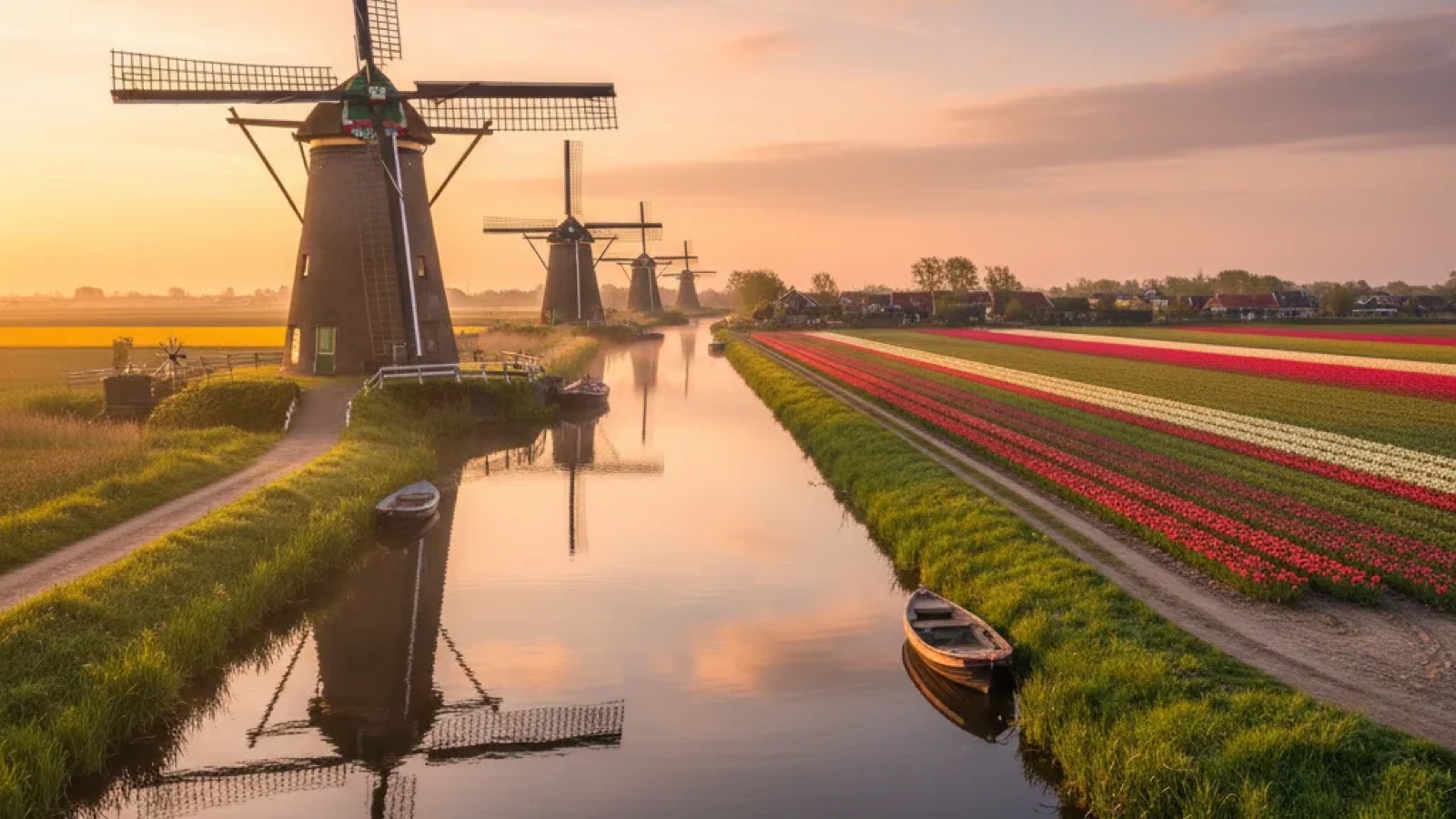
The windmill is the quintessential symbol of the Dutch battle against water. There are two main places to experience this icon. The standout is Kinderdijk, a UNESCO World Heritage site near Rotterdam. Here, 19 authentic, 18th-century windmills stand in their original location along the polder waterways. It feels real and monumental. You can walk or cycle the paths between them for free, paying only if you wish to enter the museum mills. Early in the morning, with mist rising off the canals and the massive sails turning slowly in the breeze, it's pure magic.
The other popular choice is Zaanse Schans, located just a short train ride from Amsterdam. It’s more of an open-air museum or theme park. A collection of historic windmills and traditional green wooden houses were relocated here to preserve them. It’s incredibly picturesque and convenient, with clog-making demonstrations and cheese tasting shops. However, it can feel quite tourist-focused and crowded. For convenience and a quick taste of "Old Holland," Zaanse Schans is great. For authenticity and a sense of scale, make the effort to get to Kinderdijk.
Chasing Colour: Keukenhof and the Tulip Fields
Seeing the Dutch tulip fields in full bloom is a bucket-list experience for a reason. The timing is crucial and varies slightly each year based on the weather. Generally, the season runs from late March to mid-May, with the peak bloom usually happening around mid-to-late April. This is also when Keukenhof, the world’s most famous flower garden, is open.
Keukenhof is a stunning, 32-hectare spectacle of meticulously designed gardens showcasing millions of bulbs. It is, however, incredibly popular. My advice is to book your ticket and time slot online well in advance and aim to arrive right at opening time or in the late afternoon to avoid the worst of the crowds. Keukenhof is located near the town of Lisse, and there are dedicated bus services from Schiphol, Leiden, and Haarlem during the season.
For a more organic experience, rent a bike in Leiden or Haarlem and cycle into the surrounding `Bloembollenstreek` (Flower Bulb Region). This is where you’ll find the iconic long strips of vibrant tulips, hyacinths, and daffodils. Remember that these fields are farmers’ livelihoods. Do not walk into the fields to take photos unless you have explicit permission, as this damages the bulbs and can spread disease.
Beyond the Randstad: Giethoorn and the Great Outdoors
If you have more time and want to see a different side of the Netherlands, there are some incredible options beyond the main western cities.
Giethoorn, nicknamed the "Venice of the Netherlands," is a fairy-tale village where many houses are accessible only by boat via a network of canals. It’s undeniably beautiful, but its popularity means it can be overwhelmed with visitors. To experience its charm, try to stay overnight and explore in the early morning or evening after the day-trippers have left.
For nature lovers, Hoge Veluwe National Park is a must. It’s a vast expanse of heathland, sand dunes, and woodlands. The park is famous for its free white bicycle program; you just grab one of the 1,800 bikes at an entrance or depot and explore the 40 kilometres of paved trails. In the centre of the park is the Kröller-Müller Museum, which boasts the world's second-largest Van Gogh collection and an incredible sculpture garden.
For something truly wild, head north to the Wadden Islands (Waddeneilanden). This chain of windswept barrier islands, a UNESCO World Heritage site, separates the North Sea from the Wadden Sea. Texel is the largest and easiest to reach, but islands like Vlieland and Terschelling offer a more remote feeling of endless dunes, wide beaches, and charming villages.
A Taste of the Netherlands: More Than Just Cheese
Dutch food often gets an unfair reputation, but there's so much to enjoy if you know what to look for. Of course, you must try the cheese. Visit a cheese shop or market in Gouda or Alkmaar for the full experience. And you can’t leave without eating a fresh `stroopwafel`, a warm, thin waffle cookie with a caramel syrup filling, preferably from a street market vendor.
But dive deeper. On a cold day, nothing beats a cone of `patat` (thick-cut fries) with a bewildering array of sauces – start with `patatje oorlog` ("war fries" with peanut satay sauce, mayonnaise, and chopped onions). Seek out a street stall selling `haring` (raw herring), served with pickles and onions. It’s a national obsession, and much tastier than it sounds! For a classic Dutch bar snack, order a portion of `bitterballen`, deep-fried crispy meatballs with a savoury ragout filling, served with mustard.
Don’t forget the influence of Indonesia, a former Dutch colony. An Indonesian `rijsttafel` (rice table) is a spectacular feast of dozens of small side dishes served with rice. It’s a wonderful shared dining experience. Finally, the Dutch craft beer scene is exploding. Look for local `brouwerijen` (breweries) or find a 'brown cafe' (`bruin café`), a traditional pub, and ask the bartender for a recommendation.
When to Visit: Wind, Weather and Orange Fever
The Netherlands is a year-round destination, but each season offers a very different experience. Summer (June-August) brings long, lovely evenings and the warmest weather, but also the biggest crowds and highest demand for accommodation. Spring (April-May) is glorious, with the tulips in bloom and a festive atmosphere, but be prepared for "April showers."
Autumn (September-October) is a personal favourite. The summer crowds have thinned, the light is beautiful for photography, and the weather can often be mild and pleasant. Winter (November-March) is cold, damp, and often grey, but the cities are beautiful with their festive lights, and the lack of crowds can be a huge bonus. Just be prepared for the wind. It’s a constant feature of the flat Dutch landscape, and in winter it can have a serious bite.
If you enjoy a party, plan your trip around King's Day (Koningsdag) on April 27th. The entire country erupts in a massive street party, everyone dresses in orange, and the canals of Amsterdam are choked with party boats. It's an incredible, chaotic, and unforgettable experience, but be warned: transport is disrupted, and accommodation is booked solid months in advance.
Explore in Depth
While this guide focuses on travelling the wider Netherlands, the capital city is an unmissable destination in its own right. For a dedicated guide on making the most of your time there, from museum hopping to neighbourhood exploring, see our detailed itinerary.
Frequently Asked Questions
Is it necessary to pre-book train tickets in the Netherlands?
For domestic travel within the Netherlands, it's almost never necessary or cheaper to book in advance. The fares are fixed, and the trains are so frequent that you can just show up at the station, tap your contactless card or buy a ticket, and hop on the next train. The only exceptions are for high-speed international trains like the Eurostar to London or the Eurostar (formerly Thalys) to Paris/Brussels, which you should book as far in advance as possible for the best fares. Always check the official NS website for service updates, especially on weekends when engineering work can occur.
Can I really see the country without hiring a car?
Absolutely. In fact, it's best to avoid hiring a car unless you have a very specific reason to visit a remote rural area. The train network is comprehensive, fast, and runs into the centre of every city and town. Within cities, parking is extremely expensive and difficult to find, and the streets are designed for bicycles and pedestrians, not cars. The combination of the train system and a bicycle for local exploration is infinitely more efficient and enjoyable. A car would be more of a hindrance than a help for the itinerary suggested in this guide.
How do I avoid the biggest crowds at Keukenhof and the tulip fields?
Avoiding crowds entirely during peak tulip season is tough, but you can minimise them. For Keukenhof, book the earliest possible time slot online and arrive before the gates open. Most tour buses arrive mid-morning, so you'll get an hour or two of relative peace. Alternatively, go in the last couple of hours before closing. For the surrounding fields, go on a weekday instead of a weekend. Renting a bike and heading away from the main roads near Keukenhof will also lead you to quieter, equally beautiful fields where you can enjoy the colours without the congestion.
Is it better to stay in Amsterdam or use a smaller city as a base?
This depends on your travel style. If you want to be in the heart of the action with endless nightlife and dining options right outside your door, and your budget allows, stay in Amsterdam. However, for a more relaxed and often more affordable trip, staying in a city like Haarlem, Leiden, or Utrecht is a fantastic strategy. You can easily day-trip into Amsterdam (it's only 15-30 minutes by train from these cities) and then retreat to a calmer, more local atmosphere in the evening. It allows you to see two sides of Dutch life and can significantly ease pressure on your wallet.
Are the windmills at Zaanse Schans authentic?
This is a great question. The answer is yes and no. The windmills themselves are genuinely historic, preserved structures that were moved to Zaanse Schans from other locations in the region to create a concentrated, open-air museum. So, you are looking at real 18th and 19th-century windmills. However, their current setting is a curated one, designed for tourism. This is in contrast to Kinderdijk, where the 19 windmills are also authentic but remain in the exact location where they were originally built to manage the polder's water levels. Zaanse Schans is a recreated village; Kinderdijk is a preserved historical landscape.
Final Thoughts
The Netherlands is special precisely because it rewards the curious. It’s a country that invites you to look past the obvious, to hop on a train for 20 minutes just to see what’s there. The discovery that a world-class city like Rotterdam is just a short ride from the timeless beauty of Delft, or that the quiet canals of Leiden are a stone's throw from the regal avenues of The Hague, is a joy that never gets old.
So, by all means, dive into the wonderful chaos of Amsterdam. But when you’re ready, grab a train ticket, find the right platform, and watch a landscape of flat green polders and distant church spires roll by your window. The real Netherlands is waiting, and it’s closer and easier to reach than you could ever imagine.