Gobi Desert Guide: Dunes, Ger Camps and Overland Routes
What an overland Gobi trip is actually like — route length, ger camp life, the Flaming Cliffs and Khongoryn Els dunes, seasons and how to prepare.
In this guide
- Quick Facts: Mongolia's Gobi Desert
- What the Gobi Actually Is: Cold Desert and Gravel Steppe
- Multi-Day Overland Loops: How Travelling the Gobi Works
- Key Gobi Highlights and Stopovers
- Comparing Gobi Landscapes
- Life in a Ger Camp & Nomadic Homestay Etiquette
- Reality Check: Long Driving Days, Dust and Sanitation
- Camel Riding and Horse Trekking in the Desert
- Wildlife of the Southern Steppe
- When to Visit, Naadam, and Western Festivals
- Practical Packing and Travel Advice
- Final Thoughts on the Great Southern Steppe
This guide is part of our Mongolia Itinerary: Gobi Desert, Ger Stays and Naadam — start there for the overview, when to go and how to get around.
Sunset at the Flaming Cliffs of Bayanzag is best watched from the rim with a steaming mug of salted milk tea. As the sun drops, the eroded sandstone below ignites from pale ochre into a fiery crimson that seems almost fluorescent against the darkening blue sky, while the distant, guttural grunts of Bactrian camels float across the gravel steppe on a crisp evening breeze.
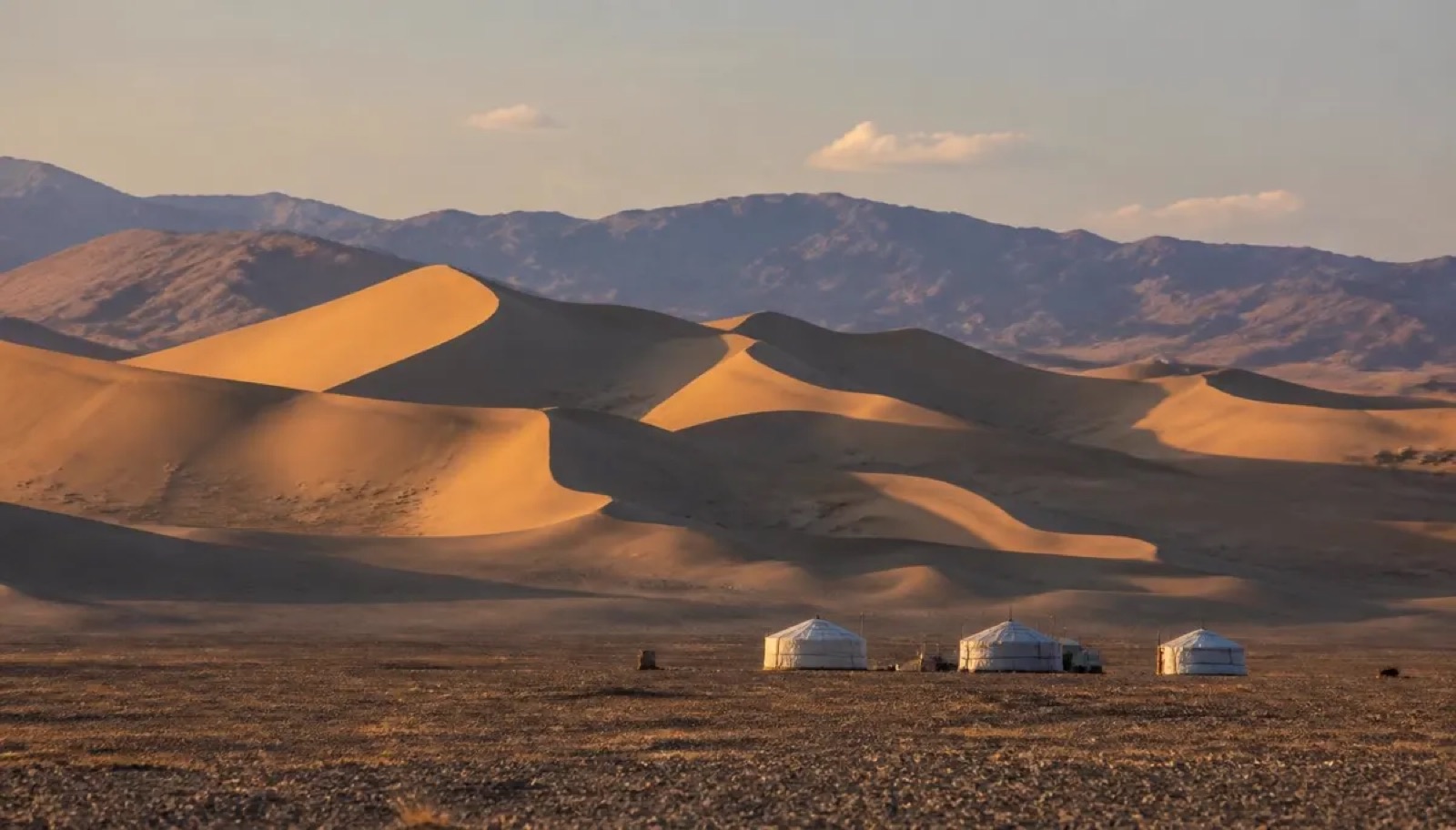
It's easy to picture the Gobi Desert as a carbon copy of the Sahara: an endless sea of soaring yellow sand dunes stretching to the horizon. The reality of this immense southern wilderness is far more nuanced, dramatic, and surprisingly cold. The Gobi is primarily a high-altitude gravel desert—a wild expanse of slate-grey plains, jagged mountain massifs, ice-filled canyons, and ancient lake beds where dinosaur eggs still rest beneath the dust.
Navigating this vast landscape requires time, resilience, and a deep appreciation for off-road travel. The Gobi is not a destination you simply visit; it is an expedition you experience through rattling van frames, vast open skies, warm family hospitality inside felt gers, and the timeless rhythm of nomadic life.
Quick Facts: Mongolia's Gobi Desert
- Geographic Scope: Expands across southern Mongolia and northern China, covering roughly 1.3 million square kilometres.
- Terrain Profile: Only 3 to 5 percent sand dunes; the remainder consists of gravel steppe, dry basins, granite formations, and alpine canyons.
- Primary Hub: Dalanzadgad, the provincial capital of Ömnögovi, located roughly 540 kilometres south of Ulaanbaatar.
- Travel Method: Almost exclusively multi-day 4WD overland loops with a professional driver and local guide.
- Accommodation: A mix of seasonal tourist ger camps and authentic family nomadic homestays with basic facilities.
- Key Wildlife: Bactrian camels, khulan (wild ass), ibex, argali sheep, black-tailed gazelles, and elusive Gobi bears.
What the Gobi Actually Is: Cold Desert and Gravel Steppe
One of the most common misconceptions among travellers planning their first trip to Mongolia is that the Gobi is a ocean of pure sand. In truth, geographers classify the Gobi as a rain-shadow cold desert, formed because the massive Himalayan range blocks moisture-laden clouds from the Indian Ocean from reaching the Central Asian interior.
Because it sits on a plateau roughly 900 to 1,500 metres above sea level, temperatures in the Gobi drop precipitously once the sun dips below the horizon. Winter brings biting Siberian winds and sub-zero temperatures, while summer days can be intensely hot before cooling down rapidly at nightfall. This vast thermal range has shaped both the ecosystem and the culture of the people who call it home.
The landscape is dominated by what locals call govi—flat, wind-scoured plains strewn with small dark stones, scrubby saxaul bushes, and wild sage. Scattered across this arid expanse are isolated mountain ridges, deep gorges carved by seasonal snowmelt, and occasional dune fields created by prevailing winds trapping fine silt against natural topographic barriers.
Multi-Day Overland Loops: How Travelling the Gobi Works
You cannot simply rent a standard hatchback in Ulaanbaatar and drive yourself into the Gobi. Paved highways extend south past Mandalgovi towards the border, but the moment you turn off towards the major sights, paved roads disappear entirely. What remains is a tangled webbing of faint tire tracks stretching across hundreds of kilometres of open steppe.
Travelling here requires an experienced driver who can read the subtle contours of the landscape, navigate without road signs, and repair mechanical issues on the fly. Most travellers book an overland loop lasting anywhere from six to twelve days, travelling in either a classic four-wheel-drive Soviet UAZ Furgon (a rugged loaf-shaped van built for extreme conditions) or a modern Japanese 4WD vehicle like a Toyota Land Cruiser.
While domestic flights operate between Ulaanbaatar and Dalanzadgad during peak season, flying skips the dramatic transition of landscapes that makes an overland journey so rewarding. A typical overland loop leaves the capital, head south through the Middle Gobi, cuts west through the national parks of the South Gobi, and then curves north through the rolling grasslands of the Orkhon Valley before returning to Ulaanbaatar.
Key Gobi Highlights and Stopovers
Baga Gazriin Chuluu: Granite Rock Formations
Rising abruptly out of the flat plains of Middle Gobi province, Baga Gazriin Chuluu is a dramatic granite rock massif surrounded by open steppe. The wind-carved granite towers reach up to 1,700 metres in elevation, creating a maze of hidden ravines, narrow slots, and sheltered pockets where spring water collects.
Centuries ago, Buddhist monks sought refuge in these remote rock crevices during periods of political persecution. Today, you can hike through narrow passages to discover tiny cave shrines, ancient petroglyphs chiseled into the rock faces, and the ruins of a 17th-century monastery hidden inside a natural amphitheatre of stone.
Tsagaan Suvarga: The White Stupa
Approaching Tsagaan Suvarga across the flat desert plains, you might not realise anything unusual is ahead until the ground suddenly drops away beneath your feet. This striking geological formation is a sheer, 50-metre-high cliff stretching for over 400 metres, carved over millennia by wind and ancient ocean currents.
The cliff face is striped with horizontal bands of vibrant colour ranging from chalky white and pale pink to deep rusty orange and purple, reflecting different mineral deposits laid down millions of years ago. Standing at the base of the cliffs during late morning light feels remarkably like walking across an ancient, dry seabed.
Yolyn Am: Vulture Valley and the Ice Canyon
Located within the rugged Gurvan Saikhan Mountains (the "Three Beauties"), Yolyn Am offers a startling contrast to the surrounding desert heat. This deep, narrow gorge was carved by a mountain stream and is flanked by sheer rock walls that rise hundreds of metres above the canyon floor.
Because the gorge is so narrow and deep, direct sunlight rarely reaches the canyon floor. For much of the year, a thick sheet of ice remains frozen solid at the bottom of the gorge, persisting well into late June or early July despite summer heat on the plains outside. Walking into the cool, shaded interior of the canyon, you are greeted by the piping calls of pikas darting between boulders and bearded vultures (lammergeiers) soaring high overhead.
Khongoryn Els: The Singing Sand Dunes
Spanning about 100 kilometres in length and reaching heights of up to 300 metres, Khongoryn Els represents the quintessential dune landscape that most travellers imagine when visiting the Gobi. These massive golden sand mountains run parallel to the high peaks of the West Saikhan mountain range, created by strong winds sweeping sand off the dry plains and depositing it against the mountain wall.
The dunes are locally known as Duut Mankhan, or the Singing Dunes. When the wind moves the top layers of dry sand, or when visitors slide down the steep slip faces, the friction produces a deep, booming hum that resonates through the valley like a distant aircraft engine.
Climbing to the crest of the highest dune for sunset is a quintessential Gobi challenge. The climb up the shifting, knee-deep sand is exhausting, but reaching the narrow ridge unveils a breathtaking panorama: sweeping golden dunes on one side, verdant green marshland fed by mountain streams at the base, and dark granite peaks rising directly behind.
Bayanzag: The Flaming Cliffs and Fossil Fields
Bayanzag holds an legendary place in both geography and paleontology. It was here, in the 1920s, that American explorer Roy Chapman Andrews and his team from the American Museum of Natural History made history by discovering the first recorded nest of fossilised dinosaur eggs, alongside extensive skeletal remains of Protoceratops and Velociraptor.
Andrews dubbed the site the Flaming Cliffs due to the intense orange-red glow the sandstone formations emit during the final hour before sunset. Walking along the top of the eroded bluffs, you can look out across a maze of gullies and pinnacles where fossil hunters continue to unearth prehistoric specimens exposed by wind erosion.
Ongi Monastery Ruins
Situated on the banks of the Ongi River in the transition zone between desert and steppe, Ongiin Khiid was once one of the largest Buddhist monastic complexes in southern Mongolia. Founded in the 17th century, it expanded to include two separate monastery grounds housing over a thousand monks across dozens of temples.
Tragically, the entire complex was destroyed in the late 1930s during anti-religious purges, leaving behind a vast field of stone foundations scattered across the hillsides. A small operational temple has been rebuilt on site by surviving monks and local villagers, housing a modest museum that displays artifacts recovered from the ruins.
Comparing Gobi Landscapes
To help you structure your itinerary and understand what each key site offers, the table below highlights the distinct character and travel conditions of the primary Gobi stops.
| Site Name | Landscape Type | Best Time of Day | Physical Effort | Key Attraction |
|---|---|---|---|---|
| Khongoryn Els | Massive sand dunes & oasis | Sunset or Early Morning | High (Strenuous dune climb) | Singing sand hum, camel treks, sunset views |
| Yolyn Am | Alpine canyon & narrow gorge | Mid-day to Late Afternoon | Moderate (Flat valley walk) | Seasonal canyon ice, wildlife, cool shade |
| Bayanzag | Red sandstone cliffs & gullies | Golden Hour / Sunset | Low to Moderate (Cliff walk) | Paleontological history, vivid sunset colours |
| Tsagaan Suvarga | Eroded multi-coloured cliffs | Sunrise or Late Afternoon | Low (Easy surface walking) | Mineral stratifications, ocean bed views |
| Baga Gazriin Chuluu | Granite rock formations | Anytime during daylight | Moderate (Scrambling over rocks) | Monastery cave ruins, rocky canyons |
Life in a Ger Camp & Nomadic Homestay Etiquette
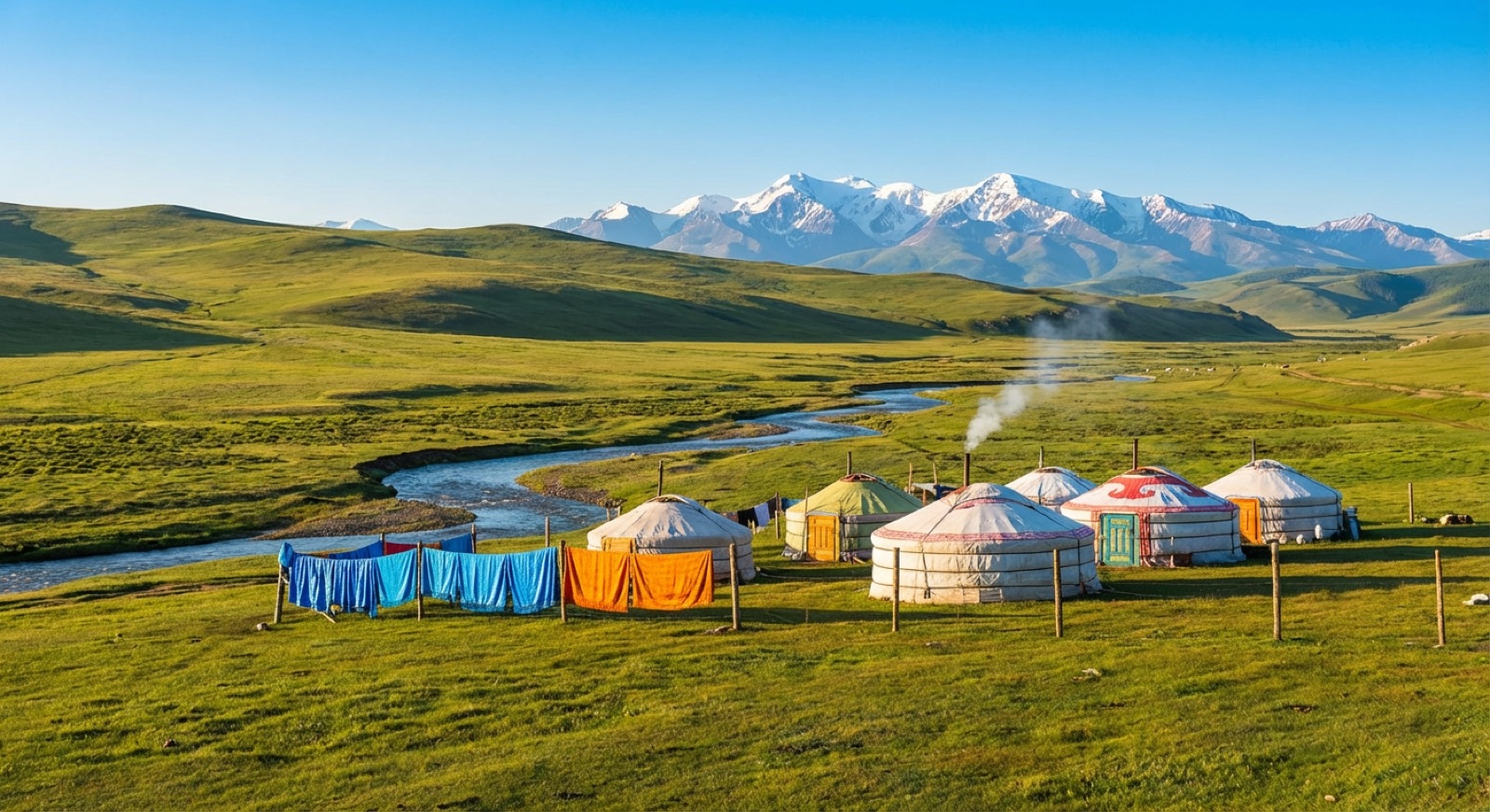
Accommodation in the Gobi revolves entirely around the ger, the traditional felt-lined round dwelling that has housed Central Asian nomads for thousands of years. During an overland journey, you will typically alternate between tourist ger camps and direct homestays with nomadic families.
Tourist Ger Camps: These are semi-permanent seasonal camps designed for visitors. They feature wooden platform beds with clean linens, a central wood or dung stove, and a communal building housing western-style toilets and hot showers (when water supply permits). Staying here offers comfort while maintaining the circular layout of traditional desert living.
Nomadic Family Homestays: For a far more immersive experience, many itineraries include stays alongside local nomadic families. You will sleep in a guest ger pitched beside the family's main home, share homemade meals, and observe the daily routine of herding livestock, milking goats, and processing dairy products. Living alongside nomadic hosts is an unforgettable privilege, but it requires strict adherence to cultural norms.
Essential Ger Etiquette Rules
- Never step on the threshold: The wooden beam at the base of the ger doorframe symbolises the neck of the home owner. Always step completely over it when entering or exiting.
- Walk clockwise: When moving inside a ger, always move in a clockwise (sunwise) direction around the central support posts and furnace.
- Mind the centre posts: Never pass objects between the two central wooden poles supporting the roof ring. Walking between them is considered disrespectful to the home's spiritual hearth.
- Accept offerings with your right hand: When a host hands you a bowl of tea or a snack, receive it with your right hand, while gently supporting your right elbow with your left hand as a sign of respect.
- Sample served food: If offered airag (fermented mare's milk) or suutei tsai (salted milk tea), take at least a small sip even if the taste is unfamiliar. Turning down an offering completely without touching it is seen as impolite.
- Keep feet tucked away: When sitting on stools or rugs inside the ger, never point the soles of your boots directly at other people, sacred objects, or the central stove.
Reality Check: Long Driving Days, Dust and Sanitation
Travelling the Gobi is immensely rewarding, but it is not a luxury holiday. To fully enjoy the experience, it helps to go in with realistic expectations regarding physical discomforts and daily travel rhythms.
Long Drives over Rough Terrain: You will routinely spend between four to eight hours a day inside your vehicle. Non-existent paving means navigating corrugations, deep sand, rocky tracks, and dried river beds. Mongolians humorously refer to this constant, violent jostling as a "Mongolian massage." If you are prone to motion sickness, bringing preventative medication is essential.
Dust Management: Fine desert dust gets everywhere. It penetrates closed van windows, coats your luggage, and settles into every layer of clothing. Keeping electronics sealed inside dry bags or zip-top plastic bags when not in use is vital for protecting camera lenses and charging ports.
Sanitation Realities: Outside of Ulaanbaatar and established tourist camps, modern plumbing does not exist. During homestays and long driving segments, toilet facilities consist of basic outdoor pit latrines ("long drops") with wooden floorboards and open views. Showers are rarely available every night. Bringing ample supplies of biodegradable wet wipes, quick-drying towels, hand sanitiser, and leave-in hair products will make daily hygiene much easier.
Camel Riding and Horse Trekking in the Desert
The Gobi is the historic stronghold of the domestic Bactrian camel, the two-humped species native to Central Asia. Unlike their sleek, single-humped Arabian cousins, Bactrian camels are heavy-set, shaggy creatures superbly adapted to withstand both winter blizzards and summer desert heat.
Riding a two-humped camel is surprisingly comfortable compared to a horse. You sit comfortably cradled in the natural saddle formed between the two soft, fatty humps. Local herders near Khongoryn Els offer riding excursions ranging from short one-hour strolls along the base of the dunes to multi-day camel treks through remote valleys.
When riding camels or horses in the Gobi, always keep the following points in mind:
- Approach animals calmly from the side or front; never walk up directly behind a camel or horse unannounced.
- Wear sturdy closed-toe boots with long trousers to protect your legs from rough wool saddles and coarse leather stirrups.
- Avoid loose, flapping clothing or sudden gear adjustments while mounted, as desert livestock can startle easily.
- Rely on your local handler to guide the animal; desert camels respond to nose peg reins rather than traditional bit bridles.
Wildlife of the Southern Steppe
Despite its arid climate, the Gobi supports a remarkable array of cold-adapted wildlife. The vast, unfenced spaces allow large herds of ungulates to migrate freely following opportunistic rain showers and green pastures.
While driving between sites, keep a sharp eye trained on the open gravel plains. You are very likely to spot herds of khulan (Mongolian wild ass) and sleek black-tailed gazelles sprinting parallel to your vehicle at incredible speeds. In the rocky high peaks of Gurvan Saikhan National Park, wild mountain goats (ibex) and massive argali sheep navigate vertical cliff faces with effortless grace.
The Gobi is also home to two of the rarest large mammals on Earth. Deep within protected nature reserves near the Chinese border lives the Mazaalai (Gobi bear), a critically endangered desert-adapted grizzly bear species numbering fewer than fifty individuals in the wild. High in the secluded crags of the desert mountains, small populations of snow leopards hunt ibex, though spotting one of these elusive "ghosts of the mountain" requires extraordinary luck and expert guidance.
When to Visit, Naadam, and Western Festivals
The ideal window for travelling to the Gobi stretches from late May through late September. During this period, daylight hours are long, night-time temperatures are manageable, and ger camps operate fully across the region.
May and June: Late spring brings dry weather and blooming desert flora, though high winds and localized dust storms are common. Nights remain cool, but tourist crowds are sparse.
July and August: Peak summer brings warm, pleasant weather and vibrant grass growth along river systems. July is also the month of Naadam, Mongolia's national festival celebrating the "Three Manly Games": wrestling, archery, and long-distance horse racing. Attending a small, rural soum (village) Naadam in the Gobi offers a wonderfully authentic glimpse of community life without the stadium crowds of Ulaanbaatar.
September: Early autumn is considered by many seasoned guides to be the sweet spot for Gobi travel. Summer heat yields to crisp, clear days, yellowing autumn grass, stable winds, and minimal dust.
Note on Festival Geography: Travellers often confuse Mongolia's autumn cultural events. The famed Golden Eagle Festival, where Kazakh eagle hunters showcase their traditional falconry skills, takes place in October in the far western province of Bayan-Ölgii in the Altai Mountains—not in the Gobi Desert. If you want to experience the eagle festival, you will need to plan a separate journey or flight to Western Mongolia.
Practical Packing and Travel Advice
Preparing for an expedition through the Gobi requires careful gear selection to handle extreme day-to-night temperature swings and dusty outdoor conditions.
Essential Packing List
- Multi-layer clothing system: Lightweight, breathable long-sleeve shirts for hot daytime sun, paired with fleece mid-layers and a windproof, insulated down jacket for cold desert nights.
- Quality sleeping bag liner: Homestays provide wool blankets, but a silk or fleece liner adds warmth and personal hygiene assurance.
- Dust protection: A snug neck gaiter or bandana, sealable dry bags for gear, and extra lens cleaning cloths for cameras.
- High-capacity power bank: Mains electricity is non-existent during homestays and limited to solar-powered hours at tourist camps. Bring robust external battery packs to keep phones and cameras charged.
- Headlamp: Essential for navigating unlit ger camps and visiting outdoor pit latrines after dark. Pack spare batteries.
- Rehydration and personal medical kit: Electrolyte replacement powders, eye drops for dust irritation, lip balm with high SPF, broad-spectrum sunscreen, and stomach medicines.
- Physical cash (Mongolian Tögrög): Credit cards are useless outside major towns like Dalanzadgad. Bring sufficient small-denomination cash to purchase handmade herder crafts, tipped local drivers, and pay for snacks at remote steppe general stores.
Final Thoughts on the Great Southern Steppe
The Gobi Desert has a way of recalibrating your perspective on distance, time, and human connection. There are no grand monuments built of stone here, nor are there luxury resorts offering artificial comforts. Instead, the magic of the Gobi lies in its wide open horizons, the deep quiet that settles over the gravel plains at dusk, and the enduring warmth of herding families who welcome strangers into their felt homes with open hands.
If you set out into the southern steppe prepared for dusty roads, simple living, and long travel days, the Gobi will reward you with landscapes and cultural memories that stay with you long after the red dirt has been washed from your boots.