Interlaken and the Jungfrau Region: A Guide
Interlaken, Lauterbrunnen and Grindelwald explained: which viewpoint to pick, the mountain railways, hikes and weather.
In this guide
- Quick Facts
- Interlaken: Your Gateway, Not Your Destination
- Where to Stay: The Great Debate
- The Lauterbrunnen Valley: Waterfall Wonderland
- Wengen and Mürren: Car-Free Alpine Dreams
- The Great Mountain Debate: Jungfraujoch vs. Schilthorn
- Beyond the Titans: First, Männlichen and Harder Kulm
- Getting Around: An Engineering Marvel
- On Foot: Two Unforgettable Hikes
- Timing is Everything: Seasons and Maintenance Closures
- Lake Steamers and Adventure Sports
- Explore in Depth
- Frequently Asked Questions
- Final Thoughts
This guide is part of our Switzerland Travel Guide: Trains, Alps and Cities — start there for the overview, when to go and how to get around.
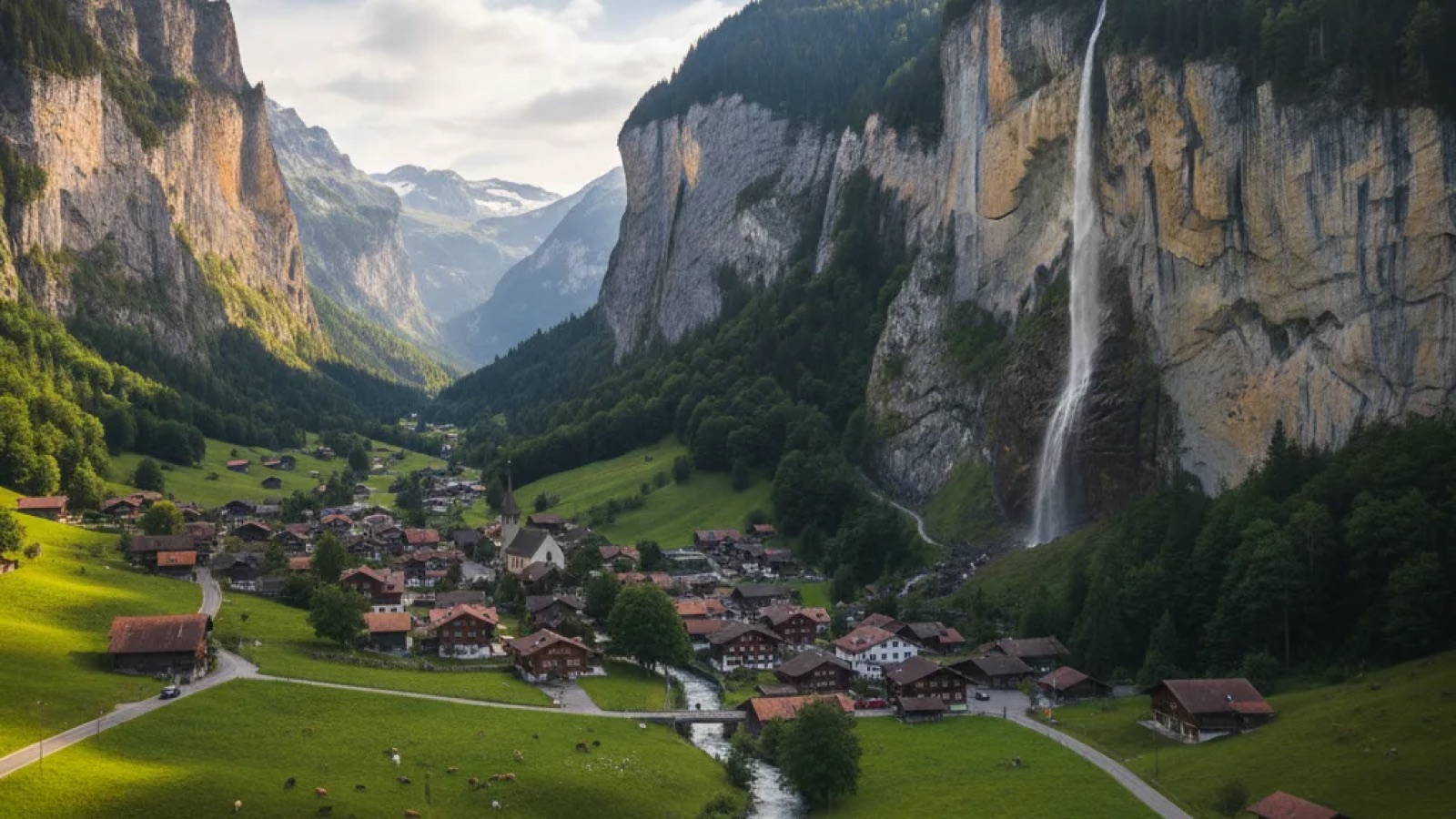
Just outside Lauterbrunnen village, the air is sharp, cold, and smells of pine needles and damp earth. The Staubbach Falls peel away from a sheer cliff face, a 300-metre ribbon of whitewater dissolving into mist before it can even hit the valley floor. Across the valley, the Breithorn’s snow-dusted peak catches the morning sun. The only sounds are the distant chime of cowbells and the ever-present roar of plunging water. The scale of the Bernese Oberland is something you feel in your bones long after you’ve left.
This region, with Interlaken as its famous gateway, is the Switzerland of postcards and dreams. It’s a landscape of impossible contrasts: serene turquoise lakes giving way to valleys so deep and green they seem unreal, all lorded over by the terrifyingly beautiful trio of the Eiger, Mönch, and Jungfrau. This guide walks you through how to navigate this incredible place. We’ll cover where to base yourself, which mountain peaks are truly worth your time and money, a few standout hikes, and the practicalities of a transport system that is an engineering marvel in itself. This is a place of profound beauty, and a little planning goes a long way to making the most of it.
Quick Facts
- Location: The Jungfrau Region is in the heart of the Bernese Oberland in central Switzerland.
- Getting There: The main hub, Interlaken, is easily reached by direct train from major Swiss cities like Zurich, Bern, Geneva, and Lucerne. Zurich Airport is the most common international gateway.
- Getting Around: An exceptional network of trains, cogwheel railways, cable cars, gondolas, and lake steamers connect everything from valley floors to mountain summits. A regional travel pass can be a very good investment.
- Language & Currency: The local language is Swiss German, but English is spoken almost everywhere in the tourism industry. The currency is the Swiss Franc (CHF).
- Best Time to Visit: June to September for hiking, green valleys, and wildflowers. December to March for a full-on winter sports experience with extensive skiing and snow-covered landscapes. Be aware of the quiet "in-between" seasons of April-May and October-November when many lifts and hotels close for maintenance.
Interlaken: Your Gateway, Not Your Destination
The first thing to realise about Interlaken is its geography. The name literally means "between the lakes," and that’s precisely where it sits, on a narrow strip of flat land connecting the impossibly blue Lake Thun and Lake Brienz. This unique position makes it a natural transport hub. All the main train lines from across Switzerland converge here before branching off into the mountains, which is why most journeys to the region begin here.
The town has two main train stations: Interlaken West, closer to the town centre and some hotels, and Interlaken Ost (East). For travellers heading into the mountains towards Lauterbrunnen or Grindelwald, Ost is your station. This is where the smaller, regional Bernese Oberland Railway (BOB) trains depart. They are literally waiting on the platform as your mainline train arrives, making the connection seamless.
While Interlaken is fantastically convenient and the centre for booking adventure sports like paragliding and canyoning, it lacks the true alpine magic you’ve come here to find. It’s a functional, pleasant town, but it’s not in the mountains. Its best use is as a launchpad. Arrive here, orient yourself, maybe take a steamer trip on one of the magnificent lakes, but then press on into the high country.
Where to Stay: The Great Debate
This is the most important decision you’ll make when planning your trip. Where you sleep completely defines your experience. There’s no single "best" answer, only the best fit for your travel style and itinerary.
Interlaken
Pros: Widest range of accommodation, from hostels to grand old hotels. More budget-friendly options. Central for exploring the wider region, including both lakes and day trips to places like Bern or Lucerne. The main hub for adventure sports companies.
Cons: Lacks alpine atmosphere. You’ll spend time and money commuting into the mountains each day. The views are of distant peaks, not immersive ones.
Grindelwald
Pros: A bustling, lively mountain resort with road access (unlike Wengen and Mürren). Stunning, direct views of the Eiger’s North Face. Huge range of shops, restaurants, and activities. The terminal for the new Eiger Express gondola and gateway to the First adventure area.
Cons: It is the busiest and most developed of the mountain villages. The constant traffic and large car parks can detract from the alpine charm for some.
Lauterbrunnen
Pros: Situated on the valley floor, it's breathtakingly dramatic. It’s a fantastic transport hub for exploring both sides of the valley (Wengen on one side, Mürren on the other). The sight of Staubbach Falls from your window is unforgettable.
Cons: Being at the bottom of a deep valley, it gets less direct sunlight than the villages higher up, especially in the afternoon. It can feel a bit shaded and cool.
Wengen & Mürren
Pros: This is the dream. Car-free, quiet, and perched on mountain terraces with unbelievable views. When the day-trippers leave, you have the Alps almost to yourself. The evenings are peaceful, filled only with the sound of cowbells. This is the pick for a truly immersive alpine stay.
Cons: You have to take a train (to Wengen) or a cable car and train (to Mürren) to get there, which adds an extra step with luggage. There are fewer shops and restaurants, and they tend to be pricier. You are more committed to exploring one side of the valley.
The Lauterbrunnen Valley: Waterfall Wonderland
They say Lauterbrunnen Valley is home to 72 waterfalls, and it's easy to believe. After a heavy rain or during the spring melt, water seems to pour from every crack in the towering limestone cliffs. The most famous is Staubbach Falls, which drapes itself over the cliff right at the edge of the village. There’s a short, steep path that takes you up behind the waterfall, where you can feel the spray on your face and hear its thunderous power.
But the real showstopper is Trümmelbach Falls. This isn’t a waterfall you just look at; it’s one you experience from the inside. A lift tunnels up inside the mountain, and from there, a series of platforms and staircases allow you to witness the glacial meltwater from the Eiger, Mönch and Jungfrau carving its way through the rock. It carries up to 20,000 litres of water per second. The roar is deafening, the air is thick with spray, and the sheer power is humbling. It's an absolute must-do.
Photography Tip: To capture the classic shot of Lauterbrunnen village with Staubbach Falls, walk a few hundred metres down the main road out of the village. The slight elevation from the road gives you the perfect perspective. An early morning shot often has beautiful light and fewer people. Use a wide-angle lens to get the full scale of the cliffs.
Wengen and Mürren: Car-Free Alpine Dreams
The concept of a "car-free" village is central to the magic of the Jungfrau Region. It means no public traffic, no exhaust fumes, no noise—just the clip-clop of the occasional electric hotel cart. It forces a slower, more deliberate pace of life.
You reach Wengen via a charming cogwheel train from Lauterbrunnen. The village spreads across a sunny, south-west facing terrace, offering glorious views across the valley to Mürren and the high peaks beyond. It's the larger and slightly more developed of the two, hosting the famous Lauberhorn ski race in winter.
To reach Mürren, you take a large cable car from Lauterbrunnen up the cliff face to Grütschalp, then transfer to a small, single-track train that winds its way along the cliff edge. The journey itself is an event. Mürren is smaller, quieter, and feels a bit more remote. The views from here are arguably the most dramatic in the entire region, with the Eiger, Mönch, and Jungfrau presented like a grand theatre stage directly opposite you.
The Great Mountain Debate: Jungfraujoch vs. Schilthorn
This is the big question for many visitors. Both are phenomenal engineering feats offering world-class views, but they are very different experiences.
Jungfraujoch – Top of Europe
The journey is the destination here. Taking the train from Kleine Scheidegg, you travel for kilometres inside the Eiger and Mönch mountains, a mind-boggling concept. At the top (3,454 metres), you find a complex with an ice palace, viewing platforms, shops, and the Sphinx Observatory. The view of the Aletsch Glacier, the longest in the Alps, snaking its way south is truly sublime. However, it's an extremely popular and expensive trip. It takes a good chunk of your day, and the high altitude can affect some people. It's an icon, and for many it's a bucket-list item they are glad they did.
Schilthorn – Piz Gloria
Reached by a series of cable cars from Mürren (or Stechelberg on the valley floor), the Schilthorn summit (2,970 metres) is famous for its role in the James Bond film On Her Majesty's Secret Service. The main draw is the 360-degree revolving restaurant, Piz Gloria, and the panoramic viewing platform. The great thing about the Schilthorn is the view of the iconic trio. You get a perfect, unobstructed lookout at the entire Eiger-Mönch-Jungfrau massif. It generally feels a bit less crowded and rushed than the Jungfraujoch, and the journey up is a scenic adventure in itself.
The advice? Check the webcams obsessively before you buy a ticket for either. Paying a fortune to stand inside a cloud is a traveller’s tragedy. If the weather is perfect and it's on your bucket list, do the Jungfraujoch. For arguably the best panoramic alpine view for your time and money, the Schilthorn is often the better choice.
Beyond the Titans: First, Männlichen and Harder Kulm
Some of the most rewarding mountain experiences are found away from the two most famous peaks.
- Grindelwald-First: Accessed by gondola from Grindelwald, this is the region's adventure hub. The "First Cliff Walk by Tissot" is a metal walkway bolted to the side of the cliff, offering thrilling views. It’s also the launch point for the First Flyer (a zip line) and a fantastic hub for hikes, like the one to Bachalpsee lake.
- Männlichen: A cable car from Wengen (or gondola from Grindelwald) whisks you up here. The view is one of the top three in the region. You stand high above the Lauterbrunnen valley, looking straight down, with the Eiger, Mönch and Jungfrau range right in front of you. It is simply staggering.
- Harder Kulm: This is Interlaken's local mountain. A steep funicular railway near Interlaken Ost station takes you up to a viewing platform with an incredible vantage point over both Lake Thun and Lake Brienz, and the entire Jungfrau massif in the distance. It’s a perfect option for a short trip or a sunset view if you're staying in Interlaken.
Getting Around: An Engineering Marvel
The transport system here is not just a way to get around; it's an attraction in its own right. Cogwheel trains that defy gravity, cable cars that float up vertical cliffs, and modern gondolas make the entire region accessible. The new Eiger Express tricable gondola from Grindelwald Terminal to the Eiger Glacier station has significantly cut travel time up to the Jungfraujoch.
Navigating it all can seem complex, but it's quintessentially Swiss: efficient, clean, and perfectly synchronised. The SBB app is your best friend for checking timetables. For visitors spending several days and planning multiple mountain excursions, it's well worth investigating a travel pass like the Jungfrau Travel Pass or the Berner Oberland Pass. These cover most (but not always all) trains and lifts in a designated area for a set number of days. While they represent an upfront cost, they can offer significant savings and priceless convenience over buying individual tickets for every leg of your journey. Do the maths based on your planned itinerary to see if one works for you.
On Foot: Two Unforgettable Hikes
To truly connect with the landscape, you have to walk it. The network of trails is vast and impeccably signposted with yellow signs indicating directions and approximate walking times.
Männlichen to Kleine Scheidegg
If you only do one hike, make it this one. It's a relatively easy, mostly downhill or flat 4.5-kilometre walk that takes about 90 minutes. You start from the Männlichen cable car station and walk towards Kleine Scheidegg. For the entire duration, the colossal North Face of the Eiger, the Mönch, and the Jungfrau are right in front of you. It's like walking through a gallery of the world's finest landscapes. It's suitable for most fitness levels and families.
Mürren to Gimmelwald
This is less of a hike and more of a glorious 30-minute stroll. It's a paved, downhill path connecting the village of Mürren with the tiny, rustic hamlet of Gimmelwald below. The views over the end of the Lauterbrunnen valley and the surrounding peaks are immense. Gimmelwald itself feels like a step back in time. From there, you can catch the Schilthorn cable car back down to the valley floor at Stechelberg or ride it back up to Mürren.
Timing is Everything: Seasons and Maintenance Closures
The Jungfrau Region transforms dramatically with the seasons. Summer (late June to early September) is peak season for hiking. The meadows are a riot of colour, the cows are out, and all lifts and trails are generally open. Winter (December to March) is a snow-covered paradise for skiers and snowboarders, with the main ski areas being Grindelwald-Wengen and Mürren-Schilthorn.
Crucial advice: Be very careful with the shoulder seasons of April-May and October-November. This is when the seasons change over. Skiing has finished, but the snow hasn't melted at higher elevations. Many cable cars, funiculars, and mountain hotels close for essential maintenance during these periods. While the valleys can be beautiful and quiet, your options for high-altitude excursions will be severely limited. Always check the official operating dates for specific lifts on the Jungfrau Railways website before you book your trip for these months.
Lake Steamers and Adventure Sports
Don’t forget the two magnificent lakes that bookend Interlaken. A trip on one of the historic paddle steamers that cruise Lake Thun or Lake Brienz is a wonderfully relaxing way to spend an afternoon. The perspective from the water, looking up at the mountains you’ve just been in, is fantastic. The steamers stop at charming villages along the shore, like Thun with its impressive castle or the wood-carving village of Brienz.
For adrenaline junkies, Interlaken is the undisputed adventure capital of Switzerland. The sight of paragliders circling over the town is constant. They launch from the hills above Beatenberg and land in the central Höhematte park. You can also organise everything from skydiving and bungee jumping to canyoning and river rafting through numerous operators based in town.
Explore in Depth
Planning a trip to Switzerland is part of a bigger puzzle. These guides can help you put all the pieces together for your next great adventure.
Frequently Asked Questions
What should I wear for a trip up to Jungfraujoch or Schilthorn?
Layers, layers, layers. Even on a hot summer day in Interlaken, the temperature at over 3,000 metres will be at or near freezing. You must bring a warm jacket (a fleece and a windproof/waterproof shell is ideal), gloves, and a beanie. Sunglasses are absolutely essential to protect against the intense glare from the snow and ice. Sunscreen is also a must, as the sun is much stronger at high altitudes. Wear sturdy, comfortable walking shoes, not sandals or flip-flops.
Is it better to stay in Interlaken or one of the mountain villages?
This depends entirely on your priorities. If you are on a tighter budget, need maximum flexibility to visit other regions, or want to be the centre of the adventure sports scene, Interlaken is a practical choice. However, if you are travelling all this way for the quintessential alpine experience of waking up to staggering mountain views from a car-free village, then staying in Wengen or Mürren is absolutely worth the extra effort and cost. Grindelwald and Lauterbrunnen offer a good compromise between the two.
Do I need to book mountain railway and cable car tickets in advance?
For most lifts and trains, including the Schilthorn, you do not need to book far in advance and can buy tickets on the day. The exception is the Jungfraujoch: from 1 May to 31 October a paid seat reservation (CHF 10 per person) is compulsory for the Jungfrau Railway, and trains can sell out at peak times. However, booking online a day or two before can sometimes save you from queueing at the ticket office. The most important factor is weather; never book a non-refundable ticket for a high-altitude peak until you have a reliable, short-term weather forecast. Flexibility is key.
Are the car-free villages difficult to get to with luggage?
Not at all. The Swiss transport system is brilliantly designed for exactly this. The trains to Wengen and the cable car/train combination to Mürren are built to accommodate travellers with suitcases. You simply roll your luggage onto the train or into the cable car with you. The only challenge is your own packing; it's best to pack as light as possible and use wheeled luggage to make the short walk from the station to your hotel much easier.
Can I visit the Jungfrau region on a day trip from Zurich or Lucerne?
Technically, yes. The train system is so efficient that it's physically possible to travel to the region, go up one mountain (like Jungfraujoch), and return in one very long day. However, it's strongly inadvisable. You will spend a huge portion of your day in transit and feel incredibly rushed. This area deserves, at a minimum, two or three nights to even scratch the surface. A day trip only gives you a tiny, stressful glimpse of what makes it so special.
Final Thoughts
Few mountain ranges have the pull of the Bernese Oberland. There’s a unique harmony here between the wild, untameable power of the high peaks and the gentle, ordered world of the valleys below. One minute you can be standing on a glacier at Jungfraujoch, feeling the chill of ancient ice; a few hours later, you can be sipping a coffee in a car-free village, listening to the chime of distant cowbells.
It’s a place that caters to every speed. You can push your limits climbing, hiking, or flying, or you can simply sit on a balcony and watch the light change on the face of the Eiger. The advice: slow down. Don’t try to tick off every peak. Pick a base, breathe the clean air, and let the sheer scale of it all sink in. It’s an experience that will recalibrate your sense of wonder.