Switzerland Travel Guide: Trains, Alps and Cities
Planning Switzerland: the rail network and travel passes, which alpine regions to pick, seasons, and how to keep costs sane.
In this guide
- Quick Facts
- A Clockwork Country: Navigating Switzerland
- Decoding the Swiss Travel Pass and Half-Fare Card
- The Grand Train Tour: Scenic vs. Regular Routes
- Choosing Your Alps: Switzerland's Iconic Regions
- Beyond the Peaks: Switzerland's Vibrant Cities
- A Taste of Italy: Exploring Ticino
- Walk This Way: Hiking in the Swiss Alps
- Timing Is Everything: Understanding Swiss Seasons
- Smart Switzerland: Practical and Photography Tips
- Explore in Depth
- Frequently Asked Questions
- Final Thoughts
On a balcony in Grindelwald, as the morning sun starts to warm the valley floor, the air fills with a gentle, melodic clanging. It isn’t just one bell; it’s hundreds. A symphony of cowbells echoes off the sheer faces of the Eiger and the Wetterhorn. That sound is the essence of Switzerland: an immense, powerful landscape made human and accessible. It’s a country that feels both epic and intimate at the same time, where a journey to a 4,000-metre peak can begin with a quiet coffee and a croissant in a village that seems plucked from a fairy tale. Its perfection lies not just in its peaks, but in the clockwork precision that connects them.
This guide covers the Swiss Alps and cities. We’ll skip the fleeting details and focus on the things that truly matter for planning your own adventure. We’ll show you how to navigate the world's best public transport system like a local, help you choose between iconic mountain regions that each offer a completely different experience, and share practical tips on timing your trip, finding the best light for your photos, and making the most of every moment. From the high-altitude glamour of St. Moritz to the thundering waterfalls of the Lauterbrunnen Valley, this is your practical guide to the heart of Switzerland.
Quick Facts
- Location: Landlocked in the heart of Western Europe, bordered by France, Germany, Italy, Austria, and Liechtenstein.
- Getting There: The main international gateways are Zurich Airport (ZRH) and Geneva Airport (GVA), both with direct train stations connecting you to the entire country.
- Getting Around: The Swiss Travel System is a world-class, integrated network of trains, buses, boats, and even mountain lifts. Public transport is the best, and often only, way to see the country.
- Language & Currency: Switzerland has four national languages: German, French, Italian, and Romansh. English is widely spoken in tourist areas. The official currency is the Swiss Franc (CHF).
- Best Time to Visit: For hiking and warm weather, June to September. For skiing and winter wonderlands, December to March. The shoulder seasons (April-May and October-November) are quieter but many mountain lifts and trails will be closed.
A Clockwork Country: Navigating Switzerland
The single most important thing to realise about travelling in Switzerland is that the journey is the destination. The transport network isn't just a way to get from A to B; it's an engineering marvel designed to showcase the landscape. Trains curve around mountainsides, buses climb impossible-looking switchbacks, and boats glide across pristine lakes, all synchronised with baffling precision. You can often watch your connecting postal bus pull up to the train station just as your train is pulling in.
Your journey will almost certainly begin at either Zurich or Geneva airport. Forget about rental cars or expensive taxis; both airports have train stations integrated directly into the terminals. Within minutes of collecting your luggage, you can be on a clean, quiet, double-decker train heading towards the Alps. This efficiency sets the tone for your entire trip. The system is so comprehensive that it reaches even the most remote valleys and tiny alpine villages, often with services running late into the night.
The key to unlocking it all is the SBB Mobile app, the official app of the Swiss Federal Railways. It's your timetable, ticket machine, and route planner all in one. You can check connections from a city centre right to a mountaintop cable car station. Expect to use it dozens of times a day while you're there.
Decoding the Swiss Travel Pass and Half-Fare Card
Navigating Swiss transport passes can feel a bit daunting at first, but the concept is simpler than it looks. It’s all about calculating whether you’ll save money with an all-in-one pass versus paying for individual journeys. The two main players for tourists are the Swiss Travel Pass and the Swiss Half Fare Card.
The Swiss Travel Pass is your all-access ticket. For a set number of consecutive or flexible days, it gives you unlimited travel on the entire network of trains, buses, and public boats. It also includes public transport in over 90 cities and gives you free entry to hundreds of museums. On top of that, it provides a significant discount (often half-price) on most mountain railways and cable cars, which are typically privately owned and not fully covered. This pass is best for travellers who plan on moving around a lot, taking multiple long-distance journeys, and visiting museums.
The Swiss Half Fare Card, on the other hand, is valid for a month and does exactly what its name suggests: it gives you a 50% discount on virtually every single train, bus, boat, and mountain lift ticket you buy in the country. This option is often better for those who are staying in one or two locations for a longer period and taking fewer long-distance trips, but still want to explore the surrounding mountains extensively. You have to buy a ticket for every journey, but each one is half price. Which one is right for you depends entirely on your itinerary, so it pays to sketch out your main travel days and intended mountain excursions to see which offers better value.
The Grand Train Tour: Scenic vs. Regular Routes
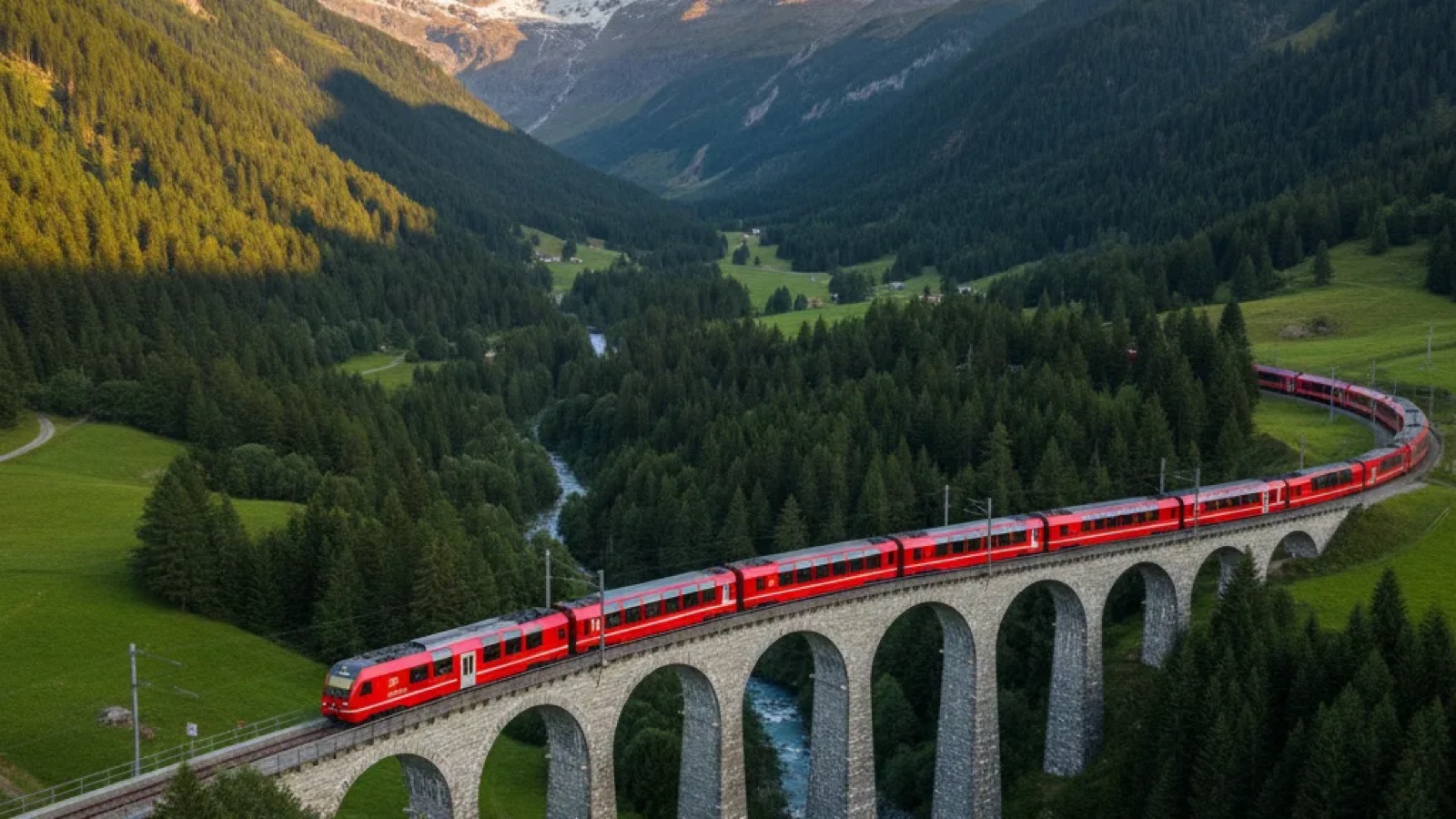
Switzerland actively markets its famous scenic train routes, and for good reason. The Glacier Express, Bernina Express, and GoldenPass Line are journeys of a lifetime, featuring panorama cars with massive windows that curve up into the roof, offering uninterrupted views. The experience is magnificent. The Glacier Express, dubbed the "world's slowest express train," snakes its way from Zermatt to St. Moritz across 291 bridges and through 91 tunnels. The Bernina Express is even more dramatic, a UNESCO World Heritage route that climbs over the Alps and descends into the Italian-speaking part of Switzerland amidst palm trees.
A mandatory seat reservation is required for these special panoramic trains, in addition to a valid ticket or pass. This secures your spot in the fancy carriages. However, here’s one of the most valuable pieces of advice: regular, local trains run on the exact same tracks, often just an hour or two before or after the "express" version.
On these regional trains, you won't get the panoramic windows or the at-seat service, but you get something photographers often value more: windows you can open. Being able to put a lens out of a window to get a crisp, reflection-free shot of the Landwasser Viaduct or the glacial lakes of the Bernina Pass is a huge advantage. You also don't need a reservation, offering far more flexibility. So, if you're on a budget or prioritise photography, consider taking the local trains along these famous routes. You see the same world-class scenery for a fraction of the hassle.
Choosing Your Alps: Switzerland's Iconic Regions
Deciding where to base yourself is the biggest choice you'll make. Each alpine region has a distinct character, landscape, and feel.
The Bernese Oberland: Classic Green Alps
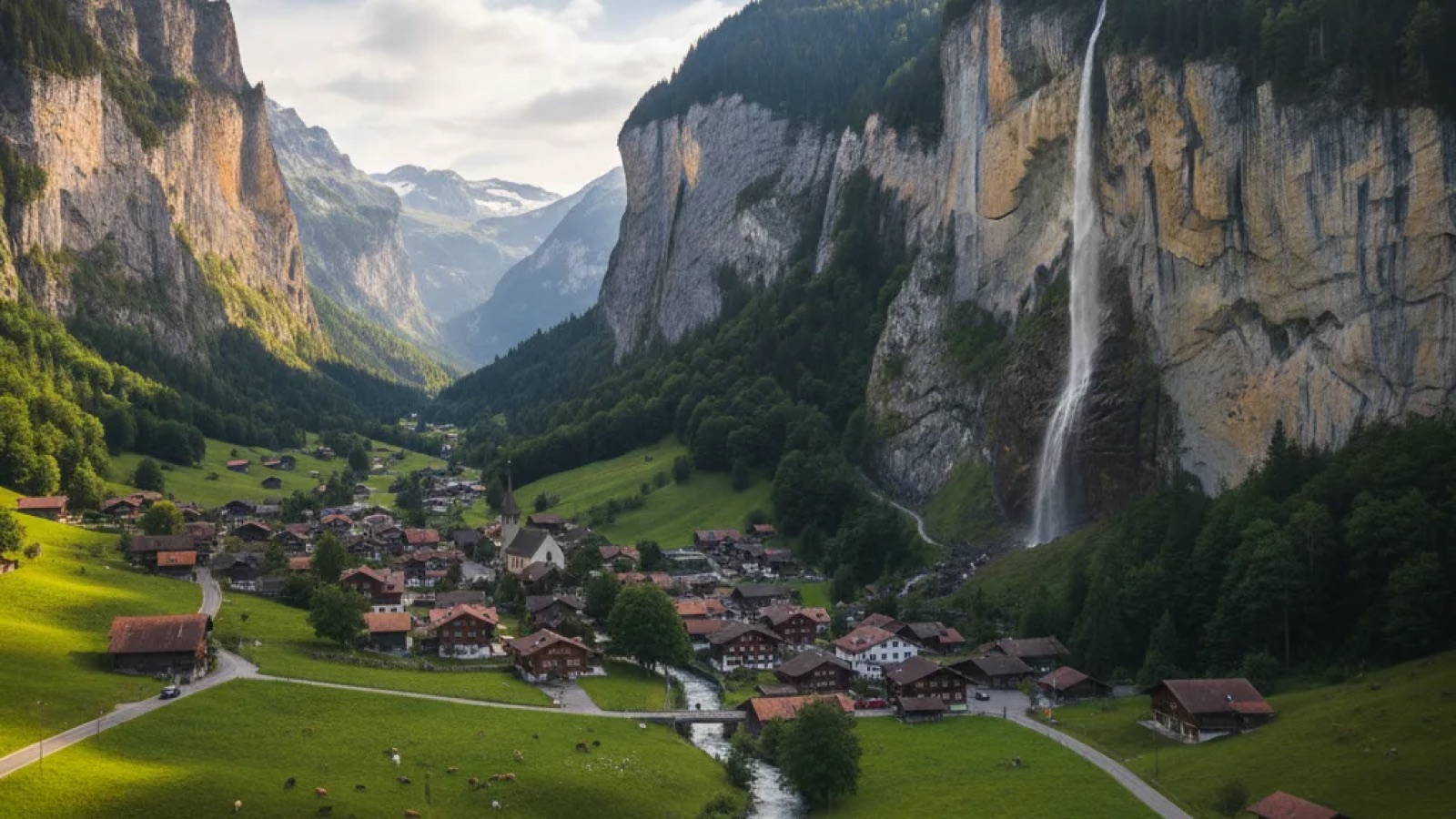
This is the Switzerland of postcards. Centred around the town of Interlaken, which sits between two stunning turquoise lakes, the region is dominated by the iconic trio of peaks: the Eiger, Mönch, and Jungfrau. The real magic, however, lies in the mountain villages above. Grindelwald offers jaw-dropping views of the Eiger North Face, while the Lauterbrunnen Valley is a geographical marvel, a deep cleft in the earth with 72 waterfalls, including the famous Staubbach Falls. For pure, unadulterated alpine charm, the car-free villages of Wengen and Mürren, perched on opposite sides of the valley, are unbeatable. This region is a hiker's paradise and perfect for a first-time visitor.
The Valais: High, Dry and Dramatic
Home to the mighty Matterhorn, the Valais region feels wilder and more rugged than the Bernese Oberland. The town of Zermatt is the main draw, a bustling, car-free resort town sitting at the foot of the world's most recognisable mountain. The air here is drier, the sun more intense, and the scale of the surrounding 4,000-metre peaks is humbling. The Gornergrat railway journey is a highlight, offering arguably the most spectacular mountain panorama in the country, a 360-degree view of glaciers and giants, with the Matterhorn holding court.
Graubünden: Wild and Remote
Switzerland's largest and easternmost canton feels like a world apart. It's home to the glamour of St. Moritz, but also to the vast, wild spaces of the Swiss National Park and the stunning Engadin valley. This is where the Bernina and Glacier Express routes showcase their most impressive scenery. It's less crowded than the Bernese Oberland and offers a wonderful sense of discovery, with Romansh, Switzerland's fourth national language, still spoken in its remote valleys.
Central Switzerland: Lakes and Legends
Centred on the beautiful city of Lucerne and its namesake lake, this region offers the perfect blend of city culture and mountain adventure. The lake itself, with its fjord-like arms, is best explored by the fleet of historic paddle steamers that still ply its waters (fully included in the Swiss Travel Pass). From the lake shore, you can ascend Mount Pilatus via the world’s steepest cogwheel railway or take a series of cable cars and trains up Mount Rigi for breathtaking 360-degree views. It's an incredibly accessible region, perfect for shorter trips.
Beyond the Peaks: Switzerland's Vibrant Cities
While the Alps are the main draw, don't overlook Switzerland's cities. They are clean, safe, and brimming with history and culture. Zurich, the country's largest city, is often mislabelled as just a banking hub. In reality, its beautifully preserved old town (Altstadt), lively riverside swimming areas (known as 'badis'), and world-class art museums like the Kunsthaus make it a fantastic destination in its own right.
Bern, the nation's capital, is a particular delight. Its medieval old town is a UNESCO World Heritage site, a stunning peninsula of sandstone buildings enclosed by the turquoise Aare river. Its six kilometres of covered arcades, called 'Lauben', make it a perfect city to explore in any weather.
In the French-speaking west, Geneva sits elegantly on the shores of its vast lake (Lac Léman), with the iconic Jet d'Eau fountain soaring into the sky. It's a global city, home to the United Nations and the Red Cross, with a sophisticated, international feel. A short train ride away, Lausanne rises steeply from the lake, its hilly old town dominated by a magnificent Gothic cathedral. It's also the home of the Olympic Museum, a truly inspiring place to visit.
A Taste of Italy: Exploring Ticino
Crossing the Gotthard or San Bernardino pass from the German-speaking north is like entering another country. Suddenly, the language switches to Italian, the architecture takes on a southern European flair, and palm trees line the shores of deep blue lakes. This is Ticino, Switzerland's Italian-speaking canton.
The main centres are Lugano and Locarno, set on the shores of Lake Lugano and Lake Maggiore respectively. Life here moves at a different pace. It’s a place for lingering over a cappuccino in a sun-drenched piazza, exploring the lush botanical gardens of the Brissago Islands, or hiking in the chestnut forests of the remote Verzasca and Maggia valleys. A trip to Ticino feels like a two-for-one holiday; you get the efficiency and beauty of Switzerland combined with the language, food, and culture of Italy.
Walk This Way: Hiking in the Swiss Alps
Hiking isn't just a pastime in Switzerland; it's a core part of the national identity. The country is crisscrossed by over 65,000 kilometres of immaculately maintained and signposted walking trails. You simply cannot get lost. The yellow signposts are everywhere, giving you destinations and estimated walking times (which are usually calculated for a reasonably fit local, so add a little extra time for photos!).
The entire network is organised by SwitzerlandMobility, a foundation that manages the routes for all non-motorised transport. Their website and app are exceptional resources for planning hikes, categorised by difficulty. Trails range from gentle valley walks suitable for any fitness level to challenging high-alpine routes (marked in blue-and-white) that require mountaineering experience.
One of the best things to do is a 'point-to-point' hike. Thanks to the integrated transport system, you can start a walk in one village, hike over a pass, and finish in another valley, knowing a postal bus or train will be waiting to take you back to your base. It gives you an incredible sense of freedom and allows you to cover so much ground.
Timing Is Everything: Understanding Swiss Seasons
Choosing when to visit Switzerland has a massive impact on your trip. The country transforms completely between seasons.
Summer (June to early September) is peak season for hiking. The days are long and warm, all the passes and high-altitude trails are open, and the meadows are a riot of colourful wildflowers. It's glorious, but it's also the busiest and most expensive time. Always check mountain webcams before you go up; the weather in the valley can be completely different from the weather at 3,000 metres. A sunny morning can turn into a cold, foggy afternoon in minutes.
Winter (December to March) is for snow sports. The landscape is blanketed in white, and the atmosphere in the ski resorts is magical, especially around Christmas. Many lower-altitude hiking trails are groomed for winter walking, but the high country is largely inaccessible without skis or snowshoes.
Be cautious of the shoulder seasons (April-May and late September-November). While you can find great deals and fewer crowds, this is maintenance season for the mountains. Many cable cars, cogwheel railways, and hotels shut down for several weeks to prepare for the coming summer or winter peak. Trails can be a mix of mud, snow, and ice, making hiking unpredictable. Always check the opening dates for specific lifts and attractions if you plan to travel during these months.
Smart Switzerland: Practical and Photography Tips
Switzerland has a reputation for being expensive, but there are simple ways to travel smarter. One of the top tips is to stay in a valley town instead of a car-free mountain village. For example, staying in Interlaken or Lauterbrunnen is generally more affordable than staying up in Wengen or Mürren, but you can still reach them easily by a short train ride for day trips.
Embrace the supermarket picnic! The two main chains, Coop and Migros, are found in almost every town and train station. They have excellent bakeries, fresh produce, and a huge selection of local cheeses and cured meats. A fresh loaf of bread, some Gruyère cheese, and a spot by a lake or on a mountain trail is a five-star lunch. Also, look for the public water fountains found in every town and village; the water is almost always pristine drinking water straight from the mountains. Bring a reusable bottle.
For photographers, timing is critical in the deep valleys. In places like Lauterbrunnen or Zermatt, the sun can disappear behind a high ridge hours before the official sunset time, plunging your scene into shadow. The best light is often earlier in the day. A photography planning app helps you see the sun's direction and altitude. The golden hour right after sunrise is magical, as the first light hits the high peaks, making them glow pink and orange – an effect known as 'alpenglow'. It's well worth the early start.
Explore in Depth
For a more focused look at one of Switzerland's most popular regions, or for tips on incorporating Switzerland into a wider European adventure, check out these other guides:
Frequently Asked Questions
Is it worth getting a Swiss Travel Pass if I'm only staying in one region?
It depends on your plans. If you're staying in one place, like Grindelwald, and plan to spend most of your time hiking locally and taking one or two big mountain excursions (like the Jungfraujoch), the Half Fare Card might be better value. You'd buy half-price tickets for those specific journeys. The Swiss Travel Pass excels when you're making multiple long-distance train trips between cities and regions, as the cost of those individual tickets adds up quickly. It's best to map out your dream itinerary and compare the costs.
Do I need to speak German, French, or Italian to get by?
While learning a few basic phrases like 'Grüezi' (hello in Swiss German) or 'merci' (thank you) is always appreciated, you absolutely do not need to be fluent. In any area with tourism – which is most of the country – English is widely and readily spoken. Staff at train stations, hotels, restaurants, and on mountain lifts are almost always fluent. All important signage is often multilingual or uses clear universal symbols. You will have no trouble communicating for all your travel needs.
How physically fit do I need to be to enjoy the Swiss Alps?
You can enjoy the Alps at any fitness level. Switzerland's incredible network of cable cars and funiculars means you can get to breathtaking viewpoints without strenuous effort. Many of the most famous views are just a short, flat walk from a train station or lift terminal. For hikers, trails are clearly graded. There are thousands of kilometres of gentle, scenic 'Wanderweg' trails suitable for anyone who enjoys a good walk, as well as the more demanding red-and-white marked 'Bergweg' mountain trails for those with more experience and stamina.
Is a rental car a good idea for seeing Switzerland?
For most travellers, a car is best avoided. The public transport system is so efficient, comprehensive, and scenic that a car is often more of a hindrance than a help. Many of the most beautiful alpine villages like Mürren, Wengen, and Zermatt are completely car-free and only accessible by train or cable car. Parking is expensive and limited in cities and resort towns. A car simply can't take you on the spectacular train routes over mountain passes or get you as close to the trailheads as the postal bus can.
Can I really drink the water from the fountains in the towns?
Yes, absolutely! It's one of the great joys of travelling in Switzerland. The country has incredibly high standards for water quality, and the public fountains scattered throughout nearly every city, town, and village provide clean, cold, delicious drinking water, often piped directly from a mountain spring. Just bring a reusable water bottle and fill up for free. If, in the rare instance, a fountain's water is not potable, it will be clearly marked with a sign reading 'Kein Trinkwasser', 'Eau non potable', or 'Acqua non potabile'.
Final Thoughts
Switzerland remains one of the few places on earth that consistently exceeds expectations. It's a country that delivers exactly what it promises: staggering natural beauty, unparalleled efficiency, and a profound sense of peace and order. You arrive expecting mountains and what you find is a meticulously crafted outdoor playground where every detail has been considered, allowing you to immerse yourself completely in the experience.
My best advice is to embrace the Swiss way of doing things. Trust the timetables. Follow the yellow hiking signs. Take the train. Let the clockwork precision of the country carry you from a lakeside city to a glacier-ringed summit, and just focus on the view. It’s a view that never, ever gets old.