Osaka Travel Guide: Food, Castles and Day Trips
Osaka in three days: Dotonbori and Shinsekai food, the castle, Universal Studios and easy day trips to Kyoto, Nara and Kobe.
In this guide
- Quick Facts
- Arrival and Getting Your Bearings
- Where to Stay: Namba vs. Umeda vs. Shin-Osaka
- A Different Kind of Japan: Osaka vs. Tokyo & Kyoto
- Dotonbori: The Neon Heart of Osaka
- Kuidaore: Eating Until You Drop
- Kuromon Ichiba Market: Kansai's Kitchen
- Osaka Castle: A Symbol of Power and Resilience
- Shinsekai: A Nostalgic Trip Back in Time
- The View from Above: Umeda Sky Building
- A Moment of Peace: Sumiyoshi Taisha Shrine
- Universal Studios Japan: An Alternate Reality
- Excellent Day Trips from Osaka
- When to Visit: Navigating the Seasons
- Explore in Depth
- Frequently Asked Questions
- Final Thoughts
This guide is part of our Ten Reasons to Visit Japan — start there for the overview, when to go and how to get around.
In a bustling alley just off Dotonbori, the steam hits your face first, thick with the savoury scent of dashi stock and sizzling batter. A chef’s hands move in a blur, flipping dozens of little spheres of batter in a cast-iron pan, a piece of octopus tentacle tucked inside each one. The clatter of pachinko parlours, the roar of a thousand conversations, the electric glow of a ten-metre-high crab hanging off a building—it all fades into the background when you're handed a plastic tray of six golden-brown takoyaki, a generous squiggle of mayonnaise and a dusting of bonito flakes dancing in the heat. This is the city’s unofficial motto in action: kuidaore. Eat until you drop.
Welcome to Osaka. While Tokyo is Japan’s formidable brain and Kyoto is its elegant soul, Osaka is, without a doubt, its rumbling, insatiable stomach. This is a city that wears its heart on its sleeve and its passions on a plastic food menu out front. It’s loud, it’s friendly, and it’s unapologetically fun. This guide is your key to unlocking it all: from navigating the sprawling train stations and finding the perfect neighbourhood to base yourself, to diving headfirst into the neon-drenched food scene of Dotonbori, exploring historic castles, and using this incredible city as a launchpad for exploring the wider Kansai region.
Quick Facts
- Location: In the Kansai region on the main island of Honshu, Japan. Part of the Keihanshin metropolitan area along with Kyoto and Kobe.
- Getting There: Most international travellers arrive at Kansai International Airport (KIX), built on a man-made island in Osaka Bay. It's connected to the city by efficient train services.
- Getting Around: An extensive subway system and the JR Osaka Loop Line are the backbone of city transport. An IC card (like ICOCA or Suica) is essential for tap-and-go convenience.
- Language & Currency: Japanese is the official language. You'll find English signage in major tourist areas and stations. The currency is the Japanese Yen.
- Best Time to Visit: Spring (March-April) for cherry blossoms and Autumn (October-November) for pleasant weather and autumn colours are ideal, though busy. Winter is chilly but clear, while summer is notoriously hot and humid.
Arrival and Getting Your Bearings
Flying into Kansai International Airport (KIX) is a breeze. The airport is modern, efficient and located on a remarkable feat of engineering—a man-made island in Osaka Bay. Once you clear immigration and customs, your first task is getting into the city. Forget taxis; the train is your best friend in Japan. You have two main choices, and which one you take depends on where you’re staying.
The Nankai Electric Railway runs the sleek, blue Rap:t express service directly to Namba Station. If you're staying in the southern part of the city centre, around Dotonbori or Shinsaibashi, this is your most direct route. Alternatively, the JR Haruka express train services Tennoji, Osaka (Umeda) and Shin-Osaka stations. This is the better option if your accommodation is in the north (Umeda) or if you need to connect immediately to the Shinkansen (bullet train) at Shin-Osaka.
My number one piece of advice on arrival is to get an IC card. In the Kansai region, this is usually the ICOCA card, but any major card from another region (like Tokyo's Suica or Pasmo) will work fine. This is a rechargeable tap-and-go card you can use for almost all subways, trains, and buses in Osaka and across Japan. It saves you from fiddling with ticket machines for every single journey. You can load it with cash at machines in any station. It's the single best tool for making yourself feel like a local and navigating the city's brilliant transport network with ease.
Where to Stay: Namba vs. Umeda vs. Shin-Osaka
Choosing your base in Osaka can dramatically shape your trip. The city’s two main hubs are Minami (South), centred around Namba, and Kita (North), centred around Umeda. Each has a distinct personality.
Namba (Minami): If you’re here for the food, the nightlife, and the stereotypical "Osaka" energy, stay here. This is the district that contains Dotonbori, Shinsaibashi, and the Kuromon Ichiba Market. It’s vibrant, sometimes chaotic, and endlessly entertaining. You can stumble out of your hotel and be within metres of world-class street food and buzzing restaurants. The trade-off is that it can be noisy and crowded. This is the heart of Osaka and the best place to stay to feel truly immersed.
Umeda (Kita): This is the city's modern business and transport hub. It’s more polished, sophisticated, and packed with huge department stores, office towers, and upmarket restaurants. Osaka/Umeda Station is a labyrinthine complex that connects you to everywhere, making it a fantastic base for day trips. It's cleaner and quieter than Namba at night, but lacks some of its gritty, older character. If you prefer a more organised, modern city feel, Umeda is a great choice.
Shin-Osaka: There’s a third option to consider, primarily for practical reasons. Shin-Osaka is the station where the Shinkansen (bullet train) arrives and departs. The area around it is mostly business hotels and offices. Its main advantage is convenience; if your itinerary involves many early-morning bullet train journeys to places like Hiroshima or Tokyo, staying here can save you a 15-minute commute from the city centre. However, the area itself lacks character and dining options compared to Namba or Umeda. It only makes sense for travellers on a whirlwind, train-heavy schedule.
A Different Kind of Japan: Osaka vs. Tokyo & Kyoto
A common saying in Japan holds that Tokyo is for business, Kyoto is for culture, and Osaka is for living. It’s a simplification, but it holds a lot of truth. The personality of Osaka is palpably different from its more famous neighbours. Where Tokyo can feel vast and impossibly futuristic, and Kyoto can feel reserved and steeped in ancient etiquette, Osaka feels grounded, boisterous, and welcoming.
People here seem more direct, quicker to laugh, and stand on the right side of the escalator (the opposite of Tokyo!). This is a city built by merchants, not samurai or aristocrats, and that pragmatism and focus on commerce and good living endures. This isn't to say Osaka lacks culture—it has it in spades—but its culture is expressed through the sizzle of an okonomiyaki grill and the roar of the crowd at a Hanshin Tigers baseball game rather than the silent contemplation of a Zen garden.
For photographers, this contrast is fantastic. Tokyo gives you sleek minimalism and cyberpunk cityscapes. Kyoto offers serene temples and geishas in Gion. Osaka gives you raw, vibrant street scenes filled with expressive characters, incredible textures, and a cascade of chaotic neon that feels authentically lived-in. Don't come here expecting the quiet reverence of Kyoto; come here to join the party.
Dotonbori: The Neon Heart of Osaka
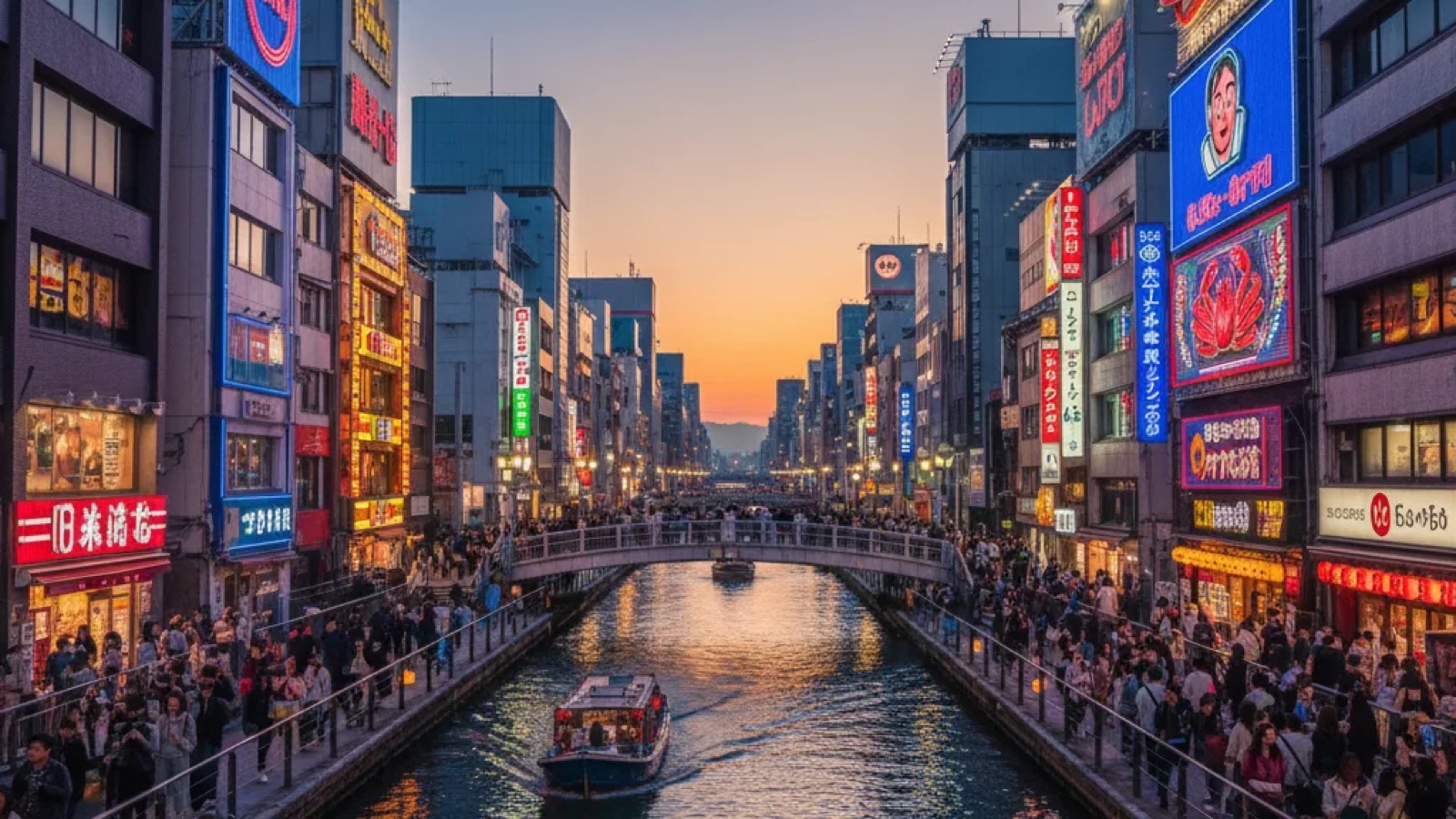
There is no place on earth quite like Dotonbori. It’s a sensory explosion, a kilometre-long carnival dedicated to eating and entertainment. By day, it’s a busy thoroughfare along the Dotonbori Canal. But by night, when the switch is flipped, it transforms into a dazzling fantasyland. Giant mechanized crabs wave their claws, and the iconic Glico Running Man billboard illuminates the entire Ebisu Bridge in a triumphant glow.
This is the epicentre of Osaka’s nightlife and food scene. The main street and its countless side alleys are crammed with restaurants, street food stalls, bars, and arcades. Walking here is an activity in itself. The classic photography spot is on Ebisu Bridge, looking towards the Glico sign. Arrive just after sunset during "blue hour" to capture the deep blue of the twilight sky contrasting with the warm, riotous colour of the neon signs reflecting in the canal. A tripod is useful here for longer exposures to smooth out the water and create light trails from the boats.
Don't just stick to the main drag. Duck into the smaller lanes like Hozenji Yokocho, a moss-covered, stone-paved alley that feels like a step back in time, lit by traditional lanterns and home to tiny, exquisite restaurants. It’s a quiet, atmospheric pocket just metres from the neon chaos.
Kuidaore: Eating Until You Drop
You can’t understand Osaka without understanding kuidaore. The term, often translated as "to eat oneself into ruin," perfectly captures the city's obsession with food. It’s a place where eating is not just sustenance; it’s a passion, a hobby, and a primary form of entertainment. And there are three dishes you absolutely must try.
Takoyaki
These are the quintessential Osaka street food. Small balls of batter filled with a piece of octopus (tako), pickled ginger, and spring onion, cooked in a special moulded pan. They're served piping hot, slathered with a tangy brown sauce, mayonnaise, and topped with green laver (aonori) and dried bonito flakes (katsuobushi) that seem to dance from the heat. Watching the vendors expertly flick the balls over with a metal pick is half the fun.
Okonomiyaki
Often called a "Japanese savoury pancake," this is a much more substantial meal. Its name literally means "grilled as you like it." A base of shredded cabbage, flour, egg and dashi is mixed with your choice of ingredients—pork belly is classic, but you can get squid, shrimp, cheese, and more. It’s grilled on a flat-top teppan, then brushed with that same tangy sauce, mayo, and bonito flakes. In some restaurants, you grill it yourself at the table, which is a fantastic experience.
Kushikatsu
This is Osaka’s answer to deep-fried bar food, but elevated to an art form. Various ingredients—meats, seafood, vegetables—are put on a bamboo skewer (kushi), coated in a light panko batter and deep-fried (katsu). They are served with a communal pot of thin dipping sauce. This brings us to the most important rule of kushikatsu: no double-dipping! For hygiene reasons, you dip your skewer once and only once. If you need more sauce, you use a piece of the complimentary cabbage to scoop some onto your plate.
Kuromon Ichiba Market: Kansai's Kitchen
If Dotonbori is Osaka’s dining room, then Kuromon Ichiba Market is its kitchen. This covered market arcade stretches for over half a kilometre and has been serving chefs and locals for over a century. Walking through here is a feast for the senses. Stalls are piled high with glistening tuna, enormous crab legs, trays of sea urchin, and perfectly marbled wagyu beef.
While it's still a functioning market for residents, it has become a major destination for food tourism. Many vendors will cook their produce for you on the spot. You can buy a single giant oyster, a skewer of grilled eel, a scallop torched with butter and soy sauce, or a tray of fatty tuna sashimi and eat it right there. It’s a brilliant way to sample incredibly fresh, high-quality ingredients without the formality of a restaurant. My advice is to go on an empty stomach and just wander, trying small bites from different stalls. It's also a great place to pick up food-related souvenirs like high-quality knives, pickles, or tea.
Osaka Castle: A Symbol of Power and Resilience
Rising above a vast park and protected by immense stone walls and deep moats, Osaka Castle is the city’s most famous historic landmark. The castle has a turbulent history, having been originally built in the 16th century, destroyed, rebuilt, and destroyed again by lightning and war. It’s important for visitors to realise that the current main tower is a steel-reinforced concrete reconstruction from 1931. While this means it lacks the authentic wooden interior of an original castle like Himeji, it houses an excellent museum detailing the castle's history and the life of its founder, Toyotomi Hideyoshi, a pivotal figure in Japan's unification.
The most impressive parts are the original defensive structures. The sheer scale of the moats and the massive, perfectly-fitted stones of the walls are a testament to the power and ambition of its builders. The surrounding Nishinomaru Garden is a beautiful spot for a stroll, especially during cherry blossom season in early April, when the park fills with hundreds of flowering trees and locals enjoying picnics. The view from the observation deck at the top of the main tower offers a panoramic perspective of the sprawling modern city that now surrounds this historic icon.
Shinsekai: A Nostalgic Trip Back in Time
Step into Shinsekai, and you step into a different era. This "New World" district was developed before the war, modelled partly on Paris (with the Tsutenkaku Tower as its Eiffel Tower) and New York's Coney Island. Time seems to have moved slower here, and the whole area is steeped in a gritty, retro Showa-era charm. It’s less polished than Dotonbori, but bursting with character.
The neighbourhood is dominated by the Tsutenkaku Tower. You can take a lift to the top for views and to see the Billiken statue, a good-luck charm who you're meant to rub the feet of. The real joy of Shinsekai, however, is on the ground. This is the spiritual home of kushikatsu, and dozens of restaurants, adorned with colourful and sometimes garish signs, compete for your business. It's a fantastic area for street photography, with its old-school pachinko parlours, lantern-lit alleys, and fascinating local characters.
The View from Above: Umeda Sky Building
While Osaka Castle and Tsutenkaku Tower offer views, the most breathtaking cityscape vista is from the Umeda Sky Building. This striking piece of modern architecture consists of two 40-story towers connected at the top by the "Floating Garden Observatory." The journey up is part of the experience: a high-speed lift followed by a glass-enclosed escalator that crosses the void between the two towers, making you feel like you’re flying into the sky.
The open-air observatory deck allows for 360-degree, uninterrupted views of Osaka. Sunset is the best time to come up here. Watching the sky change colour and the city lights flicker to life across the vast urban plain is a mesmerising experience. You can see the rivers, the maze of train lines, and the distant mountains. It provides a real sense of scale and helps you understand the geography of this massive metropolis.
A Moment of Peace: Sumiyoshi Taisha Shrine
When the relentless energy of the city gets too much, a trip to Sumiyoshi Taisha offers a welcome dose of tranquillity. Located in the south of Osaka, this is one of Japan's oldest Shinto shrines, founded long before Buddhism arrived in the country. This means it has a purely Japanese style of architecture, called Sumiyoshi-zukuri, characterised by straight roofs and simple, elegant lines—a marked contrast to the more ornate, curved roofs you see at many temples.
The most iconic feature is the stunning, steeply-arched Sorihashi Bridge (also known as the Taiko-bashi), which reflects beautifully in the water below. It's believed that crossing the bridge symbolically cleanses you before you enter the main shrine grounds. The atmosphere here is serene and deeply spiritual. It feels a world away from Dotonbori and provides a beautiful glimpse into Japan’s indigenous faith.
Universal Studios Japan: An Alternate Reality
For a completely different kind of day out, Universal Studios Japan (USJ) is one of the country's most popular attractions. It’s a world-class theme park with a distinct Japanese flair, featuring unique seasonal events and collaborations with famous anime like Attack on Titan or Sailor Moon alongside the blockbuster Hollywood rides.
The two biggest draws are, without question, The Wizarding World of Harry Potter and the immersive Super Nintendo World. The latter is an absolute masterpiece of theme park design, making you feel like you've literally jumped inside a video game. Be warned: the park is incredibly popular. Planning is essential. You absolutely must check the official USJ website for ticketing options, crowd calendars, and to understand the system for securing entry into Super Nintendo World, as access is often restricted and requires a timed-entry ticket or a specific express pass. These systems change, so checking the official source is non-negotiable.
Excellent Day Trips from Osaka
Osaka’s strategic location and incredible transport links make it one of the best bases for exploring the entire Kansai region. Three day trips are particularly essential.
- Kyoto: The former imperial capital is just a 30-minute train ride away. You can spend a day immersing yourself in a world of sublime temples, tranquil gardens, and the winding alleys of the Gion district. The contrast between fast-paced Osaka and elegant Kyoto is a highlight of any Japan trip.
- Nara: Even closer than Kyoto, Nara was Japan’s first permanent capital. Its main attraction is Nara Park, where hundreds of sacred (and very bold) deer roam free. They've learned to bow for special deer crackers! The park is also home to Todai-ji Temple, which houses a colossal bronze Buddha statue inside one of the world’s largest wooden buildings (the largest until 1998). It's a truly awesome sight.
- Himeji & Kobe: You can combine these two in a single, long day trip. Start early and head to Himeji Castle, arguably Japan's most beautiful original castle. Nicknamed the "White Heron" for its brilliant white exterior and elegant shape, it's a UNESCO World Heritage site and a must-see. On your way back, stop in Kobe, a cosmopolitan port city famous for its delicious, marbled beef.
When to Visit: Navigating the Seasons
Like all of Japan, Osaka is a city of four distinct seasons. Spring (late March to April) is peak season, when the city’s parks, especially around the castle, are awash with the pale pink of cherry blossoms (sakura). The weather is mild and pleasant, but be prepared for significant crowds and higher accommodation demand. Autumn (late October to November) is arguably the best time to visit. The weather is crisp and clear, the humidity of summer has vanished, and the autumn foliage (koyo) brings beautiful colours to the parks and surrounding mountains.
Summer (June to August) is a challenge. It gets very hot and, more importantly, incredibly humid. It can feel draining to be sightseeing in the sticky heat. This is also when rainy season (tsuyu) occurs, typically in June and July. Typhoon season follows, usually peaking in August and September, which can bring heavy rain and wind, potentially disrupting travel plans. Winter (December to February) is cold and can be grey, but it’s often dry and clear. The biggest advantage is the lack of crowds; you’ll have many sights almost to yourself.
Explore in Depth
This guide is just the beginning of your journey. For more detailed advice on neighbouring cities and major attractions, check out the other guides on the Kansai region and beyond:
Frequently Asked Questions
How many days do I really need in Osaka?
To do the city itself justice, allow a minimum of two full days. This allows you to dedicate one day to the Namba area (Dotonbori, Kuromon Market, Shinsekai) and another to the northern sights like Osaka Castle and Umeda. However, Osaka's real strength is as a base. If you plan to take day trips to Kyoto, Nara, and Himeji, you could easily spend five to seven days here, using the evenings to explore Osaka's incredible food scene after returning from your travels.
Is the Osaka Amazing Pass worth getting?
The Osaka Amazing Pass provides unlimited travel on subways and buses, plus free entry to dozens of attractions like the castle, Tsutenkaku Tower, and Umeda Sky Building. Whether it's "worth it" depends entirely on your itinerary. If you plan to visit three or more included attractions in a single day, it almost always provides great value. My advice is to plan a prospective day, add up the individual transport and entry costs, and compare it to the pass price. Don't buy it just for the transport; you need to use the attraction entries to make it pay off.
Osaka vs. Tokyo for a first-time visitor to Japan?
There's no wrong answer here. Tokyo is the iconic mega-city, an immense, electrifying experience that defines modern Japan for many. It has everything. Osaka is smaller (though still huge!), more manageable, friendlier, and arguably has a better food scene concentrated in one area. If your main interests are food and using a convenient base for exploring Kansai's historical sites, start in Osaka. If you want the quintessential "wow" factor of Japan's scale and modernity, start in Tokyo.
What is the best way to travel between Osaka and Kyoto?
You have several excellent train options, and the "best" one depends on where you are and where you're going. The JR Special Rapid Service is fast and convenient, linking Osaka Station (in Umeda) with Kyoto Station. If you're staying in Namba, it can be easier to take a private railway line. The Hankyu Line runs from Umeda to central Kyoto (near Gion), while the Keihan Line serves areas in eastern Kyoto famous for temples. All are efficient and take around 30-45 minutes.
How difficult is it to get by with only English in Osaka?
In major tourist areas like Dotonbori, Umeda, the castle, and major train stations, you will find English signage and staff at hotels, information centres, and some restaurants who speak basic English. You can navigate the city and order food without speaking Japanese. However, once you step into smaller, local establishments or residential areas, English becomes much less common. Learning a few basic phrases like "Arigato" (Thank you), "Sumimasen" (Excuse me/Sorry), and "Kore o kudasai" (This one, please) will go an incredibly long way and is always appreciated.
Final Thoughts
Few cities capture the heart—and the appetite—quite like Osaka. It’s a city that trades pomp for personality, and reverence for revelry. It doesn't ask you to admire it from a distance; it invites you to jump in, get your hands dirty, and have a good time. It’s the sizzle of batter on a hotplate, the warmth of a shared laugh with a stranger at a tiny bar, and the electric hum of a city that is truly, unapologetically alive.
Come for the castles and the convenience, but stay for the kuidaore. Stay for the feeling of being welcomed into Japan’s magnificent, chaotic, and utterly delicious kitchen. You might leave with a full stomach, but your spirit will be even fuller.