Palawan Guide: El Nido, Coron and Island Hopping
Palawan planned well: El Nido versus Coron, the lettered island-hopping tours, the Underground River and when to go.
In this guide
- Quick Facts
- Palawan's Geography and Main Hubs
- Getting to and Around Palawan
- El Nido: Gateway to the Bacuit Archipelago
- Coron: Wrecks and Otherworldly Lakes
- Puerto Princesa and the Underground River
- Quieter Corners: Port Barton and Nacpan Beach
- Best Time to Visit and Weather Considerations
- Practicalities: Cash, Connectivity, and Power Cuts
- A Photographer's Notes on Palawan
- Explore in Depth
- Frequently Asked Questions
- Final Thoughts
This guide is part of our Philippines Travel Guide: Islands, Seasons, Routes — start there for the overview, when to go and how to get around.
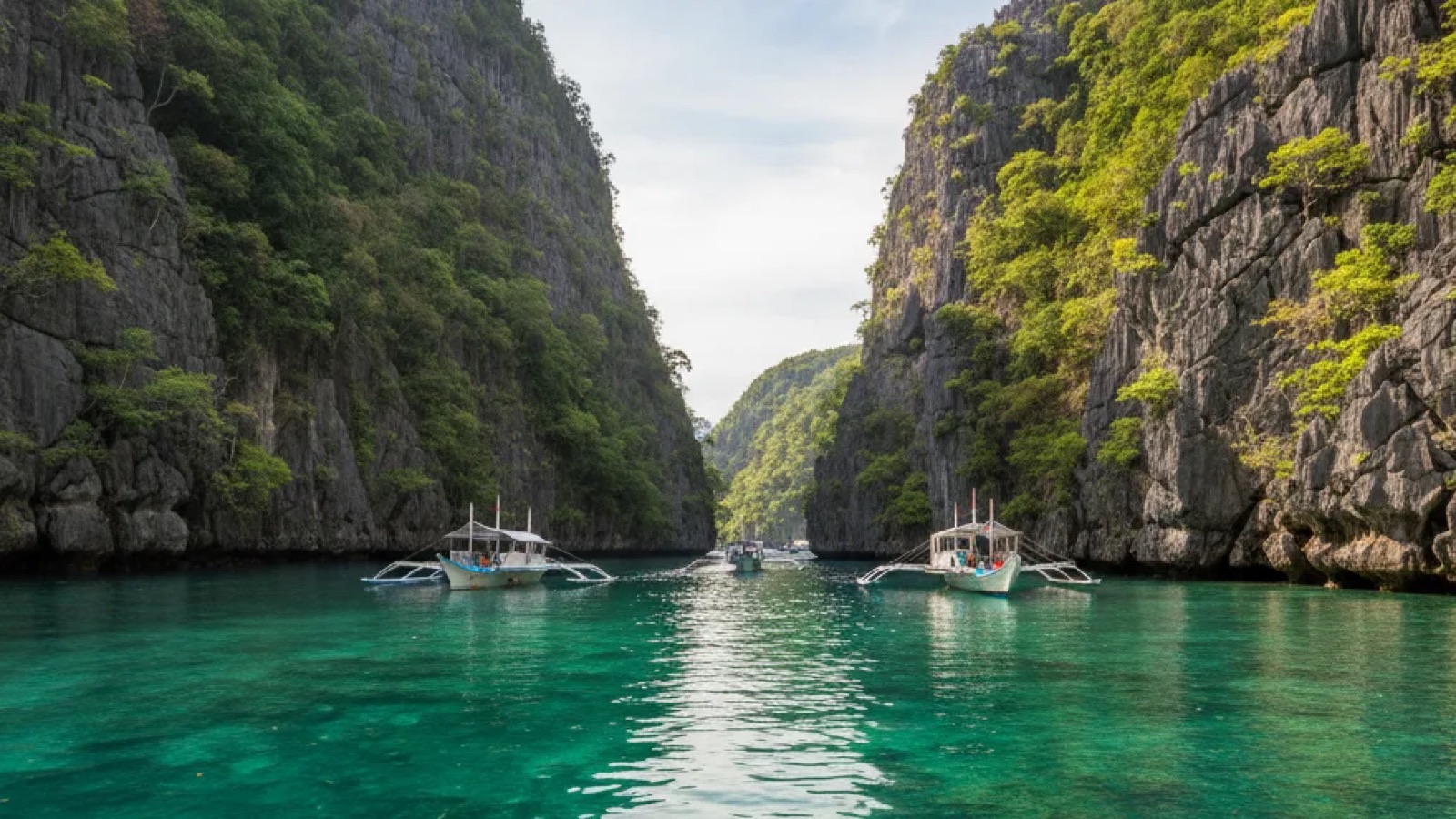
The first time our white-and-blue bangka boat rounded a sheer, black limestone cliff and entered El Nido’s Big Lagoon, our skipper cut the engine. The sudden silence was absolute, broken only by the gentle slap of water against the hull and the distant cry of a sea eagle. Below us, the water shifted from deep sapphire to an impossible, glowing turquoise, so clear I could see the shadows of coral heads metres below. All around us, karst towers draped in jungle foliage clawed at the sky, ancient and immense. It’s a moment that’s been photographed a million times, but standing there, feeling the scale of it, I realised no picture could ever truly capture the magic. This is Palawan: raw, dramatic, and utterly unforgettable.
Hailed as one of the world's most beautiful islands, Palawan is a long, slender sliver of paradise that serves as the Philippines' wild western frontier. It's a place of jagged limestone cliffs, hidden lagoons, world-class wreck diving, and some of the most stunning seascapes I've ever had the privilege to photograph. This guide is built from my own journeys across the island, focusing on the three main hubs—Puerto Princesa, El Nido, and Coron—and the unforgettable island-hopping adventures that connect them. We’ll cover how to get there and get around, what to expect from the classic tours, and the hard-won practical tips that will make your trip smoother, safer, and more spectacular.
Quick Facts
- Location: A long, narrow island province in the western Philippines, separating the South China Sea from the Sulu Sea.
- Getting There: Main airports are Puerto Princesa (PPS) for the south/central island, Busuanga/Coron (USU) for the northern islands, and a smaller, more direct airport at El Nido (ENI).
- Getting Around: Tricycles for short distances in towns; shuttle vans and local buses for long-distance travel between hubs like Puerto Princesa and El Nido; and chartered bangka boats for island hopping.
- Language & Currency: Filipino (Tagalog) and local dialects are spoken, but English is widely understood in tourist areas. The currency is the Philippine Peso (PHP).
- Best Time to Visit: The dry season, roughly November to May, offers the calmest seas and sunniest weather, ideal for boat tours. The shoulder months of November and May can be a great balance of good weather and fewer crowds.
Palawan's Geography and Main Hubs
To understand Palawan, you have to appreciate its geography. It's over 450 kilometres long but barely 50 kilometres wide at its broadest point. This long, skinny shape means you can't just "base yourself" in one spot and see it all. Travel between the main points of interest takes time, and you’ll need to plan your route logically.
There are three main anchor points for travellers:
- Puerto Princesa: The provincial capital in the central part of the island. Most people arrive here and use it as a jumping-off point for the Underground River or as a transit hub for the long journey north to El Nido. The city itself is functional more than beautiful, but it's where your adventure often begins.
- El Nido: Located near the northern tip of the main island, El Nido is the world-famous gateway to the Bacuit Archipelago. This is the home of the iconic limestone karst landscapes and the legendary island-hopping tours. The town itself is a bustling, sometimes chaotic mix of tour agencies, dive shops, restaurants, and guesthouses.
- Coron: This refers to both the main town (Coron Town) on Busuanga Island and the nearby Coron Island, ancestral home of the Tagbanua people. It's located further north in the Calamian Islands group. Coron is renowned for its World War II wreck diving and its own collection of breathtaking lakes and lagoons, offering a slightly more rugged and dive-focused vibe than El Nido.
Getting to and Around Palawan
Your port of entry will largely define the shape of your trip. Most international travellers will first fly into Manila (MNL) or Cebu (CEB) and then take a domestic flight to Palawan. You have three primary choices.
Flying into Puerto Princesa (PPS) is often the most common and budget-friendly option. From here, you can explore the Underground River before starting the journey north. The catch? The infamous van ride to El Nido. Be prepared: it's a 5 to 6-hour journey on winding roads in a potentially cramped minivan. While I appreciate the scenery, I'll be honest—it's exhausting. If you have the time, I strongly recommend breaking the journey in a quieter spot like Port Barton to recover.
For those focused on the northern wonders, flying into El Nido (ENI) directly is a game-changer. It’s a smaller airport serviced by a single carrier, so flights can be more expensive and book out far in advance, but it saves you an entire day of grueling overland travel. You land and you're practically ready to go island hopping the next morning.
To reach Coron, you'll fly into Busuanga Airport (USU). This is the most logical choice if your primary interest is wreck diving and the stunning lakes of Coron Island. You can travel between El Nido and Coron via a high-speed ferry, which is an adventure in itself. Be warned, though: this route is notorious for cancellations during rough seas, so always have a buffer day in your itinerary.
El Nido: Gateway to the Bacuit Archipelago
El Nido town is the vibrant, sometimes frantic, heart of tourism in Palawan. The main beach isn't for swimming; it's a parking lot for hundreds of bangka boats, their engines rumbling to life each morning. The real magic lies just beyond, in the 45 islands and islets of the Bacuit Bay.
The entire experience is built around standardised island-hopping tours, conveniently labelled A, B, C, and D. You'll see signs for them everywhere. While the combinations can change and local authorities sometimes implement rotation systems to manage crowds, the core destinations remain consistent. Always check with your tour operator on the day for the exact itinerary, as sites can be closed with little notice.
You’ll also need to pay a one-time Eco-Tourism Development Fee (ETDF), which is a permit valid for several days. Keep the receipt safe, as you'll need to show it for every tour.
Understanding the El Nido Tours
- Tour A: This is the superstar, the "greatest hits" tour that everyone does first. It focuses on lagoons and beaches. The highlights are the Big Lagoon, where you can kayak through a majestic channel of towering cliffs, and the Small Lagoon, which you enter through a small crevice in the rock. It also typically includes Secret Lagoon (less of a secret these days) and a stop at a beautiful beach like Seven Commandos Beach. It's popular for a reason—it’s absolutely stunning.
- Tour B: Often called the "cave and cove" tour. This one takes you to more varied spots like Snake Island, a sandbar that connects two islands at low tide (it looks like a snake from above), and the impressive Cathedral Cave. It can be a little less crowded than Tour A and offers a different perspective on the bay.
- Tour C: My personal favourite for dramatic scenery. This tour ventures further out into the open sea, so it’s the most likely to be cancelled in choppy weather. The reward is visiting the incredible Matinloc Shrine (check if it's open to the public when you visit), and the breathtakingly beautiful Hidden Beach and Secret Beach, which are accessible only by swimming through small openings in the cliffs. The feeling of emerging into a completely enclosed, private beach is pure magic.
- Tour D: Primarily focused on beaches on Cadlao Island, this is generally considered the most relaxed and least crowded tour. It’s a great option if you just want a chill day on the water, with plenty of time for swimming and snorkelling at spots like Paradise Beach and Bukal Beach.
Coron: Wrecks and Otherworldly Lakes
A fast ferry ride north of El Nido, Coron offers a different but equally potent flavour of paradise. The town on Busuanga Island is grittier and feels more like a frontier town than El Nido, but its surroundings are pristine. The main attractions are managed by the local Tagbanua people, and access requires joining a tour and paying environmental fees.
The crown jewel is Kayangan Lake. After a short, steep climb up a staircase that offers a now-iconic viewpoint over the bay, you descend to the lake itself. The water is a mesmerising mix of fresh and saltwater, and so clear that the underwater rock formations look like a submerged mountain range. It's often called the cleanest lake in the Philippines, and it’s a phenomenal spot for a swim.
Nearby, Twin Lagoon offers another unique experience. You can swim through a small underwater archway at low tide (or climb a ladder at high tide) to get from the outer lagoon to the inner one, where the water temperature changes as cool freshwater meets the warmer saltwater. For certified divers, Barracuda Lake is a must-do. It's a volcanic crater lake known for its extreme thermoclines, where the water temperature can jump dramatically as you descend.
But Coron's biggest draw for many is its world-class wreck diving. A fleet of Japanese supply ships and warships was sunk here by an American airstrike in 1944, and today these colossal wrecks rest on the seafloor. Exploring ships like the Okikawa Maru or the Akitsushima, watching schools of fish swim through what were once engine rooms and cargo holds, is a haunting and unforgettable experience. Many are accessible to recreational divers, while some deeper penetrations are reserved for technical divers.
Puerto Princesa and the Underground River
For many, Puerto Princesa is simply a functional entry point, but it's home to one of Palawan's most famous natural wonders: the Puerto Princesa Subterranean River National Park. This UNESCO World Heritage Site is an 8.2-kilometre-long underground river that flows directly into the sea. Visitors take a paddle boat into the first section of the cave system, guided by torchlight through massive cathedral-like domes filled with stalactites and stalagmites.
Planning is essential here. Visitor numbers are strictly limited, and you absolutely must secure a permit well in advance, especially during peak season. Most people book this as a day tour from Puerto Princesa. It's an impressive sight, but be aware that it involves a long day of travel for a relatively short time inside the cave itself.
Quieter Corners: Port Barton and Nacpan Beach
If the crowds of El Nido and the long travel days feel daunting, Palawan has quieter havens. Port Barton, situated on the west coast between Puerto Princesa and El Nido, is a sleepy beach village with a laid-back vibe. The island hopping is beautiful, the beaches are serene, and the pace of life is wonderfully slow. It's the perfect place to decompress for a few days, read a book in a hammock, and just enjoy the simple beauty of the coast.
North of El Nido, a 45-minute tricycle or motorbike ride will bring you to Nacpan Beach. This magnificent, 4-kilometre-long stretch of golden sand is often touted as one of the best beaches in the Philippines. While it's no longer a secret, its sheer size means you can always find a quiet patch of sand. You can stay in simple bungalows here or just visit for the day, but watching the sunset paint the sky from the southern headland is an experience I highly recommend.
Best Time to Visit and Weather Considerations
Palawan's climate is governed by two main seasons: the dry season (known as *Amihan*) from roughly November to May, and the wet season (*Habagat*) from June to October. Without a doubt, the dry season is the best time to visit. The weather is generally sunny, the humidity is lower, and most importantly, the seas are calm. This is crucial, as almost all of Palawan's best activities depend on boat travel.
Travelling during the wet season is possible, and you might find fewer crowds, but it comes with risks. Heavy rains are common, and typhoons, while not as frequent as in other parts of the Philippines, can and do occur. Rough seas can lead to the Coast Guard cancelling all boat tours for days at a time, which could completely derail a short itinerary. If you travel in the shoulder or wet seasons, build plenty of flexibility and buffer days into your plan.
Practicalities: Cash, Connectivity, and Power Cuts
Palawan is stunning, but it's still a developing region with infrastructure that can feel a bit flaky. A little preparation goes a long way.
- Cash is King: While larger hotels and dive centres in Puerto Princesa and El Nido might accept credit cards, for almost everything else—guesthouses, local restaurants, tricycle rides, market shopping—you will need cash. ATMs exist in the main towns, but they are not always reliable and can run out of money, especially on weekends or holidays. My advice: bring more cash than you think you'll need, stashed safely in a couple of different places.
- Connectivity: Don't expect seamless Wi-Fi. It’s often slow and unreliable, even in hotels that advertise it. Power outages, or 'brownouts', are also common and can last for hours. Buying a local SIM card (Globe or Smart) upon arrival in Manila or Puerto Princesa is your best bet for staying connected, but even then, data coverage can be patchy in more remote areas. Consider it a great opportunity to disconnect. A portable power bank is an absolute lifesaver.
- Health and Safety: Take precautions against mosquito-borne illnesses like dengue and malaria. While the risk is low in the main tourist hubs, it's higher in rural, jungle areas. Use insect repellent, especially at dawn and dusk, and consider wearing long, loose-fitting clothing. On boat tours, the sun is relentless. A wide-brimmed hat, high-SPF sunscreen, a rash vest, and sunglasses are non-negotiable. Dehydration is a real risk, so drink plenty of water.
- Snorkelling and Reef Care: You'll spend a lot of time in the water. While you can rent snorkelling gear, the quality can be hit-or-miss. I always travel with my own mask and snorkel for a perfect fit and better hygiene. When you're in the water, please be mindful. Never touch or stand on coral—it's a living organism and is incredibly fragile. Use reef-safe sunscreen to help protect the delicate marine ecosystems you've come to enjoy.
A Photographer's Notes on Palawan
For a photographer, Palawan is both a dream and a challenge. The landscapes are epic, but capturing them well requires some thought.
The best light for shooting the limestone karsts is in the early morning or late afternoon. The 'golden hour' light brings out the texture and colour of the rock, casting long, dramatic shadows. Midday sun is harsh and flattens the scene, but it's also when the water clarity is at its peak. This is the time for those top-down shots of your boat seeming to float on air, so a good polarising filter is essential to cut through the glare on the water's surface.
Drones can capture the incredible scale of places like Bacuit Bay or the sandbar at Snake Island. However, be aware that there are significant restrictions. Flying is strictly prohibited in many protected areas, including the Puerto Princesa Underground River National Park and within certain zones of El Nido and Coron without special permits. The rules change, so always check with local authorities and your tour operator before you fly. Sometimes, finding a high viewpoint on foot, like the climb at Kayangan Lake or Taraw Cliff in El Nido (only for the very fit and with a guide), can yield just as stunning a result with far less hassle.
Explore in Depth
This guide to Palawan is one part of a larger series on travelling through the Philippines. For a broader look at the country, including advice on inter-island travel, seasonal weather patterns across different regions, and itinerary planning, be sure to read the main country guide.
Frequently Asked Questions
How many days do I need for Palawan?
I’d recommend a minimum of 7-10 days to get a real taste of Palawan without feeling rushed. This would allow you to spend 3-4 days in El Nido focusing on island hopping, and another 3-4 days in Coron for the lakes and diving. This accounts for the travel time between them. If you also want to see the Underground River near Puerto Princesa or relax in Port Barton, you should plan for at least two weeks. Rushing Palawan means spending more time in vans and airports than lagoons.
Is the van from Puerto Princesa to El Nido that bad?
Honestly, it can be. It's a 5-6 hour drive on winding roads in a shared minivan that is often filled to capacity. While it's the most common way to travel, it's not particularly comfortable and can be exhausting after a long flight. If your budget and schedule allow, I highly recommend either flying directly into El Nido's Lio Airport or breaking up the journey with a couple of nights in the much more relaxed town of Port Barton. This turns a long travel day into a part of the adventure.
Do I need to book my island hopping tours in advance?
In the peak season (December to April), it's a good idea to book your tours, especially the popular Tour A in El Nido, a day or two in advance to secure a spot. However, you don't need to book everything before you arrive in the country. There are dozens of tour operators in El Nido and Coron, and you can easily walk around and book in person the day before. This also gives you the flexibility to make decisions based on the weather, which can be unpredictable.
Which is better, El Nido or Coron?
This is the classic Palawan question! They're both spectacular but offer different experiences. El Nido is famous for its dramatic scenery of jagged cliffs rising from the water and its hidden lagoons and beaches. The landscape feels more epic and concentrated. Coron is more rugged and known for its otherworldly lakes (like Kayangan), incredible wreck diving from WWII, and a slightly more adventurous, less polished feel. If you love landscapes and kayaking through lagoons, choose El Nido. If you're a diver or looking for unique swimming spots, lean towards Coron. If you have the time, do both!
Is it safe to travel in Palawan?
Yes, Palawan is generally a very safe destination for travellers. The main tourist areas like El Nido, Coron, and Puerto Princesa are well-policed and accustomed to international visitors. The primary concerns are practical: petty theft (so keep an eye on your belongings), road safety (wear a helmet on motorbikes), and nature-related risks like sun exposure, dehydration, and respecting sea conditions. Standard travel precautions apply, but violent crime against tourists is extremely rare. The local people are overwhelmingly friendly and welcoming.
Final Thoughts
Twelve years of travelling have taught me that some places are just different. They get under your skin in a way that goes beyond a simple checklist of sights. Palawan is one of those places. It's a land of sharp contrasts—the chaotic energy of El Nido town giving way to the sacred silence of a hidden lagoon, the deep, dark history of a sunken wreck lying beneath some of the brightest, most life-affirming water you'll ever see.
My best advice is to embrace the journey. Accept the long van rides, the power cuts, and the patchy Wi-Fi as part of the experience. Slow down. Spend an extra day in Port Barton. Take that kayak out in the Big Lagoon. Sit on the sand at Nacpan and just watch the waves. Palawan doesn't just show you its beauty; it makes you work for it a little. And I promise you, it's worth every single second.