Philippines Travel Guide: Islands, Seasons, Routes
Making sense of 7,000 islands: which regions to combine, the typhoon calendar, domestic flights and ferry realities.
In this guide
- Quick Facts
- Making Sense of 7,641 Islands
- When to Visit: Seasons and Winds
- Getting There and Getting Around
- Palawan: The Last Ecological Frontier
- The Visayas: Island Hopping's Heartbeat
- Luzon: Rice Terraces and Colonial Ghosts
- Mindanao: Siargao, Surfing, and Beyond
- Diving and Ethical Wildlife Encounters
- A Photographer's Notes from the Field
- Practical Advice for Smooth Travels
- Explore in Depth
- Frequently Asked Questions
- Final Thoughts
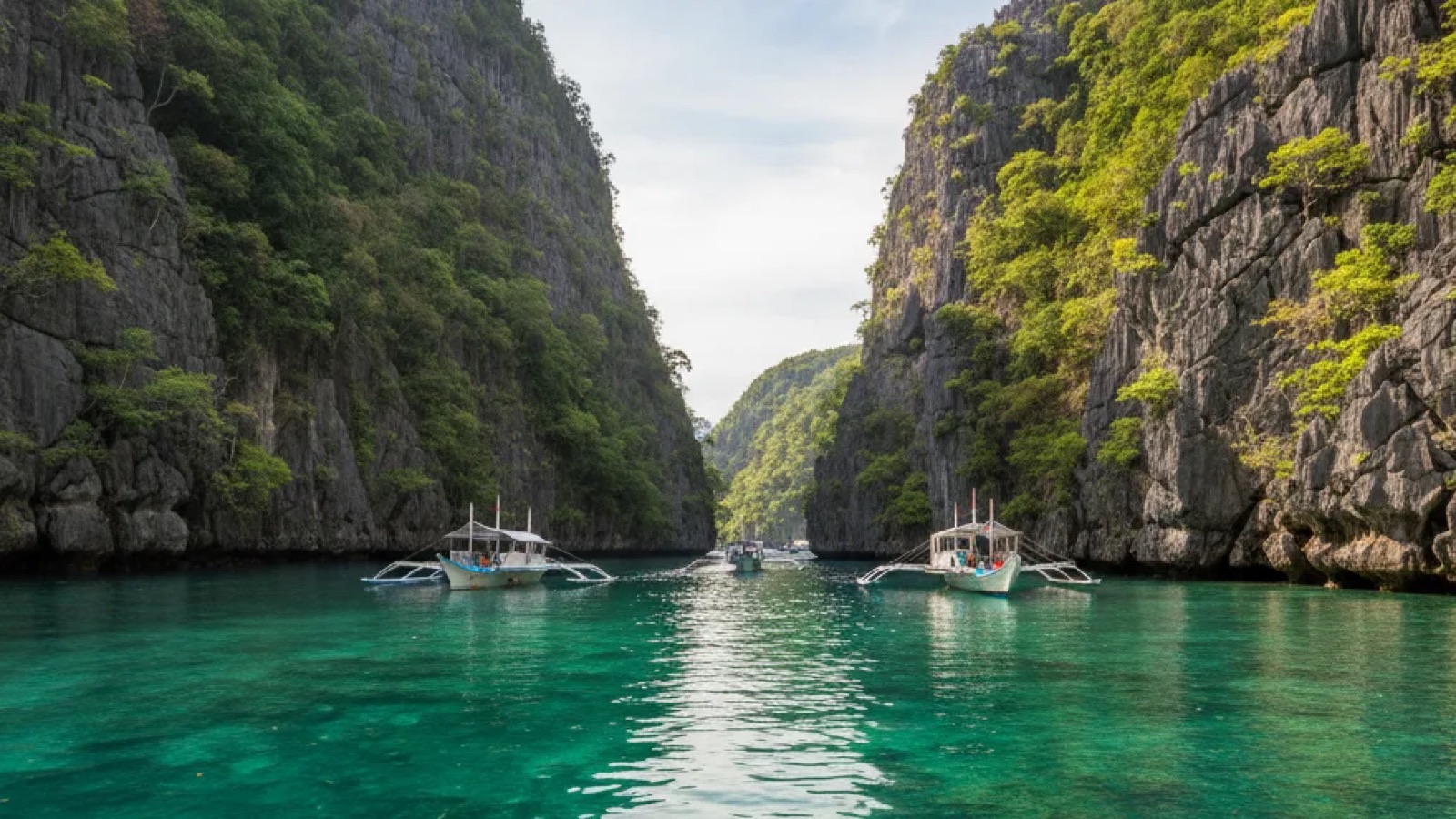
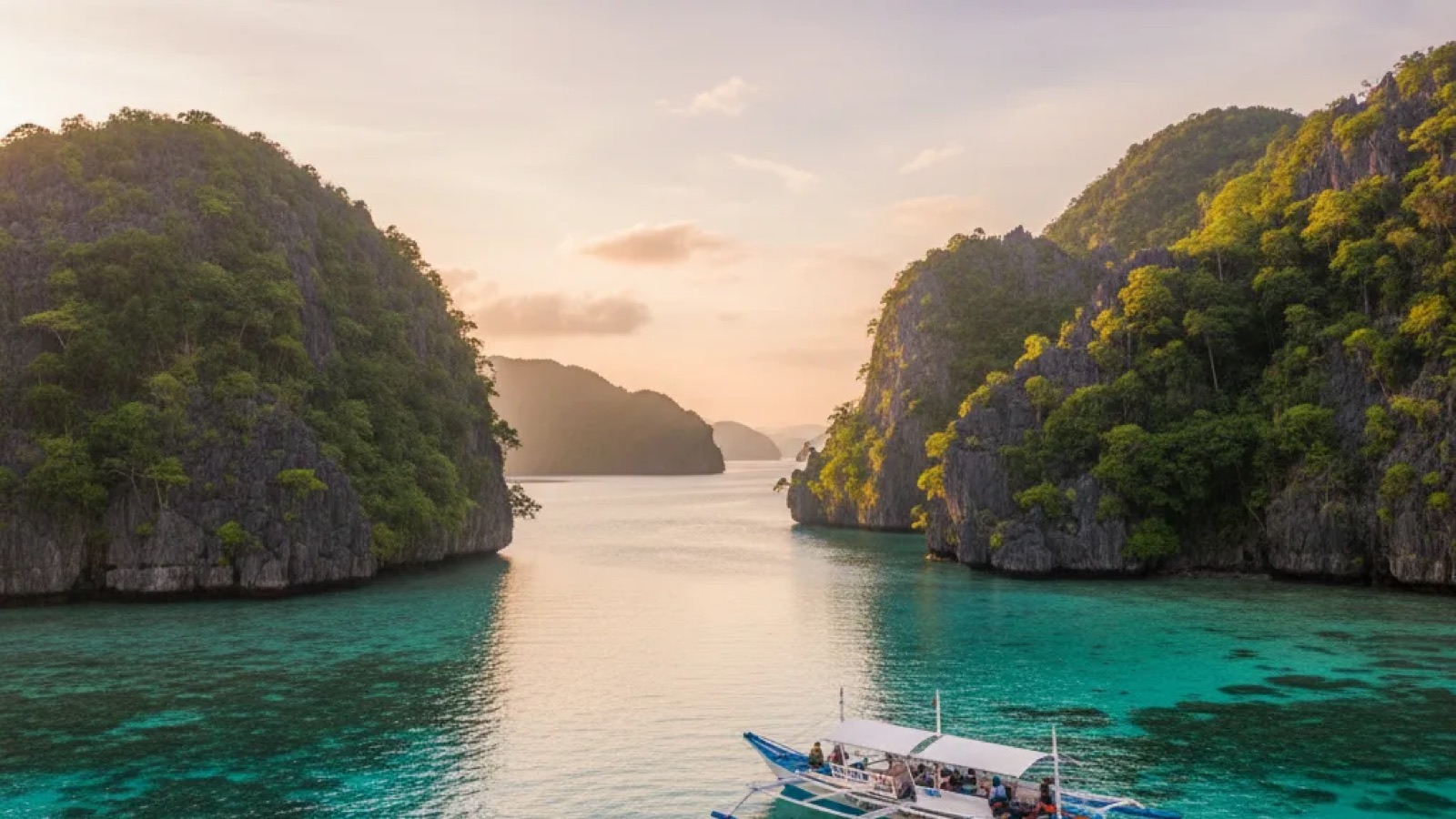
The outrigger of a long, narrow bangka boat slices through water so turquoise and clear that coral gardens glide past metres below. The air is thick with salt and the heat of a high sun, cooled only by the sea spray. Ahead, colossal limestone karsts draped in a riot of jungle green erupt from the sea, their dark silhouettes softened by the morning haze. This is island hopping in Palawan, but it could be anywhere in the Philippines – a country that doesn't just show you its beauty, but immerses you in it, one unforgettable, sensory-drenched moment at a time.
The Philippines is a nation defined by its staggering geography – over 7,000 islands – and the boundless warmth of its people. This guide is designed to help you navigate the beautiful chaos. We’ll cover how to make sense of the archipelago, the best times to visit, how to get around without losing your mind, and where to find those moments of pure magic, from the rice terraces of the north to the surf breaks of the south.
Quick Facts
- Location: A sprawling archipelago in Southeast Asia, located in the western Pacific Ocean.
- Getting There: The main international gateway is Manila (MNL), with growing hubs in Cebu (CEB) and Clark (CRK) offering direct international flights.
- Getting Around: A network of domestic flights is the backbone for island-hopping. Ferries, fast-craft, and local bangka boats connect shorter distances. Jeepneys and tricycles are ubiquitous for local trips.
- Language & Currency: Filipino and English are the official languages; English is very widely spoken, making travel relatively easy. The local currency is the Philippine Peso (PHP).
- Best Time to Visit: The dry season, roughly November to May, offers the most stable and sunny weather. The wet season from June to October sees more rain and a higher risk of typhoons.
Making Sense of 7,641 Islands
The first thing you need to realise about the Philippines is its scale. It’s not a single landmass like Thailand or Vietnam; it’s a beautifully fragmented collection of islands, each with its own character, dialect, and rhythm. Trying to ‘see the Philippines’ in one trip is like trying to drink the ocean. The single most important piece of advice is this: choose two or three areas and explore them properly. A rushed itinerary of ticking off bucket list spots will only leave you exhausted and familiar with the inside of airports and ferry terminals.
Geographically, the country is divided into three main island groups. Luzon in the north is the largest and most populous, home to the sprawling capital of Manila, the UNESCO-listed rice terraces of the Cordilleras, and colonial towns like Vigan. In the centre are the Visayas, the heart of the archipelago and arguably what most people picture when they dream of the Philippines: a dense cluster of islands like Cebu, Bohol, Siquijor, and Boracay, offering world-class beaches, diving, and endless island-hopping opportunities. To the south is Mindanao, a large island less frequented by tourists but home to gems like the surf capital, Siargao, and the pristine Camiguin island.
When to Visit: Seasons and Winds
Timing your trip to the Philippines is crucial and goes beyond a simple ‘wet’ or ‘dry’ season. The weather is governed by two main monsoon winds. The Amihan (northeast monsoon) brings cool, dry air from roughly November to May. This is the peak tourist season, offering the most stable weather, sunny skies, and calm seas, especially in the western parts of the country. This is the ideal time for beach holidays and diving in places like Palawan and the Visayas.
Conversely, the Habagat (southwest monsoon), from June to October, brings warmer, more humid air and is responsible for the country’s rainy season. This doesn’t mean it rains all day, every day – often you’ll get intense afternoon downpours followed by clear skies. However, this is also the primary typhoon season. Typhoons are most likely to affect the northern and eastern parts of the country, and can cause significant travel disruptions. If you travel during these months, you need to build flexibility into your itinerary and always have travel insurance. Some eastern-facing regions, like Siargao, have a reverse pattern, with their main surf season coinciding with the Habagat.
Always check weather forecasts before any sea travel, and remember that even in the dry season, the Philippines has a tropical climate, meaning a rain shower is never completely out of the question.
Getting There and Getting Around
Your journey will almost certainly begin at Manila’s Ninoy Aquino International Airport (MNL). While it’s a necessary stop, it’s best treated as a transit hub rather than a destination in itself, unless you have a specific reason to explore the mega-city. Increasingly, Cebu-Mactan International Airport (CEB) and Clark International Airport (CRK) north of Manila are becoming excellent alternative gateways, allowing you to fly directly closer to the central islands or northern Luzon.
The Reality of Domestic Travel
Domestic flights are the workhorse of inter-island travel. Local airlines operate a spiderweb of routes connecting the archipelago. However, one truth you must accept is that delays are the rule, not the exception. The reasons are many – air traffic congestion in Manila, weather, or operational issues. Never book a tight connection, especially one linking a domestic flight to your international flight home. Always leave a buffer of several hours, or better yet, plan to be in your departure city the night before.
For shorter distances, ferries are a fantastic way to travel. They range from large, multi-deck vessels on major routes (like between Cebu and Bohol) to smaller, faster 'fast-craft' boats. For local island hopping, you'll be on a bangka, a traditional wooden outrigger boat. These are the lifeblood of coastal communities and your ticket to hidden lagoons and empty beaches. Always check the safety equipment on board and be mindful of the weather; if the sea looks too rough, it probably is.
On the ground, you’ll navigate using flashy, chaotic jeepneys (the iconic, highly decorated buses) for set routes in cities, and motorised tricycles for short, point-to-point journeys. Agree on the fare before you get in a tricycle, and for jeepneys, just watch how the locals do it – pass your fare up the line of passengers and tell the driver where you want to stop.
Palawan: The Last Ecological Frontier
There's a reason Palawan is consistently voted one of the world's best islands. It feels like a land that time forgot. The main draws are the towns of El Nido and Coron, gateways to the Bacuit Archipelago and Calamian Islands, respectively. This is the classic Philippines postcard: jagged limestone cliffs rising from gin-clear water, secret lagoons you access by swimming through a small hole in a rock, and blindingly white sand beaches.
Island hopping tours are the main activity here. They are typically organised into set lettered tours (Tour A, B, C, D) which visit a roster of spectacular spots. While these group tours are a fantastic and affordable way to see the highlights, it’s worth saving up for a private tour at least once. It allows you to tweak the itinerary, leave earlier to beat the crowds, and linger longer at your favourite spots. Imagine having a place like the Small Lagoon in El Nido almost to yourself just as the morning light hits the water – it's an experience you'll never forget.
The Visayas: Island Hopping's Heartbeat
The Visayas are the geographical and spiritual centre of the archipelago. Cebu is the main hub, a bustling island province with a major international airport. While Cebu City is a chaotic metropolis, the island's south is a paradise for adventure seekers, famous for canyoneering at Kawasan Falls and diving.
A short ferry ride from Cebu is Bohol, an island of two halves. The main island is famous for the otherworldly Chocolate Hills – over 1,200 conical mounds that turn brown in the dry season – and the tiny, saucer-eyed Philippine Tarsier. Please only visit the official Philippine Tarsier Sanctuary, which provides a more ethical, semi-wild environment for these delicate, near-threatened primates. The other half is Panglao Island, connected by a bridge, which is Bohol's beach and diving hub.
For a different vibe, head to the mystical island of Siquijor, once feared for its healers and witchcraft, now beloved for its laid-back atmosphere, waterfalls, and lovely, uncrowded beaches. And, of course, there's Boracay. After a high-profile, government-mandated rehabilitation, it has reopened with stricter regulations. The legendary White Beach is cleaner and more beautiful than ever, but the island now focuses on sustainability. It's no longer the wild party island it once was, but a more organised, upmarket beach destination.
Luzon: Rice Terraces and Colonial Ghosts
Don't make the mistake of just transiting through Luzon. The north of the island offers some of the country’s most dramatic landscapes. An overnight bus ride from Manila will transport you to the Cordillera mountain range, home to the Banaue and Batad Rice Terraces. These 2,000-year-old, hand-carved terraces are often called the ‘Eighth Wonder of the World’ and are a staggering testament to human ingenuity. Hiking through villages like Batad, staying in a local homestay, and waking up to see the morning mist burn off the emerald-green amphitheatre of rice is one of Southeast Asia's quintessential experiences.
For a complete change of pace, travel to the coastal city of Vigan in the Ilocos region. It's a beautifully preserved example of a 16th-century Spanish colonial town, a UNESCO World Heritage site where horse-drawn carriages (kalesa) still clatter down cobblestone streets. It feels like stepping onto a film set. Closer to Manila, a popular day-trip or overnight trip is the trek to the crater lake of Mount Pinatubo, a volcano whose colossal 1991 eruption changed global weather. The journey involves a bumpy 4x4 ride across a vast lahar plain followed by a moderate hike to a stunning, turquoise lake – a beautiful scar left by nature's power.
Mindanao: Siargao, Surfing, and Beyond
For a long time, Mindanao was off-limits for most travellers due to security concerns in its western regions. While it's still crucial to check government travel advisories, the eastern parts of the island group are safe, welcoming, and incredible. The teardrop-shaped island of Siargao has exploded in popularity, transforming from a secret surf spot to a major international destination.
It’s the surfing capital of the Philippines, home to the legendary Cloud 9 wave, but there’s so much more to it. Rent a scooter and cruise under endless coconut palms, find hidden beaches, swim in the magical Sugba Lagoon, and explore the nearby islands of Naked, Daku, and Guyam on a day trip. Siargao has a fantastic, creative vibe with a great food scene and a strong sense of community.
Another gem is Camiguin, the ‘Island Born of Fire’. This small volcanic island packs in an incredible number of volcanoes, waterfalls, and hot springs for its size. Its most iconic sight is the Sunken Cemetery, which was submerged by a volcanic eruption in the 1870s, now marked by a giant cross out in the sea.
Diving and Ethical Wildlife Encounters
The Philippines sits in the heart of the Coral Triangle, the global centre of marine biodiversity. For divers and snorkellers, it's paradise. You can find incredible underwater worlds almost everywhere, but a few places stand out. Apo Reef Natural Park, off the coast of Mindoro, is the country’s largest contiguous coral reef system, a vast and healthy reef on UNESCO's World Heritage tentative list. For the most dedicated divers, the Tubbataha Reefs Natural Park is the holy grail. This remote atoll in the Sulu Sea is only accessible via liveaboard boats for a few months a year (March to June) and offers a pristine, shark-rich environment unlike anywhere else on Earth.
A note on whale sharks: These gentle giants are a huge draw, but how you see them matters. The mass-tourism site in Oslob, Cebu, involves operators feeding the sharks to guarantee sightings. This practice is heavily criticised by marine biologists for altering the sharks' natural migratory and feeding behaviours. A more ethical alternative is found in Donsol, Sorsogon, where sightings are not guaranteed as you interact with wild, non-baited sharks in their natural environment, guided by strict interaction protocols. It requires more patience and luck, but the reward is a truly wild and responsible encounter.
A Photographer's Notes from the Field
The Philippines is a visual feast, especially for photographers. The light is incredible, but you need to know how to work with it. The limestone karsts of Palawan and the Chocolate Hills of Bohol are best shot during the golden hours of sunrise and sunset. The low, warm light defines their texture and shape, which can appear flat and washed out in the harsh midday sun.
If you're bringing a drone, be aware that the winds, especially near the coast, can be much stronger than they feel on the ground. Keep an eye on your battery life and always maintain line of sight. For underwater photography, even with a simple action camera, the key is to get close to your subject and shoot with the sun behind you. This minimises the amount of water between your lens and the subject, resulting in sharper, more colourful images. If you don't have strobes, try setting your camera's white balance to the 'underwater' or 'cloudy' setting to help restore some of the reds and yellows that water filters out.
Finally, don't put your camera away when it rains. Some of the most dramatic light appears in the minutes just after a tropical downpour. The air is washed clean, the clouds part, and incredible sunbeams break through, illuminating the landscape with an ethereal glow. Be ready for it.
Practical Advice for Smooth Travels
A little preparation goes a long way in the Philippines. English is an official language and is spoken to a high degree almost everywhere, which makes communication incredibly easy compared to neighbouring countries.
When it comes to money, while major cities and tourist hubs like Boracay have reliable ATMs and accept credit cards in hotels and larger restaurants, this changes quickly as you venture to smaller islands. Many small islands have a cash-heavy economy and may have no ATM at all, or one that frequently runs out of money. Always carry enough cash to cover your expenses for a few days, especially before heading to more remote areas.
Packing essentials should include a dry bag – it's non-negotiable for protecting your electronics on island-hopping trips. Sun protection is vital; the tropical sun is intense. Invest in a high-SPF, reef-safe sunscreen to protect both your skin and the delicate coral ecosystems you're there to enjoy. A wide-brimmed hat, sunglasses, and a lightweight long-sleeve shirt for snorkelling are also brilliant ideas. Lastly, pack your patience. Things run on 'Filipino time'. Embrace the slower pace, smile, and you’ll find that everything eventually works out.
Explore in Depth
The Philippines is too vast for one article. For a deep dive into one of its most breathtaking regions, use the detailed guide to planning your adventure in the archipelagos of El Nido and Coron.
Frequently Asked Questions
Is two weeks enough time to see the Philippines?
Two weeks is a great amount of time for an introduction, but it forces you to be selective. The biggest mistake is trying to squeeze in too much. For a two-week trip, choose just two regions. For example, you could fly into Cebu, explore Bohol and Siquijor in the Visayas for a week, and then fly to Palawan to spend your second week island hopping in El Nido or Coron. This minimises travel time and lets you actually relax and soak in the places you're visiting.
What is the best way to handle money and payments?
A mix of strategies is best. Use a credit card for major purchases like hotels and flights booked in advance. In major cities and popular tourist spots like Metro Manila or Boracay, card acceptance is common. However, once you get to smaller islands or local restaurants, it's a cash-first economy. Always have a good amount of Philippine Pesos on you. It's wise to withdraw a larger sum from a reliable ATM in a city like Manila or Cebu before flying to a smaller island where ATMs might be non-existent or empty.
What should I pack for a trip to the Philippines?
Pack light, breathable clothing made from cotton or linen. Essentials include swimwear, a quick-dry towel, and a rash guard for sun protection while snorkelling. You'll need sturdy water shoes or sandals for island hopping and rocky beaches. A non-negotiable item is a dry bag to protect your phone and camera on boat trips. Also crucial are reef-safe sunscreen, insect repellent (especially for evenings), a reusable water bottle to reduce plastic waste, and any personal medications. Don't forget a hat and sunglasses!
Are the Philippines safe for solo travellers?
Yes, the Philippines is generally safe for solo travellers, especially in the main tourist areas. Filipinos are incredibly welcoming and hospitable people. Standard precautions apply: be aware of your surroundings in big cities like Manila, don't flash expensive belongings, and avoid walking alone in unlit areas at night. It's also important to check official government travel advisories for specific regions, particularly for parts of Mindanao. For solo female travellers, the warm, friendly, and English-speaking culture makes it a very accessible destination.
Do I need to book domestic flights and accommodation in advance?
It depends on when you travel. During the peak season (Amihan, from November to May), especially around Christmas, New Year, and Easter, it is absolutely essential to book domestic flights and popular accommodation well in advance. Prices soar and things sell out completely. During the shoulder or low season (Habagat, from June to October), you have more flexibility. You can often find deals and book things on the fly. However, for key destinations like El Nido or Boracay, booking your first few nights is always a good idea.
Final Thoughts
The Philippines is a country that’s raw, yet gentle; chaotic, yet serene. It’s the taste of freshly grilled fish on a remote beach, the chatter of a shared tricycle ride, the feeling of floating in a lagoon surrounded by ancient cliffs. It’s the genuine, ever-present smile of a people who have mastered the art of finding joy in the everyday.
Arrive with a plan, but be ready to throw it away. Talk to people. Take the side trip. Wait out the rainstorm. Let the Philippines happen to you. If you do, you won’t just leave with a camera full of photos, but with a heart full of warmth and a longing to return.