Provence Travel Guide: Lavender, Villages and Wine
Planning Provence: the lavender window, the Luberon villages, Avignon and Arles, and why you need a car for the good bits.
In this guide
- Quick Facts
- Orienting Yourself in Provence
- When to Visit: Seasons and the Mistral Wind
- Getting There and Around: The Essential Car Hire
- Avignon, the Reign of Popes
- Arles, Van Gogh and Roman Grandeur
- Aix-en-Provence: Fountains and Cézanne's Ghost
- Chasing Lavender: The Valensole and Sault Plateaux
- The Hilltop Villages of the Luberon
- Europe's Grand Canyon: The Verdon Gorge
- The Wild Camargue: Horses, Bulls and Flamingos
- A Grittier Grace: Marseille and the Calanques
- Explore in Depth
- Frequently Asked Questions
- Final Thoughts
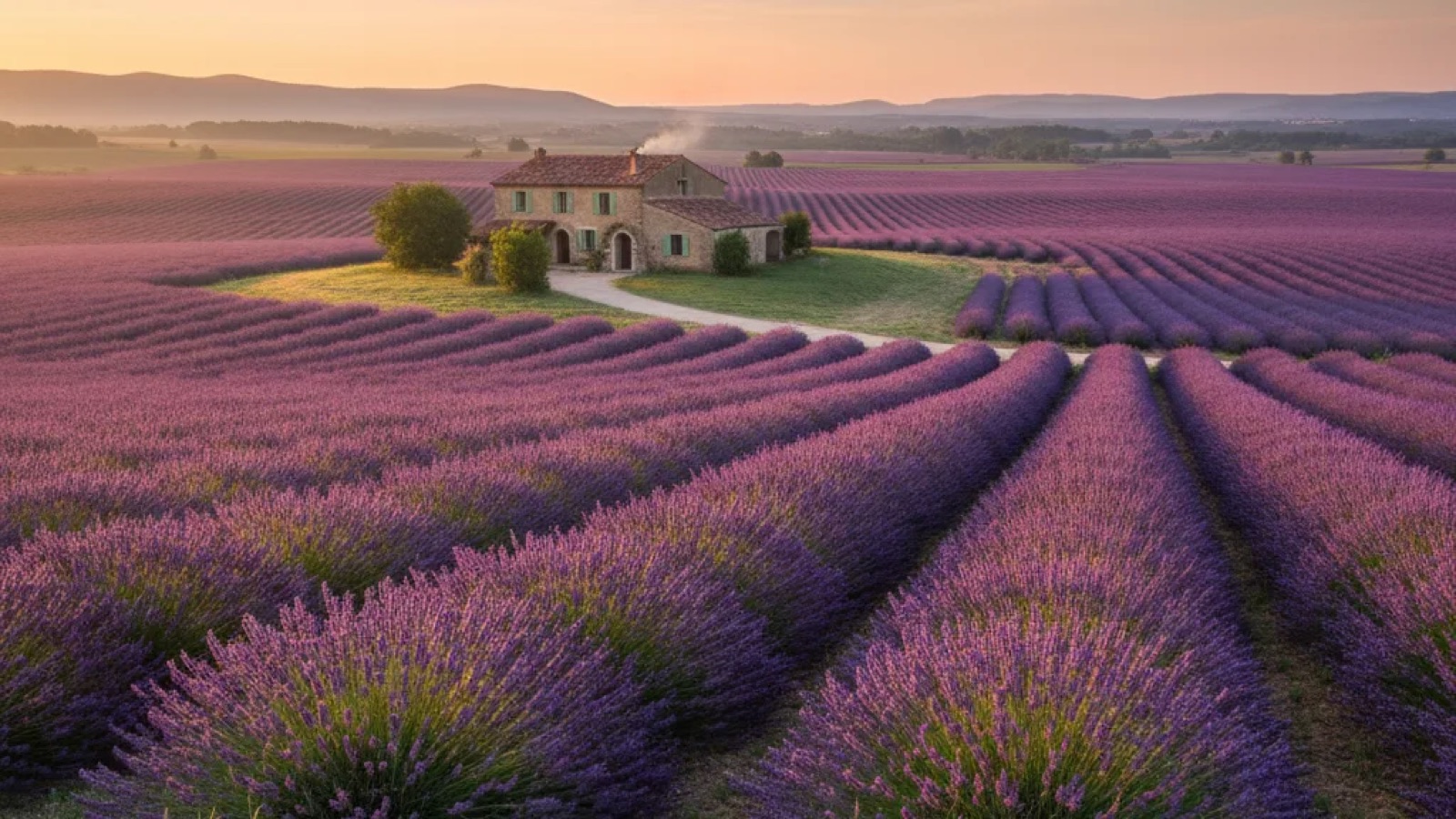
On the Valensole Plateau, the air is thick and warm and carries the scent of lavender, honey and dry earth, all baked together under a relentless sun. Above the low, constant hum of a million bees, the harsh buzz of cicadas echoes from the olive groves, and impossibly long, ruler-straight rows of purple line the dusty tracks. As the sun begins to dip, the sky turns a hazy orange, painting the lavender in hues of deep violet and gold. This is the Provence everyone dreams of: a moment of pure sensory overload, an image that has launched a thousand trips. It’s a place that feels both epic and intimate at the same time.
But Provence is so much more than its iconic lavender fields. It’s a sprawling, sun-drenched region of southern France that unfolds in layers, from the mighty Rhône River in the west to the dramatic Verdon Gorge in the east. It’s a land of grand Roman ruins, papal palaces, and the lingering ghosts of artists like Van Gogh and Cézanne. It’s a rhythm of life dictated by weekly markets, long lunches, and the ever-present bottle of pale pink rosé. In this guide, we’ll journey through it all: the grand cities of Avignon and Arles, the elegant avenues of Aix-en-Provence, the impossibly charming hilltop villages of the Luberon, and the wild, untamed landscapes of the Camargue and the Calanques. We’ll cover how to find those famous flowers, but also how to escape the crowds and find a slice of this magical place for yourself.
Quick Facts
- Location: A historical and cultural region in southeastern France, bordering Italy and the Mediterranean Sea. It's part of the modern administrative region of Provence-Alpes-Côte d'Azur.
- Getting There: High-speed TGV trains connect Paris to Avignon and Aix-en-Provence in under three hours. The main international airport is Marseille Provence Airport (MRS).
- Getting Around: Hiring a car is a near-necessity for properly exploring the villages, lavender fields, and natural parks. Book a compact vehicle to navigate narrow village streets.
- Language and Currency: The language is French. While English is spoken in major tourist centres, knowing a few basic French phrases is appreciated. The currency is the Euro.
- Best Time to Visit: Late spring (May-June) for pleasant weather and wildflowers. Late June to mid-July is peak season for lavender. Autumn (September-October) offers golden light, wine harvests, and fewer crowds.
Orienting Yourself in Provence
Understanding Provence’s geography is the key to planning a trip that makes sense. It’s not a single destination but a mosaic of distinct territories. To the west, the mighty Rhône River valley is home to major hubs like Avignon and Arles, steeped in Roman and papal history. This area is also the heart of the celebrated Côtes du Rhône wine region.
Moving east, you enter the Luberon, the quintessential Provence of Peter Mayle’s books. This is a range of mountains dotted with famous villages perchés (hilltop villages) like Gordes and Roussillon, surrounded by vineyards and agricultural plains. Further east again, the landscape becomes wilder and more dramatic, culminating in the magnificent Verdon Gorge and the vast lavender fields of the Valensole Plateau.
Finally, the southern edge of Provence meets the Mediterranean. Here you’ll find France’s oldest and second-largest city, Marseille, a bustling, gritty port with a character all its own, and the unique wetland wilderness of the Camargue delta, just west of the city.
When to Visit: Seasons and the Mistral Wind
Choosing when to visit will fundamentally shape your experience. The shoulder seasons are the best times to visit. Spring (April to early June) is glorious. The countryside is lush and green, poppies pepper the fields, and the temperatures are perfect for exploring towns and hiking. The crowds have yet to arrive in full force.
Summer (late June to August) is prime time, and for good reason. This is the season for lavender and sunflowers, with the peak bloom generally happening from the last week of June through the first two weeks of July. Be warned: it gets incredibly hot, and the crowds in popular villages can be overwhelming. August is also when many French people take their own holidays, so expect peak demand and some smaller shops or restaurants to be closed for les grandes vacances.
Autumn (September to October) is a fantastic alternative. The light is softer, the grape harvest is underway, and the summer heat has broken. The crowds thin out, and a more relaxed pace returns to the region. Winter is very quiet, with a stark beauty, but many attractions and restaurants operate on reduced hours.
A note on the weather: Provence is famous for the Mistral, a fierce, cold, and dry wind that blows down the Rhône valley. It can appear at any time of year, bringing stunningly clear blue skies but also a significant wind chill. Always pack a windproof jacket, even in summer.
Getting There and Around: The Essential Car Hire
Accessing Provence has become remarkably easy. The TGV, France’s high-speed train, is a marvel. From Paris’s Gare de Lyon, you can be in the centre of Avignon or Aix-en-Provence in about three hours, making it a brilliant and relaxing way to arrive. For international travellers, flying into Marseille is your best bet, with plenty of car hire options available at the airport.
Once you’re here, however, a car is not just a luxury; it’s essential for freedom. Public transport between the major cities is fine, but it simply won’t get you to the hilltop villages, the hidden lavender fields, or the scenic lookout points that truly define the region. Book the smallest car that will comfortably fit you and your luggage. The medieval lanes of the tiny villages are no place for a family-sized sedan.
A crucial piece of practical advice: when you visit the popular hill towns, do not try to drive into the historic centre. The streets are often impossibly narrow, pedestrianised, or one-way. Look for the designated public car parks (usually marked with a 'P') on the outskirts of the village and be prepared to walk a few hundred metres uphill. It saves an immense amount of stress.
Avignon, the Reign of Popes
Standing in the main courtyard of the Palais des Papes in Avignon, it's impossible not to be floored by the sheer scale of the place. This was the centre of the Catholic world in the 14th century, and it feels more like a fortified city than a palace. The vast, austere halls are largely empty now, but their immense size speaks volumes about the power and wealth of the Avignon Papacy. It’s a must-see, but allow plenty of time to wander its labyrinthine corridors.
Beyond the palace, Avignon is a charming, lively city, enclosed by its remarkably preserved medieval walls. Head to the Pont d'Avignon (officially the Pont Saint-Bénézet) which famously stops halfway across the Rhône. The real joy of Avignon is getting lost in the cobbled streets of the old town, discovering quiet squares like Place des Corps Saints, and soaking up the atmosphere of a city that beautifully balances its epic history with a vibrant, modern university town feel.
Arles, Van Gogh and Roman Grandeur
Arles has a different vibe to Avignon—it feels grittier, earthier, and deeply connected to its Roman and artistic past. The magnificent Roman Arena, still used for events today, dominates the city. You can climb to the top for a fantastic view over the terracotta rooftops. A short walk away is the equally impressive Roman Theatre.
But above all, Arles is synonymous with Vincent van Gogh. It was here, during a feverishly productive period, that he painted some of his most famous works. You can follow a marked trail around the city to see the locations that inspired him, like the Place du Forum, site of his painting Café Terrace at Night. Seeing the real-life setting and then the artist’s interpretation is a powerful experience. The city has a deep respect for its artistic legacy, which you can feel everywhere.
Aix-en-Provence: Fountains and Cézanne's Ghost
If Avignon is about power and Arles is about history, Aix-en-Provence is about elegance. This is a city of leafy boulevards, bubbling fountains, and chic boutiques. The main artery is the Cours Mirabeau, a magnificent avenue shaded by a canopy of plane trees, perfect for strolling and people-watching from a café terrace. The entire old town is a pedestrian-friendly maze of golden-stone buildings and hidden squares.
Aix is also inextricably linked to the painter Paul Cézanne, who was born here and painted the surrounding landscape, particularly Mont Sainte-Victoire, obsessively. You can visit his beautifully preserved studio, Atelier de Cézanne, just a short walk north of the old town; during ongoing restoration it opens seasonally (4 July to 31 October in 2026). It’s been left almost exactly as it was when he died, with his smocks, palettes, and the still-life objects that appear in his famous paintings. It’s a quiet, moving glimpse into his world.
Chasing Lavender: The Valensole and Sault Plateaux
This is the main event for many summer visitors. First, a reality check: lavender has a short and variable season, roughly from the last week of June until the harvest begins in mid-to-late July. The timing depends on the altitude and the year's weather, so always check recent reports before you go. Don't plan a trip for August expecting to see fields of purple.
There are two main areas to focus on. The Valensole Plateau is the most famous, offering vast, rolling fields of lavender often planted alongside golden wheat or sunflowers. This is where you find those iconic, seemingly endless rows. It’s incredibly photogenic, but also the most crowded. For the best light and fewest people, you have to be there at sunrise. The soft morning light on the purple flowers is pure magic.
The second area is the Sault Plateau, which is higher in altitude. The lavender here tends to bloom a couple of weeks later than on the Valensole. The fields are smaller and more integrated with the landscape, often surrounding farms and the charming town of Sault itself. It feels a little more rustic and less overwhelming than Valensole.
One of the most famous photographs is of the Abbaye de Sénanque, a 12th-century Cistercian abbey with a perfectly placed lavender field in front. It’s located near Gordes in the Luberon. Be aware that access to the field itself is now heavily restricted to protect the monks' crop. You can still get the classic shot from the approach road, but you can't wander among the rows right in front of the abbey.
The Hilltop Villages of the Luberon
The Luberon is the romantic heart of Provence, a region of vineyards, olive groves, and enchanting hilltop villages. You could spend weeks exploring them, but a few stand out as essential stops.
Gordes
Arguably the most spectacular of all, Gordes is a village of pale stone houses that spiral up a steep hill to a Renaissance château at its peak. The view of Gordes is as famous as the village itself. There's a designated scenic viewpoint on the D15 road as you approach from the west. My photography advice is to be there for the golden hour before sunset, when the sinking sun lights up the stone buildings in a warm, breathtaking glow.
Roussillon
Roussillon is utterly unique. The village is built on and surrounded by one of the world's largest ochre deposits. The cliffs and buildings blaze in an incredible palette of reds, oranges, and yellows. You can walk the "Sentier des Ocres" (Ochre Trail) through the former quarries, a surreal and colourful landscape. Unlike Gordes, Roussillon's colours are at their most intense under the harsh light of midday, which makes the pigments pop.
Ménerbes and Bonnieux
These two beautiful villages face each other across a valley. Ménerbes is listed among the "Most Beautiful Villages of France", and both offer stunning views and a slightly quieter, more authentic atmosphere than Gordes. Ménerbes boasts a rich artistic history, while Bonnieux is known for its dramatic terraced setting and two churches, one at the top and one at the bottom of the village. Exploring either is a perfect way to spend a slow afternoon.
Europe's Grand Canyon: The Verdon Gorge
To the east of the lavender plateaux, the landscape is ripped open by the Gorges du Verdon, a river canyon of staggering proportions. The turquoise Verdon River has carved a chasm up to 700 metres deep through the limestone. The best way to experience it is to drive the scenic loop roads (the Corniche Sublime on the south rim is a standout) that cling to the cliffs, stopping at the many breathtaking viewpoints (belvédères).
At the western end of the gorge, the river flows into the stunning Lac de Sainte-Croix, a man-made reservoir of an almost impossibly vivid turquoise colour. It's a hub for water sports. You can hire an electric boat, a pedalo, or a kayak from the shore and paddle up into the mouth of the canyon itself. Floating between the immense cliffs, looking up at the sky, is an unforgettable experience.
The Wild Camargue: Horses, Bulls and Flamingos
South of Arles, the Rhône River splits and forms a vast delta known as the Camargue. This is a complete change of scenery from the rest of Provence. It's a flat, marshy wetland of salt pans, reed beds, and lagoons. This unique ecosystem is famous for its semi-wild inhabitants: the sturdy, grey-white Camargue horses; the black, athletic bulls raised for local festivals; and, most spectacularly, vast flocks of pink flamingos that feed in the shallow lagoons. The Parc Ornithologique de Pont de Gau is a fantastic and accessible place to see the flamingos and other birdlife up close. The Camargue feels like another world—wild, windswept, and utterly captivating.
A Grittier Grace: Marseille and the Calanques
Don’t let anyone tell you to skip Marseille. It's the perfect antidote to the sometimes-twee perfection of the Luberon villages. As France's oldest city, it's a vibrant, multicultural port with a chaotic energy and a proud, independent spirit. The heart of the city is the Vieux Port (Old Port), where fishermen still sell their catch directly from their boats in the morning. For a panoramic view, climb up to the basilica of Notre-Dame de la Garde, the city's beloved guardian.
Just outside the city lies one of France's most stunning natural treasures: the Calanques National Park. These are a series of dramatic, fjord-like inlets with sheer white limestone cliffs plunging into the turquoise Mediterranean. You can explore them by taking a boat tour from the Vieux Port or, for the more adventurous, by hiking the breathtaking coastal trails. The contrast between the urban intensity of Marseille and the rugged, pristine beauty of the Calanques next door is extraordinary.
Explore in Depth
Once you've fallen for the sun-drenched landscapes of Provence, the allure of the coast is undeniable. Continue your journey east to explore the glamorous towns and stunning coastal scenery of the Côte d'Azur.
Frequently Asked Questions
Do I really need to hire a car in Provence?
For the best experience, yes. While you can travel between the main cities like Avignon, Arles, and Aix-en-Provence by train, a car is essential for exploring the Luberon villages, the lavender fields of Valensole, the Verdon Gorge, and the countryside at your own pace. It gives you the freedom to stop at roadside viewpoints, discover tiny hamlets, and visit markets on their specific days. Without a car, you would be reliant on limited bus schedules or organised tours, which restricts your ability to truly immerse yourself in the region.
What's the best town to use as a base for exploring the Luberon villages?
Choosing a central base is a great strategy. Instead of staying in one of the uber-popular villages like Gordes, which can be expensive and crowded, consider a slightly larger town like L'Isle-sur-la-Sorgue. It's famous for its antique markets and waterways, and it’s perfectly positioned for day trips into the Luberon. Alternatively, staying in a smaller, less famous village or a rural guesthouse (holiday home) can provide a more peaceful and authentic experience, putting you right in the heart of the landscape you came to see.
Is it possible to see the lavender fields without a car?
It's challenging but not impossible. Several tour operators run day trips from major hubs like Avignon and Aix-en-Provence during the lavender season. These tours will take you to the key spots on the Valensole or Sault plateaux. However, they operate on a fixed schedule and you'll be with a group, which limits your flexibility for photography or spontaneous stops. For travellers unable or unwilling to drive, this is the most practical option, but you should book well in advance as they are very popular.
How can I photograph the lavender fields respectfully?
This is incredibly important. These fields are the livelihood of farmers. Always stay on the dirt tracks between the rows of lavender; never walk or sit down in the middle of the plants, as this can damage them. Be very mindful of the bees—they are busy working and won't bother you if you don't bother them. Drones are often prohibited and can be disruptive to both farmers and other visitors. Simply be conscious that it is a working farm, not just a photo backdrop, and leave it exactly as you found it.
What is the Mistral and how will it affect my trip?
The Mistral is a strong, cold, and often gusty wind that blows from the north, down the Rhône Valley, and into Provence. It can occur at any time of year and can last for several days. The upside is that it famously clears the air, creating the brilliant, deep blue skies and sharp light that Provence is famous for. The downside is that it can feel quite cold and make activities like cycling or sitting at an outdoor café unpleasant. Always pack a good windproof jacket, no matter the season. It’s a fundamental part of the Provençal climate.
Final Thoughts
Few places linger in the memory quite like Provence. It’s a place to be experienced with all your senses. It’s the peppery taste of olive oil at a morning market, the scent of thyme crushed underfoot on a hillside path, the sight of that impossible purple haze stretching to the horizon, and the feeling of cool rosé on your tongue on a hot afternoon.
My best advice is to slow down. Don’t try to tick off every village in a single day. Give yourself time to get a little lost, to sit in a square with a coffee and watch the world go by, to strike up a conversation with a stallholder. Provence’s magic isn’t just in its famous sights, but in the rhythm of its daily life. Embrace it, and you'll come away with photos, yes, but more importantly, with memories that will last a lifetime.