Barcelona Itinerary: Gaudi, Gothic Quarter, Beaches
Three days in Barcelona: Sagrada Familia and Park Guell booking, the Gothic Quarter, Gracia, beaches and easy day trips.
In this guide
- Quick Facts
- Planning Your Barcelona Trip: Logistics & Timing
- Navigating the City: Eixample vs. Ciutat Vella
- The Genius of Gaudí: Sagrada Família and Park Güell
- Beyond Gaudí: More Modernisme Masterpieces
- Getting Lost in the Gothic Quarter and El Born
- La Rambla and La Boqueria: A Reality Check
- Beyond the Centre: Gràcia, Montjuïc and the Beaches
- A Photographer's Perspective: Bunkers and Tibidabo
- Understanding Catalan Culture, Vermouth, and Late Dinners
- Best Day Trips: Montserrat, Sitges, and Girona
- When to Visit and Travelling Respectfully
- Explore in Depth
- Frequently Asked Questions
- Final Thoughts
This guide is part of our Spain Itinerary: Madrid, Andalusia and Barcelona — start there for the overview, when to go and how to get around.
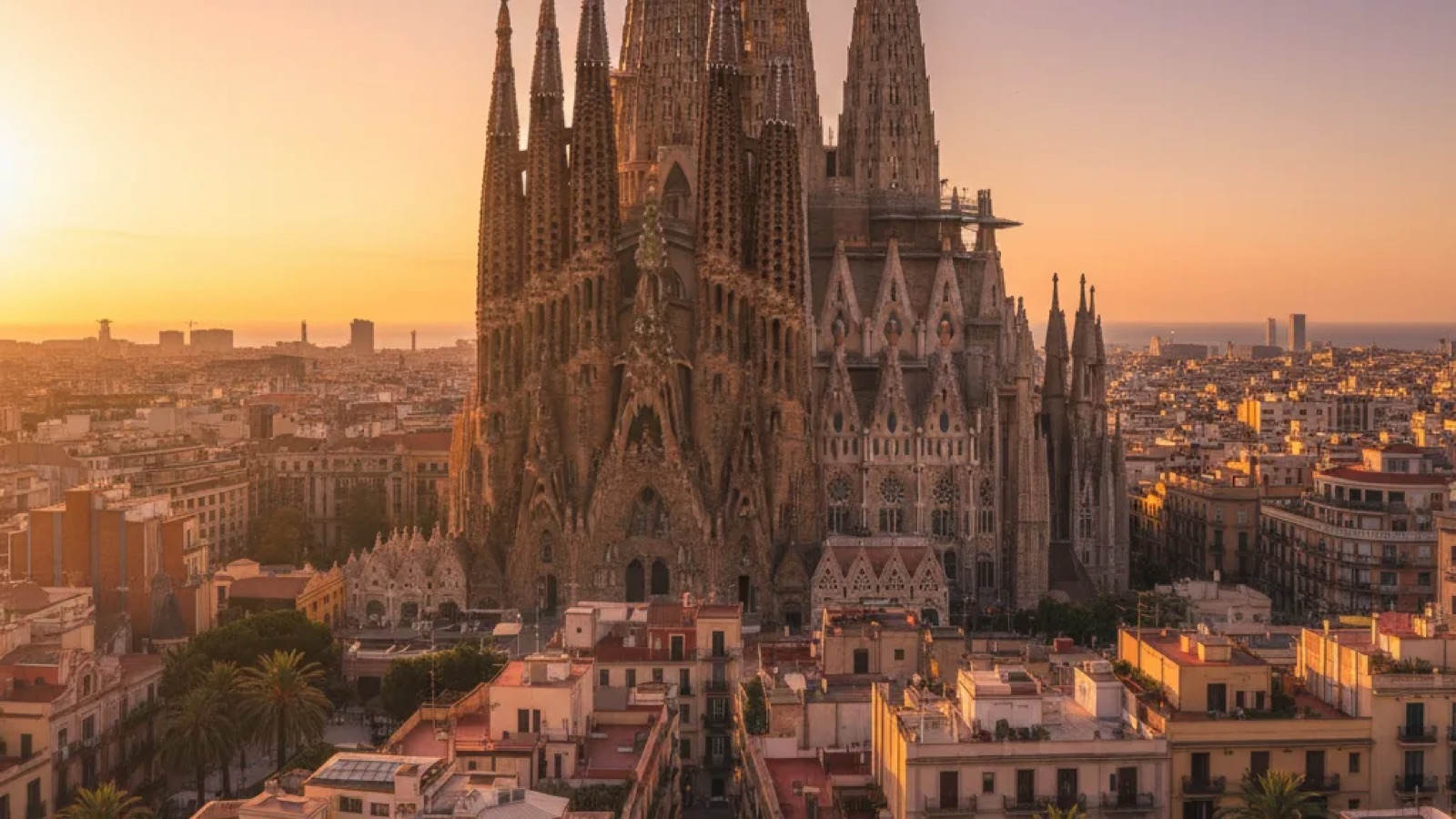
The first sight of it is a moment that sticks with you. Emerge from the dim, functional world of the Barcelona metro into the brilliant Catalan sunshine, turn a corner, and you just… stop. There it is. The Sagrada Família isn't just a church; it looks like something that has grown out of the earth, a surreal sandcastle dreamed up by a mad genius and brought to life. It's organic, utterly bonkers, and more breathtaking than any photo can prepare you for. That single moment captures the essence of Barcelona: a city that plays by its own rules, blending the ancient and the audaciously modern into something completely unique.
This isn't just a checklist of sights. It's a practical guide to navigating the city's dual personalities, from the tangled lanes of the Gothic Quarter to the perfect grid of the Eixample. We’ll cover how to smartly tackle the masterpieces of Gaudí, find the best views for your photos, understand the fiercely proud Catalan culture, escape the crowds for a perfect beach day, and travel in a way that respects the city and its people. So, let’s get you ready to explore Barcelona.
Quick Facts
- Location: Barcelona is the capital of Catalonia, an autonomous community in the northeast of Spain, right on the Mediterranean Sea.
- Getting There: The main international gateway is Barcelona-El Prat Airport (BCN). From there, you can take the Aerobus, the Rodalies R2 Nord train line, or the L9 Sud metro line into the city centre.
- Getting Around: Barcelona is a wonderfully walkable city, but its metro system is clean, fast, and efficient for covering longer distances. A multi-journey travel card is usually a great-value option.
- Language & Currency: The official languages are Catalan and Spanish. You'll see and hear both everywhere. The currency is the Euro.
- Best Time to Visit: Spring (April-June) and Autumn (September-October) offer pleasant weather and fewer crowds. July and August are very hot and packed, while winters are cool but often sunny.
Planning Your Barcelona Trip: Logistics & Timing
First things first. Getting from Barcelona-El Prat Airport (BCN) into the city is straightforward. The Aerobus is a dedicated-purpose express bus service that runs frequently and drops you at central points like Plaça de Catalunya. Often a better option, however, is the Rodalies R2 Nord train. It’s an efficient local train that connects the airport (from Terminal 2, with a free shuttle from Terminal 1) to key city stations like Sants and Passeig de Gràcia, which puts you right in the heart of the Modernisme district. There’s also the L9 Sud metro line, but be aware it doesn’t go directly to the city centre; you'll need to change lines, which can be slower with luggage.
Once you're in the city, the metro is your best friend. It’s extensive and easy to navigate. Consider purchasing a T-casual or T-familiar card, which offer multiple journeys and are far better value than single tickets. But honestly, the best advice is to walk. It’s the only way to truly appreciate the architectural details and stumble upon hidden squares and local bodegas.
The eternal question: how many days do you need? A bare minimum of three full days lets you skim the absolute highlights – the main Gaudí sites and a wander through the old city. But to do it justice, allow four to five days. This gives you time to explore a neighbourhood like Gràcia, relax on a beach, see Montjuïc properly, and maybe even take one of the fantastic day trips on offer. A week is a luxury that allows a much more relaxed pace, letting you truly soak in the rhythm of Catalan life.
Navigating the City: Eixample vs. Ciutat Vella
Barcelona is a city of two distinct characters, and understanding them is key to navigating it. The first is the Eixample, the vast 19th-century "extension" district. It's a masterpiece of urban planning, a perfect grid of wide, tree-lined avenues and chamfered street corners designed for light and airflow. It feels open, elegant, and orderly. This is where you'll find the grand boulevards like Passeig de Gràcia and the majority of Gaudí's and other Modernista architects' jaw-dropping apartment buildings.
Then there's the Ciutat Vella, or "Old City." This is the original Barcelona, a labyrinthine tangle of narrow, shadowy streets that suddenly open onto sun-drenched plaças. It's comprised of distinct neighbourhoods, primarily the Barri Gòtic (Gothic Quarter) and El Born. Here, the map is less a guide and more a vague suggestion. The best advice? Put your phone away for an hour and just get purposefully lost. You’ll find Roman walls, tiny artisan shops, centuries-old churches, and the true, beating heart of the old city. The contrast between the rigid order of the Eixample and the romantic chaos of the Ciutat Vella is one of Barcelona's great charms.
The Genius of Gaudí: Sagrada Família and Park Güell
You can't talk about Barcelona without talking about Antoni Gaudí. His work is woven into the fabric of the city. The crown jewel is, of course, the Basílica de la Sagrada Família. For photographers, the small park across the pond on the Nativity Façade side gives the classic reflection shot. But you absolutely must go inside. Nothing prepares you for the interior. Gaudí designed the columns to branch out like a forest canopy, and the effect, with sunlight streaming through the brilliantly coloured stained-glass windows, is transcendent. You must book your timed-entry ticket online, well in advance. That means weeks, or even months for peak season. They sell out every single day. Don’t just show up expecting to get in.
His other unmissable creation is Park Güell. Originally intended as a housing development, it's now a whimsical public park. Be aware that the park is split into a free general access area and the ticketed "Monumental Zone." This paid zone is where you'll find the iconic undulating mosaic bench with its panoramic city views, the famous dragon staircase, and the columned hall. Like the Sagrada Família, you need to book a timed ticket online beforehand. Go as early in the morning as you can manage to avoid the worst of the crowds and the midday heat.
Beyond Gaudí: More Modernisme Masterpieces
While Gaudí is the star, the Catalan Modernisme movement was full of brilliant architects. Take a walk down the glamorous Passeig de Gràcia and you'll find two of Gaudí’s most famous residential buildings, often facing off against each other. Casa Batlló is the stuff of fairy tales, with its skeletal balconies and a roof that looks like the scales of a dragon. A few blocks up, La Pedrera (Casa Milà) is more monolithic, an undulating cliff of a building with a truly spectacular rooftop terrace dotted with surreal, sculptural chimneys. Going inside both can be time-consuming and costly, so if you have to choose one, the sheer fantasy of Casa Batlló makes it the stronger pick.
But here’s an insider tip: for a arguably more expansive and far less crowded Modernisme experience, take the metro to the Hospital de Sant Pau. Designed by Gaudí's contemporary, Lluís Domènech i Montaner, this former hospital is a sprawling complex of stunning pavilions set in beautiful gardens, all connected by underground tunnels. Each building is a jewel of tilework, stained glass, and sculpture. It’s a UNESCO World Heritage site that many visitors miss, and spending a couple of hours here feels like discovering a glorious secret.
Getting Lost in the Gothic Quarter and El Born
The historic core of Barcelona is a joy to explore on foot. The Barri Gòtic (Gothic Quarter) is the oldest part of the city. Its narrow lanes, some too small for cars, are cool and shaded even on the hottest day. Don’t miss the magnificent Barcelona Cathedral with its cloister full of geese, a completely different beast to the Sagrada Familia. Keep an eye out for the remnants of the Roman wall and the enchanting Plaça de Sant Felip Neri, a square bearing the tragic scars of the Spanish Civil War.
Adjacent to the Gothic Quarter is El Born, which feels a little more bohemian and trendy. Its medieval streets are packed with independent boutiques, cool cocktail bars, and excellent tapas restaurants. It’s home to the impressive Basilica de Santa Maria del Mar, a breathtaking example of Catalan Gothic architecture funded by the area’s medieval merchants and sailors. Its soaring, unadorned columns give it a sense of space and light that is truly humbling. El Born also houses the Picasso Museum. It's a fantastic museum, but it’s important to know it focuses on the artist's formative years in Barcelona, so you'll see a lot of his early, more classical work rather than the cubist masterpieces he's most famous for. Again, book tickets online to avoid a very long queue.
La Rambla and La Boqueria: A Reality Check
Every visitor to Barcelona walks down La Rambla at least once. It's a wide, tree-lined pedestrian boulevard that stretches from Plaça de Catalunya down to the port. You should see it, but it’s important to see it for what it is: a crowded, tourist-heavy thoroughfare. Walk it once, then use the quieter parallel streets in the Gothic Quarter or El Raval for your north-south travels.
This area is also notorious for pickpocketing. It's not a violent crime, but a crime of distraction and opportunity. Keep your bag zipped and in front of you, don't put your phone or wallet in your back pocket, and be wary of anyone trying to distract you. Just being alert is 90% of the battle.
Halfway down La Rambla is the entrance to the famous La Boqueria market. It is an incredible explosion of colour, sound, and smell, but it can be overwhelming. The stalls at the front are mostly for tourists. For a more authentic experience, push deeper into the market where you'll see locals doing their actual shopping. A note on etiquette: this is a working market. Don't just grab fruit from the front of a beautifully arranged display to take a photo. Ask first, buy a fresh-pressed juice or a cone of jamón, and enjoy it away from the congested main aisle. Respect the vendors and their livelihood.
Beyond the Centre: Gràcia, Montjuïc and the Beaches
To really get a feel for local life, you need to leave the Ciutat Vella. The best neighbourhood for this is Gràcia. Until the Eixample connected it to the old city, Gràcia was a separate town, and it still retains a proud, independent village feel. Its lifeblood is its many 'plaças' or squares, like Plaça de la Vila de Gràcia and Plaça del Sol. In the late afternoon, these squares fill with families and friends meeting for a drink, and it’s the perfect place to pull up a chair and just watch Barcelona life unfold.
For green space and culture, head up Montjuïc hill. You can get there by funicular railway (connected to the metro) and then a cable car to the top. At the summit sits Montjuïc Castle, offering knockout views of the commercial port. The hill is also home to the excellent Fundació Joan Miró, dedicated to the Barcelona-born surrealist artist, and the Olympic Stadium. At the foot of the hill, near Plaça d'Espanya, is the Magic Fountain. On select evenings, it comes alive with a spectacular show of light, water and music. The schedules change seasonally, so always check the official city council website for current show times.
And the beaches! Barceloneta is the city's main beach, lively and full of action, but it gets incredibly crowded. For a bit more space and a more relaxed vibe, follow the waterfront promenade or take the L4 metro a couple of stops further north to Bogatell Beach or Mar Bella Beach. The sand is cleaner, the water feels fresher, and you'll have more room to lay down your towel.
A Photographer's Perspective: Bunkers and Tibidabo
For photographers chasing the best light and the perfect viewpoint, the views from Park Güell and Montjuïc are great, but two other spots offer something more. The first is the Bunkers del Carmel. These are the concrete remnants of anti-aircraft gun emplacements from the Spanish Civil War, sitting high on a hill above the city. There are no services here, just a raw, 360-degree panoramic view of the entire city grid stretching out to the sea. It's a local favourite for sunset. It takes a bus ride and a short, steep walk to get there, but the reward is the best photo you'll take of Barcelona.
The second is Mount Tibidabo, the mountain that forms the city's backdrop. Topped by the striking Temple Expiatori del Sagrat Cor and a charmingly old-fashioned amusement park, the view from here is different. It's higher and more distant than the Bunkers, giving you a grander, more sweeping perspective. A longer lens works well from here to compress the cityscape, making the Sagrada Família pop against the grid of the Eixample. Getting there is part of the fun, involving a train to Avinguda Tibidabo, a bus or the Tramvia Blau, and then the funicular.
Understanding Catalan Culture, Vermouth, and Late Dinners
It's crucial to remember that you are in Catalonia, which has its own language, history, and identity distinct from the rest of Spain. You'll see the Catalan flag everywhere and notice that street signs are in Catalan first. Learning a few basic phrases will be hugely appreciated: Bon dia (Good day), Si us plau (Please), Gràcies/Merci (Thank you), and Adéu (Goodbye).
Embracing the local rhythm will make your trip so much better. One of the most enjoyable local traditions is 'l'hora del vermut' (the vermouth hour). Before lunch, especially on weekends, locals gather for a small glass of sweet vermouth, often served on tap with a slice of orange and an olive. It’s a wonderful, civilised ritual. Dinner is also a late affair. Most restaurants don't even get busy until 9 pm, and it’s common to see people sitting down to eat at 10 pm or later. If you show up for dinner at 6:30 pm, you'll likely be eating in an empty restaurant. Adjust your schedule, have a late afternoon snack (a 'merienda'), and enjoy a properly timed Catalan dinner.
Best Day Trips: Montserrat, Sitges, and Girona
If you have an extra day, Barcelona's excellent train network makes day trips a breeze. Three stand out:
- Montserrat: Less than an hour by train, you'll find the incredible multi-peaked mountain of Montserrat, which looks like a giant saw blade cutting into the sky. A monastery is nestled into its cliffs, home to the famous Black Madonna statue. The views are spectacular, and there are numerous hiking trails for all abilities.
- Sitges: A 40-minute train ride south, this beautiful coastal town is a perfect beach escape. It has a lovely old town, a beautiful seaside promenade, and over a dozen sandy beaches. It’s also long been known as one of Europe’s most vibrant and welcoming LGBTQ+ destinations.
- Girona: About 40 minutes on the high-speed train, Girona is a perfectly preserved medieval dream. You can walk its ancient city walls, get lost in its labyrinthine Jewish Quarter (one of the best-preserved in Europe), and admire the colourful houses hanging over the Onyar River. Fans of Game of Thrones will recognise many locations.
When to Visit and Travelling Respectfully
The best times to visit Barcelona are spring (April-June) and autumn (September-October). The weather is warm and pleasant without being oppressive, the city is vibrant, and the crowds are more manageable. July and especially August are relentlessly hot and humid, and the city is packed to the gills. It’s also the traditional holiday month for locals, so you may find some smaller, family-run shops and restaurants are closed.
Barcelona has also been at the forefront of conversations about overtourism. The city has struggled with the sheer volume of visitors, and there's a tangible tension in some areas. As travellers, we have a responsibility to be part of the solution. This means staying in legally registered tourist accommodation (look for a licence number), not in illegal apartments that drive up local rents. It means keeping your voice down late at night in residential buildings and streets. It means being patient and respectful in shops and on public transport. And it means spreading your tourist euros around by exploring neighbourhoods beyond the Gòtic and El Born. Being a mindful traveller will not only benefit the city but will give you a much richer and more authentic experience.
Explore in Depth
Barcelona is often one stop on a grander tour of Spain. If you're building a bigger itinerary or looking for more European travel advice, these guides will help you plan your next steps.
Frequently Asked Questions
Is it worth paying to go inside the Sagrada Família?
Absolutely, one hundred percent yes. While the exterior is fascinating, the interior is where Gaudí's true genius is on full display. The design of the columns, modelled on a forest canopy, and the way the coloured light from the stained-glass windows filters through the space is a genuinely moving and unforgettable experience. Many visitors who skip it later regret it. Just be certain to book your tickets online well in advance, as they sell out daily and you cannot rely on buying them at the door.
What's the best way to avoid pickpockets in Barcelona?
The key is awareness, not fear. Pickpocketing here is about stealth and distraction, not violence. The best prevention is simple: don't make yourself an easy target. Wear a cross-body bag zipped and kept in front of your body, or a backpack worn on your front in crowded areas like the metro or La Rambla. Never put your wallet or phone in your back pocket. Be wary of any sudden commotion or strangers getting unusually close to you. By being mindful of your surroundings and your belongings, you can enjoy the city without worry.
Will I have trouble if I don't speak Spanish or Catalan?
You’ll be perfectly fine. In hotels, major attractions, and most restaurants in the tourist centre, English is widely spoken. However, Barcelona is in Catalonia, and making an effort with a few words in Catalan (like 'Bon dia' for 'Good day') or Spanish ('Hola', 'Gracias') is hugely appreciated and shows respect for the local culture. It’s a small gesture that can open doors and lead to warmer interactions. It's worth having a translation app on your phone for menus or more complex questions in smaller, local establishments.
Should I stay near the beach or in the city centre?
This depends entirely on your travel style. If your primary goal is to be in the heart of the action, with easy access to the main sights, museums, and restaurants, staying in the Eixample, Gothic Quarter, or El Born is ideal. You'll be able to walk almost everywhere. If your dream trip involves waking up and heading straight for the sea and you prefer a more relaxed, holiday atmosphere, then a hotel in Barceloneta or the quieter Poblenou neighbourhood further up the coast could be perfect. Thanks to the efficient metro, you can easily get to the city centre from the beach areas in 15-20 minutes.
Are the day trips from Barcelona easy to do without a car?
Yes, incredibly so. Barcelona has a fantastic regional train network (Rodalies) and bus services that make day-tripping without a car simple and efficient. For Montserrat, dedicated trains run from Plaça d'Espanya that connect with the cable car or funicular railway up the mountain. Sitges is a short and scenic ride on the coastal train from major stations like Sants or Passeig de Gràcia. For Girona, the high-speed AVE train from Sants station will get you there in under an hour. Organising these trips is very straightforward for an independent traveller.
Final Thoughts
There are cities you visit, and then there are cities you feel. Barcelona is firmly the latter. It's a place that gets under your skin – the surreal beauty of a Gaudí rooftop at sunset, the taste of salty air as you walk back from the beach, the clatter of plates and chatter from a packed tapas bar in Gràcia. It’s a city that bristles with a creative energy and a fierce pride that is utterly captivating.
More than just a collection of world-class sights, Barcelona is a lesson in living. It teaches you to look up at the details on buildings, to get lost in old streets, to appreciate the ritual of a pre-lunch vermouth, and to slow down for a late, lingering dinner. It’s a city that rewards return visits, revealing another secret, another hidden square, another reason to fall in love with it all over again. Hopefully this guide helps you find your own reasons, too.