Buenos Aires Guide: Neighbourhoods, Steak, Tango
Buenos Aires in four days: San Telmo, Recoleta, Palermo and La Boca, plus asado, tango, transport and safety basics.
In this guide
- Quick Facts
- Planning Your Trip: Airports and How Many Days
- Getting Around: The SUBE Card and Public Transport
- Choosing Your Base: A Guide to the Barrios
- The Historic Centre: Plaza de Mayo and the Casa Rosada
- Grand Stages: Teatro Colón and El Ateneo Grand Splendid
- Recoleta Cemetery: A City of the Dead
- Bohemian Souls: San Telmo and La Boca
- The Modern Waterfront and a Wild Escape
- The Heartbeat of Tango: Shows versus Milongas
- A Carnivore's Dream: The Art of the Parrilla
- Day Trips: The Tigre Delta and Uruguay
- Explore in Depth
- Frequently Asked Questions
- Final Thoughts
This guide is part of our Argentina Travel Guide: Routes, Seasons, Distances — start there for the overview, when to go and how to get around.
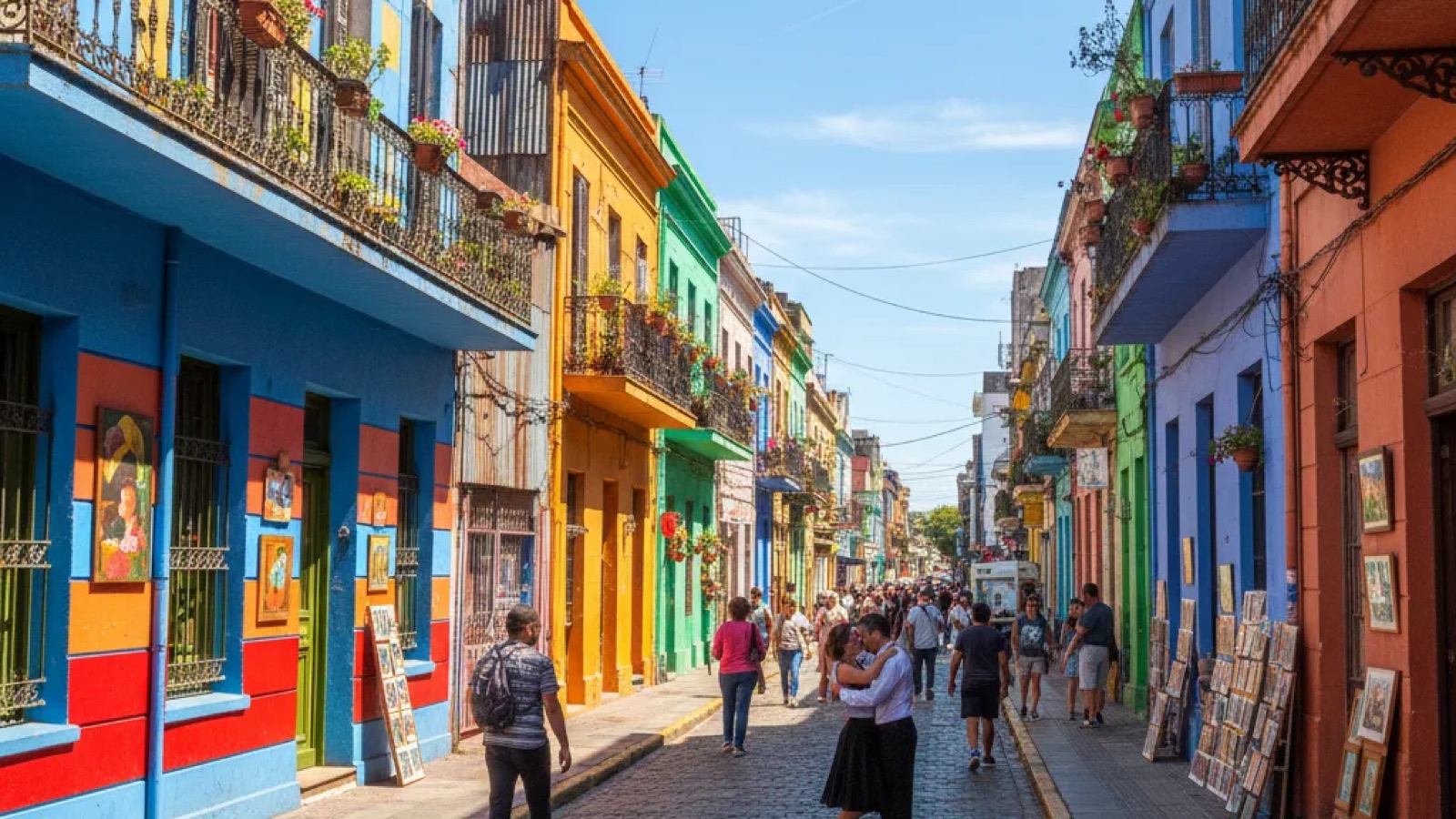
The air in San Telmo hangs thick with history. Step out of a small, dimly lit bar just off Plaza Dorrego and you might find a couple on the cobblestones, shimmering under a wrought-iron streetlamp, locked in an impromptu tango. It isn't a show; their movements are subtle, intimate, a silent conversation in a language only they understand. Around them, the city hums—the distant clatter of a closing restaurant, the murmur of Spanish from a balcony above, the faint, ever-present scent of grilled meat and exhaust fumes. That is Buenos Aires: a city of grand European boulevards and gritty, passionate side streets, where beauty and melancholy dance together under the southern stars.
They call it the "Paris of South America," but that's only half the story. Buenos Aires has a soul all its own, a complex identity shaped by waves of immigration, political turmoil, and an unbreakable creative spirit. This guide navigates the sprawling neighbourhoods, from chic Palermo to bohemian San Telmo. It dives head-first into the culture of the parrilla (steakhouse), decodes the world of tango, and uncovers the practical tips you need to explore it all safely and confidently, from which airport to fly into to how to use the local transport like a Porteño.
Quick Facts
- Location: The capital of Argentina, located on the western shore of the Río de la Plata.
- Getting There: Major international flights land at Ezeiza Airport (EZE), about 45-60 minutes from the city centre. Domestic and some regional flights use the much closer Aeroparque Jorge Newbery (AEP).
- Getting Around: An extensive public transport system using the SUBE card for the subway (subte) and buses (colectivos). Walking is the best way to explore individual neighbourhoods.
- Language & Currency: Spanish is the official language, with a distinct Argentine accent and slang. The official currency is the Argentine Peso (ARS). Note that the economy can be volatile, so it's wise to stay informed on the current situation before you travel.
- Best Time to Visit: Spring (September to November) and Autumn (March to May) offer lovely mild temperatures perfect for walking. Summers are hot and humid, while winters are cool but rarely freezing.
Planning Your Trip: Airports and How Many Days
Your arrival in Buenos Aires will likely be at one of two airports. Ezeiza International Airport (EZE) is the main gateway for long-haul flights from around the world. It’s located about 35 kilometres south of the city, and the journey into town can take anywhere from 45 minutes to over an hour, depending on traffic. Your best bets for transfers are the official airport taxis, pre-booked private car services, or specific airport shuttle buses. It’s always best to arrange this at one of the official counters inside the terminal rather than with someone who approaches you.
Aeroparque Jorge Newbery (AEP) is the city's domestic airport, though it also handles some flights from neighbouring countries. Its biggest advantage is its location, right on the riverfront and a very short taxi ride from neighbourhoods like Palermo and Recoleta. If you're arriving from another part of Argentina, like Patagonia or Iguazú Falls, you'll almost certainly land here. The convenience is a massive plus.
How long do you need? A minimum of four full days is essential to even scratch the surface. This gives you enough time to explore two or three key neighbourhoods without rushing, see a tango show, enjoy a long, leisurely steak dinner, and visit a major museum or two. With a week, you can slow down, truly get the feel of a chosen barrio (neighbourhood), explore the parks, and even take a day trip out of the city.
Getting Around: The SUBE Card and Public Transport
Buenos Aires is a huge city, but its public transport system is effective and a core part of local life. Your first mission upon arrival should be to get a SUBE card. You can buy and top it up at subte stations and countless small shops called kioscos. You can't pay for public transport with cash, so the card is the simplest option, although every Subte line and a growing number of bus lines now also accept contactless Visa and Mastercard cards and QR payments. One card can be used for multiple people; you just tap it once for each person in your group.
The subway, or Subte, is the easiest way to travel between distant neighbourhoods. It's one of the oldest in the world, and Line A ran its original wood-panelled carriages until 2013, when they were replaced by new trains. The network is colour-coded and relatively simple to navigate. It gets crowded during peak hours, so keep a hand on your belongings.
For everywhere the subte doesn't go, the colectivos (city buses) do. The network is bewilderingly vast, with hundreds of lines crisscrossing the city. For a traveller, they are best used for specific, direct routes that you've looked up beforehand. Apps like Google Maps or Moovit are indispensable for figuring out which bus to catch. Despite the complexity, riding a colectivo is a classic Porteño experience, watching the city unfold from your window.
Choosing Your Base: A Guide to the Barrios
Where you stay in Buenos Aires will define your experience. Each barrio has a distinct personality, and choosing the right one is key. These are the top recommendations.
Palermo
This is the largest and, for many, the most desirable neighbourhood. It's so big it’s split into sub-districts. Palermo Soho is the heart of the action, with its leafy cobblestone streets, countless boutiques, and a buzzing café and bar scene. Palermo Hollywood, just across the train tracks, is a culinary powerhouse, packed with some of the city's best restaurants. It’s a fantastic choice for first-timers; it feels safe, vibrant, and offers endless options for eating and drinking. It's a particularly good pick for a longer stay, as it feels like a very liveable part of the city.
Recoleta
If Palermo is the trendy heart, Recoleta is the elegant soul. This is the "Paris of South America" you hear about, with grand apartment buildings, Parisian-style architecture, upscale hotels, and immaculate parks. It’s quieter and more refined than Palermo but still centrally located and home to major attractions like the famous Recoleta Cemetery and the Museo Nacional de Bellas Artes. It’s an excellent, sophisticated base for exploring.
San Telmo
For those who love history and a bohemian vibe, San Telmo is the place. It’s one of the oldest parts of the city, and its character is written on its cobbled streets and beautifully crumbling colonial-era buildings. By day it's relatively quiet, but by night its bars and tango halls come alive. On Sundays, its famous street market takes over, transforming the entire neighbourhood. It can feel a bit grittier than Recoleta or Palermo, but its charm is undeniable.
Retiro & Microcentro
This is the central business district. It’s home to major landmarks, government buildings, and the buzzing Florida Street shopping precinct. It's incredibly busy during weekday office hours and then empties out significantly at night and on weekends. While it’s convenient for sightseeing, it lacks the neighbourhood feel and evening atmosphere of the other barrios. Staying here is practical, but perhaps less soulful.
The Historic Centre: Plaza de Mayo and the Casa Rosada
All roads in Argentina, both political and historical, lead to the Plaza de Mayo. This expansive square is the nation's ground zero. Standing in its centre, you’re surrounded by power. To the east is the unmistakable Casa Rosada, the pink presidential palace. Its balcony is seared into the national consciousness, most famously as the stage for Eva Perón's passionate speeches to the masses. You can often see the guards in their historic uniforms marching outside.
Facing the Casa Rosada are the Metropolitan Cathedral, where Pope Francis served as Archbishop, and the Cabildo, the colonial-era town hall. The plaza is also a living monument. The iconic white headscarves painted on the ground are a permanent tribute to the Mothers of the Plaza de Mayo, who began marching here in 1977 to demand answers about their disappeared children. It’s a powerful, somber place that tells the story of Argentina's turbulent past and resilient present.
Grand Stages: Teatro Colón and El Ateneo Grand Splendid
Two of the standout indoor spaces in Buenos Aires are celebrations of art, one of performance and one of literature. The Teatro Colón is simply one of the world's most magnificent opera houses. The acoustics are said to be near-perfect. Even if you don't catch a performance, the guided tour is a must. Walking through the Golden Hall, with its decadent chandeliers and gold leaf, and then stepping into the main auditorium to gaze up at the incredible ceiling frescoes is breathtaking. Book tours in advance via their official website as they fill up quickly.
Just a short walk away is a theatre of a different kind. El Ateneo Grand Splendid is consistently voted one of the most beautiful bookshops in the world, and for good reason. It’s housed in a lavishly preserved theatre that opened in 1919. The stalls are filled with bookshelves, the private boxes have become quiet reading nooks, and the stage is now a café. It's easy to spend a whole afternoon in one of the balconies with a coffee and a book, soaking in the atmosphere. From a photography standpoint, the best shot is from the top balcony looking down towards the stage.
Recoleta Cemetery: A City of the Dead
This is no ordinary cemetery. It’s a labyrinthine city of the dead, where Argentina’s wealthiest and most powerful families are entombed in elaborate mausoleums that look like small marble temples. You can spend hours wandering its narrow "streets," marvelling at the incredible variety of architectural styles, from Art Deco to Neo-Gothic. It’s strangely beautiful and peaceful.
Of course, the main pilgrimage for most visitors is to find the tomb of Eva "Evita" Perón. After a famously macabre journey following her death, her remains were finally laid to rest here in the Duarte family mausoleum. It’s surprisingly understated compared to its neighbours, a simple black marble facade, often adorned with fresh flowers left by devoted admirers. You'll need a map (or to follow the crowds) to find it. Don’t just rush to Evita’s grave, though; allow yourself time to get lost in the cemetery’s quiet grandeur.
Bohemian Souls: San Telmo and La Boca
While Recoleta speaks of wealth and Palermo of trends, San Telmo speaks of art and history. Its greatest expression is the weekly Feria de San Telmo every Sunday. What starts as an antique market in Plaza Dorrego sprawls for many blocks along Calle Defensa. The street becomes a pedestrian-only river of people browsing antiques, leather goods, and artisan crafts, with street performers and tango dancers adding to the carnival atmosphere. Even on a weekday, the area is rich with antique shops and old-school cafés perfect for exploring.
Further south lies La Boca, a neighbourhood born from the immigrant port experience. Its main tourist draw is Caminito, a short street where the houses are famously painted in a riot of bright colours. The story goes that dockworkers used leftover marine paint to decorate their corrugated iron shacks. It’s visually stunning and makes for incredible photos. However, you need to be frank about visiting La Boca. Caminito itself is very tourist-oriented, with tango dancers posing for photos and countless souvenir shops. It is absolutely worth seeing, but you must be street-smart. Visit only during daylight hours, stick to the main tourist strip of Caminito, and be very aware of your surroundings and belongings. Do not wander into the surrounding residential streets. A quick daytime visit is the best way to experience it.
The Modern Waterfront and a Wild Escape
For a complete contrast to the old-world barrios, head to Puerto Madero. This is the city's newest neighbourhood, a massive urban renewal project that transformed derelict docklands into a sleek, modern waterfront. The old red-brick warehouses have been converted into high-end restaurants and apartments, fronted by a promenade that’s popular with runners and cyclists. The defining landmark is the elegant Puente de la Mujer (Woman's Bridge), a pedestrian bridge designed by Santiago Calatrava that swivels to allow boats to pass.
The highlight of this area is what lies just beyond it. Separating Puerto Madero from the vast Río de la Plata is the Costanera Sur Ecological Reserve. This huge swathe of marshland and forest grew on reclaimed land and is now a haven for birdlife and a fantastic green lung for the city. It's a surreal experience to be walking or cycling along a dirt track, surrounded by nature, while seeing the skyscrapers of the city peeking through the trees. It’s the perfect antidote to urban overload.
The Heartbeat of Tango: Shows versus Milongas
You can't talk about Buenos Aires without talking about tango. Experiencing it is a must, but it’s important to understand the difference between a tango "show" and a milonga. The shows are spectacular, theatrical productions designed for an audience. They often include dinner, a live orchestra, and professional dancers performing highly choreographed, athletic routines. They’re fantastic entertainment and a great way to appreciate the art form’s power and drama.
A milonga, on the other hand, is where local Porteños go to dance tango. It's a social dance hall, not a performance. The atmosphere is completely different—more subdued, intimate, and governed by a fascinating set of codes and traditions (códigos). Couples dance in a counter-clockwise flow, and men typically invite women to dance with a subtle nod from across the room. Going to a milonga offers a genuine glimpse into the fabric of local culture. Many places offer a beginner's class before the main event, which is strongly recommended. It’s a humbling, wonderful experience to try.
A Carnivore's Dream: The Art of the Parrilla
The asado, or barbecue, is more than a meal in Argentina; it’s a cultural ritual. The place you go to experience this is a parrilla (steakhouse). Don't expect a lot of fancy sauces or complicated side dishes. Here, the quality of the beef is king. The menus can be intimidating, so here’s a quick guide. Bife de Chorizo (sirloin) is the classic, flavourful cut. Lomo (tenderloin) is incredibly tender, and Ojo de Bife (ribeye) is prized for its balance of flavour and texture. Steaks are huge, so sharing is often a good idea.
Don't miss the starters, either. Provoleta (grilled provolone cheese, often with oregano and chilli flakes) is a glorious, molten mess. And be sure to try a morcilla (blood sausage) if you’re adventurous. Beyond steak, the Italian heritage of Buenos Aires shines through in its excellent pasta and pizza. And you must not leave without trying empanadas, the ubiquitous savoury pastries, and indulging in anything and everything flavoured with dulce de leche, the national sweet obsession. Oh, and the ice cream (helado) is world-class, with a creamy, dense texture that is closer to Italian gelato.
A final note on dining: Porteños eat late. Very late. Lunch is typically from 1 to 3 pm. Restaurants get busy for dinner around 9:30 pm and are often packed at 11 pm. If you show up at 7 pm, you'll likely be dining alone.
Day Trips: The Tigre Delta and Uruguay
If you have an extra day, escaping the city's intensity is a great idea. The easiest and most popular day trip is to the Tigre Delta. A short and inexpensive train ride from Retiro station takes you to the town of Tigre, where the city gives way to a vast, intricate network of rivers and islands. You can take a group tour on a larger catamaran or, better still, hire a private wooden boat taxi for an hour to take you deeper into the quiet, residential canals. It's a fascinating look at a different way of life, with houses on stilts and "supermarket boats" delivering groceries.
For a more ambitious day trip, you can even visit another country. Colonia del Sacramento in Uruguay is a beautiful, UNESCO-listed colonial town just a ferry ride across the Río de la Plata. Several ferry companies run the route, which can take from one to three hours depending on the service. The historic quarter is a charming maze of cobblestone streets, Portuguese-style houses, and vintage cars. It feels like stepping back in time. Remember to bring your passport, as you will be clearing international customs and immigration. Always check current visa requirements for your nationality before booking.
Explore in Depth
Buenos Aires is often the starting or ending point for a grander adventure through Argentina's incredible landscapes. If the wild south is calling you, the guide to Patagonia is the perfect next step.
Frequently Asked Questions
What is the best way to handle money in Buenos Aires?
The economic situation in Argentina can be complex and subject to change. It's crucial to research the current conditions before your trip. While credit cards are widely accepted in larger hotels, restaurants, and shops in tourist areas, Argentina is still very much a cash-based society for smaller purchases, taxis, and local cafés. It's always wise to carry a mix of payment options. Check up-to-date travel forums or financial news regarding the best practices for obtaining local currency closer to your travel date.
Is Buenos Aires a walkable city?
Yes and no. Individual neighbourhoods like Palermo Soho or San Telmo are wonderfully walkable, and in fact, walking is the best way to discover their hidden charms and soak up the atmosphere. However, the distances between major barrios are significant. You wouldn't want to walk from San Telmo to Palermo, for example. The best strategy is to use the subte or a bus to travel between neighbourhoods and then explore them on foot once you arrive. This combination gives you the best of both worlds.
I don't speak Spanish. Will I have trouble getting by?
You can certainly manage, especially in the main tourist centres. Staff at major hotels, popular restaurants in Palermo, and tour operators will often speak English. However, your experience will be immeasurably richer if you learn a few basic Spanish phrases. Simple greetings (hola, buenos días), pleasantries (por favor, gracias), and numbers will go a long way. Argentines are generally warm and appreciate the effort. Don't be afraid to use a translation app on your phone, but doing so discreetly is always a good idea.
Are tango shows worth it, or are they just for tourists?
Tango shows are definitely designed with tourists in mind, but that doesn't mean they aren't worth it. The best shows are incredibly professional, high-energy productions featuring some of the most talented dancers and musicians in the world. They offer a fantastic, dramatic introduction to the art form. Think of it like seeing a Broadway show. It's a performance, not a spontaneous cultural event. For a more authentic, local experience, you should go to a milonga (a tango dance hall), but for sheer spectacle, a good show is hard to beat.
How seriously should I take the safety warnings about mobile phones?
Very seriously. The most common crime affecting tourists is snatch-and-grab theft, with mobile phones being the primary target. You will see locals using their phones on the street, but as a tourist, you are perceived as a more likely target. A good hard-and-fast rule is to not walk around with your phone in your hand. If you need to check a map or send a message, step into a shop or cafe. Keep your phone and wallet in a front pocket or a secure bag. This simple habit drastically reduces your risk and allows you to relax and enjoy the city.
Final Thoughts
Buenos Aires isn't a city you can simply see; it's a city you have to feel. It’s in the melancholy strains of a bandoneon, the savoury smoke drifting from a parrilla, the fierce loyalty of a football fan, and the quiet dignity of a couple dancing tango on a street corner. It's a city of a thousand details, a place that rewards patience and curiosity. It will pull you into its rhythm of late nights, long conversations, and beautiful, fleeting moments.
It's a city of exquisite contradictions that stays with you long after you've left. So go, walk its streets, drink its wine, listen to its stories, and let the passionate, complicated, and utterly captivating spirit of Buenos Aires envelop you. You won't regret it.