Cappadocia Guide: Balloons, Valleys, Cave Stays
Cappadocia in two or three days: balloon flights and cancellations, the valley walks, underground cities and staying in a cave hotel.
In this guide
- Quick Facts
- The Lay of the Land: Choosing Your Base
- Living Like a Troglodyte: The Magic of Cave Hotels
- Up, Up and Away: The Hot Air Balloon Experience
- Ground Level Spectacles: Watching the Balloons From Below
- Walk Through History: Goreme Open-Air Museum
- Exploring the Valleys: Hiking, Riding, and ATVs
- Going Underground: Derinkuyu and Kaymakli
- Understanding Cappadocia: Red and Green Tours
- Photographer's Notebook: Light, Seasons, and Ethics
- Explore in Depth
- Frequently Asked Questions
- Final Thoughts
This guide is part of our Turkey Itinerary: Istanbul, Cappadocia, Coast — start there for the overview, when to go and how to get around.
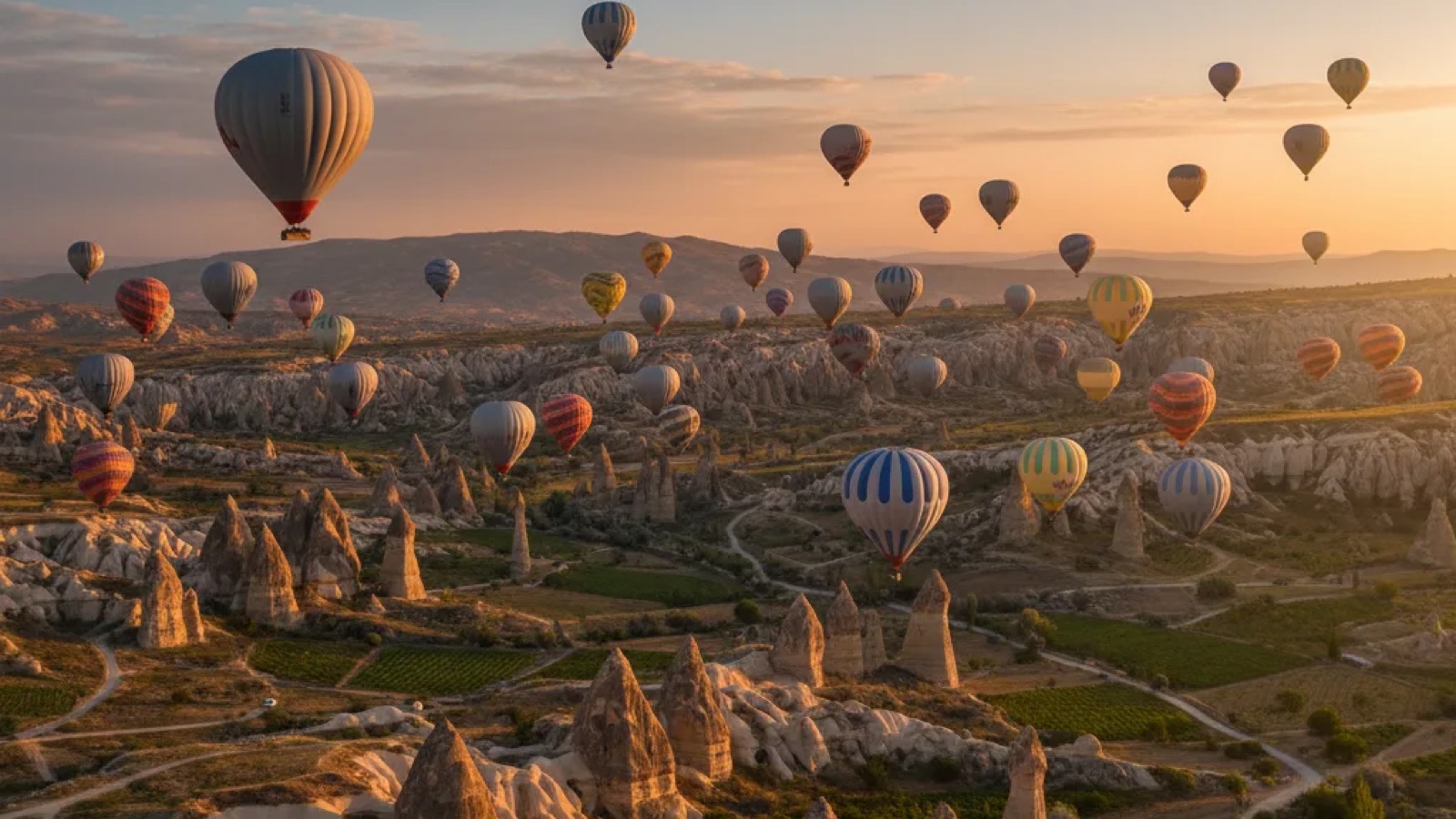
The first roar of the burner tears through the pre-dawn stillness, a dragon's breath lighting up the inside of the balloon like a giant paper lantern. It's still dark, that deep, cold blue that comes just before sunrise, and all around in the valley near Goreme, dozens of other lanterns blink to life. Then, with surprising gentleness, you lift. The ground falls away, and the surreal landscape of Cappadocia—familiar from a thousand photographs but impossible to prepare for—unfolds below. The ‘fairy chimneys’, pale and ghostly in the dim light, begin to catch the first golden rays on their mushroom-cap tops. You aren't just watching a sunrise; you're floating right through the middle of it.
Cappadocia is more than just its famous hot air balloons. It's a geological masterpiece, a sprawling open-air museum, and a testament to human ingenuity. For millennia, people have carved their lives directly into this soft volcanic tuff, creating cave homes, Byzantine-era churches, and entire subterranean cities. In this guide, I’ll share my hard-won advice from exploring this incredible region. We’ll cover how to get here, where to base yourself, and the essential experiences, from floating in a balloon to hiking the stunning valleys and descending into the earth. I’ll also include my personal photography tips and some practical realities of travelling through this truly unique corner of Turkey.
Quick Facts
- Location: Central Anatolia, Turkey. The main tourist triangle is formed by the towns of Nevşehir, Ürgüp, and Avanos.
- Getting There: Fly into Kayseri (ASR) or Nevşehir Kapadokya (NAV) airports, both about an hour's drive from the main villages. Pre-booked airport shuttles are essential. Overnight buses from Istanbul and other major cities are also a popular and economical option.
- Getting Around: A mix of walking (for exploring your immediate village and nearby valleys), local buses (dolmuş), organised tours (like the popular Red and Green tours), and hiring a car for ultimate freedom.
- Language & Currency: The language is Turkish. While English is common in hotels and tourist spots, learning a few basic phrases is always appreciated. The currency is the Turkish Lira.
- Best Time to Visit: Spring (April-May) and Autumn (September-October) offer pleasant temperatures and beautiful light. Winter brings snow, which is magical but cold, and summer can be very hot and dry.
The Lay of the Land: Choosing Your Base
Where you stay in Cappadocia can really shape your experience. The region is a collection of small towns and villages, each with a distinct character. Don't stress too much—they're all relatively close—but it pays to know the vibe you're after.
- Goreme: This is the undeniable heart of tourist Cappadocia. It sits right in the centre of the action, nestled amongst fairy chimneys. You can walk to the Goreme Open Air Museum and the trailhead for the Red and Rose Valleys from town. It has the widest range of hotels, restaurants, and tour agencies, but it's also the busiest and most crowded. If you want everything on your doorstep and don't plan on hiring a car, Goreme is your most practical choice.
- Uchisar: Perched at the highest point in Cappadocia, Uchisar is dominated by its magnificent rock-cut castle. It offers the most spectacular panoramic views, especially of the balloons at sunrise. It feels a bit more upmarket and quieter than Goreme, with a focus on boutique and luxury cave hotels. You’ll be more reliant on taxis or buses to get to other sites, but the trade-off is a more serene atmosphere.
- Urgup: A larger, more modern town with a historic old quarter, Urgup feels more like a 'real' Turkish town that also caters to tourists. It has a good mix of sophisticated hotels, wine houses (the region is known for its vineyards), and excellent restaurants. It's a great base if you have a car and want a blend of convenience and local life without the tourist intensity of Goreme.
- Ortahisar: Meaning 'middle castle', this village is quieter and less developed for tourism than the others. It's charmingly authentic, centred around its own looming rock fortress. Staying here offers a glimpse into a more traditional way of life, but you'll almost certainly need a car to explore the wider region comfortably.
Living Like a Troglodyte: The Magic of Cave Hotels
One of the absolute must-do experiences in Cappadocia is staying in a 'cave hotel'. These aren’t damp, dark holes in the ground; many are stunningly beautiful properties that blend ancient dwellings with modern luxury. Waking up inside a room carved from rock centuries ago is something you won’t forget. The rock acts as a natural insulator, keeping rooms cool in the blistering summer heat and relatively warm in winter.
There's a real art to their construction. In Goreme, a room may even be a former Byzantine-era chapel, with the original arches and niches still visible in the walls. The acoustics can be incredible, and the silence at night absolute. Many hotels have terraces built onto the hillsides, offering perfect, private spots to watch the balloons with your morning coffee.
A little tip: be aware that the term 'cave hotel' is used broadly. Some rooms are genuine ancient caves, while others are 'stone rooms' built with local rock to match the style. Some are a hybrid. If having a true, carved-from-the-earth cave room is important to you, make sure to read the room descriptions very carefully when you book. Either way, the unique architecture is a massive part of the Cappadocian charm.
Up, Up and Away: The Hot Air Balloon Experience
Let's be honest: this is why most of us first dream of Cappadocia. Seeing a hundred balloons rising in unison against a pastel sunrise is every bit as breathtaking as it looks. The whole operation is a finely-tuned machine. You're picked up from your hotel in the dark, driven to a launch site, and given a quick briefing and a small breakfast snack. The baskets are large, divided into compartments, so everyone gets a spot along the edge.
The flight itself is serene. Apart from the periodic whoosh of the burner, it’s remarkably quiet. You float low through the valleys, close enough to almost touch the fairy chimneys, then ascend high for sweeping panoramic views as the sun breaks over the horizon. The skill of the pilots is extraordinary as they navigate the winds and the crowd of other balloons.
Now for the most important pieces of practical advice I can give you. First, book your balloon flight for the very first morning of your stay. Flights are frequently cancelled due to wind, even on perfectly clear days. Safety is the absolute priority. By booking for your first morning, if your flight is cancelled, the company will automatically try to rebook you for the next day, giving you a second or even third chance. If you book it for your last day and it's cancelled, you're out of luck. Second, book well in advance, especially in high season. The demand is huge.
Ground Level Spectacles: Watching the Balloons From Below
Even if you don't fly, or if your flight gets cancelled, watching the spectacle from the ground is a magical experience in itself, and it's completely free. Many travellers actually prefer it. You get a wider, more encompassing view of the entire fleet of balloons against the landscape.
The most popular spot is the 'Sunset Viewpoint' (which is also the sunrise viewpoint) on the ridge just above Goreme. It's an easy walk from the town centre, but be prepared for crowds. People start gathering well before sunrise, setting up tripods and waiting for the show. Other fantastic spots include the terrace of your hotel (a key reason to pick a hotel with a good view!) or viewpoints around Uchisar Castle.
For photographers, watching from the ground gives you more control. You can frame the balloons with the fairy chimneys, move around to change your composition, and capture that iconic wide shot of the hundred-plus balloons filling the sky. Don't be disappointed if you can't fly; the view from below is just as iconic.
Walk Through History: Goreme Open-Air Museum
Just a 15-minute walk from the centre of Goreme town, this UNESCO World Heritage site is the historical and spiritual heart of Cappadocia. It's a dense complex of rock-cut monasteries, chapels, and churches, most dating from the 10th to the 12th centuries. This was a major centre of Byzantine monastic life, and the evidence is carved directly into the landscape.
You wander along dusty paths, ducking into one cave church after another. Inside, you're met with astonishingly well-preserved frescoes. The colours are still vibrant, depicting scenes from the Bible and portraits of saints. Some are simple line drawings in red ochre; others are elaborate, painterly masterpieces. The most famous is the 'Dark Church' (Karanlık Kilise), which requires an extra ticket but is absolutely worth it. Its isolation from daylight has preserved its frescoes in near-perfect condition.
Photography is restricted inside most of the churches to protect the delicate frescoes from flash damage, so this is a place to put the camera down and simply absorb the history. Go early in the morning to beat the tour bus crowds, as the small cave interiors can get very cramped.
Exploring the Valleys: Hiking, Riding, and ATVs
Beyond the towns and museums, the true magic of Cappadocia lies in its valleys. Each one has a unique personality, shaped by millennia of wind and water erosion. Exploring them on foot is one of my favourite ways to connect with the landscape.
Red and Rose Valleys
Easily accessible from Goreme, these interconnected valleys are a hiker's paradise. They are named for the unbelievable colours the rock takes on, especially in the late afternoon sun. The light catches the mineral-rich ridges, turning them from soft pink and yellow to fiery orange and deep red. The trails wind through a maze of sharp ridges, passing cave dwellings, hidden churches, and rock-cut dovecotes. A classic walk is to start in one valley and finish in the other, ending at a viewpoint just in time for a spectacular sunset.
Love Valley and Pigeon Valley
These two are famous for their distinctively shaped fairy chimneys. Love Valley is filled with colossal phallic-shaped pillars that are, to put it mildly, unambiguous. It always gets a few giggles, but the sheer scale of the formations is genuinely impressive. Pigeon Valley, which runs between Uchisar and Goreme, is named for the thousands of pigeon houses carved into the cliffs. For centuries, pigeon droppings were a vital source of fertiliser for the region's farms.
Ihlara and Devrent Valleys
These require a bit more effort to reach, and are usually included on the 'Green Tour'. Ihlara Valley is a world apart from the others—a 100-metre-deep canyon with the Melendiz River flowing through it. It’s a lush, green oasis where you can hike for kilometres along the riverbank, discovering hidden riverside restaurants and ancient churches carved into the canyon walls. Devrent Valley, or 'Imagination Valley', has no cave churches or houses. Instead, its fame comes from its sculptural rock formations that look like animals—a camel, a dolphin, snails, and whatever else your imagination can conjure.
For those not keen on long hikes, All-Terrain Vehicles (ATVs) and horse riding are extremely popular ways to see the valleys. Sunset ATV tours, in particular, kick up a lot of dust but are a thrilling way to cover a lot of ground. I'm a big fan of the horse riding; the name Cappadocia is thought to mean 'Land of Beautiful Horses', and exploring the trails on horseback feels wonderfully appropriate.
Going Underground: Derinkuyu and Kaymakli
As incredible as the structures on the surface are, what lies beneath is just as mind-boggling. Dozens of underground cities have been discovered in Cappadocia, with Derinkuyu and Kaymakli being the largest and most famous. These weren't just temporary shelters; they were fully-fledged subterranean communities, housing thousands of people for months at a time, primarily as a defence against invading armies.
I explored Derinkuyu, which descends eight levels deep into the earth (though not all are open to the public). The ingenuity is staggering. You find stables, wineries, chapels, schools, and living quarters, all connected by a labyrinth of narrow, low-ceilinged tunnels. A brilliant ventilation system of shafts provided air to even the lowest levels. Huge, circular stone doors, like giant millstones, could be rolled into place to block passageways from invaders.
A serious word of warning: If you have even a hint of claustrophobia or mobility issues, you should seriously reconsider visiting. The tunnels are extremely narrow and low in places, requiring you to crouch and shuffle in single file. The sheer depth can be unnerving. I found it fascinating, but I also felt a profound sense of relief upon returning to the surface. It is an intense experience, but an unforgettable look into the history of human survival.
Understanding Cappadocia: Red and Green Tours
If you're short on time or prefer not to hire a car, the standardised 'Red' and 'Green' day tours are an incredibly efficient way to see the highlights. They are offered by dozens of agencies in every town and generally include a guide, transport, and lunch. The itineraries are quite fixed.
- The Red Tour focuses on the northern Cappadocia sites, which are closer to Goreme. It typically includes the Goreme Open Air Museum, Uchisar Castle viewpoint, Devrent (Imagination) Valley, Pasabag (Monks Valley) with its classic mushroom-shaped fairy chimneys, and a visit to a pottery workshop in Avanos.
- The Green Tour covers the southern sites and involves a lot more driving. The main draws are a descent into one of the underground cities (usually Derinkuyu or Kaymakli), a hike through the Ihlara Valley, and a stop at Selime Monastery, a vast rock-cut complex.
These tours are a fantastic option for a first-time visitor. They provide context and history from a guide and handle all the logistics. The downside is that you're on a tight schedule and will be sharing the sites with many other tour groups. If you value independence, hiring a car for a day or two after taking a tour to revisit your favourite spots is a great strategy.
Photographer's Notebook: Light, Seasons, and Ethics
As a photographer, Cappadocia is both a dream and a challenge. The light is everything. The golden hours at sunrise and sunset are non-negotiable. The low, warm light makes the valleys glow and adds incredible texture and dimension to the rock formations. Midday sun is harsh, flattening the landscape and washing out the subtle colours.
The seasons dramatically change the scene. Spring brings wildflowers and green valleys. Summer is hot, and the air can be hazy, but the long days are a bonus. Autumn offers crisp air, beautiful light, and the changing colours of the foliage. Winter, for me, is perhaps the most magical. A blanket of snow transforms the fairy chimneys into something even more ethereal. It’s cold, and balloon flights are less reliable, but the photographic rewards are immense.
A note on ethics. You will see camels dressed in colourful fabrics and elaborate 'Turkish' lounge sets with carpets and tea sets arranged at viewpoints, all designed as photo props. While they make for a pretty picture, I urge you to think twice. It's important to question the welfare of the animals involved and the manufactured nature of the scene. The true beauty of Cappadocia is its raw, natural landscape and its deep history—it doesn't need staged props to be breathtaking.
Explore in Depth
Cappadocia is just one part of an incredible journey through Turkey. For more ideas on how to link your trip, see my other guides:
Frequently Asked Questions
Is it worth visiting Cappadocia if my hot air balloon flight gets cancelled?
Absolutely, yes! While the balloons are an incredible sight, they are just one part of the Cappadocia experience. The landscape itself is the main attraction. You can still have an amazing time watching the balloons from a viewpoint, hiking through the magnificent Red and Rose Valleys, exploring the Goreme Open-Air Museum's rock-cut churches, and descending into a fascinating underground city. In many ways, the land-based activities give you a deeper appreciation for the region's history and geology. Don't let the possibility of a cancelled flight put you off visiting this world-class destination.
How many days do I actually need in Cappadocia?
I would recommend a minimum of three full days. This gives you two potential mornings for a balloon flight in case of cancellation on day one. It also allows you enough time to experience the main highlights without feeling rushed. You could dedicate one day to the Goreme Open Air Museum and a local valley hike, another to a Green Tour to see the underground city and Ihlara Valley, and a third to exploring on your own, perhaps visiting Uchisar or enjoying a sunset horse ride. With four or five days, you could explore at a much more relaxed pace.
I'm scared of small spaces. Should I skip the underground cities?
Honestly, yes, you probably should. I strongly advise against it if you have any degree of claustrophobia. The experience involves walking, often crouched, through very long, narrow, and low-ceilinged tunnels deep underground. There's only one-way traffic in many sections, so turning back isn't always easy. For most people, it's an intense but manageable experience. For someone with a genuine fear of enclosed spaces, it could be genuinely distressing. There are plenty of incredible, wide-open spaces to explore on the surface in Cappadocia, so you won't be missing out on the region's magic.
Can I explore Cappadocia without joining an organised tour?
Definitely. While the Red and Green tours are very convenient, exploring independently is highly rewarding. If you base yourself in Goreme, you can easily walk to the Open Air Museum and the trailheads for Rose, Red, and Pigeon Valleys. For sites further afield like the underground cities or Ihlara Valley, you can hire a car, which gives you complete freedom to set your own schedule. Alternatively, you can use a combination of local buses (dolmuş) and taxis, which is more adventurous but perfectly doable for reaching the main towns and attractions.
What should I pack for a trip to Cappadocia?
Layers are key, as temperatures can vary significantly between day and night. Most importantly, bring comfortable, sturdy walking shoes with good grip. The paths in the valleys and around the historical sites are dusty, uneven, and can be slippery. Even if you're not planning major hikes, you'll be doing a lot of walking. Also pack sun protection—a hat, sunglasses, and sunscreen—as the sun is strong and there's little shade. In spring or autumn, a light jacket is essential for cool evenings and the pre-dawn chill of a balloon flight. In winter, you'll need a proper winter coat, gloves, and a beanie.
Final Thoughts
After travelling to nearly 50 countries, I can safely say there is nowhere on Earth quite like Cappadocia. It’s a place that manages to exceed its own hype. The photographs, as stunning as they are, can’t fully capture the feeling of walking through a valley of pink-hued rock, or the sense of wonder as you stand inside a church that was carved by hand a thousand years ago. It’s a landscape that feels ancient and alive all at once.
My best advice is to embrace both the iconic and the simple. By all means, take the balloon flight—it’s a memory for a lifetime. But also, take the time to wander without a plan. Find a small cafe, drink a strong Turkish coffee, and just watch the light change across the valleys. It’s in those quiet moments, away from the crowds, that the true, enduring magic of Cappadocia really sinks in.