Dublin Itinerary: History, Pubs and Day Trips
Two days in Dublin: Trinity and the Book of Kells, Kilmainham, the museums, a sane approach to Temple Bar, and day trips.
In this guide
- Quick Facts
- Arriving and Finding Your Feet
- How Many Days to Spend in Dublin?
- A City of Words: Trinity College & the Long Room
- Power and Protest: Dublin Castle and Kilmainham Gaol
- Cathedrals and Free Culture
- The Irish Story: Emigration and Iconic Drinks
- The Craic: Temple Bar, Pubs and Trad Music
- Green Escapes and Georgian Grandeur
- Out to the Coast on the DART
- Beyond the Pale: Wider Day Trips
- A Photographer's Guide to Dublin
- Explore in Depth
- Frequently Asked Questions
- Final Thoughts
This guide is part of our Ireland Travel Guide: Route, Weather and Driving — start there for the overview, when to go and how to get around.
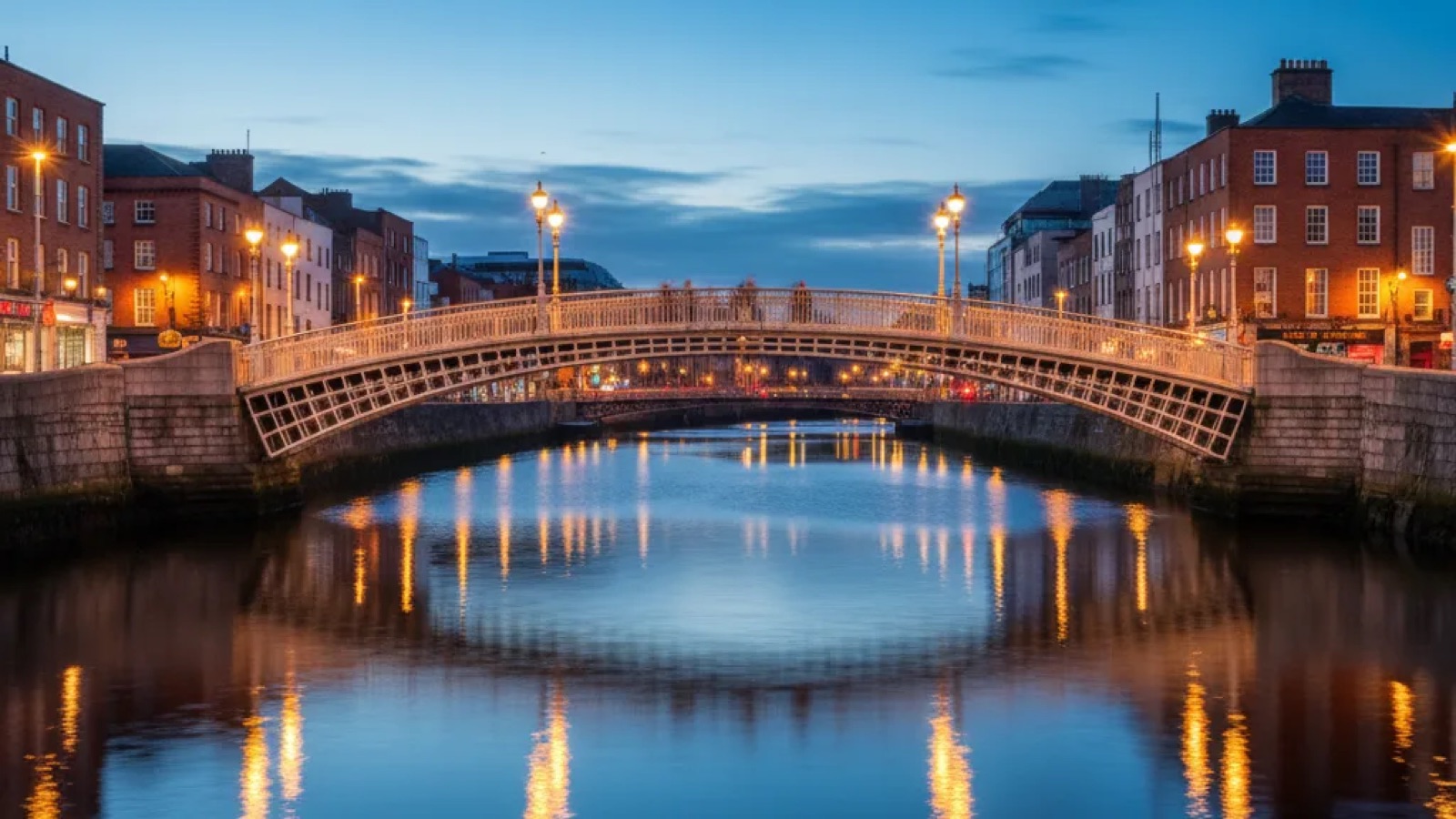
At blue hour over the River Liffey, when the sky deepens but the city lights haven't yet flattened the world into stark contrast, the Ha'penny Bridge is the place to be. Dubliners stream across its old ironwork on their way home, the damp, cool air carries the distant chime of a cathedral bell, and the faint, alluring strains of a fiddle drift over from Temple Bar. It’s where the city’s past and present, its sounds and its stillness, all converge. Dublin isn't a city that shouts; it’s one that draws you into a conversation.
Dublin is a city of stories, etched into its cobblestones, whispered in its hallowed university halls, and sung nightly in its legendary pubs. It’s compact enough to feel intimate but layered with enough history, art, and vibrant culture to fill weeks. This guide is designed to help you peel back those layers. We'll walk through a thousand years of history, from Viking foundations to the birth of a republic. We’ll navigate the tourist hotspots and find the genuine craic, explore the city’s magnificent green lungs, and use its brilliant rail links to discover the wild beauty of the coast and ancient wonders that lie just beyond the city limits. This is your guide to finding the true heart of the Fair City.
Quick Facts
- Location: On the east coast of Ireland, at the mouth of the River Liffey, overlooking the Irish Sea.
- Getting There: Dublin Airport (DUB) is the major international gateway, with excellent bus connections to the city centre. There is no direct rail link from the airport. Ferry services also connect Dublin with the UK and France.
- Getting Around: The city centre is wonderfully compact and best explored on foot. For longer distances, use Dublin Bus, the Luas tram system, and the DART train for coastal trips.
- Language & Currency: English is spoken everywhere, with Irish (Gaeilge) also being an official language and visible on all signage. The currency is the Euro (€).
- Best Time to Visit: The shoulder seasons of April-May and September-October offer the best balance of milder weather, longer daylight hours, and fewer crowds than the peak summer months of June to August.
Arriving and Finding Your Feet
Flying into Dublin Airport, your first decision is how to get to the city centre. The key thing to realise is there's no train from the airport. Your main options are bus or taxi. Several express bus services run frequently from just outside the terminals to various points across the city. These are efficient and will be the most straightforward option for most travellers. Dublin Bus also operates local routes which are a bit slower but can be useful depending on where you're staying. Taxis are readily available but will naturally be the most expensive choice.
Once you’re in the city, you’ll quickly discover its greatest asset for travellers: its scale. Central Dublin is made for walking. The River Liffey neatly divides the city into the ‘Northside’ and the ‘Southside’, a geographical and, traditionally, a subtle socio-economic marker. Most of the key historical sites, museums, and shopping streets are clustered in a relatively small area on the Southside, radiating out from Trinity College and Dublin Castle. My advice is to get a good pair of waterproof walking shoes and just wander. This is how you’ll find the hidden laneways, the quiet Georgian squares, and the unexpected moments that define a trip. For sights further afield like Kilmainham Gaol or Phoenix Park, the Luas (tram) and city buses are easy to navigate.
How Many Days to Spend in Dublin?
Allow a minimum of three full days to do Dublin itself justice. This gives you enough time to cover the heavyweight historical sites like Trinity College and Kilmainham Gaol on separate days without feeling rushed, wander through a couple of the fantastic national museums, experience the pub culture properly, and still have time for aimless exploration.
On a three-day schedule, you could dedicate one day to history (Trinity, Dublin Castle, the Cathedrals), another to the story of Ireland (Kilmainham Gaol, EPIC, Guinness Storehouse), and a third to culture and atmosphere (National Gallery, Grafton Street, Phoenix Park, a trad session). This pace allows you to soak it all in rather than just ticking boxes.
If you want to explore the stunning coastline or take a day trip to the ancient sites of the Boyne Valley or the mountains of Wicklow, add another one or two days to your itinerary. A five-day stay gives you a brilliant city break and a taste of the wilder Ireland that lies just on its doorstep.
A City of Words: Trinity College & the Long Room
Stepping through the front arch of Trinity College off the bustling Dame Street is like entering another world. The roar of traffic fades, replaced by the crunch of gravel underfoot and the scholarly quiet of Ireland's most prestigious university. Founded in 1592, the campus is a beautiful oasis of manicured lawns, cobblestone squares and elegant 18th-century architecture. You can wander the main squares freely, and it’s well worth doing so to soak up the atmosphere.
The main draw, of course, is the Book of Kells. This 9th-century illuminated manuscript is a masterpiece of early Christian art, and seeing its intricate, vibrant pages is a genuinely breathtaking experience. The exhibition leading to the book itself does a fantastic job of explaining its history and the painstaking craftsmanship involved. But for many visitors, the real showstopper is what comes next: the Long Room. Walking into this 65-metre-long, barrel-vaulted library chamber is one of Europe’s great travel moments. The scent of old paper and leather, the towering shelves holding over 200,000 of the library’s oldest books, the row of marble busts of great philosophers and writers—it’s a cathedral dedicated to knowledge.
Important Note: The Long Room is currently undergoing a major, multi-year conservation project to preserve its precious collection and structure. This means the visitor experience may be different, with books being removed from shelves and scaffolding possibly in place. You must check the official Trinity College Dublin website before your visit for the most up-to-date information on what you will be able to see to avoid disappointment. Booking tickets online in advance is essential as this is one of Dublin's most popular attractions.
Power and Protest: Dublin Castle and Kilmainham Gaol
To understand Dublin, you need to understand the intertwined story of power and rebellion, and two sites tell this story better than any other. Dublin Castle, for over 700 years, was the heart of English, and later British, administration in Ireland. Its architecture is a curious mix—part medieval fortress, part grand Viceregal palace. A guided tour is the best way to unpack its complex history, taking you from the Viking foundations in the Undercroft, through the richly decorated State Apartments where royalty was entertained, to the Chapel Royal. It’s a fascinating, if sometimes formal, look at the centre of colonial power.
For the other side of the story, you must visit Kilmainham Gaol. This is, without a doubt, one of the most powerful and moving historic sites in all of Ireland. It’s far more than just an old prison; it’s a national monument. As you walk the cold stone corridors and stand in the echoing East Wing, your guide will tell the stories of the people held here, from petty criminals of the Great Famine to the leaders of the 1916 Easter Rising who were executed in the stonebreaker's yard. Standing in that yard is an incredibly sobering moment. The tour brings Irish history to life in a way no book ever could.
A crucial piece of advice: you absolutely must book tickets for Kilmainham Gaol online, well in advance. Demand is extremely high, and tickets can sell out weeks, if not months, ahead, especially during peak season. Do not expect to be able to walk up and buy a ticket on the day.
Cathedrals and Free Culture
Dublin is punctuated by the spires of its two great cathedrals, both part of the Church of Ireland. Christ Church Cathedral, the elder of the two, has Viking roots and a stunningly restored nave with beautiful tiled floors. Don't miss the medieval crypt, one of the largest in Britain and Ireland, which houses treasures and curiosities, including the famously mummified cat and rat, discovered in an organ pipe in the 1850s.
Just a short walk away is St Patrick's Cathedral, the national cathedral of the Church of Ireland. It’s famously associated with Jonathan Swift, author of *Gulliver's Travels*, who was dean here in the 18th century. His tomb lies within its walls. The interior is grand and filled with monuments, flags, and an impressive sense of scale. While both cathedrals charge an entry fee, they are active places of worship, so check their websites for service times and closures.
One of the best things about Dublin is that much of its national culture is accessible for free. The National Museum of Ireland has several sites across the city. The standout is the Archaeology branch on Kildare Street, home to an extraordinary collection of prehistoric gold, Viking artefacts, and the deeply moving 'Bog Bodies' exhibit. The National Gallery of Ireland on Merrion Square is another treasure, housing Irish and European fine art. It's easy to spend a whole afternoon there, lost in the works of Jack B. Yeats and the spellbinding 'The Taking of Christ' by Caravaggio. It's an incredible resource to have open to everyone.
The Irish Story: Emigration and Iconic Drinks
Two modern museums tell essential parts of the Irish story in very different ways. EPIC The Irish Emigration Museum, located in the docklands, is one of the best museums anywhere. It’s a high-tech, interactive experience that tells the story of the 10 million people who have emigrated from Ireland over the centuries. It focuses not on the sadness of leaving, but on the immense impact the Irish diaspora has had on the world in politics, science, art, and more. It’s inspiring, beautifully designed, and gives you a profound appreciation for Irish influence across the globe.
Of course, for many visitors, Dublin is synonymous with its two most famous drinks. The Guinness Storehouse at St. James's Gate is a slick, seven-story immersive brand experience. You won't see the main brewery in operation, but you'll learn about the ingredients, the brewing process, the history of its iconic advertising, and even learn to pour the perfect pint. The journey culminates with a complimentary pint at the Gravity Bar, which offers some of the best panoramic views of the Dublin skyline. Similarly, the Jameson Distillery Bow St. in Smithfield offers polished, guided tours and tasting experiences focused on the history and craft of their famous Irish whiskey. Both are hugely popular and well-executed, but it's good to know they are slick visitor attractions rather than gritty, working factory tours. Booking ahead is highly recommended for both.
The Craic: Temple Bar, Pubs and Trad Music
Let’s talk about Temple Bar. With its cobblestone streets and brightly painted pubs, it's the postcard image of Dublin. And you should absolutely walk through it, take a photo, and soak up the buzzing (and often chaotic) atmosphere. But you need to know that this is peak tourist territory. The pubs here are often crowded, and the prices for a pint will be noticeably higher than elsewhere in the city. For many Dubliners, it’s a place to walk through, not to stop in.
So where do you find the real ‘craic’ (a uniquely Irish word for fun, atmosphere, and lively conversation)? The answer is: almost anywhere else. Just a few streets away from the main Temple Bar strip, you’ll find countless authentic pubs. Look around the areas of South Great George’s Street, Baggot Street, or Stoneybatter on the Northside. The key is to find a place that feels comfortable, has a mix of locals and visitors, and isn't packed to the rafters.
For traditional Irish music, or a ‘trad session’, look for pubs advertising it, often on a sign outside. The best sessions are often on weeknights and can start quite late. A session isn't a performance; it’s a gathering. Musicians will sit at a table, often with pints in hand, and simply play. There's no setlist. One person starts a tune, and others join in. The etiquette for visitors is simple: find a seat nearby, be quiet and respectful during the music, and enjoy the incredible skill on display. It's a truly magical and authentic Irish experience.
Green Escapes and Georgian Grandeur
When the city buzz gets too much, Dublin offers one of Europe's grandest urban escapes: Phoenix Park. At over 700 hectares, it is a vast expanse of grassland, forests, and avenues just a few kilometres from the city centre. It's home to Dublin Zoo, the official residence of the Irish President, and a herd of wild fallow deer that have roamed the park for centuries. Early mornings are the best time to photograph the deer against the misty light. Remember they are wild animals; keep a respectful distance and never feed them.
Connecting the city's literary heart to its green spaces is the elegant grid of Georgian Dublin. Take a walk around Merrion Square and Fitzwilliam Square to see the city's famous architectural signature: red-brick townhouses with their brightly painted, fan-lighted doors. Each door is a different colour—blue, red, yellow, black—a splash of individuality against the uniform facades. Merrion Square garden itself is a lovely place for a rest, complete with a wonderfully casual statue of Oscar Wilde, who once lived at No. 1, lounging on a rock.
Out to the Coast on the DART
One of the best things to do in Dublin is to hop on the DART (Dublin Area Rapid Transit) train. This coastal line is your ticket to a completely different side of the county. Heading north, the fishing village of Howth is a must-do. You can walk the full Howth Head cliff path loop for spectacular views of Dublin Bay and Lambay Island. The walk takes a few hours and has some steep sections, but the scenery is your reward. Afterwards, treat yourself to some excellent fish and chips on the pier, watching the seals bob in the harbour.
Heading south on the DART line takes you through a series of charming seaside towns. Dún Laoghaire (pronounced 'Dun Leary') is famous for its massive Victorian pier, perfect for a bracing walk. Further on is the lovely village of Dalkey, with its medieval castle and strong literary connections. Bray, the second-last stop before Greystones, has a long promenade and marks the start of the Bray to Greystones cliff walk, a coastal path that follows the railway line along the edge of the sea; it is currently closed because of landslides, with reopening still some years away. These towns feel a world away from the city centre and show you how integral the sea is to Dublin life.
Beyond the Pale: Wider Day Trips
Dublin is a fantastic base for exploring some of Ireland's most significant historical and natural sites. Many tour operators run day trips, or you can use public transport for more independent adventures.
For pure natural beauty, head south to County Wicklow, the ‘Garden of Ireland’. The highlight here is Glendalough, a 6th-century monastic settlement founded by St. Kevin, set in a stunning glaciated valley with two dark, tranquil lakes. The combination of the ancient round tower and the wild, romantic landscape is unforgettable.
For a journey deep into ancient history, a trip north to the Boyne Valley in County Meath is essential. Here you'll find Brú na Bóinne, a UNESCO World Heritage site that includes the megalithic passage tombs of Newgrange and Knowth. These structures are over 5,000 years old, predating both Stonehenge and the Egyptian pyramids. Access to the chambers is tightly controlled and must be done via the visitor centre, so checking tour information and booking is advised.
For a complete change of pace, the city of Belfast in Northern Ireland is only a couple of hours away by the Enterprise train service. It’s a fascinating city with a complex, recent history, incredible murals, and the magnificent Titanic Belfast museum. A day trip gives you just enough time to get a feel for the city's unique character. Just remember that you will be crossing into the United Kingdom, so check if any specific entry requirements or currency changes apply to you.
A Photographer's Guide to Dublin
As a photographer, Dublin is a joy. It’s a city of texture, colour, and moody light. My top tip is to get up early or stay out late for the blue hour. The reflections of the city lights and the deep blue sky on the Liffey are magical. The Ha'penny Bridge is the classic shot, but also walk east towards the modern Samuel Beckett Bridge, shaped like a Celtic harp, for a great juxtaposition of old and new.
Don't be afraid of the rain! A shower of 'liquid sunshine' is part of the Dublin experience. It slicks the cobblestones of Temple Bar, creating beautiful reflections, and deepens the colours of the Georgian doors. Pack a lens cloth and a rain cover for your camera. Layering your own clothes is key; a waterproof outer shell, a warm mid-layer like a fleece, and a base layer will let you adapt to the famously changeable weather.
Beyond the big landmarks, focus on the details: a perfectly poured pint of Guinness with its creamy head, the intricate ironwork on a Georgian balcony, the weathered hands of a fiddle player mid-session, or the bright yellow facade of The Winding Stair bookshop overlooking the river. The best photos of Dublin capture its spirit, not just its sights.
Explore in Depth
Dublin is often the gateway to one of the world's most epic coastal drives. If you're planning to explore further, the detailed guide to the Wild Atlantic Way is the perfect next step.
Frequently Asked Questions
Is Dublin a very walkable city?
Absolutely. Dublin's historic centre is incredibly compact and best explored on foot. Most major attractions—Trinity College, Dublin Castle, Temple Bar, Grafton Street, and the main cathedrals—are all within a 15-20 minute walk of each other. You can happily spend two or three days exploring this core area without needing any transport other than your own two feet. For sites slightly further out, like Kilmainham Gaol or Phoenix Park, the Luas tram system and Dublin Bus network are efficient and easy to use. Walking is truly the best way to discover the city's hidden charms and soak up its unique atmosphere.
Is the Guinness Storehouse worth visiting?
This depends on your interests. The Guinness Storehouse is a world-class brand experience and one of Ireland's most popular tourist attractions. It is not, however, a tour of a working brewery. It’s a seven-story, interactive museum about the history, craft, and marketing of Guinness. If you're a fan of the stout, interested in branding history, or want a guaranteed fantastic panoramic view of Dublin from the Gravity Bar with a pint in hand, you'll likely love it. If you're looking for a more intimate, less commercial brewery tour, it might not be for you. It's a fun, slickly produced afternoon out.
How do I find an authentic traditional music session?
While Temple Bar has music, the most authentic "trad sessions" are often found in pubs slightly away from the main tourist drag. Look for pubs advertising a "trad session" on a chalkboard outside, especially on weeknights from Sunday to Thursday, as this is when local musicians often gather. A true session is informal—it's not a stage performance. Musicians huddle around a table and play for each other as much as for the patrons. The key is to be respectful: keep your voice down during tunes and appreciate the incredible skill on display. Don't be shy to ask a bartender for a recommendation for a good local session.
What should I pack for a trip to Dublin?
The golden rule for packing for Dublin—and Ireland in general—is layers. The weather is famously changeable and you can experience all four seasons in one day. The absolute essentials are a reliable waterproof and windproof jacket, and a pair of very comfortable, preferably waterproof, walking shoes. Beyond that, pack clothes you can layer: t-shirts, long-sleeved tops, a warm fleece or jumper, and comfortable trousers or jeans. A warm hat, scarf, and gloves are a good idea for any season outside of high summer. This way, you can easily adapt to a sudden cool breeze or a passing shower and stay comfortable while exploring.
Is it easy to take day trips from Dublin without a car?
Yes, it's remarkably easy. Dublin is a great hub for car-free day trips. The DART train line is your gateway to the coast, making it simple to visit seaside towns like Howth, Dalkey, and Bray for coastal walks and fresh seafood. For trips further afield, Irish Rail runs frequent and comfortable train services to cities like Belfast and Galway. Bus services and numerous organised coach tours also depart daily from the city centre for popular destinations like Glendalough and the Wicklow Mountains, the Cliffs of Moher, and the ancient sites of the Boyne Valley like Newgrange, taking all the logistical hassle out of your hands.
Final Thoughts
Dublin has a way of staying with you long after you've left. You'll remember the big moments, of course—the awe of the Long Room, the solemn air of Kilmainham's yard, the view from the Gravity Bar. But what really lingers is the feeling of the city itself. It’s the warmth of a pub on a rainy afternoon, the wit of a tour guide bringing history to life, the shared smile with a stranger as a fiddle tune soars. It’s a city that hasn’t let its epic history weigh it down; instead, it has woven it into a vibrant, creative, and profoundly human culture.
My best advice for Dublin is to arrive with a plan, but be prepared to abandon it. Allow time to get lost, to follow a sound, to strike up a conversation. It's in those unscripted moments that the city truly reveals itself. It’s a capital city that feels like a hometown, and it knows how to extend a welcome. Go and find your own Dublin story.