Serengeti and Ngorongoro: Parks, Timing, Wildlife
How the Serengeti and the Ngorongoro Crater differ, where to stay in each, and how to time a visit around the migration.
In this guide
- Quick Facts
- The Serengeti: A Park of Four Worlds
- The Great Migration: A Year in Motion
- Resident Life: The Serengeti All Year Round
- Ngorongoro Crater: A Self-Contained Eden
- Inside the Crater: The Safari Experience
- Beyond the Crater Floor: Oldupai, Empakaai and History
- The Maasai and Multiple-Use Land
- Connecting the Parks: Drives, Dust, and Flights
- Where to Stay: Camps on the Plains
- Practicalities and Etiquette on Safari
- A Photographer's Notes from the Field
- Explore in Depth
- Frequently Asked Questions
- Final Thoughts
This guide is part of our Tanzania Safari Guide: Serengeti and Ngorongoro — start there for the overview, when to go and how to get around.
The engine cut out, and in the sudden, ringing silence, the sun crested the horizon. In front of our Land Cruiser, the Serengeti plains exploded into a sea of liquid gold, the colour so intense it felt like you could taste it. A lone acacia tree stood in sharp silhouette, and beyond it, the scattered shapes of wildebeest and zebra began to stir. The air, crisp and cool, carried the scent of dust and wild sage. This is the moment I come back to: the sheer, heart-stopping scale of a Serengeti dawn, a feeling of being a small, privileged witness to the Earth’s greatest wildlife spectacle. It’s a feeling that never leaves you.
The Serengeti and its famous neighbour, the Ngorongoro Conservation Area, are the crown jewels of Tanzania's northern safari circuit. They are often spoken of in the same breath, but they offer vastly different experiences. The Serengeti is about endless horizons and the epic drama of the Great Migration. Ngorongoro is a self-contained Eden, a collapsed caldera teeming with an incredible density of resident animals. In this guide, I’ll take you through the distinct regions of each park, explain the rhythm of the migration, and share the practical, hard-won advice a photographer and long-term traveller collects on the road, from choosing a camp to why a beanbag is your best friend.
Quick Facts
- Location: Northern Tanzania, part of the world-renowned Northern Safari Circuit. The Ngorongoro Conservation Area borders the Serengeti National Park to the southeast.
- Getting There: Most safaris start from Arusha. You can reach the parks via a long day's drive (often with an overnight stop), or a short internal flight from Arusha Airport (ARK) or Kilimanjaro International Airport (JRO) to one of several airstrips within the parks.
- Getting Around: A 4x4 safari vehicle with a pop-up roof and an experienced driver-guide is essential. Roads can be rough and dusty, and navigation is a specialist skill.
- Language & Currency: Swahili is the official language, but English is widely spoken in the tourism industry. The official currency is the Tanzanian Shilling, though US dollars are often accepted for larger payments in tourist areas (check details before travelling).
- Best Time to Visit: It depends on your focus. The dry season (June to October) offers superb general wildlife viewing. To see the migration's river crossings, aim for the north from July to September. For calving season, head to the southern plains from January to March.
The Serengeti: A Park of Four Worlds
The first thing that hits you about the Serengeti is its size. The name comes from the Maasai word Siringit, meaning "endless plains," and it's no exaggeration. At over 14,000 square kilometres, it feels less like a park and more like a country unto itself. It’s not one single landscape but a mosaic of different environments, each with its own character and wildlife specialties. Most visitors only see a fraction of it, so understanding its regions is key to planning your trip.
Most safaris spend significant time in the Seronera Valley, or the Central Serengeti. This is the classic landscape of acacia-dotted grasslands and is fantastic for year-round wildlife. It has a high concentration of resident predators – lions, leopards, and cheetahs – who don’t follow the great migration. The Seronera River provides a permanent water source, making it a reliable hub for game viewing at any time of year. Its accessibility means it can be the busiest part of the park, but for good reason: the game viewing is simply phenomenal.
To the south, the vast, treeless short-grass plains stretch towards the Ngorongoro Conservation Area. For much of the year, this area can feel empty and exposed. But from about December to March, when the rains arrive, it transforms into a vibrant nursery. This is where the wildebeest congregate for the calving season, attracting predators in huge numbers. It's an incredible time to be here, witnessing new life and the raw drama that follows.
Heading west, you find the Western Corridor, a narrower section of the park defined by the Grumeti River. This area is known for its lush riverine forest, home to giant crocodiles and colobus monkeys. The migration passes through here around May to June, facing the challenge of the Grumeti River crossing, a dramatic (though less famous) precursor to the Mara River crossings further north. Outside of the migration season, it's a much quieter part of the park.
Finally, the Northern Serengeti (Kogatende area) is wild and remote, bordering Kenya’s Maasai Mara. This is the main stage for the iconic Mara River crossings from roughly July to October. It’s a landscape of rolling hills, granite outcrops (kopjes), and open woodland. The tension around the river, as herds build up the courage to cross, is one of the most incredible spectacles in the natural world. Even without the migration, it’s a beautiful and less-visited region with great resident wildlife.
The Great Migration: A Year in Motion
Let's be clear: the Great Migration isn't a single event you can buy a ticket for. It's a continuous, cyclical movement of over 1.5 million wildebeest, plus hundreds of thousands of zebra and gazelle, forever searching for fresh grazing and water. Its timing is dictated entirely by rainfall, so any calendar is just an educated guess. But the general pattern is predictable.
The cycle begins anew each year on the southern Serengeti plains. Around January to March, the herds gather on these nutrient-rich grasses for the calving season. Within a few weeks, hundreds of thousands of calves are born, a synchronised event that provides a glut of food for the waiting predators. It's a time of immense vulnerability and poignant beauty.
As the southern plains dry out around April and May, the herds begin their long trek north and west. They move up through the Seronera and into the Western Corridor, growing into huge, consolidated columns of animals. This is the timing of the "rut," or mating season, when the plains are filled with the braying calls and territorial clashes of bull wildebeest.
From about July to October, the migration reaches its most famous obstacle: the Mara River in the Northern Serengeti. The herds mass on the banks, hesitating for days before making the chaotic, life-or-death plunge into the crocodile-infested waters. This is the scene everyone imagines, and it requires patience and a bit of luck to witness. Once across, they spread out into the Maasai Mara in Kenya.
By November and December, the short rains begin to fall in the south again. The scent of fresh grass draws the herds back down from the north, completing the circuit to return to the southern calving grounds. The journey is relentless, an ancient rhythm that defines this entire ecosystem.
Resident Life: The Serengeti All Year Round
While the migration is the headline act, it’s a mistake to think the Serengeti is empty when the herds are elsewhere. A huge amount of incredible wildlife stays put, making for a world-class safari experience 365 days a year. These are the residents, and they are masters of their territory.
Lions are everywhere, but the prides of the Central Serengeti are particularly famous. Leopards, famously elusive, are often found lounging in the branches of the sausage trees that line the Seronera River. Cheetahs thrive on the open plains, using their incredible speed to hunt gazelles. You’ll also find elephants, giraffes, buffalo, hippos, and an astonishing variety of birds.
A key feature of the Serengeti landscape is the kopje (pronounced "copy"). These are ancient granite outcrops that rise like islands from the sea of grass. They create their own micro-ecosystems with unique plants and resident animals like the rock hyrax. More importantly for a safari-goer, they are prime real estate for predators. Lions use them as vantage points to survey their kingdom and as a safe place to shelter their cubs. Watching a lioness silhouetted against the dawn sky on a high granite boulder is an image that will be seared into your memory.
Ngorongoro Crater: A Self-Contained Eden
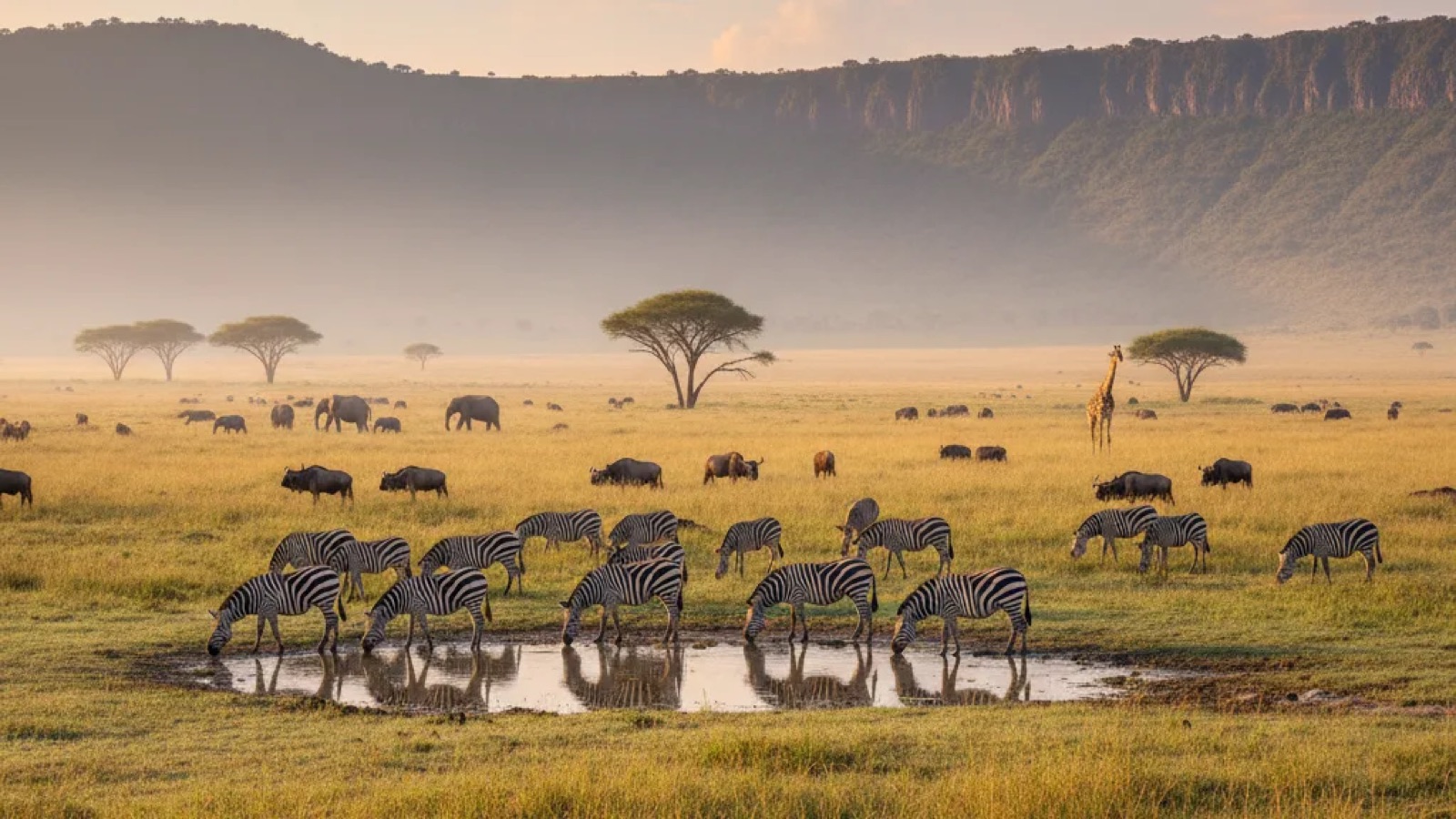
Driving from the Serengeti, you climb into the cool, misty highlands of the Ngorongoro Conservation Area. The air changes, the vegetation becomes lusher. And then you arrive at the crater rim and look down. The view is simply breathtaking. Some 600 metres below you lies the floor of the Ngorongoro Crater, a perfect, 260-square-kilometre caldera formed when a massive volcano collapsed in on itself two to three million years ago.
Unlike the Serengeti, where animals roam free across vast distances, the crater acts as a natural enclosure. This has resulted in an unbelievably high density of wildlife. An estimated 25,000 large animals live within this bowl, including a significant population of the critically endangered black rhino. It's one of the few places in Tanzania where you have a genuine chance of spotting one. The crater floor is a mix of open grassland, acacia woodland, and a large soda lake, Lake Magadi, which attracts flocks of flamingos.
Because the grazing and water are plentiful year-round, most of the animals here are permanent residents. You'll find huge tusker elephants, great prides of lions, solitary leopards, and countless hyenas. It’s often touted as the easiest place in Africa to see the "Big Five" (lion, leopard, elephant, buffalo, and rhino) in a single day. While never a guarantee, your odds are certainly better here than almost anywhere else.
Inside the Crater: The Safari Experience
A game drive in the Ngorongoro Crater is a unique experience. All vehicles must descend via a steep, winding entry road and leave via a separate ascent road, creating a one-way flow. The drive down is an adventure in itself, offering tantalising glimpses of the crater floor below. Once you're down, you're in another world. The sheer concentration of animals means you are rarely out of sight of something interesting.
This density, however, comes with a trade-off: popularity. The crater floor is a relatively small area, and park rules strictly limit the amount of time vehicles can spend there to maximise access for everyone. This can lead to crowding, especially at midday and around major sightings like a lion kill or a rare black rhino. A magnificent black-maned lion can draw fifteen other vehicles jockeying for position within ten minutes. The best advice is to start as early as possible. The first vehicles down in the morning light not only get the best photographic conditions but also a precious hour or two of relative solitude before the main rush begins.
Beyond the Crater Floor: Oldupai, Empakaai and History
The Ngorongoro Conservation Area is much more than just the famous crater. Nestled between Ngorongoro and the Serengeti is Oldupai Gorge (often Anglicised as Olduvai), a steep-sided ravine that has been instrumental in our understanding of human evolution. It was here that paleoanthropologists Mary and Louis Leakey made some of the most significant discoveries of early hominin fossils. Visiting the small museum on the gorge's rim gives you a profound sense of deep time and your own place in the long story of humanity.
For those keen to stretch their legs, the NCA offers some fantastic walking opportunities, which are strictly forbidden in most national parks like the Serengeti. A trek into the Empakaai or Olmoti Craters with an armed ranger is a highlight. Empakaai, in particular, is stunning: a smaller, deeper caldera with a beautiful lake covering much of its floor. The hike down through the montane forest is steep but rewarding, with the chance to see flamingos on the lake shore and buffalo in the surrounding forest.
The Maasai and Multiple-Use Land
One of the most significant differences between the Serengeti National Park and the Ngorongoro Conservation Area (NCA) is the human element. The Serengeti is a traditional national park, where human settlement is prohibited. The NCA, however, is a pioneering experiment in "multiple-use" land management. This means it's a conservation area where wildlife and semi-nomadic Maasai pastoralists are meant to coexist.
As you drive through the highlands of the NCA, you will see Maasai herdsmen, draped in their iconic red shukas, grazing their cattle alongside herds of zebra and wildebeest. You will pass their circular homesteads, or bomas. This model of conservation is often challenging and subject to ongoing debate aboutresource management and land rights, but it provides a fascinating insight into a culture that has lived in harmony—and conflict—with this region's wildlife for centuries. Many safari itineraries include a visit to a Maasai village, which can offer a valuable cultural exchange if organised ethically and respectfully.
Connecting the Parks: Drives, Dust, and Flights
The journey between Arusha, Ngorongoro, and the Serengeti is part of the adventure. The drive from the Ngorongoro Crater rim to the central Seronera area of the Serengeti can take a good four to five hours, not including stops for game viewing along the way. The road descending from the highlands onto the plains is notoriously bumpy and dusty—a classic "African massage." Keep your camera protected from the fine dust, as it gets everywhere!
While the long drives are a classic part of the safari experience, they do eat into your time. For those on a tighter schedule or who want to maximise their time in the more remote northern Serengeti for the river crossings, an internal flight is an excellent option. Small bush planes connect the various airstrips like Seronera, Kogatende, and Ndutu with Arusha and each other. The view of the plains from a few thousand feet up gives you a true sense of the Serengeti's scale, and a one-hour flight can replace a seven-hour drive, buying you an entire extra afternoon of game driving.
Where to Stay: Camps on the Plains
Accommodation in the Serengeti and Ngorongoro ranges from large, permanent lodges built of stone and thatch to intimate tented camps. For my money, nothing beats the experience of a tented camp. Don't picture a flimsy dome tent; these are sturdy canvas structures with proper beds, en-suite bathrooms, and private verandahs. Lying in bed at night, with only a sheet of canvas between you and the sounds of the African bush—a distant lion's roar, the whoop of a hyena—is an unforgettable experience.
Camps come in two main varieties: permanent and mobile. Permanent tented camps are set up in fixed locations, often chosen for their excellent year-round game viewing. Mobile camps are a brilliant innovation designed to follow the Great Migration. These smaller, more rustic camps move several times a year to position themselves in the heart of the action, whether that’s the southern plains for calving season or the northern Serengeti for the river crossings. They offer a more adventurous, off-the-grid feeling and put you right where you need to be.
Practicalities and Etiquette on Safari
A few practical points can make a huge difference to your safari. First, altitude. The Ngorongoro Crater rim sits at over 2,200 metres. Mornings and evenings here are cold, seriously cold. Pack layers: a fleece, a windproof jacket, a beanie, and even gloves are essential for those early morning starts before the sun gets to work.
Dust is a constant companion on the roads. A bandana or buff to cover your mouth and nose can be a comfort, and it's vital to have a protective bag or case for your camera gear. Road conditions are variable, from graded dirt tracks to deeply rutted paths, so be prepared for a bumpy ride.
Finally, safari etiquette is crucial for the well-being of the animals. Always maintain a respectful distance from wildlife. Never pressure your guide to get closer. Off-road driving is strictly prohibited in the National Parks and the Ngorongoro Crater to protect the fragile grasslands, though it may be permitted in some private concessions. A good guide will know and respect all the rules, ensuring your presence doesn't negatively impact the animals you've travelled so far to see.
A Photographer's Notes from the Field
As a photographer, Tanzania’s northern parks are a dream. The quality of light is extraordinary. That first hour after sunrise and the last before sunset—the "golden hour"—will give you your most stunning images. The low, warm light makes colours pop and creates beautiful long shadows. Plan your days around this light.
Don’t be afraid of dust and backlighting. A herd of zebra kicking up clouds of dust as the sun sets behind them is a classic, powerful shot. Expose for the highlights in the dust cloud and let the animals fall into silhouette for a dramatic effect.
If you're at a river crossing, patience is everything. The herds can wait for hours, even days. Don't get discouraged. Find a good position, get your settings ready, and wait. The explosion of action is over in minutes, and you need to be prepared. Use a fast shutter speed to freeze the motion and the splashing water.
My single most important piece of camera-support advice: leave your tripod at home and bring a beanbag. A tripod is useless in a vehicle. A beanbag, however, can be rested on the roof opening or a window frame, creating a rock-solid, vibration-dampening platform for your long lens. You can buy them out there or bring an empty one and fill it with rice or beans upon arrival.
Explore in Depth
This guide dives deep into the Serengeti and Ngorongoro. For a broader look at planning your entire Tanzanian safari adventure, including how to choose a safari operator, what to pack, and health and safety advice, start with my main overview guide.
Frequently Asked Questions
Is it better to visit the Serengeti or Ngorongoro Crater if I'm short on time?
If you must choose, it depends on your priority. The Ngorongoro Crater offers an almost guaranteed high density of wildlife, including a strong chance to see black rhino, all within a single, spectacular day. It's compact and incredibly efficient for game viewing. The Serengeti, however, offers a sense of epic scale, endless horizons, and the unparalleled drama of the Great Migration (if your timing is right). For the quintessential "Out of Africa" feeling and the migration spectacle, choose the Serengeti. For a near-certain Big Five checklist in a unique setting, choose Ngorongoro.
Can I self-drive in the Serengeti and Ngorongoro?
While technically possible for experienced 4x4 drivers, it's highly discouraged for most travellers. The roads are challenging and often poorly marked, vehicle break-downs can be a serious issue in remote areas, and park fees and logistics are complex to organise. Most importantly, you would miss out on the invaluable expertise of a local driver-guide. Their ability to spot camouflaged animals, interpret behaviour, navigate the vast plains, and share cultural and ecological knowledge is an essential part of the safari experience. It’s an investment that pays for itself many times over.
How many days do I really need for the Serengeti and Ngorongoro?
I would recommend a minimum of four to five nights to do both justice. Spend one full day (as a day trip from a nearby lodge or one night on the rim) for the Ngorongoro Crater. For the Serengeti, you need at least three nights. This gives you two full days to explore a specific region, like the central Seronera, or allows you to travel from the centre to the north or south. Rushing these parks means you spend more time driving between them than actually enjoying them. A longer stay of 6-7 nights lets you experience two different regions of the Serengeti properly.
Are balloon safaris in the Serengeti worth it?
A hot air balloon safari is a truly magical experience, but it comes at a significant extra cost. Drifting silently over the plains at dawn as the landscape wakens below is an unforgettable perspective you just can't get from a vehicle. It's fantastic for photography and for appreciating the sheer scale of the herds. However, it's not a primary game viewing activity; you're too high up to spot smaller animals or predators easily. Think of it as a breathtaking, scenic experience rather than a replacement for a vehicle-based game drive. If your budget allows, it's a wonderful addition to your safari.
What should I pack for cold mornings on the Ngorongoro Crater rim?
The altitude on the crater rim (over 2,200 metres) makes for surprisingly cold starts, with temperatures often dropping to single digits Celsius. You absolutely must pack layers. I recommend a thermal base layer, a fleece jacket, and a windproof/waterproof outer shell. A warm hat (beanie), scarf, and even a pair of light gloves are not overkill for that pre-dawn drive to the crater floor. The temperature rises quickly once the sun is up, so having layers you can easily shed and store in the vehicle is key to staying comfortable all day.
Final Thoughts
I’ve been fortunate to travel to many of the world’s wildest places, but my memories of the Serengeti and Ngorongoro remain some of my most vivid. There's something profound about being in a landscape that feels so ancient and operates on a scale that dwarfs human concerns. It's the sound of millions of hooves drumming on the plains, the sight of a leopard draped elegantly over a branch, and the impossibly vast canopy of stars over your camp at night.
These parks are more than just a holiday destination; they are a vital part of our planet's natural heritage. To visit them is a privilege, a chance to connect with something primal and magnificent. It changes your perspective, and if you let it, a little piece of that wildness will travel home with you and stay with you forever.
More Tanzania guides
Kilimanjaro Trek Guide: Routes, Altitude, Training
Climbing Kilimanjaro: choosing a route, acclimatisation and summit night, training realistically and what the days involve.
Tanzania Safari Guide: Serengeti and Ngorongoro
Planning a first Tanzanian safari: the northern circuit, the migration calendar, camps versus lodges and what a day looks like.