Singapore Hawker Food Guide: What to Order
How hawker centres work, the dishes, drinks and desserts to order, dietary needs and the best-known centres to visit, with answers to common questions.
In this guide
This guide is part of our Singapore Travel Guide: Three Days in the City — start there for the overview, when to go and how to get around.
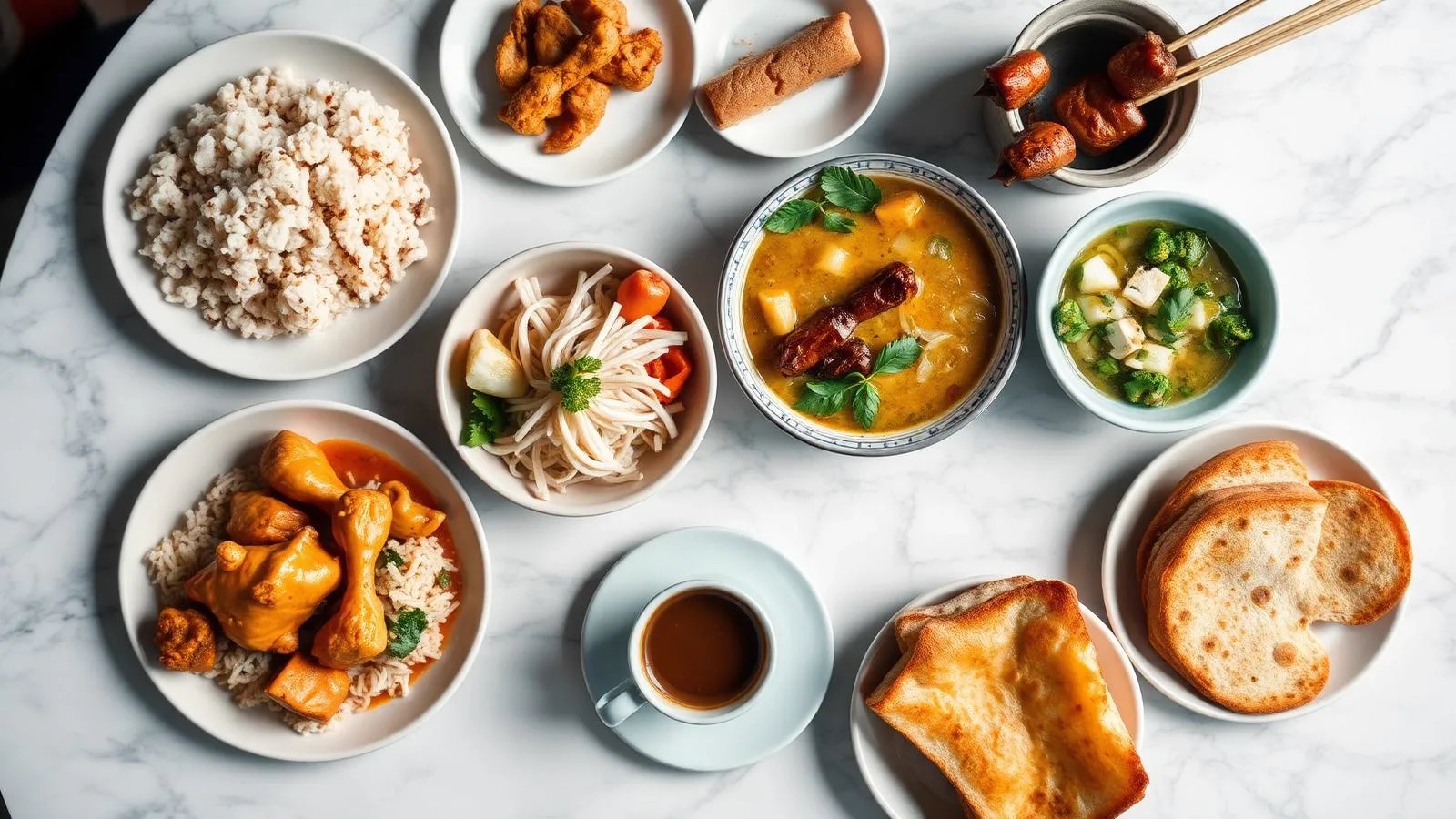
The wall of heat and noise hits you first. A humid, fragrant wave carrying a hundred different promises: the smoky char of grilling meat, the sharp tang of ginger, the sweet, heavy scent of coconut and pandan. A first visit to a Singaporean hawker centre can be overwhelming and completely captivating. It feels like walking into the city's communal dining room, a roaring, chaotic and wonderfully alive space. All around, families, office workers and solo diners are hunched over steaming bowls, their movements a well-practised ballet of chopsticks, spoons and contented sighs.
Wander a hawker centre and each stall front is a portal to a different culinary world, plastered with photos of dishes you may not be able to pronounce and watched over by a hawker who has likely mastered that single recipe over decades. There’s no polished service, no fancy decor, just the raw, honest theatre of food being cooked with passion and served with pride. Point at a bowl of fiery red noodle soup and you won’t just have a meal; you’ll have your first real taste of Singapore.
Singapore's Beating Heart: The Hawker Centre
To understand Singapore, you must understand its hawker centres. These are not just food courts; they are the bedrock of the nation’s culture, its social glue, and a source of immense national pride. They are where people from every walk of life—from construction workers to company executives—converge to share a meal. This unique culinary landscape is so integral to the Singaporean identity that it was inscribed on the UNESCO Representative List of the Intangible Cultural Heritage of Humanity.
The story of hawker centres began in the mid-20th century. To clean up the streets and improve sanitation, the government gathered the city's myriad itinerant street food vendors into purpose-built complexes. This organised move preserved the precious food heritage of generations while providing a more hygienic and structured environment. Today, these centres are a testament to that vision, offering an incredible diversity of high-quality, affordable food in a clean and safe setting. Eating here is a rite of passage for any visitor and a daily ritual for locals.
Quick Facts
- What They Are: Hawker centres are large, typically open-air or semi-open-air food complexes housing dozens, sometimes hundreds, of individual food stalls.
- Payment: While cash is still widely accepted, many stalls now display QR codes for various mobile payment apps. It's wise to have some small notes and coins on hand just in case.
- Specialisation: Most hawkers are masters of one craft. A stall will usually specialise in one or a very small number of dishes, perfecting them over many years.
- Seating: All seating is communal and works on a first-come, first-served basis. You do not sit at a table belonging to a specific stall; you find a seat and then buy food from any stall in the centre.
- Opening Hours: These vary greatly. Some centres are bustling for breakfast and lunch, while others come alive in the evening. Most stalls also have their own specific opening hours and rest days.
- Etiquette: It’s a self-service world. You queue, order, pay, and collect your food directly from the stall. And when you’re done, you’re expected to clear your table.
How It Works: A Guide for the First-Timer
For the uninitiated, the sheer energy of a hawker centre during peak hours can be intimidating. But the system is remarkably efficient and easy to navigate once you understand the unwritten rules and official policies.
The Art of 'Chope'
You’ve arrived at a busy hawker centre and there isn't a single empty table. Look closer. You'll notice tables that are unoccupied but have a small item placed on them – most often a packet of tissues, but sometimes a lanyard, an umbrella, or a staff pass. This is chope, the quintessentially Singaporean custom of reserving a seat.
This simple act of placing a non-valuable item on a table signifies that the spot is taken while its 'owner' goes off to queue for food. It’s a system built entirely on trust and mutual understanding. As a visitor, you are welcome to participate. Just place your own tissue packet on a vacant seat or share of a table and then go on your food hunt. But please, never, ever remove someone else’s chope item. It's a social contract, and breaking it is a major faux pas. If a table has six seats and only one is choped, it’s generally acceptable to ask if the other seats are available.
Ordering Your Feast
In a hawker centre, there is no table service. The process is simple: you walk, you browse, you choose, you queue. Most stalls have their menu displayed prominently, often with pictures and sometimes with English translations. Stall numbers are also clearly marked, which helps when recommending a place to friends.
Join the queue for your chosen stall. Queues are a great sign – a long line of locals is usually the best endorsement a stall can have. When it’s your turn, tell the hawker what you want. Be clear and ready to answer any questions they might have (“Spicy or not spicy?”, “Eat here or take away?”). You’ll pay on the spot and then either be given your food immediately or handed a buzzer or number to wait for your order to be prepared.
The All-Important Tray Return
For years, cleaners would clear tables, but this has changed. Today, it is mandatory for diners to clear their own trays, crockery, and litter after their meal. This policy promotes civic responsibility and keeps the environment cleaner and more pleasant for everyone. It also allows cleaning staff to focus on sanitising tables more efficiently.
You’ll see designated tray and crockery return stations dotted throughout every hawker centre. They are often colour-coded or have separate racks for halal and non-halal trays. Simply carry your tray to the station and place your items on the correct shelf. It’s a small act that shows respect for the space and the people who use it.
A Mark of Cleanliness
Concerns about food safety are understandable when exploring new culinary scenes, but Singapore’s hawker centres operate under a strict regulatory framework. The Singapore Food Agency (SFA) conducts regular checks on all food stalls.
The old A-to-D hygiene grades have been replaced by the Safety Assurance for Food Establishments (SAFE) framework, introduced in January 2026. Stalls are now graded on their food-safety track record: 'A' for a clean record of more than three years, 'B' for one to three years, and 'C' for a stall with a recent major lapse. The grade can be checked by scanning the QR code on the SFA licence displayed at each stall. This transparent system provides a quick and reliable visual cue, allowing you to dine with confidence and focus on what really matters: the incredible food.
What to Eat: A Culinary Journey
This is where the real adventure begins. With so many choices, the hardest part is deciding what to order. Singapore’s cuisine is a mouth-watering mosaic of Chinese, Malay, Indian, and Peranakan influences. Here is a guide to some of the absolute must-try dishes.
Hainanese Chicken Rice
Often lauded as one of Singapore's national dishes, Hainanese chicken rice is a masterpiece of subtlety. Don't let its simple appearance fool you; the complexity is in the details. The chicken is poached to perfection in a pork and chicken bone stock, resulting in unbelievably tender and silky meat. It's then plunged into an ice bath to tighten the skin. The rice is the true star, cooked in the chicken stock with ginger, garlic, and pandan leaves, making it aromatic and flavourful enough to eat on its own. Served at room temperature with slices of cucumber, a bowl of the light chicken broth, and three essential dipping sauces—a fiery chilli-garlic, a thick dark soy sauce, and fragrant minced ginger—it is a complete and profoundly satisfying meal.
Chilli Crab and Black Pepper Crab
Prepare to get your hands messy. Chilli crab is another contender for Singapore’s national dish, a glorious, theatrical affair best enjoyed with a group. Large mud crabs are stir-fried in a thick, sweet, and savoury tomato-and-chilli-based sauce, with egg ribbons swirled in to give it a rich consistency. Despite its name, it’s more sweet than spicy, a flavour explosion that you’ll want to mop up with every last drop. A side of fried or steamed buns, called mantou, is non-negotiable for this purpose. For those who prefer more heat and less sweetness, black pepper crab is an equally delicious alternative. It’s a drier stir-fry, with the crab coated in a robust, fragrant sauce of black pepper and butter. Whichever you choose, it’s a decadent and unforgettable experience.
Laksa
Laksa is the ultimate Southeast Asian noodle soup. The Singaporean version, often called Katong laksa, is defined by its rich, fragrant, and spicy soup base made from coconut milk, chilli, and dried shrimp. It’s filled with thick rice noodles, cockles, prawns, slices of fish cake, and fried tofu puffs that soak up the divine gravy. What makes Katong laksa unique is that the noodles are often cut into smaller pieces, allowing you to eat the entire dish with just a spoon. Every spoonful delivers a complex mix of creamy, spicy, and umami flavours. It’s pure comfort in a bowl.
Char Kway Teow
The sound of a metal spatula scraping against a well-worn wok and the smoky aroma that follows are the heralds of char kway teow. This beloved dish consists of flat rice noodles and yellow wheat noodles stir-fried over incredibly high heat with soy sauce, prawns, cockles, lap cheong (Chinese sausage), bean sprouts, and chives. The key to an excellent plate of char kway teow is the wok hei, or ‘breath of the wok’—a distinct smoky, seared flavour that can only be achieved with a seasoned wok and intense heat. It’s greasy, savoury, sweet, and utterly addictive.
Hokkien Mee
Not to be confused with other regional variations, Singapore Hokkien mee is a stir-fried dish of yellow wheat noodles and thick rice vermicelli. The noodles are braised in a rich, aromatic stock made from prawns, pork, and other seafood, which they absorb until they are plump with flavour. The dish is then stir-fried with prawns, squid, pork belly, and egg. Served with a side of sambal chilli and a squeeze of fresh calamansi lime to cut through the richness, it's a dish that beautifully balances savoury seafood essence with a zesty kick.
Bak Kut Teh
The name translates to ‘pork bone tea’, but there is no tea in the dish itself. Bak kut teh is a comforting, peppery pork rib soup. There are two main styles in Singapore: the peppery Teochew version and a darker, more herbal Hokkien style. The Teochew style is more common, featuring pork ribs simmered for hours in a clear broth with garlic, star anise, and a hefty amount of white pepper. It's often eaten for breakfast or as a nourishing supper. The soup is typically served in a bowl with the tender pork ribs and is endlessly refillable at many stalls. It's usually accompanied by a bowl of white rice, preserved vegetables, and strips of fried dough (you tiao) for dipping.
Satay
The smell of satay grilling over charcoal is one of the most enticing aromas you’ll encounter in Singapore. These are skewers of marinated meat—chicken, beef, mutton, or sometimes pork—grilled to perfection. The marinade, a blend of turmeric, galangal, lemongrass, and other spices, gives the meat its distinctive yellow colour and fragrant flavour. Satay is always served with a thick, sweet, and slightly spicy peanut sauce for dipping, alongside chunks of raw onion, cucumber, and compressed rice cakes (ketupat). It’s the perfect communal snack, especially in the evenings at outdoor centres like Lau Pa Sat, where entire streets are dedicated to it.
Roti Prata
A staple of South Indian cuisine in Singapore, roti prata is a flatbread that is both a spectacle to watch being made and a delight to eat. The dough is stretched, tossed, and folded with incredible skill until it is paper-thin, then pan-fried on a hot griddle until it’s crispy on the outside and soft and chewy on the inside. The plain version (kosong) is a classic, served with a side of fish or mutton curry for dipping. More adventurous variations include prata with egg, cheese, onion, or even sweet versions with chocolate or banana. It's a popular choice for breakfast or a late-night supper.
Nasi Lemak
Though its origins are Malay, nasi lemak is embraced by all Singaporeans. The heart of the dish is the rice, which is steamed with coconut milk and pandan leaves, giving it a rich texture and fragrant aroma. The traditional version serves this rice with a side of fiery sambal chilli, fried anchovies (ikan bilis), peanuts, a fried or hard-boiled egg, and slices of cucumber. You can then add other side dishes, such as fried chicken wing (a very popular pairing), fried fish, or begedil (potato cutlets). It's a symphony of textures and flavours, from the creamy rice to the crunchy anchovies and the spicy-sweet kick of the sambal.
Carrot Cake (Chai Tow Kway)
First things first: this is not the sweet, cream-cheese-frosted cake you might be thinking of. Singapore's ‘carrot cake’ contains no carrots. The name is a literal translation of chai tow kway, which refers to the main ingredient: steamed radish cake (white radish is also known as white carrot in a dialect). This savoury cake is chopped up and stir-fried with preserved radish, garlic, and egg. You can order it 'white' (plain fried, resulting in crispy individual cubes) or 'black' (fried with a sweet dark soy sauce, which gives it a darker colour and a sweeter, caramelised taste). Both are delicious.
Rojak
Rojak is the Malay word for an ‘eclectic mix’, and that’s a perfect description of this unique salad. The Chinese version is a bizarre but wonderful combination of fresh fruits and vegetables like pineapple, jicama, cucumber, and bean sprouts, mixed with fried tofu puffs and crispy dough fritters (you tiao). The whole lot is tossed in a thick, pungent dressing made from shrimp paste, sugar, and tamarind, then sprinkled with crushed peanuts. It’s a flavour rollercoaster—sweet, sour, savoury, spicy, and crunchy all at once.
Drinks and Desserts
No hawker meal is complete without a locally-style drink and a sweet treat to cool you down.
Kopi and Teh
Forget your lattes and flat whites for a moment and step into the world of Singaporean kopi (coffee) and teh (tea). The coffee beans are typically roasted with sugar and margarine, giving the brew a unique, caramelised flavour. Ordering can seem like learning a secret code, but it's simple once you know the lingo. Kopi is coffee with sweetened condensed milk. Kopi C uses evaporated milk and sugar. Kopi O is black with sugar. Add kosong to any order for no sugar. It's a rich, strong, and affordable caffeine fix.
| Term | Meaning |
|---|---|
| Kopi / Teh | Coffee / Tea with condensed milk and sugar |
| ... C | With evaporated milk and sugar (e.g., Kopi C) |
| ... O | Black (no milk), with sugar (e.g., Kopi O) |
| ... Kosong | No sugar (e.g., Kopi O Kosong is black coffee, no sugar) |
| ... Siew Dai | Less sugar |
| ... Gao | Extra strong/thick |
Sweet Endings
To beat the Singaporean heat, look no further than the dessert stalls. Chendol is a popular choice, a bowl of shaved ice drenched in coconut milk and gula melaka (palm sugar syrup), with toppings of soft red beans and squiggly green jelly noodles made from rice flour and pandan. Another favourite is Ice Kacang, which translates to ‘ice bean’. It starts with a mountain of finely shaved ice, drizzled with colourful syrups and evaporated milk. Buried at the bottom of the mound are treasures like red beans, sweet corn, grass jelly, and attap chee (palm seeds). It’s a nostalgic, refreshing treat.
Dietary Considerations
Finding Halal Food
Singapore is a multicultural society, and halal food is widely available in almost every hawker centre. Stalls that are certified halal will display a clear certificate. These stalls are often run by Malay or Indian Muslim vendors, and they are a fantastic place to try authentic dishes like nasi lemak, mee rebus (yellow noodles in a thick, spicy-sweet gravy), and biryani. Centres like Tekka Centre in Little India have a particularly high concentration of excellent halal options. As a rule, you will also find separate tray return stations for halal and non-halal crockery to maintain strict separation.
Vegetarian Options
Finding vegetarian food in hawker centres is also very manageable. Many centres have at least one dedicated vegetarian stall, often serving Chinese-style vegetarian cuisine. Look for the character 素 (sù) or signs that say "Vegetarian". These stalls offer a variety of dishes, including vegetarian versions of local favourites made with tofu and mock meats. When ordering from a regular stall, you can try asking for a dish without meat, but be aware that broths and sauces may still be prepared with meat or seafood products. A dedicated vegetarian stall is always your safest and most delicious bet.
Iconic Hawker Centres
While great food can be found everywhere, some hawker centres have achieved legendary status for their history, atmosphere, or sheer scale. Visiting a few different ones will give you a broader appreciation of Singapore's food scene.
- Maxwell Food Centre: Located in Chinatown, this is one of the most popular centres for both locals and tourists. It’s known for having stalls that offer many of Singapore's most famous dishes, all in one convenient place.
- Lau Pa Sat: Housed in a striking, octagonal Victorian-era structure in the heart of the financial district, Lau Pa Sat is a stunning sight. By day, it feeds the office crowd; by night, the street alongside it closes to traffic and transforms into a lively outdoor satay street.
- Old Airport Road Food Centre: Consistently ranked by locals as one of the best, this sprawling centre is a bit further from the city centre but is well worth the journey. The variety and quality here are outstanding.
- Chinatown Complex Food Centre: This is the largest hawker centre in Singapore, located within a bustling market complex. With over 260 food stalls, it's a paradise for the adventurous eater and a hub for heritage Chinese dishes.
- Tekka Centre: Situated in the vibrant heart of Little India, Tekka Centre is a multi-purpose complex with a wet market and hawker centre. It's the go-to place for incredible South Indian food like biryani and dosas.
- Newton Food Centre: Made famous by international films and media, Newton Food Centre is particularly popular for its lively evening atmosphere and its focus on seafood, including the famous chilli crab and grilled stingray.
Frequently Asked Questions
What is 'chope'?
Chope is the local custom of reserving a seat at a hawker centre while you go to order food. This is done by placing a non-valuable item, most commonly a packet of tissues, on the table or chair. It’s an informal system based on mutual respect, and you should never move an item someone else has used to chope their seat.
Is it safe to eat at hawker centres?
Yes, it is very safe. Singapore has stringent food safety regulations. Every stall is licensed and graded by the Singapore Food Agency on its food-safety track record, with 'A' being the highest. The vast majority of stalls maintain high standards of cleanliness, and a stall's grade can be checked via the QR code on its displayed licence. The mandatory tray return policy also helps maintain a clean environment for diners.
How do I pay for my food?
You pay for your food directly at the stall when you order. While cash, especially small notes, is traditionally used and still widely accepted, many stalls have adapted to modern times. You will often see QR codes displayed, allowing you to pay using various mobile payment applications on your smartphone. It’s always good practice to have a little cash handy just in case.
Are there vegetarian options available?
Yes, finding vegetarian food is quite possible. Many hawker centres have at least one dedicated Chinese vegetarian stall offering a range of dishes made with tofu, vegetables, and mock meats. Look for stalls with the character for vegetarian (素) or signs in English. While some non-vegetarian stalls might accommodate requests to omit meat, their broths and sauces may not be vegetarian, so a dedicated stall is the most reliable option.
Do I have to clear my own tray?
Yes, you do. It is now mandatory in all Singapore hawker centres for diners to clear their tables after eating. This includes returning all trays, crockery, and cutlery to the designated return stations. These stations are well-marked throughout the centre. This self-return system helps ensure tables are cleared faster and allows cleaners to focus on sanitising the space for the next diner.
Final Thoughts
A journey through Singapore’s hawker centres is far more than a culinary tour; it's a deep dive into the heart and soul of the nation. It’s where stories are shared over bowls of noodles, where friendships are forged in the queues for chicken rice, and where the rich, multicultural fabric of the city is on full display. The sounds, smells, and tastes of these vibrant food hubs are a sensory overload in the best possible way.
So the advice is simple: be brave. Be curious. Follow the longest queue. Point at something you’ve never seen before. Grab a seat, maybe even chope it with a tissue packet, and prepare for one of the most authentic and delicious travel experiences you’ll ever have. In Singapore, food is a language everyone understands, and the hawker centre is its most eloquent expression.
More Singapore guides
Singapore Stopover: 24 to 48 Hours in the City
How to make a Singapore layover count: hawker centres, Marina Bay, MRT logistics and one-day and two-day plans that beat the humidity.
Singapore Travel Guide: Three Days in the City
Three days in Singapore: Marina Bay, the heritage quarters, green corridors and hawker centres, plus transport, heat and the laws worth…