Wadi Rum Guide: Desert Camps and the Landscape
What a night in Wadi Rum is really like: jeep tours, camps, sandstone arches, star photography and choosing the right season.
In this guide
- Quick Facts
- Into the Valley of the Moon
- Getting There & How the Desert Works
- Choosing Your Desert Camp
- The Classic Jeep Tour: A Journey Through the Jebels
- Beyond the 4x4: Camels, Canyoning and Balloons
- Bedouin Hospitality: Zarb, Tea and Stories
- Photographing the Desert: Golden Hour and the Milky Way
- Desert Logistics & What to Pack
- Explore in Depth
- Frequently Asked Questions
- Final Thoughts
This guide is part of our Jordan Travel Guide: Petra, Wadi Rum, Dead Sea — start there for the overview, when to go and how to get around.
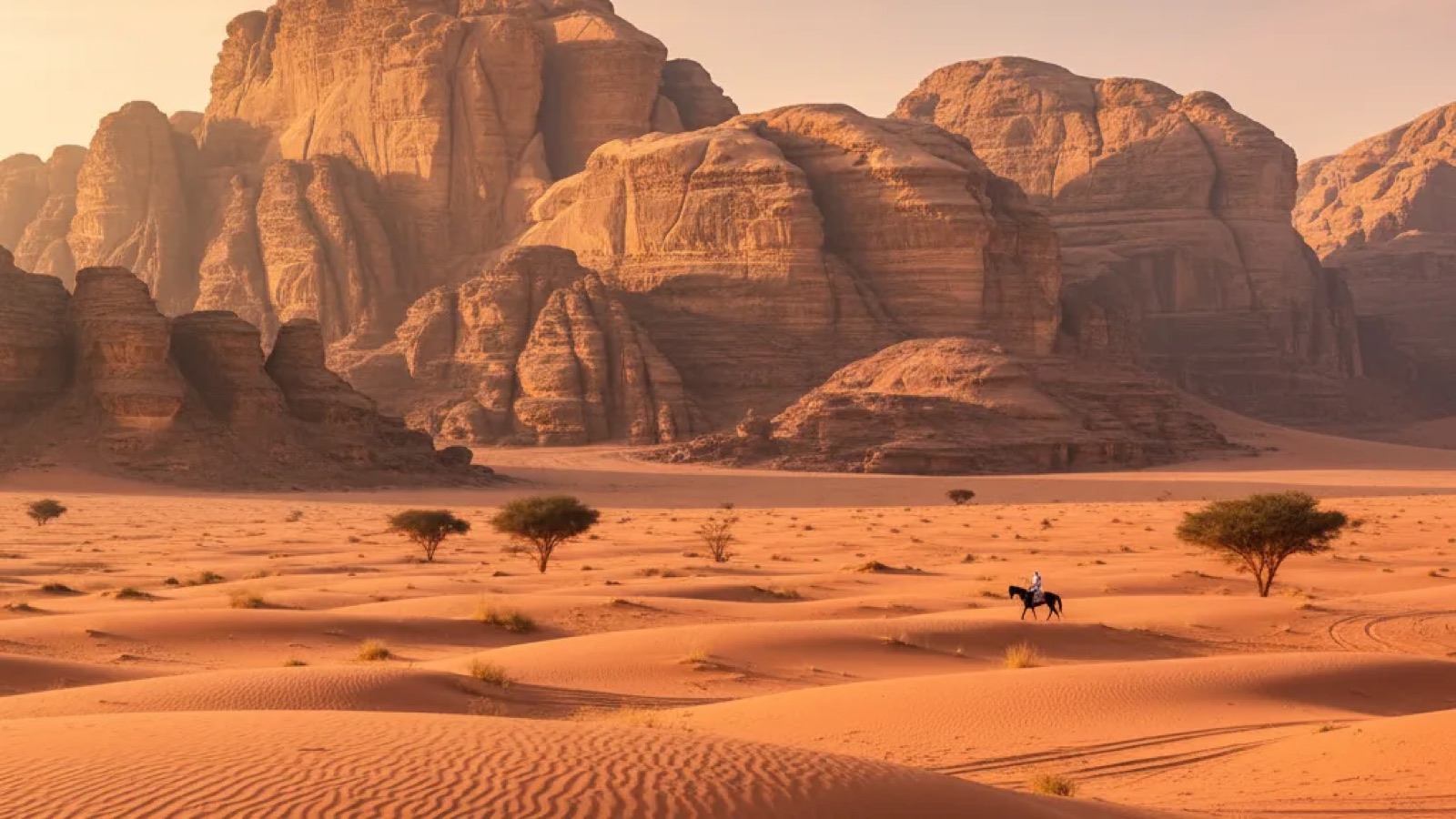
The first thing that hits you isn’t the scale, but the silence. Once the engine of a 4x4 falls quiet, it is replaced by a stillness so profound it feels like a sound in itself. The sand is a deep burnt orange, and colossal sandstone buttresses, weathered by millennia of wind into shapes that defy geology, glow red in the last light of the day. Bedouin guides traditionally welcome visitors with small glasses of hot, sweet tea. This isn't just a landscape; Wadi Rum asks you not just to see it, but to feel it.
They call it the Valley of the Moon, and for good reason. This protected desert wilderness in southern Jordan is a world away from anywhere you know. It’s a place of epic history, staggering natural beauty, and the quiet, profound hospitality of the Bedouin who call it home. This guide covers everything you need to know. We’ll cover how to get here and navigate the unique tour system, what to see on the classic jeep circuit, how to choose a desert camp, and why you absolutely must stay overnight. There's also practical advice for photographing its incredible landscapes, from the fiery dunes at sunset to the star-dusted canvas of the night sky.
Quick Facts
- Location: Southern Jordan, about a 1-hour drive from Aqaba and a 2-hour drive from Petra (Wadi Musa).
- What It Is: A 720-square-kilometre protected desert wilderness, a UNESCO World Heritage site known for its dramatic sandstone mountains, red sands, and ancient history.
- Getting There: By car or organised tour from Aqaba or Petra to Rum village. All visitors must pass through the Wadi Rum Visitor Centre.
- Getting Around: You cannot drive your own vehicle into the protected area. All travel is via pre-booked 4x4 tours driven by local Bedouin guides.
- Language & Currency: Arabic is the official language, though English is widely spoken in tourism contexts. The currency is the Jordanian Dinar (JOD).
- Best Time to Visit: The shoulder seasons of spring (March to May) and autumn (September to November) offer pleasant daytime temperatures and cool nights.
Into the Valley of the Moon
Wadi Rum is not just an empty desert; it’s a masterpiece carved by nature and time. Picture a vast valley floor of deep red and pale orange sand, from which monumental rock formations, known as jebels, rise hundreds of metres into the air. These aren't just hills; they are sheer cliffs, wind-sculpted arches, and narrow canyons of sandstone and granite. It feels primordial, like walking on Mars, which is why it has become a favourite filming location for sci-fi blockbusters seeking an otherworldly backdrop.
But this is a human landscape, too. It has been inhabited for millennia, a vital crossroads for trade caravans travelling from the Arabian Peninsula to the Levant. Its canyons hold rock carvings (petroglyphs) left by Thamudic and Nabataean peoples thousands of years ago. More recently, it was a key theatre of the Great Arab Revolt during World War I, immortalised in the writings of T. E. Lawrence (“Lawrence of Arabia”) and the epic film that bears his name. Today, it is home to the Zalabia Bedouin, who expertly manage the tourism here, sharing their culture and their ancestral land with travellers.
Getting There & How the Desert Works
Reaching Wadi Rum is straightforward. It’s located in the south of Jordan, making it an easy addition to an itinerary including Petra and Aqaba. Most travellers arrive by car, taxi, or pre-arranged transfer from either Wadi Musa (the town next to Petra) or the Red Sea resort town of Aqaba. The journey from both is scenic and takes between one and two hours.
The key thing to realise is that you don't just drive into Wadi Rum. All roads lead to the Wadi Rum Visitor Centre. This is the official gateway to the protected area. Here, you pay your entrance fee (often included if you have a Jordan Pass) and connect with your pre-booked guide. This is a critical point: you cannot drive your own rental car into the main desert wilderness. The terrain is unmarked, sandy, and requires local knowledge and specialised vehicles. You must leave your car in a secure car park in Rum village, just past the visitor centre.
Your visit will be in the hands of a local Bedouin guide with his 4x4 jeep (usually an old Toyota or Land Rover pickup with benches in the back). This isn't just a rule; it's the entire system. Tourism in Wadi Rum is cooperatively managed by the local community. You typically book a tour package with a camp, which includes your jeep tour, your guide, meals, and overnight accommodation. You'll meet your guide at an arranged point in Rum village, hop in his truck, and leave the modern world behind.
Choosing Your Desert Camp
The experience of staying overnight is the whole point of coming to Wadi Rum. A quick day trip only scratches the surface. The real magic happens when the day-trippers leave, the sun sets, and the desert reveals its quiet, starry soul. Your choice of camp will significantly shape this experience.
Camps generally fall into two categories:
Traditional Bedouin Camps
These camps consist of a collection of simple, private tents (usually with proper beds, blankets, and pillows) arranged around a large communal tent. Facilities are shared, and often quite basic—think shared bathroom blocks with flushing toilets and sometimes showers, but don't expect luxury. The focus here is on authenticity. Evenings are spent in the main tent, sipping tea around a crackling fire, sharing stories with your hosts and fellow travellers, and enjoying a traditional dinner. The atmosphere is communal, warm, and deeply connected to Bedouin culture.
Luxury & 'Bubble' Camps
In recent years, more luxurious options have sprung up, famously including the geodesic 'Martian' or 'bubble' domes with panoramic windows looking out onto the desert. These offer a much higher level of comfort: private en-suite bathrooms, air conditioning, and more upscale amenities. While they offer incredible views from your bed, they can sometimes feel more like a hotel and less like an immersive cultural experience. The choice is a personal one: do you want a more rustic, authentic connection or a more comfortable, Instagrammable stay?
Regardless of your choice, nearly all camps are booked as a package. You don't just book a room; you book a tour that includes a jeep safari, meals (dinner and breakfast), and your accommodation. A full-day tour plus an overnight stay is the classic, and for very good reason.
The Classic Jeep Tour: A Journey Through the Jebels
Your 4x4 tour is your ticket to the wonders of the protected area. The itinerary for a full-day tour is fairly standard, taking in the most famous and accessible sites. Don't worry about it feeling like a conveyor belt, though; the landscape is so vast that it rarely feels crowded.
- Lawrence's Spring: A small, leafy oasis where water trickles from the rock. It's a popular first stop where you can clamber up the rocks for a great view back towards Rum village.
- Khazali Canyon: A narrow siq, or fissure, in the side of a jebel. You can walk about 100 metres inside to find its cool, shaded walls covered in ancient Nabataean and Thamudic inscriptions and petroglyphs of animals and people.
- The Red Sand Dune: A massive, steep dune of fine, deep-red sand piled up against a rock face. The challenge is to scramble to the top for a breathtaking panoramic view. The run back down is pure joy.
- Rock Bridges: Wadi Rum is famous for its natural arches. You'll almost certainly visit the Um Fruth Rock Bridge, a high, dramatic arch that you can (carefully!) climb for an iconic photo. The larger Burdah Rock Bridge is a more challenging scramble, usually tackled on longer, dedicated hiking tours.
- Anfishiyyeh Inscriptions: Another fantastic panel of ancient rock art, showing camel caravans and hunting scenes. It’s a powerful reminder of how long this desert has been a thoroughfare.
- Lawrence's House: The romantic ruins of a Nabataean structure that T. E. Lawrence supposedly used during the Arab Revolt. While the historical connection is a little tenuous, the view from here is magnificent.
Your guide will pace the day perfectly, finding a shady spot for a simple but delicious lunch, and culminating in finding the perfect vantage point to watch the sunset paint the entire landscape in shades of gold and crimson.
Beyond the 4x4: Camels, Canyoning and Balloons
While the jeep tour is the heart of the Wadi Rum experience, there are other ways to explore. Most tours will include a short camel ride, perhaps for an hour at sunrise or sunset. It’s a wonderful way to experience the desert at a slower pace. However, be realistic: sitting on a camel for more than an hour is not comfortable if you're not used to it. As with any animal tourism, observe the condition of the animals and trust your gut.
For the more adventurous, Wadi Rum is a world-class destination for scrambling, hiking, and canyoning. This requires more time and a specialist guide. Longer treks can take you deep into the wilderness to summit peaks like Jabal Umm ad Dami (Jordan's highest mountain) or navigate remote canyons. These trips need to be organised well in advance.
A truly spectacular, if costly, experience is a hot-air balloon flight at sunrise. Seeing the vastness of the desert from above as the first light hits the tops of the jebels is an unforgettable memory. These flights are highly weather-dependent and must be booked far in advance with the licensed operators in the area.
Bedouin Hospitality: Zarb, Tea and Stories
The highlight of any overnight stay is the evening at your camp. You’ll be welcomed with endless glasses of Bedouin tea—a brew of black tea, heavily sweetened, and often flavoured with sage or mint. It’s the lubricant of social life in the desert.
The main event is dinner, which is often a traditional meal called zarb. This is Bedouin barbecue at its best. Chunks of chicken and vegetables are placed in a multi-layered tray, which is then lowered into an underground oven—essentially a hole in the sand filled with hot coals. It's covered and left to slow-cook for a couple of hours. The unearthing of the zarb is a piece of theatre in itself, and the resulting meal is wonderfully tender and smoky.
After dinner, you'll gather around the fire in the main tent or out under the open sky. This is a time for conversation, for listening to your Bedouin hosts play the oud or the rababa, and for simply staring into the flames. This genuine, unforced hospitality is the soul of Wadi Rum.
Photographing the Desert: Golden Hour and the Milky Way
For photographers, Wadi Rum is one of the great places on the planet. The light is extraordinary, but you need to know how to work with it.
Golden Hour Glory
The harsh midday sun flattens the landscape. The magic happens during the 'golden hours'—the first hour after sunrise and the last hour before sunset. The low sun creates long, dramatic shadows that define the shape of the dunes and mountains. The colour of the sand intensifies to a fiery red. When you're on your jeep tour, your guide will time your final stop for sunset. My advice: don't just photograph the sun itself. Turn around and capture the incredible pink and orange light hitting the rock faces. A polarising filter can help deepen the blue of the sky and cut the haze, making the red rocks pop even more.
Astrophotography and the Night Sky
On a clear, moonless night, the sky above Wadi Rum is one of the best you will ever see. The lack of light pollution means the Milky Way stretches from horizon to horizon like a celestial cloud. To capture it:
- Plan for the moon: For the best star photos, you need a New Moon, or a time when the moon sets early or rises late. Use a moon phase calendar when planning your trip. A bright moon will wash out the stars.
- Bring a tripod: This is non-negotiable. You’ll be using long shutter speeds (15-30 seconds), and any camera shake will blur your shot.
- Use a wide, fast lens: A lens with a wide aperture (like f/2.8 or lower) will let in the most light. A wide focal length (14-24mm) will capture the scale of the sky.
- Manual settings are key: Set your focus to infinity manually (autofocus won't work in the dark). Use a wide aperture, a shutter speed around 20 seconds, and an ISO between 1600 and 6400 to start. Experiment from there.
- Light painting: Bring a torch or headlamp. During your long exposure, you can 'paint' your foreground—a jebel, a tent, a person—with light for a few seconds to illuminate it and add context to your starry sky. Use a red light on your headtorch to preserve your night vision.
Even without a fancy camera, just lying on your back and gazing up at the sheer number of stars is a profound experience – it's easy to spend hours watching shooting stars streak across the galaxy.
Desert Logistics & What to Pack
A little preparation goes a long way to ensuring your desert trip is comfortable and safe.
When to Visit
The best times are spring (March-May) and autumn (September-November). The days are warm and sunny, and the nights are cool but comfortable. Summer (June-August) is brutally hot. Winter (December-February) can be beautiful, with crisp clear days, but nights are genuinely cold, often dropping close to freezing. You'll need serious layers. Spring can also be the season for sandstorms, which can reduce visibility and make being outside unpleasant, but they usually pass within a day or so.
What to Pack
- Layers: The desert temperature swings dramatically. Pack lightweight long-sleeved shirts, a fleece or mid-layer, and a windproof/warm jacket, even in the milder seasons.
- Scarf or Head covering: Essential. A Jordanian keffiyeh is perfect. It protects from sun, wind, and blowing sand. Your guide can show you how to wrap it properly.
- Sun Protection: High-SPF sunscreen, sunglasses, and a wide-brimmed hat are non-negotiable.
- Comfortable, closed-toe shoes: Trainers or light hiking boots are ideal for clambering on rocks and walking in sand.
- Torch or Headlamp: Crucial for navigating your camp after dark. The desert gets properly dark.
- Power Bank: Electricity at camps can be limited and only on for a few hours in the evening. A charged power bank is a lifesaver for your phone and camera.
- Personal Necessities: Any personal medication, wet wipes, and hand sanitiser.
Desert Realities
Be prepared for patchy to non-existent mobile phone signal and Wi-Fi once you leave Rum village. Embrace the digital detox. Bathroom facilities at most traditional camps are basic but functional; water is a precious resource, so keep showers short. Finally, always practice Leave No Trace principles. The desert is a fragile ecosystem. Take all your rubbish with you, don't disturb wildlife, and stick to the trails.
Explore in Depth
Wadi Rum fits perfectly into a classic Jordan itinerary. It’s the ideal contrast to the ancient city of Petra, swapping intricate carved facades for vast, natural architecture. My guide to Petra covers everything you need to know for a visit to that other incredible wonder of the world.
Frequently Asked Questions
What are the toilets and showers like at a Bedouin camp?
At most traditional camps, facilities are in a shared block, separate from the sleeping tents. You can expect western-style flushing toilets and sinks. Showers are usually available, often with hot water heated by solar power, but water pressure can be low. These facilities are generally kept clean but are basic by hotel standards. Luxury camps offer private, en-suite bathrooms. It's always a good idea to bring your own towel and toiletries, and remember that water is a precious resource in the desert, so keep your usage mindful.
Is it safe to sleep outside under the stars instead of in a tent?
Yes, and it's an incredible experience that many camps can arrange. They will provide mattresses, pillows, and plenty of warm blankets. You'll be sleeping in a designated spot within the camp's area, not completely alone in the wilderness. The desert is very safe, with no dangerous predators to worry about. The main concerns are the cold, especially in winter, and potentially scorpions or insects, though this is rare. Sleeping on a mattress off the ground minimises this risk. If you have the chance, it's highly recommended.
How much walking or climbing is involved in a jeep tour?
A standard jeep tour involves minimal strenuous activity, but you'll get out of the vehicle frequently to explore. Expect short walks on sand to sites like Khazali Canyon and Lawrence's House. The most strenuous part for most is the optional scramble up the Red Sand Dune or the Um Fruth Rock Bridge. You can choose to participate or just enjoy the view from the bottom. If you want more serious hiking or scrambling, you need to book a dedicated trekking tour in advance, not just a standard jeep tour.
Do I need to be worried about scorpions or snakes in Wadi Rum?
While snakes and scorpions do live in the desert, it is extremely unlikely you will encounter them, and even less likely you'll have a dangerous interaction. They are nocturnal and generally avoid humans. Your Bedouin guides are experts on the local environment. To be safe, always wear closed-toe shoes when walking around, especially at night, and use a torch. Before putting on your shoes in the morning, give them a quick shake, just in case. Don't let this worry you; incidents are incredibly rare.
Is it better to book a Wadi Rum tour in advance or on arrival?
It is strongly recommended to book your camp and tour package in advance, especially during the peak seasons of spring and autumn. The best and most highly-regarded camps fill up weeks or even months ahead. By booking in advance, you can research your options, read reviews, and communicate your needs directly with the camp owner. This ensures a smooth arrival, as your guide will be waiting for you. While it might be possible to find a last-minute tour in Rum village, your choices will be limited and it adds unnecessary stress to your trip.
Final Thoughts
Among the world's deserts, from the Atacama to the Sahara, Wadi Rum has a unique spirit that draws travellers back. It’s more than just the monumental scenery and the cinematic history. It’s in the warmth of the welcome, the taste of the sweet tea, the quiet conversation around a fire, and the overwhelming sense of peace that descends with the stars.
Wadi Rum isn't a destination to be ticked off a list; it’s an experience to be absorbed. It’s a chance to disconnect from the frantic pace of the modern world and reconnect with something more ancient and elemental. Don't rush it. Give it the night it deserves, and you’ll leave with more than just spectacular photos—you’ll leave with a piece of its profound silence in your soul.
More Jordan guides
Jordan Travel Guide: Petra, Wadi Rum, Dead Sea
A week in Jordan: the classic route from Amman to Petra and Wadi Rum, driving, the Jordan Pass, seasons and cultural basics.
Petra Guide: The Siq, Treasury and Monastery
How to see Petra properly: the walk through the Siq, the Monastery climb, the back trails, ticket days and beating the heat.