Athens Itinerary: Acropolis, Markets, Day Trips
Two days in Athens done properly: the Acropolis without the worst crowds, the museums that matter, Plaka and Psyri, and the best day trips.
In this guide
- Quick Facts
- How Many Days Do You Need in Athens?
- Getting Into the City and Around
- The Main Event: The Acropolis & Your Ticket Strategy
- The Acropolis Museum: A Must-Do Companion
- Exploring Ancient Athens Beyond the Acropolis
- Views & Photography: Climbing Athens' Hills
- Neighbourhood Guide: Plaka, Monastiraki, Psyri & Koukaki
- A Taste of Local Life: The Central Market & Changing of the Guard
- Gateway to the Islands: Piraeus Port & The Ferries
- Escapes from the City: Day Trips from Athens
- Explore in Depth
- Frequently Asked Questions
- Final Thoughts
This guide is part of our Greece Itinerary: Best Islands, Athens and When to Go — start there for the overview, when to go and how to get around.
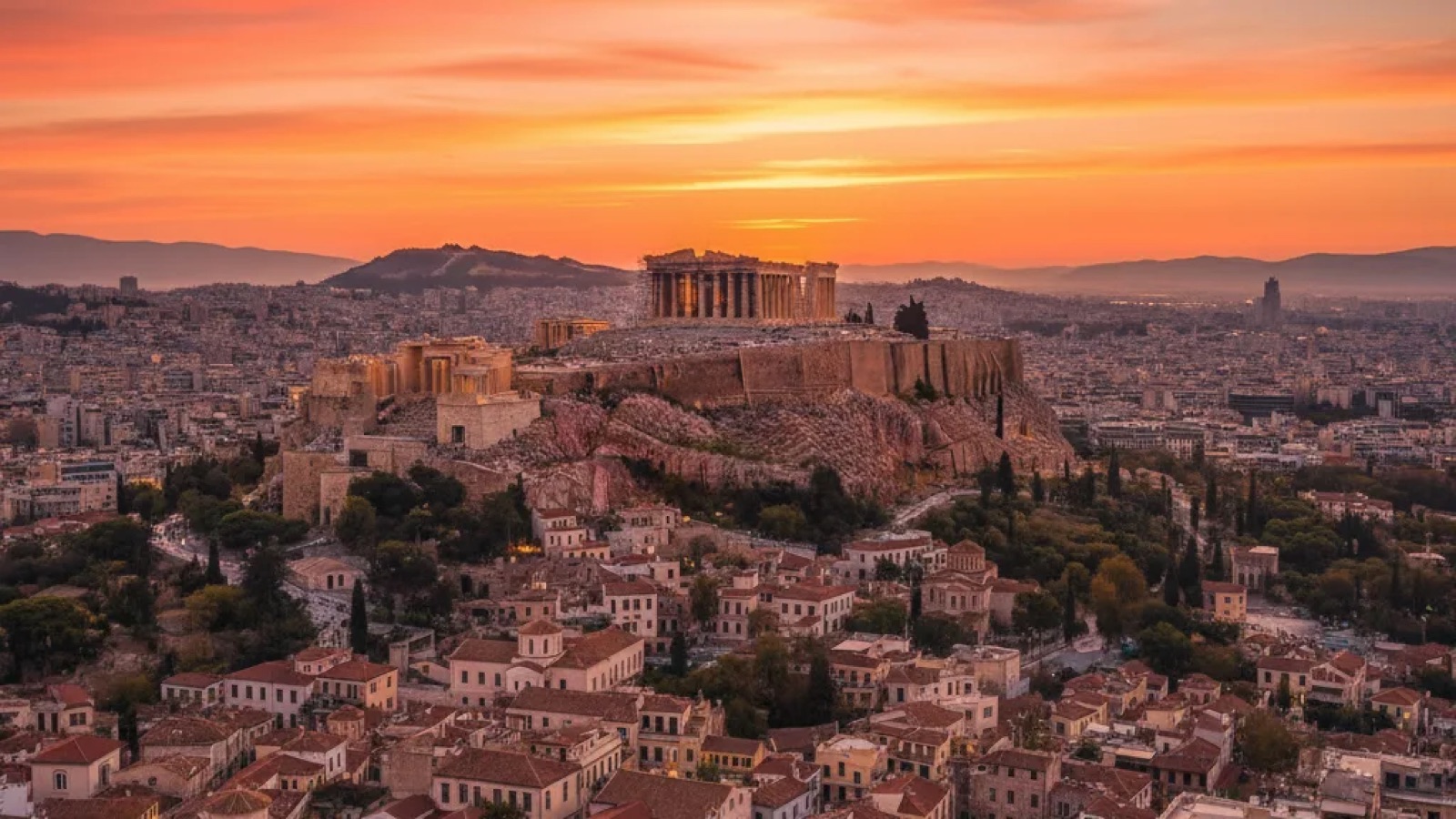
Sit on a rooftop in Monastiraki at dusk with a cold drink in hand, as the day's heat bleeds out of the concrete and bouzouki music drifts from a nearby taverna. As the lights flick on across the city, there it is: the Parthenon, floating like a golden crown on its rocky throne, floodlit against the deep indigo sky. It’s a sight that grabs you by the heart and doesn’t let go. It’s the moment you realise you’re not just in any city; you’re at the very wellspring of Western civilisation.
Athens isn't a museum piece, though. It’s a loud, chaotic, thrillingly alive metropolis where ancient wonders rub shoulders with gritty street art and world-class restaurants. This guide distills the city into a practical plan. We’ll cover how to get your bearings, how to tackle the jaw-dropping archaeological sites without burning out, where to find the best views, what to eat, and how to use Athens as the perfect launchpad for the Greek islands or epic mainland day trips. Let's dive in.
Quick Facts
- Location: Athens is the capital and largest city of Greece, located in the Attica region. It's one of the world's oldest cities, with a recorded history spanning over 3,400 years.
- Getting There: Athens International Airport (ATH) is the main hub, well-connected globally. Ferries from Piraeus port connect Athens to all the Greek islands.
- Getting Around: The central, tourist-heavy areas are very walkable. The Athens Metro is modern, clean, and efficient for longer distances, connecting the airport, city centre, and port of Piraeus.
- Language & Currency: Greek is the official language, though English is widely spoken in tourist areas. The currency is the Euro.
- Best Time to Visit: The shoulder seasons of April-May and September-October offer the best balance of pleasant weather and manageable crowds. Summer (June-August) is very hot and crowded.
How Many Days Do You Need in Athens?
This is the million-dollar question. Trying to "do" Athens in a single day on a cruise stop tends to be a frantic, sweaty affair. To do the city justice, three full days is the perfect minimum. This gives you one dedicated day for the Acropolis and its surrounding ancient sites, a second day for the major museums and exploring the core neighbourhoods like Plaka and Monastiraki, and a third day to soak in the atmosphere, climb a viewpoint for sunset, or explore a less-touristy area like Koukaki.
If you have four or five days, that's even better. It opens up the possibility of a fantastic day trip to the Temple of Poseidon at Cape Sounion or even the legendary site of Delphi, without feeling rushed. A longer stay allows you to slow down to the Athenian pace of life: enjoying a long, lazy coffee, getting lost in the markets, and discovering your own favourite rooftop bar.
Getting Into the City and Around
Athens has its logistics sorted better than many European capitals. From Athens International Airport (ATH), you have two excellent, straightforward options to get to the city centre (like Syntagma or Monastiraki squares).
The Metro's Line 3 (the Blue Line) runs directly from the airport to the centre. It’s clean, efficient, and usually the best choice. The journey takes about 40 minutes. Just follow the signs for "Trains" from arrivals. The express 24-hour airport buses are another solid option, especially if you arrive at an odd hour when the Metro isn't running. The X95 bus to Syntagma Square is the most useful for travellers. It takes longer (60-90 minutes depending on traffic) but it’s a good scenic ride in.
Once you’re in the city, the historic centre is surprisingly compact. You can walk from Plaka to Monastiraki to Psyri easily. For anything further, the Metro is your best friend. A word of warning: The Athens Metro, particularly the line to Piraeus and routes between major tourist spots, is notorious for highly skilled pickpockets. Don't be paranoid, just be prepared. Keep your wallet in a front pocket, wear your backpack on your front in crowded carriages, and be aware of your surroundings. Pickpockets often work in teams; they are professionals.
The Main Event: The Acropolis & Your Ticket Strategy
Let's be honest, this is why you're here. The Acropolis is more than just a pile of ruins; it’s an icon that has captivated humanity for millennia. Seeing the Parthenon, the Erechtheion with its famous Caryatids, and the Propylaea entrance gate up close is a profound experience. But you need a strategy.
First, timing is everything. The Acropolis is a shadeless, marble-topped hill. In summer, the heat and glare bouncing off the stone by midday are genuinely punishing. Add in the thousands of people pouring off cruise ships, and it can be overwhelming. My hard-won advice: go as soon as it opens, or go in the last couple of hours before it closes. The morning light is crisp and beautiful for photography, while the late afternoon Golen Hour bathes the Pentelic marble in a warm, ethereal glow.
Second, your ticket. The official €30 combined ticket for the Acropolis and six other sites (the Ancient Agora, Roman Agora, Hadrian's Library, Temple of Olympian Zeus, Aristotle's School (Lyceum) and the Kerameikos Cemetery) was discontinued in April 2025. Each site now has its own ticket: a single Acropolis entry costs €30, and the other sites are priced separately (the Roman Agora, for example, is €10).
Check the official Hellenic Ministry of Culture website for the most current ticketing information, opening hours, and to potentially book your ticket online, which can save you time in the queue on the day.
The Acropolis Museum: A Must-Do Companion
This can’t be stressed enough: visiting the Acropolis without visiting the Acropolis Museum afterwards is like reading only half a book. Located at the foot of the hill, this stunningly modern museum is a masterpiece in itself. It’s designed to be the perfect counterpoint to the ancient rock.
The museum brilliantly displays the artefacts found on the Acropolis, from everyday items to breathtaking sculptures. You walk over glass floors with the ruins of an ancient Athenian neighbourhood visible below your feet. The highlight is the top-floor Parthenon Gallery. It has the exact same dimensions and orientation as the Parthenon itself, which you can see in all its glory through floor-to-ceiling windows. Here, the surviving friezes are displayed in their original sequence, giving you a sense of the temple's narrative and scale that’s impossible to grasp up on the hill. It puts everything you just saw into context.
Exploring Ancient Athens Beyond the Acropolis
Separate site tickets unlock the rest of ancient Athens, which spreads out below the Acropolis. Don't try to see them all in one day!
- The Ancient Agora: This was the heart of classical Athens – the centre of commercial, political, and social life. It’s a sprawling, green, and surprisingly peaceful site to wander. The highlight is the Temple of Hephaestus, one of the most complete and best-preserved Greek temples anywhere.
- The Roman Agora & Hadrian's Library: Located a short walk away, these sites show the city's evolution under Roman rule. The Roman Agora is smaller, with its standout feature being the incredible Tower of the Winds, an ancient meteorological station.
- Temple of Olympian Zeus: You can't miss this one. Its colossal columns are visible from all over the centre. It was one of the largest temples ever built in the ancient world. Standing beside the few remaining columns gives you a humbling sense of what the full structure must have looked like.
Views & Photography: Climbing Athens' Hills
For photographers, Athens is a city that rewards a little bit of climbing with epic panoramas.
Filopappou Hill, just southwest of the Acropolis, is the best spot for that iconic postcard shot. It's an easy, pleasant walk up through pine-scented paths, and from the top, you get a perfect, unobstructed side-on view of the Acropolis, the Odeon of Herodes Atticus, and the entire city sprawling towards the sea. It's spectacular at sunset. Bring a tripod and be patient.
Lycabettus Hill is the highest point in central Athens, a limestone cone that juts dramatically out of the city. You can take a funicular to the top or, if you're feeling energetic, walk the winding path. The view from here is a 360-degree spectacle, from the port of Piraeus to the mountains surrounding Attica. The Acropolis looks almost small from this height. It’s a fantastic spot for a zoom lens to pick out details across the urban landscape. The little white chapel of St. George at the summit is beautifully photogenic.
Neighbourhood Guide: Plaka, Monastiraki, Psyri & Koukaki
The soul of Athens lives in its distinct neighbourhoods. Here's a quick rundown of the main ones you'll be exploring:
- Plaka: Tucked under the Acropolis, this is the oldest part of Athens. It’s a charming labyrinth of cobblestone streets, neoclassical mansions draped in bougainvillea, and tiny shops. It's beautiful but can feel very touristy, especially the main streets. My advice is to dive into the quieter back alleys to find the real magic.
- Monastiraki: This neighbourhood is a bustling hub of activity, famous for its sprawling flea market. It’s a mix of souvenir shops, antique stores, and trendy bars. It has a gritty, vibrant energy, especially around Monastiraki Square with its fantastic view of the Acropolis.
- Psyri (Psiri): Once a down-at-heel industrial area, Psyri is now Athens' capital of cool. It's packed with street art, independent galleries, ouzeries, live music venues, and some of the city's most creative bars and restaurants. It really comes alive after dark.
- Koukaki: South of the Acropolis and bordering Filopappou Hill, Koukaki is a more relaxed, residential neighbourhood. It's become a favourite for travellers looking for a more local vibe, with pedestrianised streets lined with great cafés, tavernas, and brunch spots. It's the perfect base if you want to be close to the sites but away from the main tourist throng.
A Taste of Local Life: The Central Market & Changing of the Guard
For a full-on sensory experience, you must visit the Varvakios Agora, Athens' central market. It's not for the faint of heart. The meat section is a cacophony of butchers cleaving carcasses, while the fish hall is a slippery, gleaming display of the Aegean's bounty. The air is thick with the smells of oregano, olives, and fresh fish. It’s an incredible slice of real Athenian life and a fantastic place for photography. The surrounding streets are full of shops selling nuts, spices, cheeses, and all manner of Greek delicacies.
For something completely different, head to Syntagma Square to see the Changing of the Guard at the Tomb of the Unknown Soldier. The ceremony happens on the hour, but the main event is the full ceremonial parade on Sunday at 11 am. The guards, known as Evzones, are an elite unit whose high-stepping, slow-motion choreography in their traditional uniform with pom-pommed shoes is a truly unique spectacle.
Gateway to the Islands: Piraeus Port & The Ferries
For most travellers, Athens is the gateway to the Greek islands, and Piraeus is the gate. This isn't some quaint little harbour; it's one of the busiest passenger ports in Europe. It's enormous, chaotic, and can be very intimidating for first-timers.
My best advice is to be organised. Book your ferry tickets well in advance, especially in summer. Your ticket will have a gate number (e.g., E7, E9). The gates can be kilometres apart, so don't just rock up to "Piraeus". The Metro line 1 (the Green Line) terminates at Piraeus right opposite the main gates, but you might need a taxi from there to get to your specific ferry, especially if you have luggage. Give yourself plenty of time. Watching the Blue Star ferries reverse into their docks with pinpoint precision is a show in itself, the start of your island adventure.
Escapes from the City: Day Trips from Athens
If you have an extra day, escaping the city can give you a whole new perspective on Greece.
- Cape Sounion: This is the easiest and one of the most rewarding day trips. A 90-minute drive or bus ride along the coast brings you to the stunning Temple of Poseidon, perched on a cliff overlooking the Aegean. The goal is to be there for sunset. Watching the sun drop into the sea behind the ancient columns is a truly magical, almost spiritual experience.
- Delphi: This is a long day trip (about 3 hours each way), but worth every second for history lovers. In ancient times, Delphi was considered the centre of the world. The setting is spectacular, on the slopes of Mount Parnassus. Walking the Sacred Way to the Temple of Apollo, where the Oracle once gave her prophecies, is unforgettable.
- Nafplio & Epidaurus: This is another long day, best done with an organised tour or your own car. You can explore the incredible theatre at Epidaurus, famous for its perfect acoustics, and then spend the afternoon in Nafplio, a breathtakingly beautiful seaside town with Venetian fortresses and charming streets. It was the first capital of modern Greece and is one of the loveliest towns in the whole country.
Explore in Depth
Athens is often the starting point for a bigger Greek odyssey. If you're plotting your course from Piraeus to the islands, or want to see what other wonders the mainland holds, these guides will help you plan your next steps.
Frequently Asked Questions
How much time do I need for the Acropolis and the Acropolis Museum?
Plan for at least half a day. Allow 2-3 hours for the Acropolis hill itself, with time to walk up, explore the Parthenon, Erechtheion, and Propylaea without rushing, and soak in the views. Afterwards, allocate another 2 hours for the Acropolis Museum. Visiting them back-to-back provides the complete story. To avoid the worst crowds and heat, start at the Acropolis as soon as it opens, then head to the air-conditioned museum as the midday heat builds up.
Is there still a combined archaeological site ticket?
No. The official combined ticket covering the Acropolis plus six other major sites like the Ancient Agora and Temple of Olympian Zeus was discontinued in April 2025, so each site is now ticketed separately and a single Acropolis entry costs €30. If you plan to spend more than one day in Athens, spreading the sites over several days still makes for a more relaxed pace of exploration rather than trying to cram everything into one exhausting day.
What's the best neighbourhood to stay in Athens?
It depends on your travel style. For first-timers who want to be in the heart of the action, Plaka or Monastiraki are perfect, with everything on your doorstep. If you prefer a trendier, more local vibe with great nightlife and street art, Psyri is an excellent choice. For a quieter, more village-like atmosphere that's still very central and close to the Acropolis Museum, Koukaki is a strong pick, especially for a longer stay.
Is it possible to do a Greek island as a day trip from Athens?
Yes, it's possible for the nearby Saronic Gulf islands. Hydra, Poros, and Aegina are all reachable via frequent high-speed ferries from Piraeus port, with journey times often around 1-2 hours each way. It makes for a long but very rewarding day. You could leave early, spend several hours exploring a car-free island like Hydra or visiting the Temple of Aphaia on Aegina, and be back in Athens for a late dinner. Just be sure to check the last ferry times back to Piraeus carefully.
Is Athens a safe city for travellers?
Yes, Athens is generally a very safe city. The main issue for travellers is petty crime, specifically pickpocketing in crowded areas. The Metro, Monastiraki flea market, and any queues at tourist sites are prime spots. Be vigilant with your belongings: use a money belt or secure bag, don't flash expensive items, and be aware of your surroundings. Violent crime against tourists is extremely rare. Use common sense as you would in any major city, and you'll find Athenians to be incredibly friendly and helpful.
Final Thoughts
Athens has a reputation as a stopover city, a necessary pause on the way to the islands. But it is so much more than that. It’s a city that wears its immense history with a kind of chaotic grace, where you can turn a corner and be confronted by 2,500 years of human ambition. It’s a place of peeling paint and sublime beauty, of quiet neighbourhood tavernas and moments of profound historical connection.
Give Athens your time and your curiosity. Let yourself get a little lost in Plaka's backstreets, linger over that second coffee in Koukaki, and stand in awe on Filopappou Hill as the sun sets over the Parthenon. When you do, you’ll discover that Athens isn’t just a gateway to Greece, it’s the heart of it.