Things to Do in Greece: Ancient Sites and Islands
Athens, Delphi and the Peloponnese, island hopping in the Cyclades and Dodecanese, Meteora's monasteries, Crete's gorges and beaches, and Greek food.
In this guide
- Essential Greece Travel Facts
- Table of Contents
- Exploring Classical Monuments: Athens, Delphi, and the Peloponnese
- Island Hopping in the Cyclades and Dodecanese
- Mainland Detours: Monasteries, Gorges, and Peaks
- Exploring Crete and Legendary Beaches
- Experiencing Greek Food Culture and Traditions
- Explore in Depth
This guide is part of our Greece Travel Guide — start there for the overview, when to go and how to get around.
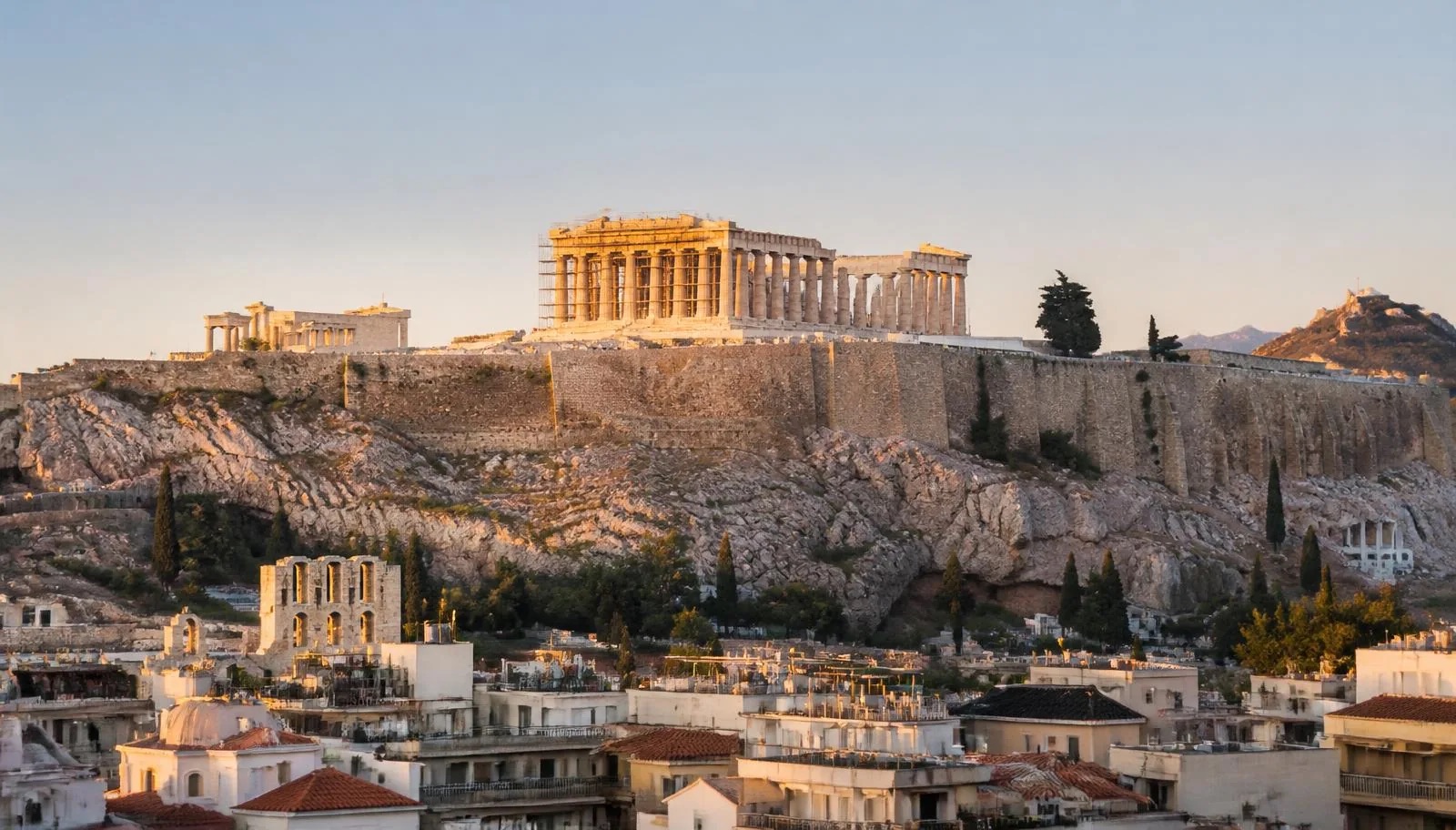
Stand on the slippery marble path of the Areopagus in Athens as an autumn wind whips across the Saronic Gulf, carrying the dry scent of pine, dusty earth and crushed oregano. Below, the Greek capital stretches into an endless sea of low-rise white concrete rooftops, but directly above, bathed in late afternoon light, stand the golden columns of the Parthenon—flawless, commanding, and seemingly indifferent to the millennia that have washed over them.
Greece is far more than a backdrop for holiday snapshots or simple beach breaks. It is a dense, multi-layered country where four thousand years of history rest alongside sleepy fishing harbours, dramatic alpine mountain passes, and deep river canyons. Whether you come to trace the footsteps of ancient philosophers, hike through mountain wilderness areas that feel worlds away from the coast, or island-hop between sun-bleached archipelagos, understanding how to navigate the geography and seasons is key to an rewarding journey.
From the rugged mainland peaks of Epirus and Macedonia down to the sun-baked stones of the Peloponnese and the scattered islands of the Aegean and Ionian seas, this guide breaks down the essential experiences across Greece into thematic, practical detours.
Essential Greece Travel Facts
- Capital: Athens
- Language: Greek (English is widely spoken in tourist centres and by younger generations)
- Currency: Euro (€)
- Getting Around: An extensive network of passenger ferries links the islands, while long-distance KTEL buses and rental cars are best for mainland travel
- Best Time to Visit: Shoulder seasons (May to June and September to October) offer warm sea temperatures, pleasant hiking weather, and far fewer crowds than midsummer
- Top Geographical Regions: Attica, Peloponnese, Thessaly, Epirus, Macedonia, Cyclades, Dodecanese, Ionian Islands, Crete
Table of Contents
- Essential Greece Travel Facts
- Exploring Classical Monuments: Athens, Delphi, and the Peloponnese
- Island Hopping in the Cyclades and Dodecanese
- Mainland Detours: Monasteries, Gorges, and Peaks
- Exploring Crete and Legendary Beaches
- Experiencing Greek Food Culture and Traditions
Exploring Classical Monuments: Athens, Delphi, and the Peloponnese
To walk through Greece is to step directly into the textbook of Western history. Rather than existing as isolated museum pieces, classical ruins form an active part of the natural landscape, framed by olive groves, mountain slopes, and the Mediterranean Sea.
Athens: The Ancient Heart of the City
Every journey into Greece's antiquities naturally begins in Athens. The Acropolis dominates the skyline, sitting atop a flat-topped limestone rock rising about 150 metres above sea level. Entering early in the morning through the monumental gateway of the Propylaea allows you to experience the Parthenon before the heat of the day and peak crowds set in. Built during the 5th century BCE under Pericles, this temple dedicated to Athena features subtle architectural illusions—such as slightly curved columns and elevated floor edges—designed to make the edifice appear perfectly straight from a distance.
Adjacent to the main plateau, the Acropolis Museum provides crucial context. Built over an active archaeological excavation visible through ground-floor glass panels, the museum houses original sculptures, friezes, and votive statues recovered from the hill. Its top-floor glass gallery is purposefully aligned at the exact angle of the Parthenon itself, offering an uninterrupted visual dialogue between the marble reliefs and the temple standing outside.
Down on the lower slopes lies the Ancient Agora, once the civic, commercial, and political heart of classical Athens. Here, Socrates debated ethics and public affairs were decided. Key features include the exceptionally well-preserved Temple of Hephaestus, which retains its original roof line, and the reconstructed Stoa of Attalos, which houses a fascinating collection of everyday artifacts including ancient voting tokens and clay pottery.
Delphi: The Sanctuary on Mount Parnassus
Located on the steep southern slopes of Mount Parnassus, high above the Gulf of Corinth, Delphi was considered by ancient Greeks to be the centre of the world—the omphalos. Home to the legendary Oracle of Apollo, ruler leaders and generals travelled across the Mediterranean to seek prophecies before going to war or founding new colonies.
The climb up the Sacred Way leads past the reconstructed Treasury of the Athenians, constructed to celebrate victory at the Battle of Marathon, up to the impressive Temple of Apollo. Further up the mountain slope sits a remarkably intact classical theatre seating 5,000 spectators with sweeping views over the olive-filled Pleistos Valley below. At the highest point of the sanctuary lies the ancient stadium, where the Pythian Games were held every four years.
The Peloponnese: Epidaurus, Mycenae, and Olympia
Cross the narrow Corinth Canal into the Peloponnese peninsula, and you enter a region dense with classical legacy and dramatic scenery.
- Epidaurus Theatre: Famous worldwide for its extraordinary acoustics, this 4th-century BCE theatre was built as part of a sanctuary dedicated to Asclepius, the god of healing. Even from the highest row of its 55 limestone seating tiers, you can distinctly hear a copper coin dropped or a paper torn at the centre of the circular performance space. During summer months, the ancient theatre still hosts live classical drama performances.
- Mycenae: Dating back to the Late Bronze Age (1600–1100 BCE), Mycenae was the citadel of King Agamemnon, leader of the Greeks in the Trojan War. Walking through the massive Lion Gate—constructed with gigantic megalithic stones known as Cyclopean masonry—reveals a civilization far older than classical Athens. Don't miss the vaulted beehive tombs (tholos), particularly the monumental Treasury of Atreus just outside the main gate walls.
- Ancient Olympia: Located in a lush valley in the western Peloponnese, this sanctuary hosted the original Olympic Games from 776 BCE until 393 CE. Visitors can walk through the arched entrance tunnel onto the dirt track of the original stadium, race along the sprint line, and inspect the massive fallen drum columns of the Temple of Zeus, which once housed one of the Seven Wonders of the Ancient World.
Island Hopping in the Cyclades and Dodecanese
With thousands of islands scattered across the Aegean and Ionian seas, island hopping is an essential Greek ritual. However, navigating the ferry networks requires understanding the distinct personality of each archipelago and accounting for variable sea conditions.
Ferry Logistics and Sailing Dynamics
Mainland Greece connects to the islands via major ports like Piraeus and Rafina near Athens. Modern ferry fleets range from large conventional vehicle ferries—slower, smooth-sailing vessels offering open sun decks—to high-speed catamarans that drastically cut travel times between islands. Keep in mind that mid-to-late summer often brings the Meltemi, a strong northerly wind that blows across the Aegean, occasionally causing delays or route changes for passenger hydrofoils. For a slower pace, chartering a sailing boat allows access to secluded coves and unpopulated islets far from scheduled ferry routes.
Santorini: Volcanic Rim and Ancient Ruins
Formed by one of the largest volcanic eruptions in recorded history, Santorini is defined by its dramatic flooded crater, or caldera. High above the water, white-washed towns like Fira and Oia cling precariously to dark basalt cliffs. A popular way to take in the geology is walking the 10-kilometre cliffside path between Fira and Oia, passing whitewashed chapels and volcanic rock formations.
Beyond the sunset viewing spots, Santorini holds significant historical depth at Akrotiri. Often referred to as the Minoan Pompeii, this prehistoric Bronze Age settlement was buried in volcanic ash around 1600 BCE. Modern wooden walkways lead through an excavated town where two-storey stone buildings, sophisticated drainage systems, and preserved store jars remain protected beneath a modern protective roof structure.
Mykonos and the Sacred Island of Delos
While Mykonos is internationally renowned for its vibrant nightlife, sandy beaches, and narrow maze-like town alleys built originally to confuse invading pirates, its greatest cultural treasure lies a short 30-minute boat ride away across open water.
The uninhabited island of Delos is one of Greece's most vital archaeological sites. In antiquity, it was revered as the sacred birthplace of Apollo and Artemis, developing into a major religious centre and bustling Mediterranean trading port. Highlights of a walking tour among the ruins include:
- Terrace of the Lions: A row of iconic marble lions carved in the 7th century BCE guarding the sacred lake area.
- Mosaic Houses: Richly decorated private homes, such as the House of Dionysus and the House of Dolphins, featuring intricate floor mosaics made from natural stone tiles.
- Mount Kynthos: A rocky hill offering panoramic 360-degree views across the surrounding Cycladic islands of Naxos, Paros, and Syros.
Rhodes Old Town: Medieval Ramparts of the Dodecanese
Situated in the far south-east Aegean close to the Turkish coastline, Rhodes offers an entirely different atmosphere. The capital's Old Town is one of the best-preserved medieval fortified cities in Europe. Built by the Knights Hospitaller of Saint John during the 14th century, the city is enclosed by massive stone ramparts and deep dry moats.
Walking along the cobblestone Street of the Knights leads past former medieval inns representing the foreign divisions of the order, terminating at the imposing Palace of the Grand Master. The palace interior features grand stone halls, arched corridors, and late Hellenistic Roman floor mosaics relocated from the nearby island of Kos.
Mainland Detours: Monasteries, Gorges, and Peaks
Many international visitors overlook the Greek mainland, yet its dramatic alpine terrain rival the coastlines in scenic intensity and historical significance.
Meteora: Monasteries Built on Rock Pillars
Rising abruptly from the flat Thessalian plain near the town of Kalambaka, Meteora features giant sandstone rock monoliths towering up to 400 metres high. Starting in the 14th century, Eastern Orthodox monks sought solitude and security here, constructing complex monasteries precariously perched on top of these sheer stone pinnacles.
Originally accessed only by long rope nets, removable wooden ladders, or baskets drawn by hand winches, six of the original twenty-four monasteries remain active and open to visitors today. Monasteries like Varlaam and Great Meteoron house intricate religious frescoes, carved wooden icon screens, and historical libraries. Access now relies on stone steps carved directly into the rock faces. Strict dress codes are maintained at all entrances: shoulders must be covered, men must wear long trousers, and women are required to wear long skirts (wraparound coverings are typically provided at the doors).
Zagori and the Deep Wilderness of Vikos Gorge
Tucked away in the Pindus Mountains of north-western Greece, the Zagori region (or Zagorohoria) comprises 46 traditional stone-built villages linked by ancient mule tracks and arched stone bridges. The architecture is distinctive, crafted almost entirely from dark local grey slate and limestone.
The primary natural landmark here is the Vikos Gorge. Listed by the Guinness Book of Records as one of the deepest canyons in the world relative to its width, the gorge drops down to 900 metres in depth while spanning only a few hundred metres across at certain points. A classic full-day trek follows the rocky trail along the canyon floor from Monodendri village down to Vikos or Aristi, framed by vertical limestone walls and cold, crystalline mountain springs.
Mount Olympus: Hiking the Home of the Gods
Mount Olympus, the highest mountain in Greece, reaches its pinnacle at Mytikas peak (2,918 metres). Rooted in Greek mythology as the seat of the twelve Olympian gods, the mountain is now protected as a national park with rich biodiversity and dense beech and pine forests.
Most hiking excursions originate in the gateway town of Litochoro. From there, a marked trail heads through the deep Enipeas Gorge, passing wooden footbridges and waterfalls. Experienced alpine hikers can continue up to mountain refuge huts situated at mid-altitude, which serve as bases for early-morning ascents toward the upper rocky peaks of Skolio and Mytikas.
Thessaloniki: Northern Capital of Culture and History
As Greece's second city, Thessaloniki sits on the Thermaic Gulf and presents a distinct northern personality shaped by Roman, Byzantine, and Ottoman history. The city's waterfront is defined by the White Tower, a former Ottoman fortification that now houses a detailed exhibition on the city's complex urban history.
Key urban detours in Thessaloniki include:
- The Rotunda and Arch of Galerius: Late 3rd- and early 4th-century Roman structures built by Emperor Galerius, showcasing detailed stone reliefs depicting military victories.
- Ano Poli (Upper Town): A historic district featuring narrow winding streets, traditional Ottoman timber-framed houses, and Byzantine city walls offering panoramic views across the harbour.
- Modiano and Kapani Markets: Bustling covered food halls where local vendors sell fresh seafood, cured meats, spices, and cheeses from across Macedonia and Thrace.
Exploring Crete and Legendary Beaches
Crete is Greece's largest island, operating almost like a country unto itself. Its distinct landscape spans high mountain ranges, fertile olive plains, deep canyons, and coastal beaches.
Knossos and the Minoan Legacy
Located just south of Crete's capital, Heraklion, Knossos was the epicenter of the Minoan civilization—Europe's earliest advanced Bronze Age society. Associated with the mythical King Minos, the Minotaur, and the Labyrinth, the sprawling palace complex contained over 1,500 interconnected rooms, multi-storey residential quarters, and sophisticated storerooms.
In the early 20th century, British archaeologist Sir Arthur Evans controversially reconstructed sections of the site using reinforced concrete and painted concrete columns. While controversial among modern historians, these vivid reconstructions help visitors visualize the architectural scale and vibrant colour schemes of the ancient complex.
To complement a visit to Knossos, the Heraklion Archaeological Museum in the city centre is unmissable. It houses the world's finest collection of Minoan artifacts, including original wall frescoes like the Bull-Leaping Fresco, delicate gold jewelry, and the enigmatic, undeciphered Phaistos Disc.
Hiking the Samaria Gorge
For outdoor enthusiasts, trekking through the Samaria Gorge in south-west Crete is a standout experience. Located in the White Mountains (Lefka Ori), this 16-kilometre national park trail drops from the Omalos Plateau at an elevation of over 1,200 metres all the way down to the shores of the Libyan Sea at the village of Agia Roumeli.
The trail follows a rocky stream bed down through vertical rock walls, pine forests, and past abandoned stone hamlets. The narrowest section of the trek, known as the "Iron Gates," compresses the canyon to a width of just four metres while cliffs tower over 300 metres overhead. Because the end of the gorge is inaccessible by road, hikers finish their day taking a coastal ferry from Agia Roumeli back to road-connected ports like Chora Sfakion or Sougia.
Iconic Greek Beaches: Elafonissi and Navagio
While Greece offers thousands of kilometres of varied coastline, two specific beaches stand out for their dramatic geographical features:
- Elafonissi Beach (Crete): Located on the far south-western tip of Crete, Elafonissi is famous for its shallow turquoise lagoon and distinctive pink-tinted sand. The pink coloration comes from millions of tiny crushed red seashell fragments washed ashore by gentle tides. Visitors can wade through knee-deep water across to a protected island nature reserve.
- Navagio Beach / Shipwreck Bay (Zakynthos): Situated on the Ionian island of Zakynthos, this cove features high vertical white limestone cliffs framing a beach of pale pebbles and bright electric-blue water. Embedded in the sand lies the rusting hull of the Panagiotis, a freight vessel stranded during bad weather in 1980. Access to the beach cove itself is subject to local safety regulations due to cliff stability, but coastal boats and cliff top lookouts offer dramatic views.
Experiencing Greek Food Culture and Traditions
Greek food is grounded in fresh, seasonal regional ingredients, minimal intervention, and high-quality extra virgin olive oil. Meals are rarely fast affairs; they are long, social gatherings centred around shared plates and local wines.
The Taverna and Meze Culture
Dining in Greece is best approached through mezedes—a series of small savour dishes designed to be shared across the table accompanied by local wine, tsipouro, or ouzo. Key elements of traditional taverna dining include:
- Horta (Wild Greens): Wild mountain greens gathered by hand, boiled gently, and dressed generously with fresh lemon juice and cold-pressed olive oil.
- Fresh Seafood: Tender octopus hung out on lines to dry in the breeze before being grilled over charcoal, alongside whole sea bass, red mullet, or small fried anchovies (gavros).
- Slow-Cooked Meat Dishes: Slow-baked lamb with lemon potatoes, or hearty baked casseroles like moussaka (layered aubergine, minced meat, and spiced béchamel sauce) and pastitsio.
- Regional Wines: Greece's indigenous grape varieties have gained global recognition. Look for crisp, mineral-heavy Assyrtiko from the volcanic soil of Santorini, aromatic Moschofilero from the Peloponnese, or bold red Agiorgitiko from the hills of Nemea.
Orthodox Easter and Village Festivals (Panigyria)
To experience authentic community life, timing a visit to coincide with local traditional festivals offers an incredible window into Greek heritage.
Eastern Orthodox Easter (Pascha) is the most significant religious and cultural event of the year, often taking place in spring. Celebrations feature candlelit Epitaphios processions on Good Friday evening, the midnight Resurrection service on Holy Saturday night, dramatic fireworks displays, and long Sunday feast gatherings centred on whole slow-roasted spring lamb and red-dyed boiled eggs.
Throughout the summer months, particularly in August, villages across both the mainland and the islands host panigyria—feast days celebrating local patron saints. Taking place in public village squares, these open gatherings feature traditional live music played on violins, lutes, and clarinets, continuous line dancing that lasts until dawn, and long communal tables packed with local food and wine.
Explore in Depth
More Greece guides
Best Islands in Greece: Cyclades, Crete or Ionian?
Choosing among the Greek islands can feel daunting. From the Cyclades to the Ionian, this guide breaks down archipelagos, ferries, and…
Greece Itinerary: Best Islands, Athens and When to Go
How many days you need in Greece, which islands are worth it, ferry logistics and real costs — a 10-day itinerary from Athens to the…
Athens Itinerary: Acropolis, Markets, Day Trips
Two days in Athens done properly: the Acropolis without the worst crowds, the museums that matter, Plaka and Psyri, and the best day trips.