How to Travel Carry-On Only Without Suffering
A carry-on-only system that works for long trips: choosing the bag, the capsule wardrobe, liquids, laundry and airline rules.
In this guide
- The Carry-On Mindset: Quick Facts
- The 'Why': More Than Just Skipping the Baggage Carousel
- When Carry-On Only Isn't the Answer
- Your Most Important Decision: Choosing the Right Bag
- The Two-Bag System: Mastering the Personal Item
- The Capsule Wardrobe: Your System for Looking Good with Less
- The Footwear Conundrum: Your Heaviest Decision
- Packing It In: Cubes, Compression, and Folding
- Liquids and Toiletries: The Solid Revolution
- Laundry On The Road: The True Secret to Infinite Travel
- The Final Checks: Avoiding Drama at the Airport
- Letting Go: What I Still Get Wrong After 12 Years
- Explore in Depth
- Frequently Asked Questions
- Final Thoughts
The baggage carousel in Naples was a special sort of purgatory. A chaotic, grinding loop of identical black suitcases under the hum of fluorescent lights, surrounded by a tense crowd. I stood there for 45 minutes once, shoulder to shoulder with exhausted travellers, watching my precious holiday time tick away, praying my pack hadn't been sent to Naples, Florida by mistake. The moment it finally appeared, I felt not joy but a grim, weary relief. A few years later, I landed in Tokyo Narita, walked off the plane, straight through immigration, tapped my Suica card at the train gates and was on the Narita Express into the city before most of my fellow passengers had even seen their bags. The difference? I had nothing but a 40-litre backpack on my shoulders. That feeling of freedom—of walking into a new country unburdened—was the real destination.
Switching to carry-on only travel is the single biggest upgrade you can make to your adventures. It's not about deprivation; it's about liberation. This isn't just another packing list. This is a guide to the entire system—the mindset, the strategy, and the practical skills you need to travel the world with everything on your back and a smile on your face. We'll cover how to choose the right bag, master the art of the capsule wardrobe, make laundry your secret weapon, and overcome the psychological hurdle of leaving those 'what-if' items at home. This is how you stop packing for your fears and start packing for your freedom.
The Carry-On Mindset: Quick Facts
- The Goal: Ultimate freedom and flexibility. To move through airports, cities, and transport hubs with speed and ease, turning travel days from a chore into a seamless part of the adventure.
- The Core Skill: Disciplined minimalism. Learning to distinguish between what you truly need and what you *think* you might need. It's a muscle you build with every trip.
- The Biggest Challenge: Letting go of 'what-if' packing anxiety. The fear of being caught without the perfect item for a hypothetical situation is the main reason people overpack.
- The Primary Tool: A well-chosen, high-quality bag in the 35-45 litre range that meets most airline dimension rules and is comfortable to carry for extended periods.
- The Secret Weapon: A simple, repeatable laundry strategy. The ability to wash a few items in a sink overnight is what makes long-term, one-bag travel possible.
- Best Suited For: City breaks, multi-stop itineraries, trips in warm or mixed climates, and any journey where you'll be using a lot of public transport.
The 'Why': More Than Just Skipping the Baggage Carousel
The most obvious benefit of carry-on only is speed. You are the first person out of the airport on arrival and the last person to need to check in on departure. This can save you hours on a multi-flight trip. But the real magic happens once you're on the ground. Dragging two huge rolling suitcases up the stone stairways of a Paris Metro station is a sweaty ordeal; with a pack, you breeze past. That's the difference. You can say yes to the fifth-floor walk-up apartment with the amazing view, you can hop on a crowded local bus without a second thought, and you can make tight train connections without breaking a sweat.
There's also the priceless peace of mind. Lost luggage is a real trip-ruiner. With carry-on, your bag is always with you. There's zero chance of it ending up on the wrong continent or getting damaged by aggressive baggage handlers. This eliminates a huge source of travel anxiety that many people don't even realise they're carrying.
Finally, it forces a beautiful discipline. When you have limited space, you question every single item. This ruthless editing makes you a smarter, more intentional traveller. You realise how little you truly need to be comfortable and happy. That minimalist mindset often spills over into the rest of your trip, encouraging you to focus more on experiences and less on 'stuff'.
When Carry-On Only Isn't the Answer
As much as I advocate for it, I have to be honest: carry-on only is not a universal solution. It's a tool, and you have to use the right tool for the job. Attempting to force it in the wrong situation will only lead to frustration. I always check a bag in these scenarios:
- Specialised Gear Trips: If the primary purpose of your trip is an activity that requires bulky equipment, checking a bag is unavoidable. Think ski or snowboarding holidays, scuba diving with your own BCD and regulators, or serious mountaineering expeditions with ropes and hardware.
- Formal Events: While you can pack a suit or formal dress in a carry-on, it's difficult and stressful. If you're travelling for a wedding or a major business conference where sharp, pristine formal wear is non-negotiable, do yourself a favour and check a proper garment bag.
- Travelling with Small Children: The sheer volume of essentials required for babies and toddlers—nappies, formula, car seats, portable cots—makes carry-on only a near-impossible task. Embrace the checked bag; you have enough to worry about.
- Major Photography/Videography Assignments: While my personal camera gear fits in my personal item, a professional assignment with multiple camera bodies, large lenses, tripods, and lighting gear will quickly exceed carry-on limits.
Your Most Important Decision: Choosing the Right Bag
Your bag is your home on the road. This is not the place to save a few dollars. A cheap, uncomfortable bag will make you miserable. The sweet spot for a versatile, do-it-all carry-on is the 35 to 45-litre range. Anything smaller is tough for more than a weekend; anything larger risks being forced into the hold at the gate.
Size and Weight: The Harsh Reality
This is the most important and most frustrating part of the game. There is no universal standard for carry-on size or weight. Every airline sets its own rules, and they can differ wildly. Full-service carriers are generally more generous, while low-cost carriers are famously strict, often with weight limits as low as 7kg. You MUST check the specific carry-on allowance for EACH airline on your itinerary before you fly. Don't get caught out. I weigh my packed bag at home with a small digital luggage scale before every single trip.
Backpack vs. Wheels: The Great Debate
This comes down to your travel style and your body. A rolling suitcase is fantastic for gliding through modern airports and on smooth city footpaths. Its fatal flaw? Cobblestones, stairs, dirt roads, and crowds. A backpack excels in all those situations, offering ultimate agility. Its weakness? You have to carry its full weight. Hybrid bags with both wheels and straps tend to be the worst of both worlds—heavy and with a compromised harness. If you choose a backpack, a proper harness with a padded hip belt is non-negotiable. The weight should be carried on your hips, not your shoulders.
Clamshell vs. Top-Loader: A Simple Choice
A top-loading hiking pack is a deep, dark hole where your gear goes to die. To get something from the bottom, you have to pull everything else out. For travel, always choose a front-loading or 'clamshell' style backpack. It opens like a suitcase, giving you full access to all your gear at once. Paired with packing cubes, it makes organisation a breeze and turns your pack into a portable chest of drawers.
The Two-Bag System: Mastering the Personal Item
Most airlines allow one carry-on bag plus one smaller 'personal item' that must fit under the seat in front of you. Don't waste this opportunity. Your personal item is your secret weapon. It’s not just a handbag; it's your flight kit, your tech locker, and your daypack all in one.
Here’s what lives in my personal item (a small, unassuming 15-litre backpack):
- In-Flight Essentials: Passport, phone, wallet, boarding passes, a pen, headphones, a power bank, lip balm, and any medications.
- Electronics & Fragiles: My laptop, camera body, primary lens, and hard drives. I would never, ever put these in a bag that might be checked.
- Critical Documents: A folder with printouts of hotel bookings, visas, and a copy of my passport photo page.
Once I arrive at my accommodation, I empty it out, and it becomes my daypack for exploring the city. This two-bag system keeps you organised and ensures that if the worst happens and you are forced to gate-check your main bag, everything truly valuable and essential stays with you.
The Capsule Wardrobe: Your System for Looking Good with Less
This is the engine room of carry-on travel. A capsule wardrobe is a small collection of clothes where everything can be mixed and matched. The goal is to create the maximum number of outfits from the minimum number of items.
It starts with a tight colour palette. I stick to neutrals like navy, grey, black, and white, and then add one or two accent colours through a a t-shirt or a scarf. This guarantees everything goes together, so you don't have to pack 'outfits'—you just pack individual items that all work in harmony.
Fabric choice is critical. Ditch cotton. It's heavy, bulky, wrinkles easily, and takes forever to dry. Your best friends are Merino wool and modern synthetics. Merino wool is a travel superpower: it’s lightweight, surprisingly warm for its weight, breathes well in the heat, and is naturally odour-resistant. I can wear a merino shirt for several days without it needing a wash. For other items, I look for quick-drying, wrinkle-resistant synthetic blends.
Finally, embrace the one-week rule. Whether my trip is for ten days or ten weeks, I pack the same amount of clothing: about a week's worth of socks and underwear, 3-4 shirts, one pair of smarter trousers or a skirt, one pair of casual travel pants, and one "nice" top or button-down shirt. The key that unlocks this is doing laundry on the road.
The Footwear Conundrum: Your Heaviest Decision
Shoes are the number one enemy of packing light. They are bulky, heavy, and awkwardly shaped. The pain of leaving behind a beloved pair of boots is real, but this is where you must be ruthless. My iron-clad rule is a two-pair maximum. Sometimes, if I'm going to a tropical climate, I can manage three if one is a pair of barely-there flat sandals.
Your first pair should be your bulkiest, most comfortable all-day walking shoes. These are the shoes you will wear on the plane. For me, this is often a pair of comfortable but smart-looking leather boots that I can walk 15 kilometres in but also wear to a nice restaurant. Your second pair should cover your other needs—perhaps a pair of lightweight trainers for workouts or a pair of smart flats or sandals for evenings.
The key is versatility. Every shoe has to earn its place by serving multiple purposes. That single-use pair of hiking boots for that one day-hike you *might* do? Leave them. Wear your trainers or boots instead.
Packing It In: Cubes, Compression, and Folding
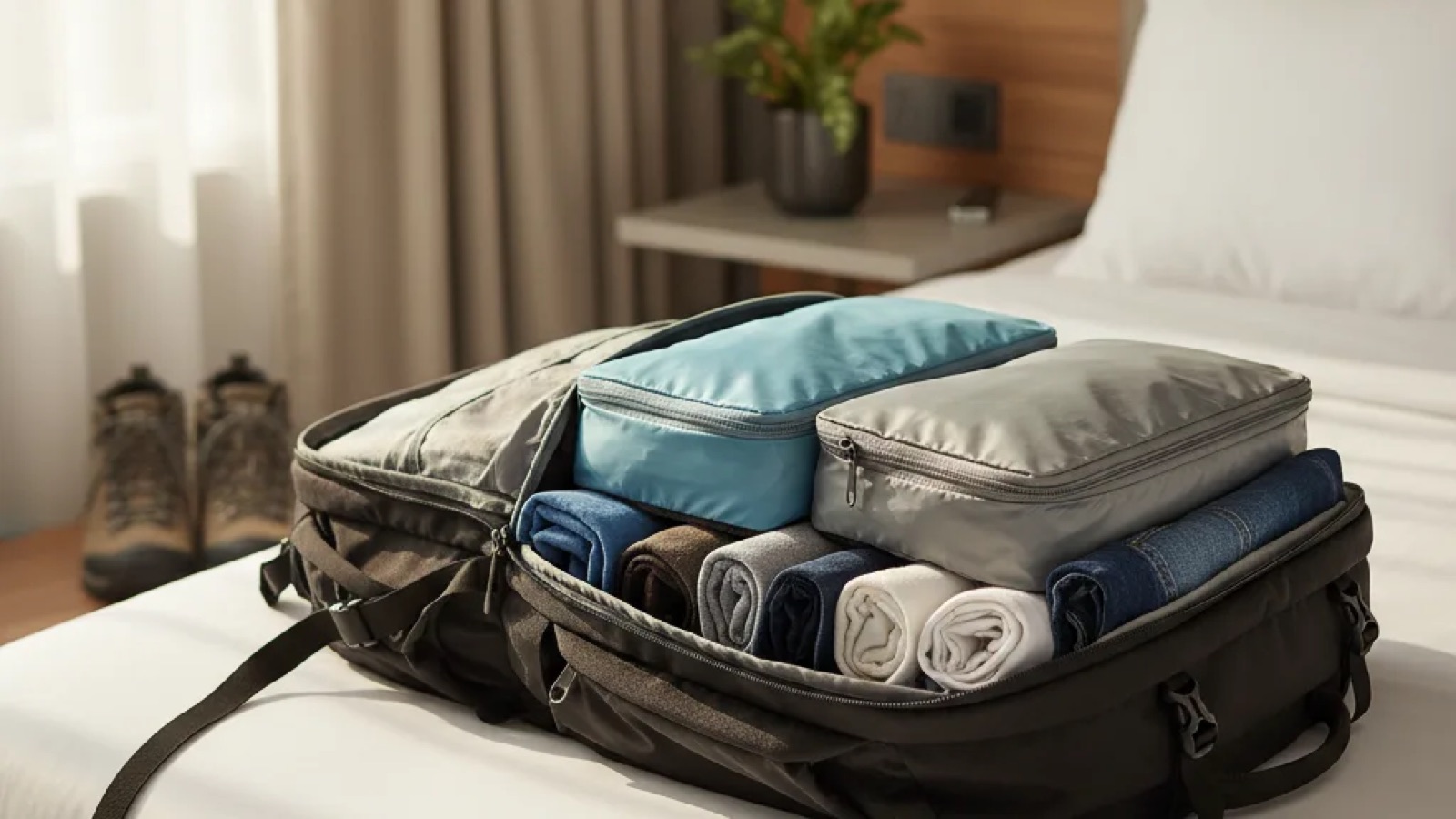
How you pack is almost as important as what you pack. A good system is built around packing cubes, used not primarily for compression, but for organisation: one for t-shirts and tops, one for underwear and socks, and one for trousers and layers. This turns your bag into a set of drawers. When you arrive, you can pull out the cubes without unpacking your entire bag. It keeps everything neat and easy to find.
For clothes within the cubes, I'm a firm believer in rolling. Rolling tightly tends to reduce wrinkles in many fabrics and allows you to pack items more densely than folding. For bulky items like a puffer jacket or fleece, a dedicated compression sack can be a game-changer, squeezing it down to a fraction of its original size.
And always remember the golden rule you learned with your shoes: wear your bulk. Your jacket, your jumper, your boots—these are all worn onto the aircraft, not packed in your bag. You can always take them off once you're on board. Sure, you might look a bit like the Michelin Man walking through a hot airport in South East Asia, but it's a small price to pay for keeping your bag within size and weight limits.
Liquids and Toiletries: The Solid Revolution
The restrictions on liquids, aerosols, and gels in carry-on luggage are a major hurdle for many travellers. The specific volume limits can vary slightly by country and change over time, so it is absolutely essential to check the official security rules for your departure airport before you pack. Generally, you're required to place all your small bottles in a single, clear, resealable bag.
My solution? I’ve almost entirely eliminated liquids from my toiletries bag. The rise of high-quality solid toiletries has been the biggest revolution in my packing in years. I now travel with:
- A solid shampoo bar
- A solid conditioner bar
- A bar of soap in a travel case (or I just use hotel soap)
- Toothpaste tablets
- A solid stick deodorant
- A solid perfume or cologne stick
For the very few liquids I still need, like sunscreen or my favourite face cream, I decant them into tiny, reusable travel-sized pots and bottles. This not only saves a huge amount of space and weight but also eliminates the risk of a bottle of shampoo exploding all over your clothes. It also means I can get through security without having to pull out a liquids bag at all.
Laundry On The Road: The True Secret to Infinite Travel
This is it. This is the skill that transforms you from a short-trip carry-on traveller to someone who can live out of a backpack indefinitely. If you can wash your clothes, you never run out. And it's so much easier than you think. You don't need to spend hours in a laundromat (though that can be a fun, local experience).
My ultra-light laundry kit consists of three items: a universal sink plug (hotel plugs are notoriously unreliable), a few dissolvable laundry detergent sheets or a small piece of a solid laundry bar, and a pegless travel clothesline with suction cups or hooks on each end. Every two or three nights, I spend 15 minutes washing my socks, underwear, and the shirt I wore that day in the sink. Because I've packed quick-drying fabrics, everything is bone dry by the morning. The discipline is to 'wash little and wash often'.
For a larger reset wash every week or so, I'll use a local laundry service where you drop off your clothes and pick them up a few hours later, washed and folded. It’s an affordable luxury in most parts of the world and a great way to get everything properly clean and fresh.
The Final Checks: Avoiding Drama at the Airport
Your packing is done, but the job isn't over. A couple of final steps can save you a world of pain at the airport. First, weigh your bag. Use a digital luggage scale and make sure you are under the limit for the strictest airline on your itinerary. If you're over, it's time for some tough decisions. What can be left behind? What can you wear instead of pack?
Second, do a 'shakedown' pack. At least a day or two before you leave, pack your bag completely. Put it on and walk around your house. Does it feel comfortable? Can you access everything easily? This practice run often reveals flaws in your system while you still have time to fix them.
Finally, have a plan for the dreaded gate-check. It can happen to anyone, even if your bag is compliant, especially on full flights. Don't argue. Be polite. My strategy is to have a small, packable tote bag folded up in an outer pocket of my backpack. If an agent tells me the bag has to go in the hold, I can quickly open it, pull out my personal-item bag (with my laptop and camera) and my packing cube of electronics, place them in the tote, and hand over the main pack with only clothes inside. It's a calm, 30-second fix that avoids a stressful repack at the gate.
Letting Go: What I Still Get Wrong After 12 Years
The hardest part of carry-on travel isn't the packing; it's the psychology. It's the battle against the 'what-ifs'. What if I need my other camera lens? What if it gets colder than I expect? What if I get invited to a fancy dinner?
My guiding principle has become: if I have to debate whether to bring an item, I leave it at home. The anxiety of not having it is almost always worse in my head than the reality of needing it on the road. Unless it's prescription medication, you can buy, rent, or borrow almost anything you find you desperately need. A warmer jumper, a smarter shirt, a different pair of shoes—these are all available for purchase across the globe.
After twelve years and nearly 50 countries, do I nail it every time? Absolutely not. I still occasionally pack a t-shirt I never wear or a book I'm too tired to read. Last year in Portugal, I lugged a 70-200mm lens all over Lisbon and never once took it out of my bag. It’s a constant process of learning and refinement. The goal isn't perfection; it's progress. Each trip, you learn a little more about what you truly need, and you travel a little lighter.
Explore in Depth
If this guide has you excited to lighten your load, these next articles will help you drill down into the specifics of gear, weight-cutting, and making the journey as comfortable as the destination.
Frequently Asked Questions
Is a 40-litre bag really big enough for a three-week trip to Europe in autumn?
Absolutely. The key is to pack for one week and plan to do laundry. With a good layering system—for example, merino base layers, a fleece or mid-layer jumper, and a packable windproof/waterproof shell jacket—you can handle a wide range of temperatures. Wear your bulkiest items (your jacket and boots) on the plane. A 40-litre bag is more than enough space for a week's worth of thoughtfully chosen, versatile clothing, which is all you need regardless of trip length.
What's the best way to handle bulky items like a winter coat or hiking boots?
The simple answer is to wear them. Your bulkiest items should never go inside your bag if you can help it; they should be on your body during travel days. Wear your hiking boots and your warmest jacket onto the plane. It might feel a bit cumbersome while boarding, but you can take the jacket off as soon as you get to your seat. This strategy saves an enormous amount of volume and weight in your pack, often being the deciding factor in whether your bag meets carry-on limits.
I'm worried about looking scruffy. How can you look presentable with so few clothes?
This is a common fear, but carry-on travel doesn't mean you have to look like a backpacker all the time. The secret is fabric selection and choosing versatile items. Opt for clothes in high-quality, wrinkle-resistant materials like merino wool or certain technical blends. Pack one "smarter" outfit, like a pair of dark-coloured travel trousers and a button-down shirt or a simple, well-fitting dress. A lightweight scarf or pashmina for women, or a nice watch for men, can instantly elevate a simple outfit with almost no packing penalty.
Won't I spend my whole trip doing laundry instead of sightseeing?
Not at all! The "sink laundry" method I mentioned takes about 15 minutes every second or third night before you go to bed. It becomes a routine, just like brushing your teeth. Because you're only washing a few small items (socks, underwear, a t-shirt), it's incredibly fast. Using a local drop-off laundry service once a week is also a huge time-saver—you drop a bag off in the morning and pick it up, clean and folded, in the afternoon. It's far less time-consuming than waiting for a checked bag at the airport.
What if my carry-on bag is flagged as being too heavy or big at the gate?
First, don't panic. Be polite and friendly with the gate agent—attitude makes a huge difference. If they say it's too heavy, see if you can put your jacket on and stuff its pockets with heavy items like a power bank or camera. You can also consolidate items from your main bag into your personal item. If it's a size issue and they insist you check it, calmly accept it. This is where having your valuables (electronics, medication, documents) in your personal item or in an easily removable cube becomes a lifesaver.
Final Thoughts
Choosing to travel carry-on only is more than a packing technique; it’s a philosophical shift. It’s an intentional choice to trade the burden of 'stuff' for the gift of freedom. The first time you step off a plane and walk straight out of the airport into the sunshine of a new city, it will click. You'll realise that the security blanket of a big suitcase was actually a cage.
It takes practice, and you will make mistakes. You’ll pack things you don’t use, and you’ll occasionally wish for something you left behind. But you'll also learn, adapt, and refine your own system. The real souvenir you bring home from this process isn't a lighter bag—it's a lighter, more agile, and more present way of moving through the world. And that's a feeling no checked bag can ever give you.
More Travel Tips guides
Egypt Weather Guide: The Complete Month-by-Month Breakdown
Month-by-month weather for Cairo, Luxor and the Red Sea - cool winter temple days, peak summer diving heat - so you can pick the right…

Dream Destinations: A Travel Bucket List by Region
Twenty-five bucket-list destinations across Asia, Europe, the Americas, Africa and Oceania, with planning and budget tips and common…

Best Time to Visit Thailand: Seasons by Region
Thailand's cool, hot and rainy seasons, month-by-month weather, how the north and the east and west coasts differ, shoulder-season value…