Isle of Skye Guide: Fairy Pools, Quiraing, Storr
Skye done properly: how many days, driving single-track roads, the walks that are worth it and how to handle weather and crowds.
In this guide
- Quick Facts
- Planning Your Skye Adventure: Timing is Everything
- Getting to and Around the Isle of Skye
- Navigating Skye's Single-Track Roads
- Where to Stay on Skye: Choosing Your Base
- The Trotternish Peninsula: A Mythical Loop
- The Fairy pools: Beauty and the Crowds
- Western Skye: Lighthouses, Castles, and Coral
- The Mighty Cuillin and the Wild South
- Skye Survival Guide: Midges, Weather and Wild Camping
- Explore in Depth
- Frequently Asked Questions
- Final Thoughts
This guide is part of our Scotland Travel Guide: Edinburgh, Highlands and Islands — start there for the overview, when to go and how to get around.
Before dawn at the Quiraing, every crunch of boots on the gravel path echoes in the immense quiet, and the damp cold seeps right into your bones. As the first hint of colour bleeds into the eastern sky, the scene resolves from shadow into one of the most unearthly landscapes anywhere. Jagged green pinnacles, crumpled and folded like a giant's discarded blanket, march towards the sea. Arrive early and, for a few perfect minutes as the sun crests the horizon and paints the landslips in gold, it can feel like the beginning of the world. This is the magic of Skye.
The Isle of Skye isn't just a place you visit; it's a place you experience with all your senses. It's an island of dramatic moods, where sun, rain, and mist can chase each other across the landscape in the space of an hour. We’ll cover how to get there and get around, where to base yourself, and how to tackle the island's iconic sights—from the Old Man of Storr and the Fairy Pools to the lesser-known corners. You’ll also find the practical advice you need to navigate the single-track roads, dodge the worst of the crowds, and truly connect with this incredible piece of Scotland.
Quick Facts
- Location: The largest island in the Inner Hebrides archipelago, off the north-west coast of Scotland.
- Getting There: Drive across the Skye Bridge from Kyle of Lochalsh (toll-free), or take the CalMac ferry from Mallaig to Armadale.
- Getting Around: A car is non-negotiable. Distances are significant, public transport is sparse, and the best places require your own wheels.
- Language & Currency: English, with some Gaelic spoken. The currency is the Pound Sterling.
- Best Time to Visit: May, early June, September, and early October (the "shoulder seasons") offer the best balance of decent weather, manageable crowds, and fewer midges.
Planning Your Skye Adventure: Timing is Everything
The first thing to realise about Skye is its scale. It’s a big island, and the winding roads mean travel times are longer than you might think. Trying to "do Skye" as a day trip from Inverness, let alone from Edinburgh or Glasgow, is a recipe for frustration. You'll spend the entire day in a car, catch a fleeting glimpse of a few crowded spots, and miss the island's true soul, which reveals itself at dawn, dusk, and in the quiet moments in between.
Allow a minimum of three full days on the island. This gives you one day for the Trotternish Peninsula loop (Storr, Quiraing), one day for the west and south (Fairy Pools, Neist Point, Talisker), and a third day to explore deeper, revisit a favourite spot, or take a boat trip. With four or five days, you can slow down, get off the beaten path, and not feel rushed by the changeable weather. If a day gets rained out, you have a buffer.
The time of year you visit will dramatically shape your experience. The peak summer months of July and August bring the warmest weather and longest days, but also peak crowds, packed car parks, and the notorious Highland midge. My preference is for the shoulder seasons. May and early June are magnificent, with spring colour, good light, and long daylight hours. September and early October can be equally stunning, with autumn hues and a calmer atmosphere. You'll need to be more prepared for wild weather, but the rewards are immense.
Getting to and Around the Isle of Skye
Getting onto the island is the first part of the adventure. The most common route is driving "over the sea to Skye" via the Skye Bridge, a gracefully curved bridge connecting the mainland village of Kyle of Lochalsh with Kyleakin on the island. The drive to the bridge itself, particularly if you come through Glen Shiel and past Eilean Donan Castle, is one of Scotland's finest.
Alternatively, you can take the CalMac ferry from the fishing port of Mallaig to Armadale in southern Skye. This is a wonderfully scenic journey of about 45 minutes, offering great views of the Cuillin hills as you approach. The drive to Mallaig, the "Road to the Isles," is also legendary, passing the Glenfinnan Viaduct. Remember to book your ferry ticket far in advance, especially your vehicle spot, as it sells out weeks or even months ahead in high season. Always check the CalMac website for the latest schedules and service status, as weather can cause disruptions.
Once you're on Skye, a car is essential. There is no way around this. The island’s key attractions are spread out, and public transport is designed for locals, not for sightseeing. Rent a car in a major city like Glasgow, Edinburgh, or Inverness before you head for the Highlands. Be aware that fuel stations are few and far between outside of the main towns like Portree and Broadford, so keep your tank topped up.
Navigating Skye's Single-Track Roads
Many of Skye’s most beautiful roads are single-track, which can be intimidating for first-time visitors. The etiquette is simple but crucial. These roads feature designated ‘passing places’ every hundred metres or so. The core rule is this: the vehicle that is closer to the passing place on their side of the road pulls in to let the other pass. If the passing place is on your right, you will need to stop on the main road opposite the passing place, to allow the oncoming car to pull into it.
It's a dance of courtesy. Acknowledge other drivers with a wave. Never, ever park in a passing place—they are not for photo stops. Be patient, look far ahead for oncoming traffic, and don't be afraid to reverse a short distance if necessary. The single-track roads are what grant access to Skye's wildest places; treat them with respect and you'll quickly get the hang of it.
Where to Stay on Skye: Choosing Your Base
The single most important piece of advice is to book your accommodation as far in advance as possible. Six months is not too soon, especially for a summer trip. Skye’s popularity has completely outstripped its accommodation capacity, and good places get snapped up instantly.
For most first-time visitors, Portree is the most logical base. As the island's capital, it has the widest selection of hotels, B&Bs, and restaurants. It also has supermarkets for stocking up on supplies, a fuel station, and a central location that makes it a decent jumping-off point for exploring both the north and south of the island. Its harbour, with its famous row of colourful houses, is a lovely spot for an evening stroll.
If you prefer somewhere quieter or have specific goals, consider these alternatives:
- Broadford: The second-largest village, located just after the Skye Bridge. A good, practical base with services, it offers quicker access to the southern part of the island like Elgol and the Sleat peninsula.
- Dunvegan: Situated in the north-west, it's ideal for exploring nearby sights like Dunvegan Castle, Coral Beach, and Neist Point Lighthouse. It has a more remote feel than Portree.
- Sligachan: More a location than a village, dominated by the famous hotel and campsite at the foot of the Cuillin hills. If you're a serious hiker or photographer focused on the Cuillin, staying here puts you right in the heart of the action.
The Trotternish Peninsula: A Mythical Loop
The drive around the Trotternish Peninsula in the north-east of Skye is the island's premier road trip. This entire area is a massive, ancient landslip, creating some of the most bizarre and spectacular landscapes in Britain. Give yourself a full day for this loop, starting early from Portree to get ahead of the tour buses.
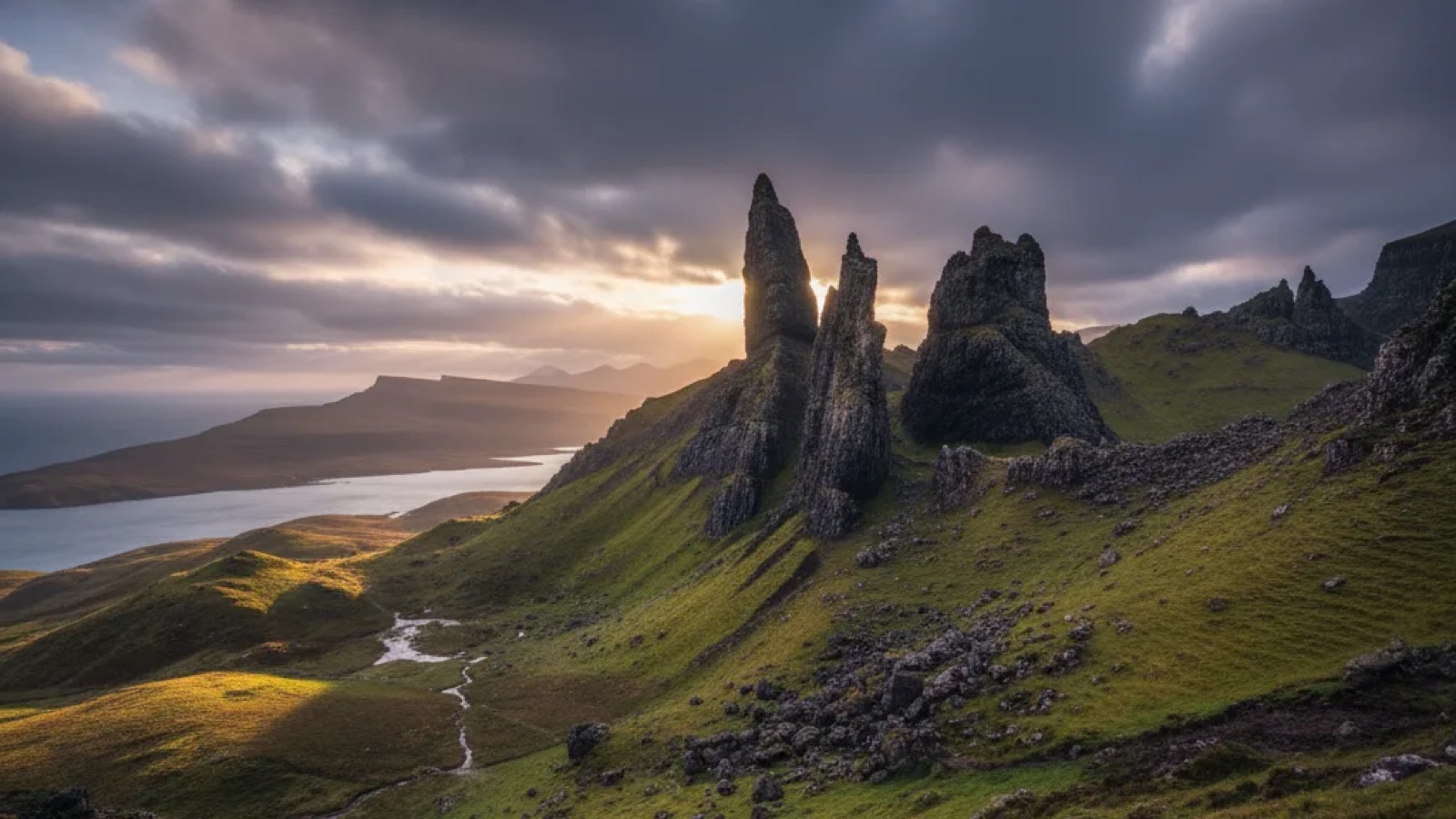
The Old Man of Storr
Just a few kilometres north of Portree, the jagged pinnacle of the Old Man of Storr dominates the skyline. The walk up to its base is an absolute must-do. The path climbs steadily from the car park, which fills up incredibly early. It's a proper hike, not a roadside stroll, so wear sturdy footwear. As you ascend, the views back over the Sound of Raasay are breathtaking. The final push brings you into the bizarre sanctuary of the Storr, standing beneath the 50-metre high 'Old Man' and its surrounding rock formations. You feel completely dwarfed, like you’ve walked onto the set of a fantasy film.
Photography Tip: For photographers, the classic shot is from further up the hill, looking down on the Old Man with the coastline behind. This is best captured in the 'blue hour' before sunrise or at sunrise itself, when soft light paints the rock and the crowds are non-existent.
Kilt Rock and Mealt Falls
Continuing north, a quick and easy stop is the viewpoint for Kilt Rock. These coastal cliffs are formed of vertical basalt columns resting on a base of sandstone, resembling the pleats of a kilt. Tumbling over the edge is Mealt Falls, which plunges directly into the sea below. It’s a spectacular sight, especially after heavy rain.
The Quiraing
This is arguably the pinnacle of Skye's landscapes. The Quiraing is another part of the Trotternish landslip, a surreal world of hidden plateaus, rocky spires like 'The Prison', and grassy slopes. The main circuit walk is a moderately challenging trail of about 7 kilometres that takes you right through the heart of this geological chaos. The path is narrow in places with some steep drops, so it requires a good head for heights. Every turn reveals a new, gob-smacking vista. Even if you don't do the full loop, the first 20 minutes of the walk provide some of the most accessible and epic views on the island.
Photography Tip: The Quiraing works best with side light, which happens in the hours after sunrise or before sunset. This raking light picks out the texture and defines the shapes of the strange landforms, creating a deep sense of dimension and drama.
The Fairy Glen
Tucked away near the village of Uig on the west side of the peninsula, the Fairy Glen is a landscape in miniature. It's a bizarre and delightful collection of tiny, perfectly conical hills, small lochans, and gnarled trees. It feels like a natural bonsai garden. You can wander freely, climbing to the top of 'Castle Ewan', a natural rock outcrop that looks like a ruined keep. Please respect this fragile place: don't move stones to create spirals on the ground, a practice that has damaged the site's delicate ecosystem.
The Fairy pools: Beauty and the Crowds
In Glen Brittle, at the foot of the Black Cuillin, the River Brittle tumbles down a series of waterfalls and crystal-clear pools. These are the famous Fairy Pools. On a sunny day, the water glows with incredible shades of turquoise and emerald, making for a magical scene. The walk from the car park follows the river upstream, with a chain of beautiful pools and cascades to discover.
Now for the reality check. The Fairy Pools are probably the single most popular spot on Skye. The road to get there is largely single-track, and the purpose-built car park, though large, can still fill up completely by mid-morning in summer. The path can be a constant stream of people. My advice is to go very early in the morning (before 9 am) or late in the afternoon. If you have the nerve for it, a dip in the icy water is an unforgettable, life-affirming experience. But please, if you see the car park is overflowing and cars are dangerously parked along the narrow road, consider coming back another time or choosing a different destination. The overtourism here is a serious issue.
Western Skye: Lighthouses, Castles, and Coral
The west of Skye has a different character—less jaggedly dramatic than Trotternish, but with its own immense coastal beauty.
Neist Point Lighthouse is the classic Skye sunset spot. Perched on a dramatic headland at the most westerly point of the island, the walk down the concrete path to the lighthouse itself is steep but rewarding. The real photographic magic, however, is found by staying up on the cliffs and walking along the precipitous edge to get the iconic view of the headland and lighthouse. It’s a phenomenal place to watch the sun sink into the Atlantic.
Photography Tip: This is a prime location for long-exposure photography. Using a neutral density filter to slow your shutter speed will smooth the motion of the waves, creating a dreamy, ethereal effect against the solid form of the cliffs and lighthouse.
Nearby, Dunvegan Castle & Gardens has been the ancestral home of the chiefs of Clan MacLeod for 800 years. It’s a fascinating place to explore, filled with clan history and treasures like the Fairy Flag. The surrounding gardens are a lush and colourful oasis in the rugged landscape. They also run boat trips out into the loch to see the local seal colony.
A little further up the coast is Coral Beach. The name is a slight misnomer; the brilliant white sand is not coral but crushed and sun-bleached calcareous seaweed (maerl). It's a beautiful, short walk from the car park to this tropical-looking cove, where the water can look startlingly blue on a sunny day.
The Mighty Cuillin and the Wild South
The Cuillin range is the serrated spine of Skye, a mountaineer's dream and a hiker's challenge. They are broadly divided into two ranges.
The Black Cuillin are the sharp, menacing peaks you see from Sligachan and Glen Brittle. Composed of dark, rough gabbro rock, they offer some of the most serious and exposed mountain scrambling and rock climbing in the UK. This is not terrain for casual hillwalkers. The full traverse of the Black Cuillin ridge is a world-class mountaineering objective that should only be attempted by experienced and well-equipped parties, ideally with a local guide.
The Red Cuillin, on the other hand, are composed of granite and have been weathered into smoother, more rounded hills. While still physically demanding, they are much more accessible to experienced hillwalkers, offering incredible views of their darker, more aggressive neighbours.
For a taste of the Cuillin's raw power without the vertigo, take the stunning drive to Elgol. This small village has one of the best viewpoints in Scotland, looking across Loch Scavaig to the heart of the Cuillin. From here, several boat operators run trips into Loch Coruisk, a freshwater loch nestled right amongst the peaks. Being dropped off here and surrounded by these black, colossal mountains is a humbling and profoundly memorable experience. Another worthy destination in the south is Talisker Bay, a beautiful beach of grey sand and stones reached by a flat 20-minute walk from the road.
Skye Survival Guide: Midges, Weather and Wild Camping
A few final, practical points. Skye's weather is notoriously fickle. The saying "four seasons in one day" was practically invented for this place. Layering is key. A waterproof and windproof outer jacket is non-negotiable, even if the day starts sunny. Sturdy, waterproof hiking boots are essential. Cotton is your enemy; stick to wool or synthetic base layers that wick moisture away.
From roughly June to early September, you'll have to contend with the Highland midge. These tiny biting insects can be a real nuisance, especially on still, overcast evenings near water. A good insect repellent is a must, and for real peace of mind, carry a midge head net. It looks silly, but you’ll be glad you have it when the swarm descends.
Mobile phone signal is patchy at best outside of the main villages. Download offline maps of the island before you go. Finally, while wild camping is legally permitted under the Scottish Outdoor Access Code, Skye has been under immense pressure from irresponsible camping. If you choose to wild camp, be completely self-sufficient, leave no trace whatsoever, and never camp in enclosed fields or near houses or roads. Use a stove, never light a fire, and carry out all your rubbish. Better yet, support the local economy by using official campsites.
Explore in Depth
My adventures in Scotland extend far beyond the Isle of Skye. The mainland Highlands are a realm of brooding glens and vast lochs, while the North Coast 500 offers one of the world's most epic road trips. Use these guides to expand your Scottish journey.
Frequently Asked Questions
Can I see the Isle of Skye without a car?
Technically, yes, but it isn't recommended. While there are local buses and private tours, they are infrequent and restrictive. You would be tied to their schedules and unable to reach many of the best locations, especially for the magical light of sunrise and sunset. The freedom to pull over at a beautiful viewpoint, wait out a rain shower, or change plans on a whim is what makes a Skye trip so special. Hiring a car gives you that freedom and is the best way to truly experience the island.
Is three days really enough for the Isle of Skye?
Three days is the absolute minimum to get a proper taste of Skye without feeling completely frantic. It allows you to dedicate a day to the northern Trotternish peninsula, a day to the west and centre (like the Fairy Pools and Neist Point), and a third day for the south or to revisit a favourite spot. It’s a busy itinerary, but manageable. If you have more time—four or five days is ideal—you can explore at a more relaxed pace, tackle longer hikes, and have a buffer day in case of poor weather, which is very common.
What's the best home base on Skye if I don't want to stay in Portree?
If you're looking for an alternative to the busy hub of Portree, Broadford is an excellent choice. It’s the first major village after the Skye Bridge, has a good range of services, and provides easier access to the southern parts of the island like Elgol and the Sleat Peninsula. For keen hikers and climbers focused on the Cuillin mountains, staying in Sligachan puts you right at the trailhead. For a quieter base in the west, Dunvegan is well-positioned for exploring Neist Point and Dunvegan Castle, offering a more remote, end-of-the-road feeling.
Are the Fairy Pools worth visiting with the crowds?
This is a tough one. The pools themselves are genuinely beautiful, with stunningly clear, turquoise water set against the backdrop of the Black Cuillin. However, their popularity means the experience can be diminished by overwhelming crowds, especially from mid-morning to late afternoon in summer. They are worth it, but only if you plan strategically. Go very early in the morning (before 9 am) or late in the afternoon. This allows you to experience their magic with a fraction of the people. If the car park is full when you arrive, please have a backup plan instead of parking dangerously on the road.
How bad are the midges on Skye and can I avoid them?
From late May/early June through to September, the midges can be a significant annoyance, but they shouldn't ruin your trip. They are most active during still, damp, and overcast conditions, particularly around dawn and dusk and near water. They hate wind and bright sun. To cope, always carry a good quality insect repellent (look for one containing Smidge or DEET). A midge head net can be a lifesaver if you plan to be outdoors in the evening. The best way to avoid them is to visit outside of their peak season, in April, early May, or October.
Final Thoughts
The Isle of Skye has rightfully earned its place on the world's travel map. It’s a landscape that feels ancient, powerful, and deeply moving. It will challenge you with its weather and reward you with views that will be seared into your memory forever. But its fame has come at a cost, and it needs to be visited with care and respect.
My final piece of advice is to look for the magic in the moments between the famous landmarks. It might be a stag appearing through the mist on a moor, a double rainbow arching over a remote loch, or the simple warmth of a pub fireplace after a day in the wind and rain. Go slow, book ahead, tread lightly, and let the Isle of Skye work its unique spell on you. It's a journey you'll never forget.
More Scotland guides
Scotland Travel Guide: Edinburgh, Highlands and Islands
Edinburgh and Glasgow, the North Coast 500, Glencoe and Skye, ferries to the isles, driving on single-track roads and how to plan around…
North Coast 500 Road Trip: Route, Timing and Tips
Planning the NC500: which direction to drive, how many days you actually need, the highlights, and the etiquette that matters.
Scottish Highlands Guide: Glencoe, Lochs and Munros
The Highlands beyond the postcards: Glencoe, Cairngorms, Loch Ness, hiking Munros, driving conditions and the best seasons.