Scottish Highlands Guide: Glencoe, Lochs and Munros
The Highlands beyond the postcards: Glencoe, Cairngorms, Loch Ness, hiking Munros, driving conditions and the best seasons.
In this guide
- Quick Facts
- Defining the Highlands: More Than Just Scenery
- Gateways to the Wild: Getting In and Getting Started
- Glencoe and Rannoch Moor: The Dramatic Heart
- Ben Nevis: Britain's Highest Peak
- The Cairngorms: A Vast Wilderness
- Loch Ness and The Great Glen: Monsters and Marvels
- The Wild West: Torridon and Wester Ross
- Hillwalking, Safety, and Access
- Practicalities: Driving, Midges, and Whisky
- When to Go: A Tale of Four Seasons
- Explore in Depth
- Frequently Asked Questions
- Final Thoughts
This guide is part of our Scotland Travel Guide: Edinburgh, Highlands and Islands — start there for the overview, when to go and how to get around.
On the A82, the rain can come in sideways, the way it only can in Scotland, turning the windscreen into a watercolour blur of greens, greys, and bruised purples. In the valley of Glencoe, the scenery feels like a living presence. The three great rock buttresses of the Three Sisters loom through the mist, their slopes slick and dark with water, waterfalls gushing white down their faces. There’s a weight to this place, a deep, resonant history that you feel long before you read the first plaque in a visitor centre. It’s a feeling that defines the Scottish Highlands: beautiful, yes, but also raw, powerful, and deeply, unforgettably wild.
Welcome to the Scottish Highlands, a region that’s less a fixed administrative area and more a state of mind. It’s a landscape of superlatives: Britain's highest mountains, deepest lochs, and most expansive wilderness. We'll cover the iconic sights like Loch Ness and Glencoe, but we’ll also get into the practicalities of navigating single-track roads, respecting the ‘right to roam,’ and how to stay safe in the hills. We’ll talk about the gateway cities, the epic train journeys, and the best ways to experience the unique culture, from mountain bagging to whisky tasting. This is a guide for adventurers, photographers, and anyone who feels the pull of big landscapes.
Quick Facts
- Location: The northern and western chunk of mainland Scotland, roughly defined by the Highland Boundary Fault line that runs from Helensburgh to Stonehaven.
- Getting There: Fly into Glasgow (GLA) or Edinburgh (EDI) for the widest range of international flights, or directly into Inverness (INV) for a Highland entry point. ScotRail trains, including the spectacular West Highland Line, connect the region.
- Getting Around: A car is almost essential for true freedom. Roads are excellent but often narrow single-track in rural areas. Trains and buses connect major towns like Fort William, Aviemore, and Inverness.
- Language & Currency: English is spoken everywhere, but you'll see and hear Scottish Gaelic (Gàidhlig) on signs and in certain communities. The currency is the Pound Sterling (£).
- Best Time to Visit: May, June, and September offer the best balance of long daylight hours, fewer crowds, and a lower chance of being devoured by midges. Winter (November-March) can be magical but requires experience with snow and ice.
Defining the Highlands: More Than Just Scenery
When people talk about the "Highlands," they're referring to a vast, sparsely populated region that feels a world away from the rolling hills of the Lowlands. Geologically, the dividing line is the Highland Boundary Fault, a slash across the country from the southwest to the northeast. Cross this invisible line and everything changes: the hills get steeper, the glens deeper, the landscape more dramatic. It’s the Scotland of postcards, but so much more visceral in person.
This is a land shaped by ice and geology, but also by a history of clans, conflict, and diaspora. The empty glens you drive through today weren't always so quiet. The Highland Clearances of the 18th and 19th centuries saw entire communities forcibly removed, a sorrow that still hangs in the air. You’ll see the evidence in the crumbling ruins of stone crofts, now just bumps in the heather-clad hillsides. To travel here is to travel through layers of history, beauty, and melancholy.
Gateways to the Wild: Getting In and Getting Started
Most journeys start in the south. While you can fly directly into Inverness, the "Capital of the Highlands," many travellers arrive via Glasgow or Edinburgh. Glasgow, in particular, is a fantastic launching point, with a direct road (the A82) that leads you along the shores of Loch Lomond and straight into the heart of the action.
The most romantic way to arrive, though, is on the West Highland Line train. It's consistently voted one of the world's most beautiful rail journeys, and for good reason. From Glasgow, it snakes its way north, crossing the desolate beauty of Rannoch Moor—a vast, boggy expanse where the tracks seem to float on a mattress of heather and peat—before climbing into the mountains.
The undisputed highlight is crossing the Glenfinnan Viaduct. Yes, it's the 'Harry Potter' bridge, and you'll see plenty of people waiting for the Jacobite Steam Train to puff across for that iconic photo. But even on a regular ScotRail service, the view as the train curves around the viaduct, with Loch Shiel stretching out into the distance, is pure magic. The line terminates at Mallaig, but many adventurers alight at Fort William, the region's main outdoor hub, nestled in the shadow of Britain's highest peak.
Glencoe and Rannoch Moor: The Dramatic Heart
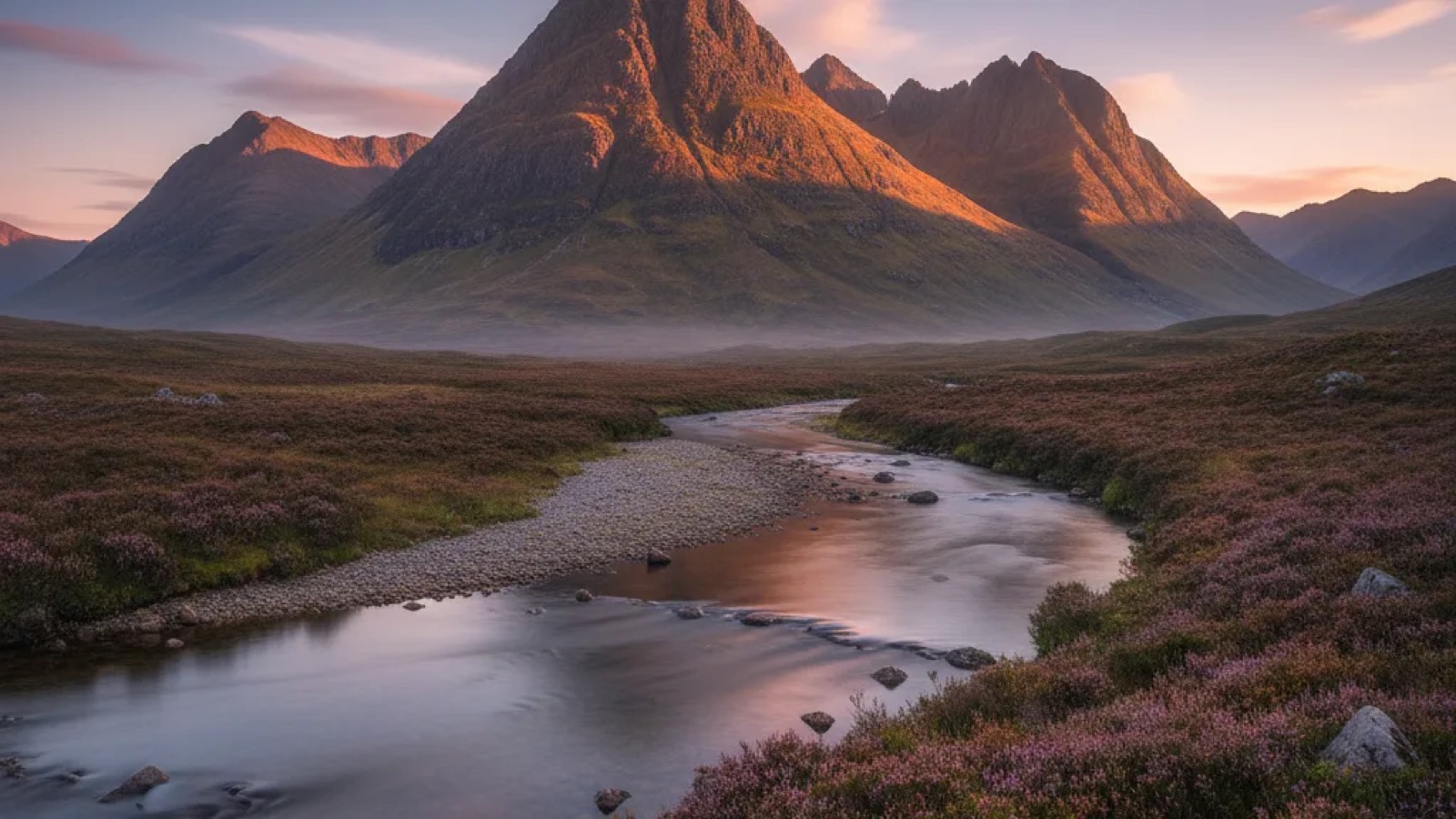
No road in Scotland is more cinematic than the A82 as it descends from the bleak expanse of Rannoch Moor into Glencoe. First, you're hit by the sight of Buachaille Etive Mor. This pyramid of rock stands like a sentinel at the entrance to the glen, and it’s a place worth returning to again and again. The best photography tip is to be here for sunrise. Find the small waterfalls on the River Coupall, frame the mountain, and wait for the first light to kiss the peak. It's a classic for a reason.
Driving through the glen itself is an experience. On either side, mountains rise up like sheer walls. The most famous are the Three Sisters of Glencoe, three jagged spurs of the Bidean nam Bian massif. There's a palpable weight here, a sombreness that goes beyond the dramatic scenery. This was the site of the 1692 Massacre of Glencoe, where soldiers betrayed the hospitality of the MacDonald clan and murdered them in their sleep. You feel it in the names: the 'Lost Valley' (Coire Gabhail), where the MacDonalds supposedly hid their rustled cattle, is a fantastic half-day walk, a hidden world tucked between the mountains.
For seasoned hillwalkers with a serious head for heights, Glencoe offers the Aonach Eagach ridge. This is not a walk. It is a serious mountain scramble, one of the most challenging and exposed on the British mainland. It should only be attempted by experienced mountaineers in good weather. For everyone else, its terrifying profile is best admired from the road below.
Ben Nevis: Britain's Highest Peak
From Fort William, you can't miss 'The Ben'. At 1,345 metres, Ben Nevis is the highest point in the UK, and climbing it is a rite of passage for many. However, let’s be brutally honest. The main route, the Mountain Track (often wrongly called the 'Tourist Path'), is a long, arduous slog. It's a well-made path, yes, but it is not a casual walk in the park. It's a full day's hillwalk on a serious mountain where the weather can turn in an instant.
The summit is a vast, stony plateau, often shrouded in cloud, and navigation can be treacherous in poor visibility. Every year, people get into serious trouble here by underestimating it. If you're going to climb it, be prepared: proper boots, waterproofs, extra layers, a map, a compass, and the knowledge to use them are non-negotiable. Check the Mountain Weather Information Service before you even think about it.
The other side of the mountain, the North Face, is another world entirely. It's a sheer, 700-metre cliff of crags and gullies, a hallowed playground for elite rock climbers and winter mountaineers. For the vast majority of visitors, this face is for admiring from a safe distance, a truly awe-inspiring piece of rock architecture.
The Cairngorms: A Vast Wilderness
If Glencoe is dramatic and sharp, the Cairngorms National Park is vast and rolling. This is Britain's largest national park, an enormous expanse of high-level plateaus, ancient Caledonian pine forests, and sparkling lochs. The main hub is the town of Aviemore, a slightly functional basecamp with fantastic access to the surrounding wilderness.
A standout easy walk here is the circuit around Loch an Eilein. It takes you through magnificent old-growth Scots Pine forest to a loch with a ruined castle on an island. It’s picture-perfect. The park is a haven for wildlife. It's home to Britain's only free-ranging reindeer herd (you can join a guided walk to see them), and a vital stronghold for rare birds like ospreys and the elusive capercaillie.
The Cairn Gorm mountain itself has long been a centre for skiing. The Cairngorm Funicular Railway was built to take people up towards the summit plateau, but it has had a complex and often-closed history. Its operational status changes, so it's absolutely essential to check the official Cairngorm Mountain website for the latest information on whether it's running and what access it provides. This landscape is fragile, and access is managed carefully to protect it.
Loch Ness and The Great Glen: Monsters and Marvels
You can't come to the Highlands and not visit Loch Ness. Let’s get the monster out of the way first. Trying to spot Nessie is part of the fun, and the various tour operators and visitor centres lean into it with gusto. But it's worth looking beyond the myth. Loch Ness is genuinely impressive in its own right. It's a vast, deep, and incredibly dark body of water, part of the Great Glen, a geological fault line that splits the Highlands in two.
The best way to appreciate its scale is from above. The ruins of Urquhart Castle, perched on a headland jutting into the loch, offer the quintessential view. It’s a popular spot, so go early or late to avoid the worst of the crowds. The whole Great Glen is connected by the Caledonian Canal, a masterpiece of 19th-century engineering by Thomas Telford that links the lochs (Lochy, Oich, and Ness) to create a waterway from the Atlantic to the North Sea. Watching boats navigate the series of locks, like Neptune's Staircase near Fort William, is a fascinating sight.
The Wild West: Torridon and Wester Ross
For many seasoned Scotland travellers, the real magic lies further west. The region of Wester Ross, particularly around Torridon, is home to some of the most spectacular and geologically ancient mountains in Britain. These aren't just hills; they are individual giants of Torridonian sandstone and quartzite that sit atop a bed of even older Lewisian gneiss. Mountains like Liathach and Beinn Eighe are monumental, their terraced slopes and jagged ridges looking like something from another planet.
This is a landscape for the discerning driver and the serious hiker. The roads are almost entirely single-track, but the views they unlock are worth every careful manoeuvre. It's a wilder, emptier and, arguably, more profoundly beautiful corner of the Highlands. The drive from Torridon to Applecross over the Bealach na Bà (Pass of the Cattle) is a legendary, white-knuckle road trip, but not for the faint of heart or those in a large vehicle!
Hillwalking, Safety, and Access
The Highlands are a paradise for walkers, but the mountains demand respect. The weather is the biggest factor; it can change from warm sunshine to a blizzard in under an hour, even in summer. Before any walk, you must check the forecast, with the Mountain Weather Information Service (MWIS) being the invaluable resource.
Here are the non-negotiable rules for staying safe:
- Navigation is Key: Don't rely on your phone's GPS. Carry a physical map and a compass, and know how to use them. In thick mist, they will save your life.
- Tell Someone Your Plan: Leave a note of your intended route and expected return time. Let someone know where you are going.
- Be Prepared for Anything: This means waterproof jacket and trousers, spare warm layers (hat, gloves), sturdy boots, food, water, and a head torch. A survival bag and a small first-aid kit are also wise.
- River Crossings: After heavy rain, streams can become impassable torrents. A crossing that was easy in the morning might be impossible by the afternoon. Be prepared to turn back.
Munro Bagging and Bothies
You’ll hear the term "Munro" a lot. These are Scottish mountains over 3,000 feet (914.4 metres), and "bagging" them—climbing them all—is a national obsession for some. It’s a great way to explore the country's wildest corners.
You may also come across 'bothies'. These are simple, unlocked shelters in remote areas, maintained by the Mountain Bothies Association. They are not hostels. There are no bookings, no staff, and no facilities beyond a roof and maybe a sleeping platform. They are a lifeline for walkers and climbers, used on a first-come, first-served basis. If you use one, follow the bothy code: leave it clean, pack out all your rubbish, and replace any fuel you use.
The Scottish Outdoor Access Code
Scotland has some of the most progressive access laws in the world, often called the "right to roam." This gives you the right to walk, cycle, or wild camp on most unenclosed land. However, this right comes with responsibilities: leave no trace, respect people's privacy, be mindful of farming and land management activities (like the deer stalking season from late summer to winter), and camp well away from roads and buildings.
Practicalities: Driving, Midges, and Whisky
The number one piece of practical advice is about driving. Many Highland roads are single-track with passing places. The rule is simple: the car nearest the passing place on their side of the road pulls in. If the passing place is on the other side, you may need to stop opposite it to let the other car through. Always give a thank-you wave. Never park in a passing place. Driving in winter requires extra caution; roads can be icy, and some minor roads may be impassable with snow. Hire cars are rarely fitted with winter tyres, so take it slow.
Now, let's talk about the midges. These tiny, biting insects are the unofficial terror of the Highlands. They appear in huge swarms from late spring to early autumn, especially on calm, damp, overcast days. They hate wind and bright sunshine. A good insect repellent is essential, and a midge head net might look silly, but it's a sanity-saver. Don't let them put you off, but do be prepared.
And finally, whisky. The Highlands are a key whisky-producing region, with styles varying enormously. The Speyside area (technically a sub-region) is famous for its smooth, fruity malts, while distilleries on the islands and coasts often have a more peated, smoky character. You don't have to be a connoisseur to appreciate a distillery tour or a dram in a cosy pub by the fire. It's part of the fabric of the place.
When to Go: A Tale of Four Seasons
Choosing when to visit the Highlands has a huge impact on your trip. There is no single "best" time, only the best time for what you want to do.
- Spring (April-May): Arguably the best season. The days are getting long, the landscape is bursting back to life with gorse and spring flowers, and the midges haven't hatched yet. The mountains often retain a beautiful cap of snow, making for stunning photography.
- Summer (June-August): Longest daylight hours—it can be light until 11 pm in the far north. The weather is at its warmest, but also its most popular. This is peak tourist season, and also peak midge season. The heather turns the hillsides a magnificent purple in August.
- Autumn (September-October): A fantastic time for photography. The crowds thin, the midges die off, and the landscape is ablaze with the gold of birch and the russet of bracken. The weather can be stable and crisp, but be prepared for the first hints of winter.
- Winter (November-March): The Highlands in winter are a serious and sometimes forbidding place, but utterly magical. The mountains are cloaked in snow and ice, demanding respect and proper equipment for hillwalking. Days are short, but the low sun creates beautiful light. Many smaller attractions and B&Bs may close.
Explore in Depth
The Highlands are a vast region, and this guide is just the beginning. Once you have your bearings, you can dive deeper into specific regions that have their own unique character. The Isle of Skye is a world of its own, while the North Coast 500 is one of the world's most epic road trips.
Frequently Asked Questions
Do I need a 4x4 to drive in the Scottish Highlands?
Absolutely not. For 99% of travellers, a regular car is perfectly fine. The roads, including the single-track ones, are sealed and well-maintained. A 4x4 offers no real advantage in summer and can give a false sense of security. The key is to drive slowly, be considerate at passing places, and in winter, the most important factors are your tyres and your experience driving in icy conditions, not your drivetrain. A larger vehicle can actually be a hindrance on narrow roads.
How hard is it to climb Ben Nevis?
Climbing Ben Nevis via the Mountain Track is not a technical climb, but it is a very strenuous and serious mountain walk. Expect it to take 7-9 hours for a round trip. It's a relentless ascent of over 1,300 metres on rocky paths. The biggest challenge is the weather, which can be severe and change rapidly. The summit is frequently cold, windy, and covered in fog, making navigation difficult. Do not attempt it without proper hiking boots, full waterproofs, extra layers, and plenty of food and water.
Are the midges really that bad?
In a word: sometimes. From late May to early September, on a calm, damp, overcast day near water or trees, yes, they can be utterly miserable. A good insect repellent (many locals swear by ones containing Smidge or DEET) and a head net can make the difference between a ruined evening and a minor annoyance. However, on a breezy or sunny day, or in a town centre, you might not notice them at all. They’re a factor to plan for, not a reason to cancel your trip.
Can I wild camp in the Highlands?
Yes, thanks to the Scottish Outdoor Access Code, wild camping is generally permitted. This is based on a "leave no trace" principle. You must camp away from roads and buildings, be respectful of the environment, and take all your litter with you. There are some specific, well-signposted areas—most notably around Loch Lomond and in some parts of the Trossachs—where bylaws restrict camping to designated sites during peak season to manage environmental pressure. Always check for local restrictions.
Can I see the Highlands without a car?
It's more challenging, but definitely possible. The train network, particularly the West Highland Line and the Kyle Line to Kyle of Lochalsh, offers access to key hubs like Fort William and Aviemore, and the journeys themselves are spectacular. From these towns, buses can take you to trailheads and villages. Several tour companies also run multi-day trips that handle all the transport. It requires more planning and you won't have the same freedom to stop at every viewpoint, but you can still have an incredible, car-free adventure.
Final Thoughts
The Scottish Highlands are a place that gets under your skin. It’s in the sheer scale of the landscape, the way a vast glen can make you feel both tiny and connected to something immense. It’s in the quality of the light, the long summer twilights that seem to last forever, and the way the rain can make the whole world smell of wet earth and pine.
This isn't a passive destination; it’s a place that asks something of you. It asks for your respect on the hills, your patience on the roads, and your curiosity about its deep, sometimes sorrowful history. Give it that, and the Highlands will reward you with moments of profound beauty and a quiet sense of adventure that you'll carry with you long after you've returned home.
More Scotland guides
Scotland Travel Guide: Edinburgh, Highlands and Islands
Edinburgh and Glasgow, the North Coast 500, Glencoe and Skye, ferries to the isles, driving on single-track roads and how to plan around…
Isle of Skye Guide: Fairy Pools, Quiraing, Storr
Skye done properly: how many days, driving single-track roads, the walks that are worth it and how to handle weather and crowds.
North Coast 500 Road Trip: Route, Timing and Tips
Planning the NC500: which direction to drive, how many days you actually need, the highlights, and the etiquette that matters.