Prague Castle Guide: What to See and When to Go
How to visit Prague Castle without the crush: the ticket circuits, St Vitus, Golden Lane, the changing of the guard and best light.
In this guide
- Quick Facts
- First Things First: It's Not One Castle
- Getting There: The Climb or The Tram?
- Security, Tickets, and Timing Your Visit
- St. Vitus Cathedral: The Heart of the Nation
- The Old Royal Palace and Vladislav Hall
- St. George's Basilica: A Romanesque Refuge
- Golden Lane: A Street of Miniature Houses
- Gardens, Guards, and Great Views
- Best Photography Spots
- How Long Do You Need? (And What to Wear)
- Explore in Depth
- Frequently Asked Questions
- Final Thoughts
This guide is part of our Prague Itinerary: 3 Days of Old Town, Castle and Beer — start there for the overview, when to go and how to get around.
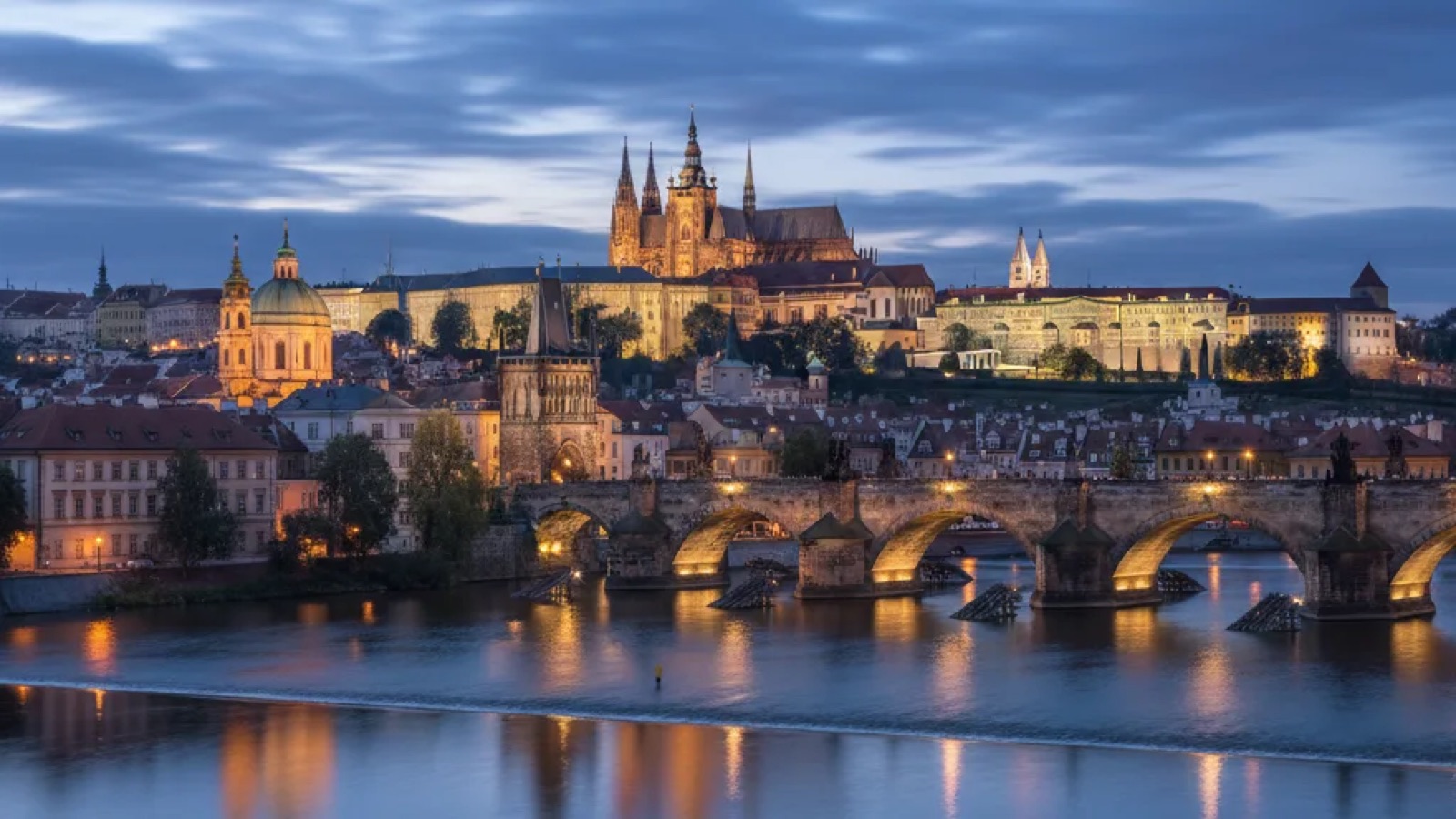
For photographers, the Charles Bridge at ‘blue hour’ is the moment to wait for. As the last orange glow of sunset fades behind Petřín Hill, the city lights begin to prick the deep twilight violet. Then a chain of golden lights flickers on, tracing the silhouette of the castle ramparts and the soaring spires of St. Vitus Cathedral high on the hill across the Vltava River. It looks less like a real place and more like a kingdom from a half-remembered fairytale, a symbol of Prague's immense, almost theatrical, beauty.
Visiting Prague Castle (Pražský hrad) isn’t like visiting a single fortress. It’s about exploring an entire district, a city-within-a-city, that has been the seat of Czech kings, Holy Roman Emperors, and presidents for over a thousand years. It can feel overwhelming, a sprawling confusion of palaces, churches, and hidden laneways. This guide is designed to help you make sense of it all. We’ll cover how to get there, how the tickets work, what you absolutely must see inside St. Vitus Cathedral and the other main buildings, and where to find the best views. It's a collection of practical tips and highlights to help you discover the heart of this incredible place.
Quick Facts
- Location: Hradčany (the Castle District), overlooking Malá Strana (the Lesser Town) and the Vltava River in Prague 1.
- Getting There: The most scenic route is walking up the New Castle Steps (Nové zámecké schody) or Nerudova Street from Malá Strana. The easiest route is taking Tram 22 to the Pražský hrad stop and walking down.
- Getting Around: The complex is huge and hilly, with lots of cobblestones. Wear comfortable, sturdy shoes. The main sights are all walkable once inside the castle grounds.
- Language & Currency: Czech (Čeština) is the official language, but English is widely spoken in all tourist areas. The currency is the Czech Koruna (CZK).
- Best Time to Visit: Arrive right at opening time to beat the worst of the security queues and tour groups. Spring (April-May) and Autumn (September-October) offer pleasant weather and fewer crowds than the peak summer months. Winter is quiet and magical, especially with a dusting of snow.
First Things First: It's Not One Castle
The single biggest mistake visitors make is expecting to find a single, turreted fairytale castle. Prague Castle is something far grander and more complex. It's listed by Guinness World Records as the largest ancient castle complex in the world, covering an area of nearly 70,000 square metres. Think of it as a small town, walled off from the rest of Prague, containing palaces, churches, fortifications, gardens, and laneways all built across different centuries.
The entire complex is organised around three main courtyards, which you can walk through for free. These courtyards act as your navigational anchors. You’ll enter through a security checkpoint into the first courtyard, pass through the magnificent Matthias Gate into the second, and then finally emerge into the third courtyard, where the jaw-dropping facade of St. Vitus Cathedral will stop you in your tracks. The ticketed historical buildings are all accessed from these courtyards.
Getting There: The Climb or The Tram?
There are two main approaches to the castle, and they offer very different experiences. The best, especially for a first-time visit, is the walk up from Malá Strana below. You have two choices: the Old Castle Steps (Staré zámecké schody) from the east, or the more popular route up Nerudova Street, which flows into the grand New Castle Steps (Nové zámecké schody) near the main gate.
The walk up Nerudova is an experience in itself. It's a steep, curving street lined with beautiful old buildings, many decorated with historic house signs—a stone lobster, three little fiddles, a golden key—that predate numbered addresses. It's a bit of a puff, but the views of Malá Strana's red rooftops that open up as you climb are your reward. You arrive at the main entrance in Hradčanské Square, ready for the Changing of the Guard.
The more practical, leg-saving option is to take Tram 22. This is a classic Prague experience in its own right, as the tram winds its way up the hill. Get off at the Pražský hrad stop. From here, it's a short, mostly flat walk to the entrance for the Second Courtyard. This is an excellent strategy if you have mobility issues, are travelling with small children, or simply want to save your energy for exploring the vast complex itself. You can then spend your day walking downhill through the grounds, exiting at the bottom to explore Malá Strana.
Security, Tickets, and Timing Your Visit
Before you even think about tickets, you need to be aware of the security screening. There are checkpoints at all entrances to the castle complex, and queues can get incredibly long, especially from mid-morning onwards. Even arriving 20 minutes before the grounds open can still mean another 15-minute wait to get through, and an hour later the queue can snake right across Hradčanské Square. The strongest advice is to arrive at opening time or even slightly before.
Once you are inside the grounds, you can walk through the courtyards for free. You don't need a ticket to see the outside of St. Vitus Cathedral or to watch the Changing of the Guard. To enter the historical buildings, however, you need to buy a ticket.
The system can seem confusing, but it's based on "circuits". You don't buy a ticket for one building; you buy a ticket for a combination of them (Circuit A, Circuit B, etc.). The main circuit typically includes the four big highlights: St. Vitus Cathedral, the Old Royal Palace, St. George's Basilica, and the Golden Lane. Smaller circuits might include fewer buildings. The ticketing structure and which buildings are included can change, so it is essential to check the official Prague Castle website for the current options, opening hours, and any temporary closures before your visit. Ticket offices are located in the information centres in the second and third courtyards.
St. Vitus Cathedral: The Heart of the Nation
The moment you step into the third courtyard, St. Vitus Cathedral commands your complete attention. Its full name is much longer, but everyone knows it as St. Vitus. This isn't just a church; it's the spiritual soul of the Czech nation, the site of coronations and royal burials. Its soaring Gothic architecture took nearly 600 years to complete, and that long history is written in its glorious details.
Your circuit ticket allows you into the main body of the cathedral. Look for three things in particular:
- The Art Nouveau Window: As you enter and walk along the left aisle, you'll suddenly be bathed in an ethereal, almost painterly light. This is not a medieval window. It was created in 1931 by the celebrated Czech artist Alphonse Mucha. You can instantly recognise his distinctive style in the flowing robes and Slavic figures. It’s a breathtaking splash of 20th-century modernism in a purely Gothic space.
- The St. Wenceslas Chapel: This side chapel is the holy of holies. It's a dazzling, semi-precious jewel box built over the tomb of St. Wenceslas, the nation's patron saint. The lower walls are encrusted with over 1,300 polished semi-precious stones and decorated with 14th-century frescoes depicting the Passion of Christ. It feels ancient and sacred.
- The Silver Tomb of St. John of Nepomuk: You can't miss the enormous, ornate silver shrine in the main ambulatory. It's a spectacular piece of Baroque artistry, a monument to the saint who was supposedly thrown from the Charles Bridge.
Remember to be quiet and respectful inside; this is still an active place of worship. Photography is usually allowed, but without flash. Also, dress appropriately—cover your shoulders and knees as a sign of respect.
Climbing the Great South Tower
For one of the best views in all of Prague, you can climb the Great South Tower. This requires a separate ticket, purchased at the base of the tower. It's a gruelling climb up a narrow spiral staircase—there's no lift—but the reward is immense. You emerge onto a viewing gallery with a 360-degree panorama of the castle complex, the red roofs of Malá Strana, the Charles Bridge, and the Old Town beyond. It’s absolutely worth the effort if you have the stamina.
The Old Royal Palace and Vladislav Hall
Next on your circuit is likely the Old Royal Palace. From the outside, it looks rather plain compared to the cathedral, but its interior holds one of Prague's architectural treasures: Vladislav Hall. Stepping into this vast, light-filled hall is like stepping inside the skeleton of a great whale. Its soaring, vaulted ceiling is a masterpiece of late Gothic engineering, a delicate-looking web of stone ribs that curve and intersect like intertwining tree branches.
This was no mere ballroom. This hall was built to host jousting tournaments—knights on horseback would enter via the Riders' Staircase—as well as banquets and coronations. Standing in the centre of the empty hall, you can almost hear the echoes of history. You can also walk out onto a balcony for a fantastic view south over the city.
St. George's Basilica: A Romanesque Refuge
After the overwhelming Gothic splendour of St. Vitus, the calm simplicity of St. George's Basilica is a welcome contrast. Tucked behind the cathedral, its cheerful red Baroque facade hides the oldest surviving church building within Prague Castle. Inside, it’s a different world. The pale, unfinished stone, the thick walls, and the simple rounded arches create a feeling of quiet, solid permanence. It feels far older and more grounded than St. Vitus. It's a peaceful space that provides a wonderful lesson in the architectural layers of the castle.
Golden Lane: A Street of Miniature Houses
A highlight of the castle complex is the impossibly charming Golden Lane (Zlatá ulička). Tucked away against the castle's northern wall, it’s a tiny cobbled street of brightly coloured, miniature houses originally built to house the castle guards. Later, goldsmiths and other artisans moved in, giving the lane its name.
Each little house is now a tiny museum or shop. You have to stoop to enter the doorways. One shows a recreated herbalist's home, another a simple tavern. Most famously, the novelist Franz Kafka lived and wrote at No. 22 for a short period. The lane can get incredibly crowded, so try to visit either first thing in the morning or late in the afternoon when the tour groups have thinned. The upper level, running along the fortification wall, contains a fascinating display of medieval armour and weaponry.
Gardens, Guards, and Great Views
Don't just stick to the main buildings. The castle complex is full of other corners to explore. The Royal Garden, situated to the north of the main complex, is a beautiful and often quiet Renaissance garden, perfect for a peaceful stroll. At its eastern end is the elegant Royal Summer Palace, also known as the Belvedere.
A simple but unmissable ceremony is the Changing of the Guard at the main gates in Hradčanské Square. This happens on the hour, every hour. While the hourly change is brief, the main event is the formal ceremony with a full band and exchange of standards, which takes place daily at 12:00 pm (midday) in the first courtyard. It’s pure pomp and circumstance, and well worth planning your arrival to see it.
For the best viewpoint, once you've finished exploring, don't just leave the way you came. Walk to the far eastern end of the complex, past the Lobkowicz Palace. Here, you'll find a gate that leads out to the Old Castle Steps. The viewing platform just outside this gate offers arguably the definitive view of Prague: a panorama across the terracotta rooftops of Malá Strana, looking down towards the river and the bridges. This is the spot to be in the late afternoon as the sun begins to warm the colours of the city below.
Best Photography Spots
For photographers, Prague Castle is a gift. But it's also a challenge with the crowds. Here are the best spots:
- The Blue Hour Classic: This isn't in the castle, but of it. Stand on the Charles Bridge as dusk falls and wait for the castle lights to come on. Use a tripod and a slow shutter speed to smooth out the water and capture that deep blue sky.
- Morning Light in the Third Courtyard: Be the first one into the complex. In the early morning, the sun rises from behind the Old Royal Palace, sending golden rays of light across the facade of St. Vitus Cathedral. You can capture the intricate stonework without thousands of people in your shot.
- The Eastern Viewpoint: As mentioned above, the view from the top of the Old Castle Steps, looking west over Malá Strana, is unbeatable for capturing the scale of the city below the castle walls. It's best in the afternoon light.
- Inside the Golden Lane: It's tough with the crowds, but if you can manage it, get low and use a wide-angle lens to exaggerate the small scale of the houses and the curve of the lane.
How Long Do You Need? (And What to Wear)
To do justice to the main circuit of historical buildings and have a wander through the courtyards, you need to budget at least four hours. If you want to climb the cathedral tower, explore the gardens, and watch the midday guard change, it could easily stretch into five or six hours. It’s not a place to be rushed.
Wear your most comfortable walking shoes. You'll be on your feet for hours, covering a lot of ground that is often uneven and cobbled. Even in summer, bring an extra layer. The interiors of the cathedral and the palace can be cool, and the wind can whip across the hilltop. Finally, remember the note about respectful dress (shoulders and knees covered) for entering the religious sites like St. Vitus Cathedral and St. George's Basilica.
Explore in Depth
Prague is just the beginning of what Czechia has to offer. The country is filled with fairytale towns and magnificent castles that are often just a day trip away. Check out the other guides for more inspiration.
Frequently Asked Questions
Can I see Prague Castle for free?
Yes, you can experience a good part of Prague Castle for free. You can enter the complex after security screening and walk through all three courtyards, admire the stunning exterior of St. Vitus Cathedral, explore the grounds, and watch the Changing of the Guard without a ticket. You only need to purchase a ticket if you want to go inside the historical buildings like the cathedral interior, the Old Royal Palace, St. George's Basilica, and the Golden Lane. This makes it a great destination even for travellers on a tight budget.
Is climbing the Great South Tower of St. Vitus worth it?
If you have good mobility and aren't claustrophobic, then absolutely. The climb is strenuous—nearly 300 steps up a tight spiral staircase—and it requires a separate ticket. However, the reward is one of the most breathtaking panoramic views in Prague. You get a unique perspective looking down on the castle precincts themselves and a sweeping vista across the entire city, from the red roofs of the Lesser Town to the spires of the Old Town. It's a fantastic photo opportunity and a very memorable experience.
How much time should I plan for my visit to Prague Castle?
Set aside a minimum of four hours. This will give you enough time to get through security, purchase tickets, and see the main highlights on the popular circuit (St. Vitus, Old Royal Palace, St. George's, Golden Lane) without feeling too rushed. If you want to add the cathedral tower climb, spend time in the Royal Garden, see the Story of Prague Castle exhibition, or watch the full midday Changing of the Guard ceremony, you could easily spend five to six hours. It's a huge complex, so don't underestimate the time it takes to walk around.
What is the best way to get to Prague Castle to avoid the hills and crowds?
The smartest way to avoid the steep uphill walk and some of the queueing chaos is to take Tram 22 to the Pražský hrad stop. This places you near the second courtyard entrance, bypassing the main gate where crowds for the Changing of the Guard congregate. From here, you can explore the entire complex by walking gently downhill. This saves your energy for the vast castle grounds. At the end of your visit, you can exit from the eastern gate and walk down the Old Castle Steps into Malá Strana, enjoying the beautiful city views on your way down.
Is Prague Castle a good place to visit with children?
Yes, with a bit of planning. The sheer scale of the place, the knights' armour in the Golden Lane, and the pomp of the Changing of the Guard can be very exciting for children. The Golden Lane, with its tiny, colourful houses, often feels like it's straight out of a storybook. However, the long walks, potential queues, and historical exhibitions can be tiring for younger kids. Consider taking the tram up to save their little legs, focusing on the more visually engaging sights, and planning for plenty of breaks in the courtyards or gardens.
Final Thoughts
Prague Castle is more than just the city's number one tourist attraction. It’s the anchor of Prague’s history and its skyline. It has witnessed coronations and revolutions, architectural genius and artistic flourish. To walk its courtyards is to walk through a thousand years of European history. It can be crowded, and it can be confusing, but it is never, ever underwhelming.
The best advice is to go early, take your time, and look beyond the main sights. Find a quiet corner in the Royal Garden, listen to the bells of St. Vitus echo across the cobblestones, or just stand at the eastern rampart and watch the city spread out at your feet. That’s where you’ll find the real magic of Pražský hrad.