Split Travel Guide: Diocletian's Palace and Islands
Split as a base for Dalmatia: living inside Diocletian's Palace, Marjan hill, and ferries to Hvar, Brac and Vis.
In this guide
- Quick Facts
- Split vs. Dubrovnik: Why Split is the Smarter Base
- Diocletian's Palace: The City's Living Heart
- The Riva and the Art of the Passeggiata
- Marjan Hill: Split's Green Lung
- Beyond the Palace: Varoš and Radunica
- The Gateway to the Islands: Navigating the Ferry Port
- Essential Day Trips from Split
- Dalmatian Flavours: What to Eat in Split
- The Art of Timing and Tackling the Crowds
- Practicalities: Driving and Parking in Split
- Explore in Depth
- Frequently Asked Questions
- Final Thoughts
This guide is part of our Croatia Travel Guide: From Dubrovnik to Istria — start there for the overview, when to go and how to get around.
The first time I truly understood Split, it wasn't in a museum or on a guided tour. It was dusk. I was sitting on the worn stone steps of the Peristyle, the ancient heart of Diocletian's Palace, nursing a cool drink. The stones beneath me, polished smooth by seventeen centuries of footsteps, still held the day's warmth. Above, the sky was a deep violet, silhouetting the grand Roman columns and the soaring bell tower of the cathedral. But this wasn't a silent ruin. All around me, music spilled from a nearby bar, children chased each other across the square, and the murmur of conversation in a dozen languages filled the air. This wasn't a relic; it was a living room. And that's the magic of Split.
For many travellers, Split is just a transit point—a quick stop on the way to the famous Dalmatian islands. I'm here to convince you it's so much more. In my dozen years of crisscrossing Croatia, I've come to see Split as the country's most dynamic and versatile coastal city, a perfect blend of ancient history and vibrant, modern life. It's a better base for exploration than its southern rival, Dubrovnik, and a destination that rewards those who slow down. In this guide, I'll share my hard-won advice on exploring the living palace, finding the best views from Marjan Hill, navigating the ferry system like a local, and tasting the very best of Dalmatian cuisine. We'll cover the essential day trips, the realities of summer crowds, and my favourite spots for capturing that perfect photograph.
Quick Facts
- Location: The largest city on the Dalmatian Coast of Croatia, located on a peninsula in the central Adriatic.
- Getting There: Fly into Split Airport (SPU) with easy bus and taxi connections. Arrive by sea via the huge ferry port connecting to Italy and all major Croatian islands. The A1 motorway and coastal road link it to the rest of Croatia and Europe.
- Getting Around: The Old Town and Diocletian's Palace are entirely pedestrian. The city is very walkable. Ferries and catamarans are essential for island hopping. Local buses cover the wider city area.
- Language & Currency: The official language is Croatian, but English is spoken almost universally in the tourism sector. Croatia uses the Euro.
- Best Time to Visit: May, June, and September offer the best balance of beautiful weather, warm seas, and manageable crowds. July and August are hot, vibrant, and very busy.
Split vs. Dubrovnik: Why Split is the Smarter Base
I love Dubrovnik, I really do. Walking its magnificent walls is an experience every traveller to Croatia should have. But as a base for exploring Dalmatia? I'll choose Split every time. Where Dubrovnik can sometimes feel like a perfectly preserved film set (and it often is), Split feels like a real, working city that just happens to be built inside a 1700-year-old Roman palace. It has a grit and energy that I find completely captivating.
The practicalities are what really set it apart. Split's ferry port is the undisputed hub of the Adriatic, a whirlwind of activity with connections to dozens of islands, near and far. From here, Brač, Hvar, Šolta, and Vis are all straightforward journeys. Dubrovnik's connections are more limited. Split is also more centrally located for epic day trips on the mainland—the waterfalls of Krka National Park, the historical richness of Trogir and Salona, and the adventure sports on the Cetina River are all much closer to Split. While Dubrovnik gets completely overwhelmed in summer, Split, being a much larger city, seems to absorb the crowds a little better, especially once you wander away from the four main palace gates.
Diocletian's Palace: The City's Living Heart
The most important thing to realise about Diocletian's Palace is that it's not a single ticketed attraction. It is the old town of Split. The Roman Emperor Diocletian built it as his retirement home around 305 AD, and over the centuries, a city grew within its walls. Today, thousands of people live here. There are apartments with laundry lines strung between Roman columns, restaurants tucked into medieval fortifications, and shops operating from spaces that were once guardhouses.
The Palace's Key Sights
- The Peristyle: This is the central courtyard and ceremonial entrance to the old imperial apartments. It’s the city’s magnificent public square. The architecture is grand and imposing, flanked by Egyptian sphinxes Diocletian had imported. The best thing to do is simply find a spot on the steps and watch the world go by.
- The Substructures: Often called the 'cellars', these cavernous, vaulted halls beneath the palace are astonishingly well-preserved. This is one of the few ticketed parts of the palace. Walking through the echoing, dimly lit chambers gives you a true sense of the palace's immense scale. Their moody atmosphere also made them a perfect filming location for dragon scenes in Game of Thrones.
- Cathedral of St. Domnius & Bell Tower: Originally built as Diocletian's mausoleum, this compact octagonal building was converted into a cathedral in the 7th century. The real highlight for me is climbing the bell tower. It's a dizzying ascent up a series of metal stairs, but the 360-degree panoramic view from the top—over the red-tiled roofs, the bustling port, and the islands beyond—is simply breathtaking.
- Temple of Jupiter: Tucked into a tiny alleyway, this small, perfectly preserved Roman temple is a quiet, atmospheric gem. It was converted into a baptistery, and the headless sphinx guarding its entrance adds to the mystique.
The Riva and the Art of the Passeggiata
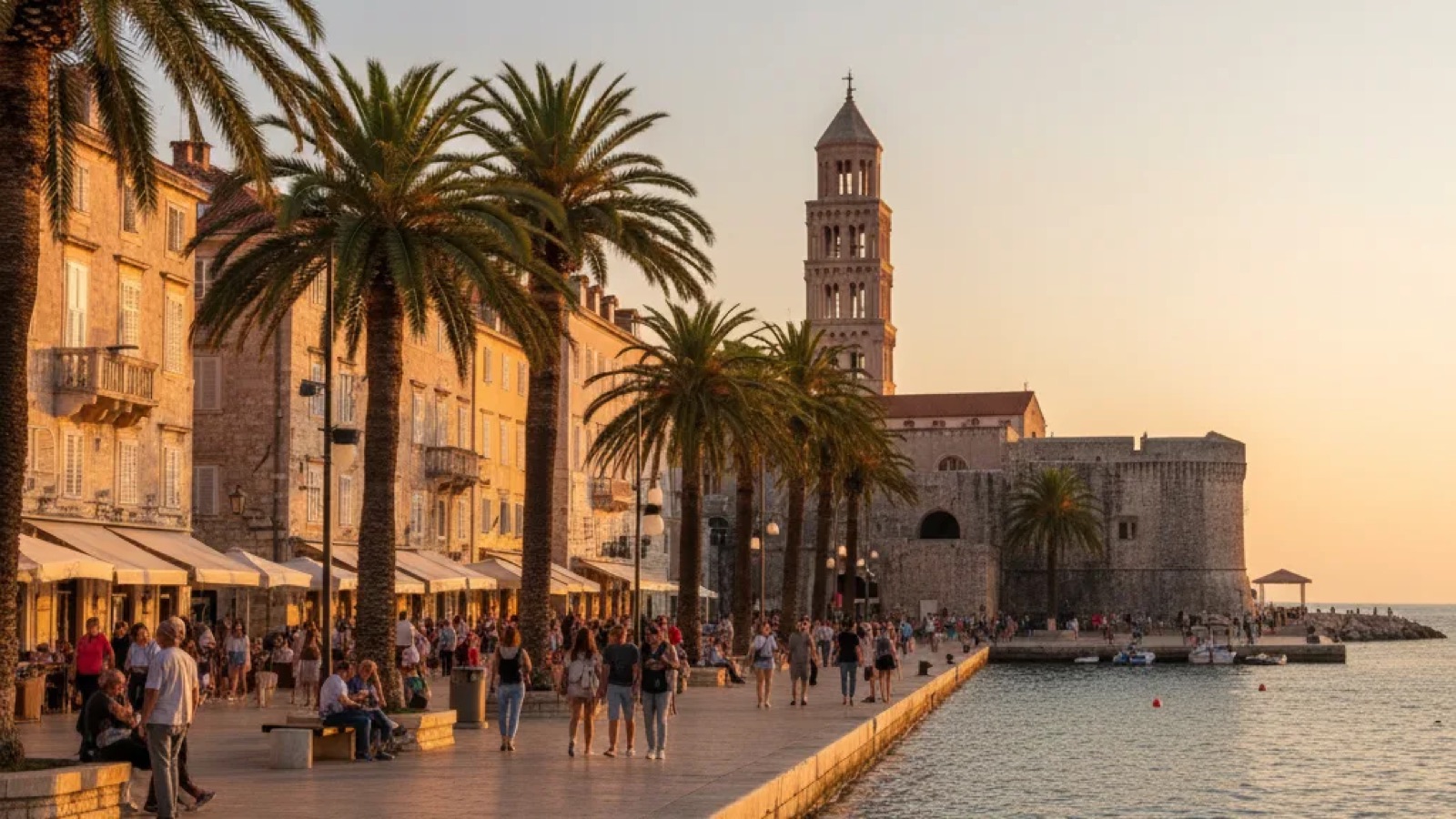
If the Peristyle is Split's living room, the Riva is its front porch. This wide, palm-lined promenade runs the entire length of the palace's southern facade, separating ancient stone from the sparkling Adriatic. It’s lined with cafés and bars, but its true purpose is revealed in the early evening. This is when all of Split seems to descend for the *passeggiata*, the traditional evening stroll.
Families, couples, and friends walk up and down, greeting each other, stopping for a chat, and soaking up the last of the day's light. The energy is infectious. Finding a table at a cafe, ordering a drink, and just watching the parade is one of my favourite Split rituals. It’s the city at its most social and relaxed.
Photography Tip: The Riva is a photographer's dream. For the best light, come during the golden hour just before sunset. Position yourself at the western end of the promenade and shoot back towards the palace. The low sun illuminates the facade in a warm, honey-coloured light, creating a beautiful contrast with the blue of the sea.
Marjan Hill: Split's Green Lung
When the summer heat and city crowds get a bit much, I do what the locals do: I head for Marjan. This large forested park covers the peninsula just west of the old town, a sprawling sanctuary of pine trees, jogging trails, and secluded beaches. A simple flight of stairs near the Varoš neighbourhood takes you up into a different world.
The first lookout point, where the Vidilica cafe is located, offers the most iconic postcard view of Split. But I encourage you to walk further. The trails wind up to higher peaks, past tiny medieval chapels and hermit caves built into the cliffs. The scent of pine and salt hangs in the air, and the only sounds are cicadas and the distant hum of a ferry. It’s the perfect place for a morning run or a sunset walk, offering a completely different perspective on the city below.
Beyond the Palace: Varoš and Radunica
To really get a feel for the old Split, you need to wander into the neighbourhoods clinging to the outside of the palace walls. To the west lies Varoš, and to the east, Radunica. These were once the humble quarters of fishermen and farmers. Today, they are charming, labyrinthine mazes of narrow stone streets, hidden courtyards, and houses adorned with colourful shutters and overflowing flower pots.
Getting lost here is a joy. Every turn reveals a new detail: a worn stone archway, a cat sleeping on a windowsill, the sound of a family having lunch in a private garden. It feels a world away from the tourist buzz of the Peristyle, yet it's only five minutes on foot. It’s in these backstreets that you'll find a more authentic, quieter side of Split.
The Gateway to the Islands: Navigating the Ferry Port
Split's port is your launchpad for island adventures, but it can be chaotic. Understanding the system is key. There are two main ways to travel: the large, state-owned Jadrolinija car ferries and the smaller, faster, passenger-only catamarans (run by Jadrolinija and private companies like Krilo).
- Car Ferries: These are the big, slow-moving workhorses of the Adriatic. They are generally more affordable, and crucially, they have large open-air decks where you can stand, feel the sea spray, and get incredible photos as you pull away from the coast. This is the best way to travel when you're not in a hurry. A classic example is taking the car ferry to Supetar on Brač island.
- Catamarans: These are much faster and connect directly to popular tourist towns, like Bol (for Zlatni Rat beach) on Brač or Hvar Town on Hvar. They are passenger-only, and you're seated inside, so the journey is less scenic but much quicker.
Your choice depends on your destination and priorities. For a day trip to Zlatni Rat beach, a direct catamaran to Bol is most efficient. To explore Hvar island with a car, you’d take the ferry to the port of Stari Grad. For a laid-back trip to quiet Šolta or remote Vis, the ferry is a wonderfully relaxing experience. Always check schedules and book tickets online in advance, especially from June to September, as popular routes sell out. Timetables are seasonal and change frequently, so check the official carrier websites for the most current information.
Essential Day Trips from Split
Split's central location makes it an unbeatable base for exploring. Here are a few of the best day trips:
- Trogir: Just a 30-40 minute bus or boat ride away, this entire town is a UNESCO World Heritage site. It’s like a miniature, more intimate version of Split, set on its own tiny island, packed with Romanesque and Renaissance architecture.
- Klis Fortress: Perched dramatically on a cliff overlooking Split, this fortress has a bloody and heroic history. Its strategic location offers jaw-dropping views. Fans of Game of Thrones will instantly recognise it as the city of Meereen. It's best reached by car or one of the many organised tours.
- Krka National Park: While Plitvice Lakes is more famous, Krka is much closer to Split and equally stunning. It's a wonderland of waterfalls, cascades, and lush greenery. Note that swimming at the main waterfall (Skradinski Buk) has been banned since January 2021.
- Omiš and the Cetina River: A short drive south brings you to the town of Omiš, squeezed between towering limestone cliffs where the Cetina River meets the sea. This is Dalmatia's adventure capital, offering fantastic white-water rafting, canyoning, and rock climbing.
- Salona: For the true history buff, the ruins of the ancient Roman city of Salona, just outside Split, are a must. It was once the capital of the Roman province of Dalmatia and is a vast, fascinating archaeological park.
Dalmatian Flavours: What to Eat in Split
Dalmatian food is all about simplicity, freshness, and letting incredible ingredients shine. Forget complex sauces; here, it's about the quality of the fish, the richness of the olive oil, and the bounty of the garden.
My absolute favourite is peka, a sublime dish of meat (often veal or lamb) or octopus and vegetables slow-cooked for hours under a bell-shaped lid covered in hot embers. The result is unbelievably tender and flavourful. You almost always have to order it several hours or a day in advance, so plan ahead. Another classic is crni rižot, or black risotto. Don't be put off by the colour—it comes from cuttlefish ink and has a deep, savoury flavour of the sea that is utterly addictive.
And of course, you can't leave without having simple grilled fish. Head to a traditional tavern, or *konoba*, and see what the catch of the day is. A whole sea bream or bass, grilled over wood, drizzled with local olive oil, garlic, and parsley, and served with some blitva (chard and potatoes), is Dalmatian perfection on a plate.
The Art of Timing and Tackling the Crowds
I cannot stress this enough: your experience of Split will be dramatically different depending on when you visit. In July and August, the city is electric. The energy is high, the evenings are long and balmy, and there's a festival atmosphere. However, the heat can be intense, often soaring well above 30°C. The narrow alleys of the palace can become choked with tour groups, and prices for accommodation are at their peak.
For a more relaxed trip, I wholeheartedly recommend the 'shoulder seasons' of May, June, and September. The weather is still gloriously sunny and warm, the sea is perfect for swimming, and the crowds are significantly thinner. You can wander the palace with some breathing room, get a table at a waterfront cafe without a battle, and enjoy the sights at a more leisurely pace. To me, this is Split at its absolute best.
Practicalities: Driving and Parking in Split
Here is my single most important piece of practical advice for Split: do not try to drive or park in or near the Old Town. The core of the city, including Diocletian's Palace, is a pedestrian-only zone. The surrounding streets are a frustrating one-way maze, and parking is a nightmare. The large, paid car park by the port fills up incredibly early, especially in summer, and street parking is almost non-existent.
If you're arriving by car, the best strategy is to book accommodation that is either outside the centre with its own dedicated parking, or one of the few hotels in the vicinity that offers it. From there, you can easily walk into the Old Town or use a local bus or ride-sharing service. Renting a car is fantastic for day trips, but for exploring Split itself, your own two feet are your best friends.
Explore in Depth
Split is a fantastic gateway to the rest of this incredible country. If you're plotting a wider Croatian adventure, my other guides have the detail you need to connect the dots and plan the perfect trip.
Frequently Asked Questions
Is Split a better base than Dubrovnik for island hopping?
Yes, for most travellers, Split is the superior base for island hopping. Its central location on the Dalmatian coast and its massive port provide more frequent and diverse ferry and catamaran routes. You can easily reach popular islands like Brač, Hvar, and Vis, as well as quieter gems like Šolta. While Dubrovnik offers access to the beautiful Elaphiti Islands and Korčula, Split's sheer number of connections makes it a much more practical and flexible hub for exploring the Adriatic archipelago.
How much time do I really need to see Diocletian's Palace?
You can rush through the main sights of the Palace—the Peristyle, Cathedral, and substructures—in half a day. However, to truly appreciate it, I recommend dedicating at least one full day. This gives you time not just to see the monuments, but to experience the palace as a living neighbourhood. Use the extra time to get lost in the labyrinthine alleys, browse the small shops, linger over a coffee on the Peristyle steps, and feel the unique rhythm of a city thriving within Roman walls.
Can I visit Zlatni Rat beach from Split in a day?
Absolutely, it's a very popular and achievable day trip. The most efficient way is to take an early morning passenger catamaran directly from Split to the town of Bol on Brač island. The journey is scenic and relatively quick. From Bol's harbour, the famous Zlatni Rat (Golden Horn) beach is a pleasant 20-minute walk along a shaded seaside promenade, or a short trip by water taxi. Just be sure to check the return catamaran schedule carefully, as the last departure can be earlier than you think, especially outside of July and August.
Is it difficult to drive and park in Split?
It is extremely difficult. I strongly advise against it. The historical centre is entirely pedestrianised, and the surrounding streets are a congested, confusing network of one-way lanes. Finding a parking space near the old town or the port in summer is a stressful and often fruitless task. Your best bet is to choose accommodation with private parking and explore the city on foot. For day trips, you can either rent a car for the day or rely on Croatia's excellent network of buses, boats, and organised tours.
What is Bačvice beach like and is it worth visiting?
Bačvice is Split's main city beach, and it's an experience. It’s a sandy, very shallow bay just a short walk from the ferry port. Don't expect a tranquil, secluded cove; it's lively, crowded, and full of local families. Its main claim to fame is as the birthplace of *picigin*, a unique game where players dive acrobatically to keep a small ball from hitting the water. It’s fantastic fun to watch. Go to Bačvice not for the perfect beach day, but for a vibrant slice of local Split life.
Final Thoughts
After more than a decade of travelling, some places stick with you more than others. Split is one of those places for me. It’s a city that wears its history with a casual, lived-in comfort. Other great historical sites in the world can feel like sterile museums, roped off and preserved under glass. Split is the opposite. It’s a place where you can lean against a 1700-year-old wall to check your phone, where children play football in a Roman emperor's front yard, and where the past isn't just something you look at—it's something you live in.
That's the city's enduring appeal. It's a place of spectacular beauty and profound history, but it never forgets that it is, first and foremost, a home. It's a city with a pulse, a gateway to adventure, and a destination that reveals more of its soul every time I return.