Porto Travel Guide: Port Cellars and the Douro
Porto in two or three days: Ribeira and the bridges, the port cellars in Gaia, azulejo tiles, and whether the Douro Valley is worth a day.
In this guide
- Quick Facts
- Porto vs. Lisbon: A Tale of Two Cities
- Getting There and Getting Your Bearings
- How Many Days in Porto?
- The Heart of the City: Ribeira and the Dom Luís I Bridge
- Across the Douro: Port Wine in Vila Nova de Gaia
- A Masterpiece in Blue: São Bento Station
- High Points: Clérigos Tower and Livraria Lello
- Porto's Pantry: Mercado do Bolhão and Northern Flavours
- To the Atlantic: Foz do Douro and Matosinhos
- Beyond Porto: Day Trips to the Douro Valley, Guimarães and Braga
- Practical Advice: Hills, Cobbles, and Atlantic Rain
- Explore in Depth
- Frequently Asked Questions
- Final Thoughts
This guide is part of our Portugal Travel Guide: Where to Go and When to Visit — start there for the overview, when to go and how to get around.
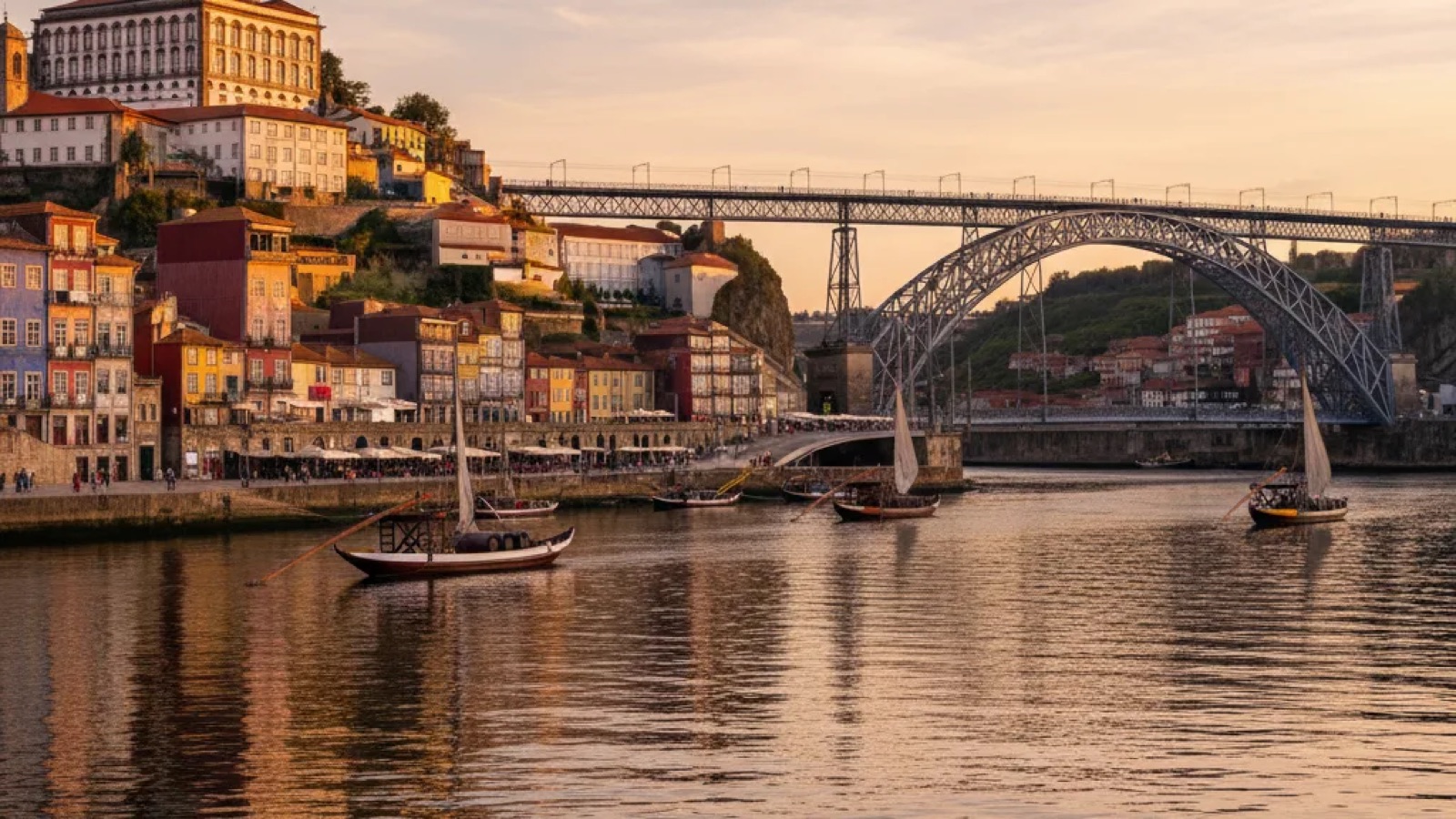
From the upper deck of the Dom Luís I Bridge, metro trains rumble past just metres away while the evening sun burns gold on the terracotta roofs of Vila Nova de Gaia, casting long shadows across the Douro River below. Down on the Ribeira waterfront, the first lights twinkle in the riverside cafés, reflecting in the dark water where the old rabelo boats, once used to ferry port wine from the vineyards, are moored like museum pieces. The cool air carries the faint, briny scent of the nearby Atlantic and the distant aroma of grilling food. This is the essential Porto moment: perched between two cities, suspended over a river rich with history, watching the day turn to night over the world capital of port wine.
Often seen as Lisbon’s grittier, harder-working northern sibling, Porto has a soulful, intoxicating character all its own. This is a city built on granite hills, defined by its river, and coloured by the deep red of its famous fortified wine. It’s a place of breathtaking bridges, baroque bell towers, and tiled train stations that are works of art. This guide takes in its steep, cobbled lanes and its wild coastline. We’ll cover how to get your bearings, the best way to explore the port cellars, where to find the most soul-stirring views, what to eat, and how to plan the perfect day trip into the Douro Valley wine country.
Quick Facts
- Location: Northern Portugal, where the Douro River meets the Atlantic Ocean.
- Getting There: Fly into Francisco Sá Carneiro Airport (OPO), which is connected directly to the city centre by Metro Line E. For train travel, Campanhã is the main station for long-distance services (including from Lisbon), with frequent connections to the central São Bento station.
- Getting Around: The historic centre is compact but extremely hilly. Be prepared to walk up steep climbs on cobblestone streets. A good public transport network of metro, buses, and vintage trams helps connect the centre to the coast and suburbs.
- Language & Currency: Portuguese is the official language, though English is widely spoken in tourist areas. The currency is the Euro.
- Best Time to Visit: The shoulder seasons of late spring (May-June) and early autumn (September) offer the best balance of pleasant weather and manageable crowds. Summer is popular but can be very busy. Always be prepared for rain, no matter the season.
Porto vs. Lisbon: A Tale of Two Cities
First-time visitors to Portugal often ask whether they should visit Lisbon or Porto. The truth is, you should visit both, because they are wonderfully different. There’s an old Portuguese saying that goes, “While Lisbon shows off, Porto works.” While that’s a bit of an oversimplification, it gets to the heart of their distinct characters. Lisbon is the glamorous, sun-drenched capital; a city of grand plazas, sweeping views, and a laid-back, cosmopolitan air.
Porto feels different. Its roots are mercantile and industrial, and that history is etched into its granite facades and the industrious spirit of its people (who famously call themselves Tripeiros, or "tripe-eaters," a nickname earned from sacrifice). It feels more compact, perhaps a little more brooding under the Atlantic skies, but incredibly soulful. The colour palette is deeper, the buildings are pressed closer together, and life revolves more tightly around the river. Where Lisbon’s vibe is expansive, Porto’s is concentrated. You don’t just visit Porto, you feel it in your legs as you climb its hills and in your spirit as you sip its wine.
Getting There and Getting Your Bearings
Porto is brilliantly easy to get to. Most international visitors arrive at Francisco Sá Carneiro Airport (OPO). The best thing about this airport is its seamless integration with the city. You can walk out of arrivals and straight onto the metro. Line E (the Violet line) runs directly from the airport to Trindade station in the city centre, the main hub of the metro system. It’s efficient, clean, and the most straightforward way to begin your trip.
If you’re travelling within Portugal, especially from Lisbon, the train is the best way to go. The high-speed Alfa Pendular and the slightly slower Intercidades services connect Lisbon’s Santa Apolónia or Oriente stations with Porto’s Campanhã station in around three hours. Campanhã is a little outside the historic centre, but virtually every train that arrives there allows for a free, quick transfer to the magnificent São Bento station, which is right in the heart of everything. Make sure your ticket includes this final leg.
To orient yourself, think of the city in two halves split by the Douro River. The north bank is Porto proper, with the historic Ribeira district on the waterfront and the main city sprawling up the hill behind it. The south bank is the separate city of Vila Nova de Gaia, home to all the famous port wine lodges. The two are connected by several bridges, most notably the iconic Dom Luís I Bridge.
How Many Days in Porto?
Allow a minimum of three full days to do Porto justice. This gives you enough time to explore the Ribeira, climb the Clérigos Tower, get lost in the backstreets, cross over to Gaia for a proper port tasting, and maybe even take the old tram out to the coast at Foz do Douro. This pace allows you to soak in the atmosphere without feeling rushed, leaving time for long lunches and spontaneous discoveries.
If you have four or five days, that’s even better. It opens up the possibility of a fantastic day trip. The most popular and arguably most spectacular option is a journey into the Douro Valley wine region. Alternatively, you could explore the historic cities of Guimarães and Braga to the north. Don't try to cram it all into a weekend; Porto is a city that rewards a slower, more deliberate pace.
The Heart of the City: Ribeira and the Dom Luís I Bridge
The soul of Porto resides along the Cais da Ribeira. This UNESCO World Heritage waterfront is a beautiful, chaotic jumble of tall, narrow houses painted in shades of ochre, orange, and blue, leaning against each other as if for support. It’s intensely atmospheric. By day, the promenade hums with street performers and the clatter of cafés. By night, it transforms into one of the most romantic settings imaginable, with the lights of the port lodges in Gaia sparkling across the river.
Looming over it all is the Dom Luís I Bridge, the city's defining landmark. This two-tiered iron marvel was designed by Théophile Seyrig, a former partner of Gustave Eiffel, and the pedigree shows. The lower level carries road traffic and has pedestrian walkways, providing a direct, bustling connection from the Ribeira to the base of Gaia’s port cellars. It’s great for a close-up view of the river traffic.
But the real magic is on the upper level. Accessible by funicular or a steep climb up from Ribeira, this level is shared by pedestrians and the city’s metro. Walking across here, nearly 60 metres above the water, delivers one of Europe’s great urban panoramas. The best photography spot is right in the middle, looking back towards the dense medieval fabric of Ribeira. Time your walk for the late afternoon and stay for sunset; the view is something you’ll remember for a lifetime.
Across the Douro: Port Wine in Vila Nova de Gaia
One of the first things to realise about port wine is that it isn’t aged in Porto at all. The entire industry is based across the river in Vila Nova de Gaia. For centuries, barrels of wine were brought down the Douro River from the vineyards on traditional rabelo boats and taken to the cool, dark cellars (or 'lodges') in Gaia to mature. Today, the names of the great port houses—Taylor's, Graham's, Sandeman, Cálem—are emblazoned on the tiled roofs, creating a unique skyline.
Visiting the lodges is an essential Porto experience. The process is generally very straightforward. You can walk along the Gaia waterfront and choose from dozens of lodges. Most offer a few options: you can take a guided tour that explains the history of port and the differences between Ruby, Tawny, White, and Vintage ports, usually followed by a tasting. Or, if you prefer, many have patios or tasting rooms where you can simply order a 'flight' of different ports to sample at your own pace.
Pick one or two. Don’t try to tour them all. Some of the lodges higher up the hill, like Graham's or Taylor's, require a bit of a climb but reward you with spectacular terraces overlooking the whole city. It's wise to check their websites, as booking tours online in advance can save you a long wait, especially in peak season.
A Masterpiece in Blue: São Bento Station
Even if you’re not arriving or departing by train, you absolutely must visit São Bento station. Stepping into the main vestibule is like walking into a living art gallery. The walls are covered with approximately 20,000 azulejo tiles, the classic blue-and-white tiles that are a hallmark of Portuguese design. But these are no mere patterns; they are epic historical murals.
Created by the artist Jorge Colaço over more than a decade in the early 20th century, the panels depict great battles, royal weddings, and scenes from the history of transport and rural life in Portugal. Take your time to really look at them. It’s a stunning, and free, introduction to the nation's story. It remains a busy, functioning train station, and the contrast between commuters rushing for their trains and visitors standing in silent admiration is part of its charm. For photographers, early morning light is best, before the crowds become too dense, letting you capture the sheer scale and detail of this incredible space.
High Points: Clérigos Tower and Livraria Lello
Two of Porto’s most famous landmarks are conveniently located near each other, and both involve a bit of a queue and an entrance fee, so it’s good to plan ahead.
The Clérigos Tower
The slender, baroque Torre dos Clérigos is the bell tower of the Clérigos Church and the undisputed symbol of the Porto skyline. For centuries, it was the tallest structure in the city and served as a lighthouse for ships coming up the Douro. The climb up its 200-plus narrow stone steps is a bit tight, but the payoff is immense. From the top, you get a breathtaking 360-degree panorama of the city’s red-tiled roofs, winding streets, the river, and the ocean beyond. It’s the perfect way to get a sense of Porto’s geography.
Livraria Lello
A short walk from the tower is Livraria Lello, often called the most beautiful bookstore in the world. Its fame has exploded in recent years due to its rumoured connection to J.K. Rowling’s creation of Harry Potter (though Rowling, who lived and taught in Porto in the early 1990s, said in 2020 that she never visited the shop). The neo-Gothic interior is a dream of carved wood, stained glass, and a magnificent, sinuous red staircase that seems to defy gravity. It truly is stunning.
However, you need a strategy. The bookstore's popularity means you can't just walk in. You must purchase a ticket, which you can (and absolutely should) do online in advance. The good news is that the ticket price is fully redeemable against any book purchase. To avoid the worst of the crowds, which can be overwhelming, try to visit first thing in the morning or in the last hour before closing. Be prepared for it to be busy, but for lovers of books and architecture, it's worth it.
Porto's Pantry: Mercado do Bolhão and Northern Flavours
To really get a feel for a city's culinary heart, head to its main market. In Porto, this is the magnificent Mercado do Bolhão. After a long period of renovation, the historic two-storey wrought-iron market is back and more vibrant than ever. It's a feast for the senses. The ground floor is a bustling maze of vendors selling glistening fresh fish from Matosinhos, local cheeses, smoked meats, mountains of fruit and vegetables, and beautiful flowers. Upstairs, you'll find small eateries and cafes where you can sample some of that produce. It's the perfect place to absorb the daily life of the city.
When it comes to local food, you have to talk about the Francesinha. This is Porto’s signature dish, and it's not for the faint of heart. It translates as "Little Frenchie" but it is anything but little. It’s a gut-busting sandwich of steak, smoked sausage, and ham, packed between two slices of thick bread, covered in melted cheese, and then drowned in a rich, spicy tomato and beer sauce. It's usually served with a mountain of chips and sometimes topped with a fried egg. You don’t need one every day, but you have to try it once. Another local specialty, for the more adventurous, is Tripas à Moda do Porto, the tripe stew that gave the locals their nickname.
To the Atlantic: Foz do Douro and Matosinhos
When the city centre gets a bit intense, do what the locals do and head for the coast. The easiest and most charming way to do this is by hopping on the vintage Tram Line 1. This historic tram trundles along the riverbank from Ribeira all the way to Foz do Douro, where the river finally meets the Atlantic Ocean. The atmosphere here is completely different—fresh, salty, and windswept. You can walk along the promenade, past the Felgueiras Lighthouse where waves often crash spectacularly against the sea wall, and enjoy a more relaxed, seaside vibe.
For a true feast, continue a little further up the coast to Matosinhos (easily reached by city bus or metro). This is Porto’s main fishing port and, consequently, its seafood paradise. The streets near the harbour, like Rua Heróis de França, are lined with restaurants that set up charcoal grills right on the pavement. The air is thick with the incredible smell of grilling fish. The process is simple and brilliant: you choose your fish or squid from the fresh display, they grill it for you on the spot, and serve it with potatoes and salad. The grilled sardines, in particular, are a Portuguese national treasure.
Beyond Porto: Day Trips to the Douro Valley, Guimarães and Braga
With an extra day, Porto becomes a fantastic base for exploring Northern Portugal.
- The Douro Valley: This is the world's first demarcated wine region and a UNESCO World Heritage site. The landscape is extraordinarily dramatic, with impossibly steep terraces covered in vines plunging down to the winding river. The best way to see it independently is on the Linha do Douro scenic railway line from São Bento or Campanhã stations. The journey itself, especially the section past Peso da Régua to Pinhão, is the main attraction. Alternatively, full-day boat cruises or organised bus tours that include a river cruise and a visit to a wine estate (quinta) for a tasting can be a great, hassle-free option.
- Guimarães and Braga: Easily reachable by a direct urban train from São Bento, these two cities can be combined for a long day trip. Guimarães is known as the "birthplace of Portugal," as it was the home of the country's first king. Its beautifully preserved medieval centre, dominated by a formidable castle and the Palace of the Dukes of Braganza, is a joy to explore. Nearby Braga is one of Portugal's oldest cities and its religious heart. Its main draw is the magnificent Bom Jesus do Monte sanctuary, located just outside the city, famous for its incredible zigzag baroque staircase that represents the ascent to heaven.
Practical Advice: Hills, Cobbles, and Atlantic Rain
One thing matters above all: Porto is a city of hills. The historic centre is a series of steep climbs and descents. The beautiful black-and-white cobblestone pavements, known as calçada portuguesa, are charming but can be uneven and become incredibly slippery when wet. This has one major implication for your visit: comfortable, supportive shoes with good grip are not a recommendation, they are an absolute necessity. Leave the smooth-soled dress shoes at home.
The city's position on the Atlantic coast also governs its weather. It can be unpredictable, with glorious sunshine and sudden downpours possible in the same afternoon, even in summer. Always pack a light raincoat or an umbrella, regardless of the forecast. This maritime climate is precisely what makes the cellars in Gaia so perfect for ageing port, but it means you should always be prepared for four seasons in one day. Thankfully, a sudden shower is the perfect excuse to duck into a café for another coffee or a glass of wine.
Explore in Depth
Now that you've got the essentials for Porto, you might be planning the rest of your Portugal adventure. These guides offer a deeper dive into some of the country's other highlights.
Frequently Asked Questions
Is Porto a very walkable city?
Yes and no. The historic centre is compact and best explored on foot, as many of its most charming streets are pedestrianised or too narrow for cars. However, 'walkable' in Porto means being prepared for a serious workout. The city is built on several steep hills, with lots of staircases and sloping cobbled lanes. While you can walk between most major sights, you'll definitely feel it in your legs. Comfortable, non-slip footwear is absolutely essential. For longer distances, like going to the coast at Foz or Matosinhos, the excellent public transport is the way to go.
Do I need to book port cellar tours in advance?
For the most famous and popular port lodges in Vila Nova de Gaia, booking your tour in advance online is highly recommended, especially from May to September and on weekends. This guarantees you a spot on a tour at your preferred time and in your chosen language, saving you from long queues or disappointment. For smaller, less famous lodges, or if you simply want a tasting without the full guided tour, you can often just walk in. The advice is to book your 'must-visit' lodge ahead of time and leave some flexibility to discover another one spontaneously.
What's the best way to see the Douro Valley from Porto?
There are several great ways, depending on your preference. For independent travellers, taking the scenic Linha do Douro train from São Bento station to Pinhão is a spectacular and affordable option, offering breathtaking views from the carriage window. For a more relaxing experience, full-day river cruises depart from Porto, though they spend a lot of time getting through the locks near the city. A popular and efficient choice is a combination tour, which often involves a bus ride to the heart of the valley, a visit to a wine estate (quinta) for a tour and tasting, and a short boat trip on the most scenic part of the river.
Is the Livraria Lello bookstore really worth the queue and ticket?
For anyone who appreciates architecture, history, or literature, yes, it's a worthwhile experience. The Art Nouveau interior with its famous crimson staircase is genuinely breathtaking. However, it's crucial to manage your expectations. It will be crowded. The key is to book your time-slot ticket online in advance to avoid a separate queue. Remember that the ticket cost functions as a voucher that you can use towards buying a book, so it encourages you to leave with a souvenir. Go early in the morning or late in the afternoon for a slightly less crowded experience.
What is a 'francesinha' and where should I try one?
The francesinha, or "little Frenchie," is Porto's signature culinary invention, and it's an icon of hearty, comfort food. It's a loaded sandwich with layers of steak, cured sausage, and ham, encased in bread, smothered in melted cheese, and then drenched in a unique, rich sauce made from tomato, beer, and spices. It's almost always served with a side of chips. You can find it on menus all over the city, from traditional beer halls (cervejarias) to modern restaurants. Asking a local for their favourite spot is always a good way to find an authentic version.
Final Thoughts
Porto isn't a city that lays all its cards on the table at once. It asks you to put in a little work—to climb its hills, to navigate its winding alleys, to brave a sudden Atlantic shower. But the rewards are immense. It's a city with a deep, tangible sense of place, a proud history that you can feel in the granite under your feet and see in the centuries-old tilework. There's an authenticity here that is becoming rare in Europe's most popular destinations.
From the grandeur of the Douro at sunset to the quiet satisfaction of a glass of tawny port in a cool Gaia cellar, Porto engages all the senses. It’s a city for wanderers, for photographers, for food lovers, and for anyone who believes that a city’s character is found in its heritage and its hills. It might make your legs ache, but it will most certainly capture your heart.