South Korea Itinerary: Seoul, Busan and Jeju
Palaces, KTX trains, Busan seafood and Jeju hiking — a realistic first South Korea itinerary and the seasons worth planning around.
In this guide
- Quick Facts
- When to Visit: Spring Blossoms and Autumn Foliage
- Getting Around: KTX Rail and the T-Money Card
- Where to Base Yourself: Key Neighbourhoods
- Seoul: Palaces, Historic Villages, and Urban Pulse
- Exploring the Demilitarised Zone (DMZ)
- Gyeongju: The Open-Air Museum of Ancient Silla
- Busan: Beaches, Fish Markets, and Cliffside Temples
- Jeju Island: Volcanic Peaks, Waterfalls, and Coastal Trails
- Korean Culinary Guide: BBQ, Street Food, and Dining Etiquette
- Budgeting, Tech, and Practical Travel Advice
- Common Mistakes to Avoid in South Korea
- The Two-Week South Korea Itinerary
- Final Thoughts
- Explore in Depth
Stand on the crater rim of Seongsan Ilchulbong as the first blush of morning light paints the Pacific Ocean in shades of lilac and amber, and you’ll realise just how dramatically South Korea alters your sense of pace. Thirty-six hours earlier you could be in the neon-drenched belly of Seoul’s Hongdae district, surrounded by buskers, sizzling skewers of street food, and an electric urban pulse that seems to ignore the clock entirely. To move from the hyper-dense, futuristic energy of the capital to the quiet, wind-sculpted basalt cliffs of Jeju Island is to experience one of the most rewarding contrasts in modern travel.
Having travelled through nearly fifty countries over the past twelve years as a travel writer and photographer, few destinations offer such a seamless blend of antiquity and ultra-modern convenience. South Korea is a country where centuries-old Joseon Dynasty palaces sit comfortably in the shadow of glass skyscrapers, and where high-speed trains whir past quiet pine forests and ancient royal burial mounds at over three hundred kilometres per hour. It is compact, incredibly safe, culturally rich, and endlessly fascinating for anyone with a camera and a healthy appetite.
Creating a balanced trip to South Korea requires understanding its distinct geographical regions. By linking the historic capital of Seoul, the ancient imperial capital of Gyeongju, the vibrant coastal metropolis of Busan, and the volcanic sanctuary of Jeju Island, you build a journey that captures the full spectrum of the nation’s heritage, scenery, and soul. Whether you are planning your first trip or returning to dig deeper, this guide covers everything you need to navigate the peninsula efficiently and authentically.
Quick Facts
- Capital City: Seoul
- Official Language: Korean (Hangul script)
- Primary Public Transport: High-speed KTX trains, extensive subway systems, regional buses
- Payment Essential: Reloadable T-money card for transit and local convenience stores
- Best Travel Seasons: Spring (April to May) for cherry blossoms; Autumn (September to November) for foliage
- Visa Basics: Many nationalities receive visa-free entry or require an electronic travel authorisation (check official government portals prior to departure)
- Power Outlets: Type C and Type F plugs, standard 220V voltage
When to Visit: Spring Blossoms and Autumn Foliage
Spring (April to May)
Spring turns the Korean peninsula into a canvas of pastel hues. The cherry blossom season usually begins in late March on the southern shores of Jeju Island and works its way north to Seoul by early April. Walking through the palace grounds in Seoul or along the canal banks in smaller towns when the pink petals blow across the cobbled pathways is undeniably special. The weather during spring is generally clear and dry, with mild daytime temperatures ideal for long walking tours and alpine hikes. However, spring can occasionally bring dust storms originating from the Gobi Desert, so carrying a high-quality protective mask is a smart practical measure.
Autumn (September to November)
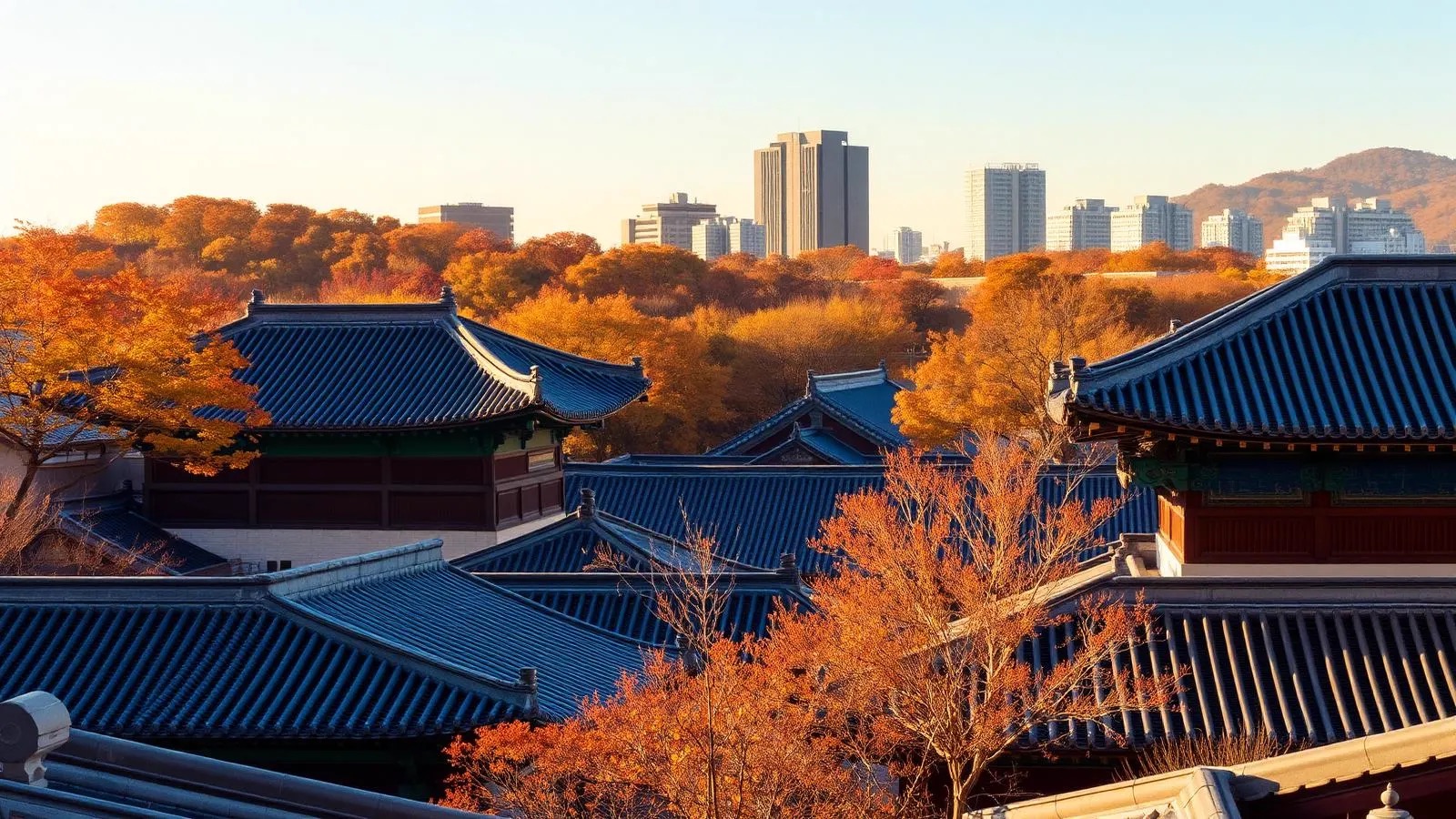
If you ask local photographers their favourite time of year, autumn wins almost every time. From late September through November, the country experiences crisp, clear skies and comfortable temperatures. By mid-October, the mountain ranges—including Hallasan on Jeju and the national parks surrounding Seoul—transform into blazing waves of crimson, orange, and gold. The ginkgo trees lining Seoul’s urban avenues shed leaves that blanket the pavements in bright yellow. Autumn also coincides with the main harvest period, meaning seasonal delicacies and local produce are at their absolute peak.
Summer and Winter Considerations
Summer (June through August) brings hot, humid weather along with the monsoon rain season (jangma). While coastal Busan and Jeju Island offer cooling sea breezes during these months, outdoor trekking can become sweaty and uncomfortable. Winter (December to February) drops temperatures well below freezing across much of the mainland. While winter offers excellent ski conditions in the northern provinces and beautiful snow-covered temple scenes, travellers must pack heavy thermal layers and prepare for sharp icy winds coming down from Siberia.
Getting Around: KTX Rail and the T-Money Card
The High-Speed KTX Rail Network
South Korea possesses one of the world's most impressive rail transport systems. The KTX (Korea Train eXpress) connects major hubs across the country at astonishing speeds. Travelling from Seoul Station to Busan on the southern coast takes under three hours, replacing what would otherwise be a tedious day on the road. The trains are clean, punctual to the minute, equipped with onboard Wi-Fi, and offer wide windows ideal for watching the rural landscape flash past. Tickets can be booked weeks in advance through official operator platforms, which is strongly advised if you are travelling during peak holiday periods or weekends.
Mastering the T-Money Card
Your single most useful item in South Korea is a small plastic card called the T-money card. Available at almost every convenience store upon arrival at the airport or train stations, this rechargeable contactless card works seamlessly across subways, city buses, and even taxis in Seoul, Busan, and most regional towns. You can also use it to pay for small purchases at convenience stores and vending machines. Simply tap in and out at gates. It is important to note that while credit cards are widely accepted across Korea, topping up a T-money card requires physical cash at station kiosks or convenience counters, so keep paper currency on hand for transit top-ups.
Navigating Jeju Island
While the mainland relies heavily on trains and subways, Jeju Island operates differently. Jeju has no passenger railway network. To make the most of your time on the island, renting a car is highly recommended. The roads on Jeju are paved, clear, and easy to navigate using local satellite navigation systems. Drivers must secure an International Driving Permit prior to leaving home. If driving is not an option, public buses circle the island, though route planning requires more flexibility and time allowance.
Where to Base Yourself: Key Neighbourhoods
Seoul Neighbourhood Breakdown
Because Seoul is a vast, polycentric metropolis, choosing the right base significantly reduces travel time on the subway.
- Hongdae: The creative and youthful heart of the city, surrounding Hongik University. Excellent for independent shops, live busking, vibrant cafes, and budget dining options. Ideal for younger travellers or solo explorers.
- Myeongdong: A bustling commercial central hub filled with shopping streets and street food markets. Its central location makes accessing key historic sights exceptionally straightforward.
- Insadong & Bukchon: Nestled between the royal palaces, these areas offer atmospheric alleyways, traditional tea houses, and restored hanok architecture. Perfect for heritage enthusiasts wanting a quieter, atmospheric stay.
- Gangnam: South of the Han River, this district represents modern commercial Korea, featuring polished wide boulevards, luxury shopping malls, and upscale dining.
Busan Base Locations
Busan stretches along a dramatic coastline divided by rugged hills, making location choice crucial depending on your travel style.
- Haeundae: The premier beach district, ideal if you want ocean views, seaside promenades, high-end resorts, and fresh seafood restaurants right on your doorstep.
- Seomyeon: The geographic and transit centre of Busan. It lacks a beach, but makes up for it with unbeatable subway connections to all corners of the city, phenomenal nightlife, and market alleys.
- Nampo-dong: A southern coastal hub close to the historic fish markets, harbour docks, and hillside art villages. Great for street food lovers and photographers.
Jeju Island Hubs
When staying on Jeju, splitting your stay between two areas or choosing a strategic midpoint works best.
- Jeju City (North): Close to the main international airport, ideal for late arrivals, early departures, and quick access to northern coastal routes.
- Seogwipo (South): A charming city set along dramatic southern cliffs, offering closer access to major waterfalls, the southern Olle walking trails, and Mount Hallasan hiking routes.
Seoul: Palaces, Historic Villages, and Urban Pulse
The Five Grand Palaces
To understand Korea's dynastic past, visit the royal palaces constructed during the Joseon Dynasty. Gyeongbokgung is the largest and most grand. Positioned against the backdrop of Mount Bugaksan, its vast stone courtyards and intricate wooden pavilions offer an incredible look into royal life. Arrive in time to witness the colourful changing of the guard ceremony at the main gate. A short walk east lies Changdeokgung, famous for its Secret Garden (Huwon)—a carefully designed landscape of lily ponds, ancient trees, and quiet reading pavilions that harmonious blends built architecture with nature.
Traditional Alleys and Panoramic Views
Directly between Gyeongbokgung and Changdeokgung lies Bukchon Hanok Village. This residential neighbourhood preserves hundreds of traditional Korean homes (hanok) featuring distinctive tile roofs and wooden beams. Because people live here, visitors should explore quietly and stick to main alleyways. From Bukchon, wander south through Insadong, an artistic street lined with craft shops, traditional paper galleries, and quiet teahouses serving warm jujube and green teas.
For a sweeping view across Seoul's dramatic urban landscape, head up to N Seoul Tower atop Namsan Mountain. You can reach the peak via a scenic cable car or by hiking up paved mountain trails. Visiting near sunset allows you to watch the sun sink behind the surrounding ridges as millions of city lights flicker to life across the valley floor.
Modern Culture and Urban Design
Seoul’s modern architecture is as compelling as its historic sights. The Dongdaemun Design Plaza (DDP), designed by Zaha Hadid, resembles a curved silver spaceship rested in a historic market district. At night, its metallic exterior illuminates, hosting design markets and modern art installations. For a relaxing evening walk, join local residents along the Cheonggyecheon Stream, a reclaimed sunken urban river path that cuts through the core of the financial district, providing an oasis of quiet water and greenery beneath towering modern towers.
Exploring the Demilitarised Zone (DMZ)
Understanding the Border History
Located just fifty kilometres north of central Seoul lies the Demilitarised Zone (DMZ), a four-kilometre-wide buffer strip that has separated North and South Korea since the armistice agreement was signed. Visiting the DMZ offers a profound look into the cold-war tension that still shapes modern geopolitical realities on the Korean peninsula.
Key Sites Along the Border
Standard guided excursions take visitors to several historical sites along the southern side of the border fence:
- Imjingak Park: A park housing historic monuments, artillery pieces, and the Freedom Bridge, where prisoners of war were exchanged.
- The Third Infiltration Tunnel: An underground tunnel dug by North Korean forces, discovered in the late 1970s. Visitors can put on hard hats and walk deep into the damp bedrock channel to view the final concrete barrier blocking entry across the border line.
- Dora Observatory: Equipped with high-powered binoculars, this peak allows visitors to look directly across the border into North Korea, viewing agricultural collective villages and distant industrial zones.
Practical Logistics for DMZ Visits
All visitors must access the DMZ through registered official bus tours due to military security controls. You must carry your physical passport on the day of travel, as military personnel board the transport to verify identity documents at perimeter checkpoints. Dress respectfully (avoid torn jeans or offensive printed clothing), follow your guide’s instructions carefully, and pay attention to designated photography zones, as camera usage is strictly prohibited at certain lookout points.
Gyeongju: The Open-Air Museum of Ancient Silla
Spiritual Heritage: Bulguksa and Seokguram
Located on the southeastern rail line between Seoul and Busan, Gyeongju was the capital of the Silla Kingdom, which ruled much of the Korean peninsula for nearly a millennium. The city is often described as an open-air museum due to its concentration of archaeological sites, pagodas, and ancient ruins.
Nestled on the slopes of Mount Tohamsan lies Bulguksa Temple, a masterwork of Buddhist architecture. Built upon multi-tiered stone platforms, its wooden halls, ornate bridges, and twin stone pagodas showcase the structural sophistication of eighth-century builders. A short drive further up the winding mountain road brings you to Seokguram Grotto, an artificial stone cave housing a magnificent granite statue of the seated Buddha looking out toward the East Sea.
Royal Tombs and Nighttime Splendour
Right in the heart of Gyeongju town, you will find Daereungwon Tomb Park. Rather than traditional graveyards, ancient Silla royalty were buried beneath massive grass-covered earthen mounds that resemble rolling green hills. Walking among these silent mounds in the early morning mist feels like stepping back into ancient history. You can step inside the Cheonmachong Tomb to view reconstructed golden crowns, weapons, and ceremonial ornaments excavated from the site.
Nearby stands Cheomseongdae, the oldest surviving astronomical observatory in East Asia, constructed from 362 granite blocks representing the days of the lunar year. As darkness falls, stroll over to Donggung Palace and Wolji Pond. The illuminated wooden pavilions cast flawless reflections across the surrounding artificial lake, creating one of the most memorable night photography locations in the entire country.
Busan: Beaches, Fish Markets, and Cliffside Temples
Coastal Temples and Ocean Beaches
South Korea’s second city, Busan, trades Seoul’s landlocked valley setting for a dynamic coastline of dramatic sea cliffs, long sandy beaches, and sprawling port facilities. Start your coastal tour early at Haedong Yonggungsa Temple. Unlike most Korean temples tucked deep into mountain ranges, this ancient Buddhist complex sits directly on rocky ocean cliffs where white sea spray hits the stone statues below.
After visiting the temple, travel down the coast to Haeundae Beach, Korea's most famous coastal strip. Lined with modern towers, seaside cafes, and a long wooden promenade, it is perfect for an afternoon stroll. In the evening, move to Gwangalli Beach, famous for its grand view of the Gwangan Diamond Bridge spanning the bay. The bridge lights up each night, creating a spectacular backdrop for dining at seafront restaurants.
Artistic Villages and Bustling Port Markets
On the steep slopes overlooking the port sits Gamcheon Culture Village. Originally built by refugees fleeing during wartime, this neighbourhood was transformed into a colourful artistic hub through community arts projects. A labyrinth of narrow stairways, painted alleys, pastel houses, and outdoor sculptures line the cliff face, earning it a reputation as a visual delight for photographers.
Down by the harbour, experience the chaotic energy of Jagalchi Fish Market, the largest seafood market in the nation. Here, local market stalls display thousands of marine species in bubbling water tanks. You can choose fresh fish or shellfish on the ground level and take your selection upstairs to indoor dining halls where cooks prepare your seafood meal immediately.
Jeju Island: Volcanic Peaks, Waterfalls, and Coastal Trails
Summiting Mount Hallasan
Formed by volcanic eruptions millions of years ago, Jeju Island features dramatic topography dominated by Mount Hallasan, a shield volcano rising 1,947 metres above sea level, making it South Korea’s highest peak. Summiting Hallasan is a bucket-list experience for outdoors enthusiasts. The two main paths leading to the crater top are the Seongpanak and Gwanumsa trails.
The hike requires a full day, proper footwear, layer garments for changing weather, and an advance permit booked through the official national park online platform. Reaching the crater rim rewards hikers with panoramic views of the island coastline and the inner crater lake (Baengnokdam).
Volcanic Wonders and Coastal Walks
If high-altitude mountain trekking seems too strenuous, Jeju offers plenty of easily accessible geological natural features:
- Seongsan Ilchulbong (Sunrise Peak): A dramatic tuff cone crater formed by hydrovolcanic eruptions rising directly out of the eastern ocean. A steep set of wooden stairs leads to the bowl-shaped summit in about twenty-five minutes.
- Manjanggul Cave: One of the longest lava tubes in the world, featuring immense underground stone tunnels, lava columns, and unique geological formations.
- Jeju Olle Trails: A network of twenty-seven walking routes (21 main routes and six sub-routes) that encircle the island's perimeter, taking walkers past black basalt beaches, quiet mandarin orchards, and coastal cliffs.
- Seogwipo Waterfalls: Visit Cheonjiyeon and Jeongbang waterfalls along the southern coast; Jeongbang is particularly famous as one of the few waterfalls in Asia that falls directly into the open sea.
The Living Heritage of the Haenyeo
While exploring Jeju’s rocky coasts, look out for the Haenyeo—Jeju’s legendary free-diving women. Operating without oxygen tanks, these skilled divers plunge into frigid ocean waters to harvest sea cucumbers, abalone, sea urchins, and octopus by hand. Many of these dive matriarchs are in their sixties, seventies, or even eighties, preserving a UNESCO-recognised cultural tradition. You can watch them enter the sea near Seongsan Ilchulbong or sample their fresh catch at small stone shacks near coastal paths.
Korean Culinary Guide: BBQ, Street Food, and Dining Etiquette
The Art of Korean BBQ
Dining in South Korea is intrinsically social, and nowhere is this clearer than at a local barbecue restaurant. Tables feature built-in gas grills or glowing charcoal braziers beneath ventilation tubes. Popular meat cuts include samgyeopsal (uncured pork belly strips), galbi (marinated beef short ribs), and high-grade domestic beef (hanwoo).
The standard way to enjoy BBQ is to grill the meat to a crisp finish, slice it into bite-sized pieces with shears, place a piece onto a fresh lettuce or sesame leaf, add cooked garlic, a dab of fermented soybean paste (ssamjang), and roll it into a neat package to eat in one single bite. Every BBQ meal comes with free refillable side dishes (banchan), including various types of fermented kimchi, seasoned bean sprouts, pickling radishes, and potato salad.
Street Food Staples to Sample
Korean street food stalls (pojangmacha) offer incredible variety and taste. Keep an eye out for these essential street dishes:
| Dish Name | Description | Best Enjoyed At |
|---|---|---|
| Tteokbokki | Chewy rice cakes simmered in a spicy, sweet red pepper sauce (gochujang). | Night markets & subway stalls |
| Hotteok | Warm fried dough pancakes stuffed with brown sugar, cinnamon, and chopped seeds. | Busan BIFF Square |
| Gimbap | Rice, vegetables, pickled radish, and meat rolled in seaweed and sliced into rounds. | Day trips & train journeys |
| Bungeoppang | Crispy fish-shaped waffle pastry filled with sweet red bean paste or custard. | Winter street corners |
Essential Table Etiquette
Understanding local meal customs demonstrates respect to your hosts:
- Respect Seniority: Allow the oldest person at the table to lift their spoon or chopsticks before everyone else begins eating.
- Two-Handed Courtesy: When receiving or pouring drinks (such as water or local rice wines like makgeolli), hold the bottle or glass with both hands or support your pouring arm at the elbow with your free hand.
- Utensil Placement: Place chopsticks and long spoons back onto provided small ceramic rests or paper napkins when pausing; never stick chopsticks vertically into a bowl of rice, as this mirrors ancestral funeral rituals.
- Self-Service Water & Banchan: In casual diners, water jugs and supplementary side dishes are often marked as self-service (mul-eun self), located at small cooling stations around the room.
Budgeting, Tech, and Practical Travel Advice
Essential Navigation Apps and Connectivity
One common trap for international visitors is relying on standard global mapping applications. Due to South Korean mapping security laws, standard international map apps do not offer reliable walking or driving turn-by-turn directions. Before landing, download regional navigation platforms such as Naver Map or KakaoMap. Both offer full English interfaces, detailed transit schedules, walking paths, and location tags.
For communication, stay connected by picking up an e-SIM or picking up a physical SIM card at the airport arrival terminal. Alternatively, portable Wi-Fi routers (often called "Wi-Fi eggs") can be rented at main airport hubs and shared across multiple devices.
Payment Systems and Financial Advice
South Korea operates predominantly as a cashless society. International credit cards (Visa and Mastercard) are accepted at almost all brick-and-mortar stores, hotels, cafes, and restaurants. However, cash remains necessary for two main activities:
- Topping up your physical T-money card at subway stations and convenience store kiosks.
- Buying snacks at informal street market stalls and small rural vendor stands.
ATMs marked with "Global ATM" banners accept foreign bank cards for cash withdrawals. Always check current official exchange rates before your trip and notify your foreign banking provider to prevent automated card freezes during travel.
Common Mistakes to Avoid in South Korea
- Relying solely on Google Maps: As noted above, global map applications lack accurate walking directions in Korea. Install Naver Map before arriving.
- Talking loudly on public transport: Subway cars and local buses are remarkably quiet spaces. Speaking loudly on phones or to companions is frowned upon by locals. Avoid taking seats marked specifically for the elderly, pregnant, or disabled, even if the carriage is empty.
- Waiting for KTX tickets at the last minute: High-speed train seats along major routes, especially Seoul to Busan, sell out days ahead during peak spring, autumn, and weekend travel slots. Reserve your tickets online in advance.
- Assuming all items belong on a single plate: Korean meals are designed around communal sharing. Keep side dishes in their small serving bowls rather than raking everything onto your main plate at once.
- Tipping service staff: Tipping is not part of Korean dining culture. Leaving extra money on a restaurant table can cause confusion, as staff may run out to return money you inadvertently left behind. Excellent service is included in the food price.
The Two-Week South Korea Itinerary
Days 1–5: The Seoul Metropolitan Experience
- Day 1: Arrival & First Impressions. Touch down at Incheon Airport, collect your SIM card and T-money card, then ride the airport express train into central Seoul. Spend your evening taking in the energetic street stalls and busking performances in Hongdae.
- Day 2: Royal Heritage & Panoramic Views. Visit Gyeongbokgung Palace in the morning, wander through the historic timber homes of Bukchon Hanok Village, sample tea in Insadong, and take the cable car up Namsan Mountain for sunset views from N Seoul Tower.
- Day 3: DMZ Border Excursion. Take an organised day trip out to the Demilitarised Zone to view Imjingak, walk inside the Third Infiltration Tunnel, and peer across the border at Dora Observatory. Return to Seoul for late-afternoon shopping in Myeongdong.
- Day 4: Modern Design & Night Markets. Explore the futuristic architecture of Dongdaemun Design Plaza, stroll along the quiet Cheonggyecheon Stream, and enjoy an authentic Korean barbecue dinner in Gangnam.
Days 5–7: Historical Journey to Gyeongju
- Day 5: KTX Train to Gyeongju. Board an early morning KTX train bound for Gyeongju station (formerly Singyeongju station). Drop your bags at your accommodation and spend the afternoon exploring the royal grass mounds of Daereungwon Tomb Park and the ancient Cheomseongdae Observatory. Watch the lights twinkle over Donggung Palace and Wolji Pond after dark.
- Day 6: Temples and Stone Sanctuaries. Take a local bus up Mount Tohamsan to explore Bulguksa Temple and the nearby Seokguram Grotto Buddha shrine. Spend your evening wandering through the restored traditional houses and craft shops of Hwangridan-gil.
Days 7–10: Coastal Beats and Markets in Busan
- Day 7: Southward to the Coast. Take a quick regional train connection down to Busan. Base yourself near Haeundae Beach, spend the afternoon walking along the coastline, and enjoy local seafood near the shore.
- Day 8: Cliffside Architecture & Hillside Villages. Visit Haedong Yonggungsa Temple built over ocean rock ledges. Head west to explore the winding art stairways of Gamcheon Culture Village before enjoying dinner in the bustling Seomyeon district.
- Day 9: Markets and Ocean Heights. Explore Jagalchi Fish Market to see the morning catch, wander through nearby street stalls on BIFF Square, and catch panoramic coastal sunset views over the harbour from the Busan Tower observatory.
Days 10–13: Island Wilderness on Jeju
- Day 10: Flight to Jeju Island. Take a short domestic flight from Busan’s Gimhae Airport across to Jeju Island. Pick up a rental vehicle at the airport and drive south along the scenic coastal route to base yourself near Seogwipo. Stop to view the dramatic sea waterfall at Jeongbang.
- Day 11: Summit Hike or Coastal Trails. Set aside a full day to scale Mount Hallasan (ensure your online trail reservation is pre-booked), or spend a gentle day walking coastal sections of the Jeju Olle Trail system, stopping at local mandarin farms.
- Day 12: Volcanic Wonders of the East Coast. Wake up early to hike up Seongsan Ilchulbong (Sunrise Peak) for sunrise views. Explore the vast interior chambers of Manjanggul Lava Tube and watch the legendary Haenyeo female divers along the rocky shorelines.
Day 14: Return to Seoul & International Departure
- Day 13-14: Journey Home. Catch a short morning domestic flight from Jeju back to Seoul (Gimpo or Incheon Airport), pick up last-minute travel souvenirs, and connect to your international flight home.
Final Thoughts
What makes South Korea so captivating is its complete lack of pretense. It is a nation intensely proud of its ancient dynastic traditions, yet entirely focused on innovating for the future. In a single week, you can find yourself drinking matcha inside a wooden hanok teahouse built centuries ago, travelling across mountain ranges on a silent high-speed train, and sharing a lively barbecue table with locals in a modern coastal metropolis.
The secret to a memorable Korean journey lies in balancing your itinerary. Give yourself time to wander beyond the main tourist routes, get slightly lost in the vibrant urban alleyways, scale a volcanic peak in the morning mist, and embrace the incredibly warm hospitality that greets travellers throughout this remarkable peninsula. Pack a sturdy pair of walking shoes, set up your local navigation apps early, and prepare for a journey that will stay with you long after you fly home.
Explore in Depth
More South Korea guides
Seoul Itinerary: Four Days in the Korean Capital
A four-day plan for Seoul covering palaces, markets, hikes and neighbourhoods, with notes on the city's layout, transport, etiquette and…
Busan Travel Guide: Beaches, Markets and Temples
Busan beyond the beaches: clifftop temples, Jagalchi market, Gamcheon and coastal walks, plus how to plan a few days on Korea's southern…